
Entry-level radiologists’ career planning is the process of matching your training to a first attending position with the aim of building a sustainable clinical practice. This 2026 guide covers entry level radiologist careers for physicians finishing residency or fellowship, where board status, clinical backup, and credentialing matter as much as the job title.
- Entry level radiologist careers should start with clinical scope, backup coverage, and credentialing requirements—not compensation alone.
- RadBoard is best for radiologists who want an aggregated radiology job search across 20 sources.
- Compare academic, hospital-employed, private-practice, outpatient, and remote positions against your training and support needs.
- Confirm board-status requirements, call duties, workload expectations, and malpractice responsibilities before accepting your first attending position.
Why career planning matters for entry-level radiologists
Your first attending job changes who carries responsibility for the final interpretation. A familiar modality does not establish readiness for every examination, procedure, or overnight assignment attached to a position.
For a 2026 search, separate eligibility from preference. Start with training completion, licensure, privileges, and the employer’s certification requirements; physicians awaiting certification can review this guide to radiology jobs for board-eligible physicians.
Choose the clinical scope you can support before choosing the schedule you prefer. A remote position, partnership track, or subspecialty title does not answer whether experienced help is available during your actual shift.
How to choose your first radiology position
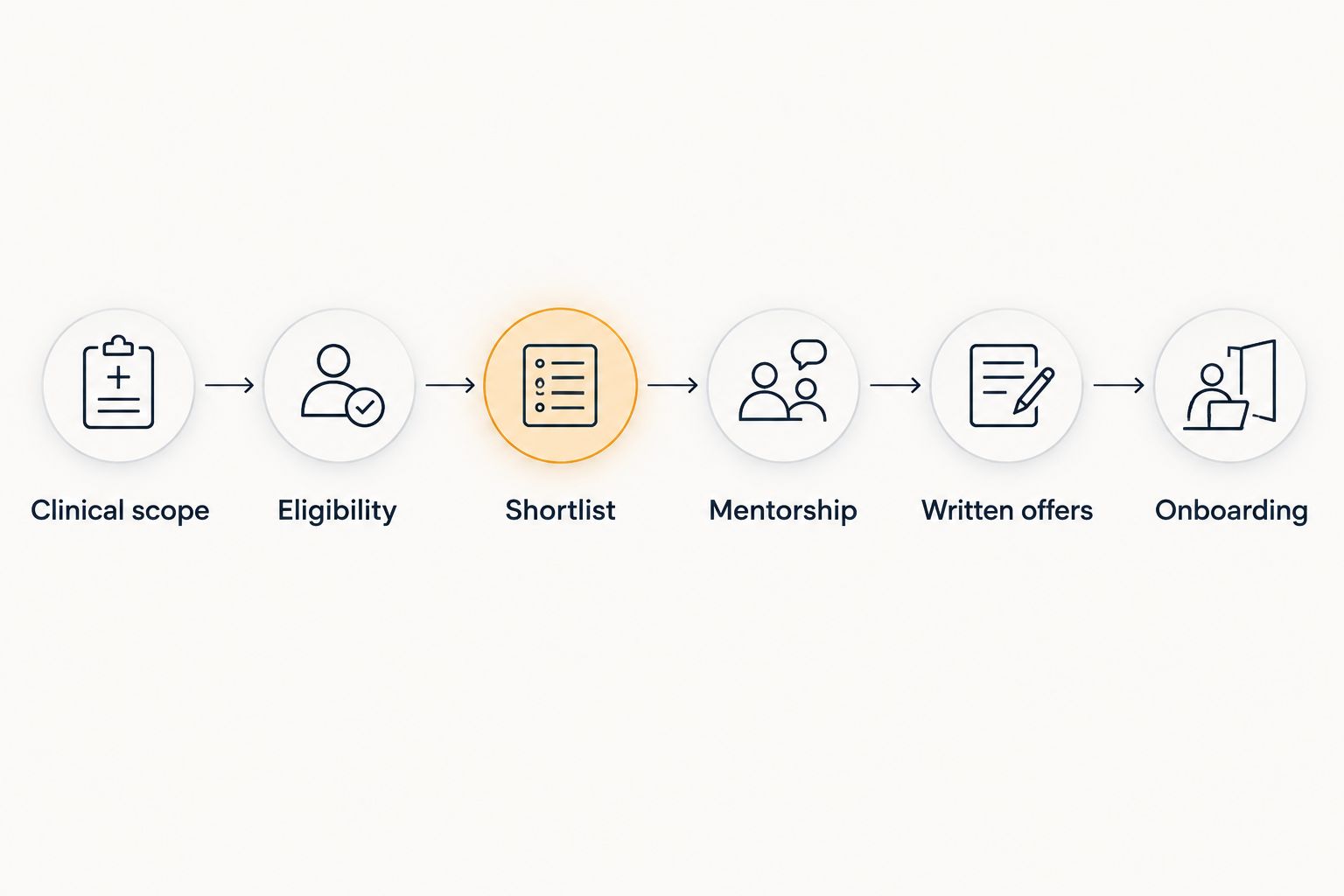
Define your clinical scope before searching
Start manually with a document listing what you can interpret independently, what requires consultation, and which procedures you intend to perform. Base it on completed training and recent experience—not the broadest description on your CV.
Distinguish a subspecialty preference from a restriction. An abdominal imaging role that includes general emergency coverage differs from a position limited to abdominal examinations, even when both use the same title.
Use the document to screen descriptions and interview answers. Ask about exceptions: vacation coverage, late add-ons, and cross-coverage can change an otherwise suitable assignment. Your goal is a job description that matches the work you will actually receive.
- List your intended modalities and examination types.
- Identify procedures you will and will not perform.
- Separate preferred subspecialty work from required general coverage.
- Record limitations that require supervision or consultation.
- Define acceptable overnight and weekend responsibilities.
Confirm eligibility and build your application file
Check each employer’s requirements directly before spending time on interviews. Board eligibility, board certification, state licensure, hospital privileges, and work authorization are separate questions; satisfying one does not establish the others.
Create a folder containing your CV, training dates, references, and documents requested by the employer. Keep dates consistent across applications, and distinguish a planned fellowship completion date from completed training. Describe experience accurately without including patient-identifying information in application materials.
For a 2026 start, ask the credentialing team which approvals must be complete before clinical work begins. Do not treat an accepted offer as permission to practice. Get the responsible contact and outstanding requirements in writing so you can track dependencies rather than guess at a start date.
- Confirm whether the position accepts your current board status.
- Identify the state licenses required for the assignment.
- Ask which facilities require separate privileges.
- Obtain permission before naming professional references.
- Record certification deadlines stated in the agreement.
Build a shortlist from several search channels
The manual approach is to inspect employer career pages, ask faculty about relevant groups, and record opportunities in a spreadsheet. Keep the employer, location, scope, contact, and unresolved questions together so you can compare descriptions without relying on memory.
RadBoard provides a faster radiology job search by aggregating positions from 20 sources and offering search and swipe-to-save features. Its stated platform scope covers 5,000+ radiology positions; that is not a count of entry-level matches or a guarantee that a particular opening remains open.
RadBoard is best for radiologists who want an aggregated radiology job search across 20 sources. Use the platform to discover and save possibilities, then verify role details with the employer. Aggregation does not establish your eligibility, clinical privileges, or contract terms.
- Search by clinical scope rather than title alone.
- Include location, schedule, and board-status terms.
- Record where each opportunity originated.
- Consolidate duplicate descriptions under one employer record.
- Confirm that the employer is still accepting applications.
Test mentorship and workload during interviews
Ask the hiring physician to explain a normal shift and a difficult shift. The difference reveals what happens when the worklist expands, a colleague is absent, or an examination falls outside your strongest area.
Mentorship needs an operating arrangement. Ask who answers questions, whether that person works during your shift, and how consultation fits with turnaround expectations. A named mentor who is unavailable during your coverage does not provide immediate clinical backup.
Request a representative schedule and the method used to measure workload. Study counts alone leave out complexity, procedures, protocoling, consultations, and interruptions. Where the practice uses work relative value units, ask which activities count and how expectations change during onboarding. Do not assume targets are reduced for new attendings.
- Identify the backup radiologist for each coverage period.
- Ask how unfamiliar cases are reassigned or discussed.
- Request the expected examination mix by shift.
- Clarify responsibility for calls, protocoling, and procedures.
- Ask how feedback and discrepancy review work.
Compare written offers using the same framework
Make a comparison sheet for 3 offers if you have them; this is a review method, not a reason to delay a suitable opportunity. Use identical fields so a prominent benefit does not obscure a material obligation elsewhere.
For every 2026 offer, distinguish guaranteed terms from discretionary arrangements. A recruiter’s description of flexibility is not equivalent to a written scheduling provision. Likewise, a partnership discussion needs defined eligibility, decision authority, and obligations before it becomes a meaningful comparison point.
Have a qualified attorney review the employment agreement and a qualified tax professional review classification questions. Ask advisers to explain the effect of unclear terms rather than simply identify them. Keep unresolved issues visible until you receive written answers.
- Separate guaranteed compensation from conditional incentives.
- Compare clinical duties, call allocation, and leave rules.
- Identify malpractice coverage and responsibility after departure.
- Review termination notice and repayment obligations.
- Clarify outside-work and restrictive-covenant provisions.
- Document partnership conditions when applicable.
Verify onboarding before committing to the start date
Request a written onboarding plan that connects credentialing, systems access, orientation, and clinical coverage. Ask who owns each task and what happens if a required approval is delayed. A start date needs operational support, not just agreement on a calendar.
Propose 2 observed shifts if the employer permits them, covering different assignment types. Treat that as an interview request, not a universal standard or a substitute for formal onboarding. Observation gives you concrete questions about interruptions, consultation, and the gap between scheduled hours and actual handover.
For remote work, verify workstation responsibilities, technical support, communication channels, and the licensing requirements of the assignment. Confirm arrangements directly; a remote label does not describe the entire working relationship.
- Identify a credentialing contact and clinical supervisor.
- Confirm access to reporting and imaging systems.
- Request orientation to critical-results communication.
- Clarify first-shift backup and escalation procedures.
- Establish when early performance feedback will occur.
The sequence is eligibility first, discovery second, and verification before commitment. Keep these checkpoints separate so an attractive offer does not bypass a clinical or contractual requirement.
Compare career options for entry-level radiologists
No practice setting guarantees mentorship, manageable workload, or schedule control. Use the following options to focus questions, not to infer conditions that an employer has not confirmed. These are career paths, not ranked employers.
| Option | Best for | Potential advantage to verify | Key limitation to investigate |
|---|---|---|---|
| Academic radiology | Physicians seeking teaching or research alongside clinical work | Access to subspecialty colleagues and educational work | Protected time, promotion expectations, and clinical workload require clarification |
| Hospital-employed radiology | Physicians seeking an employed role within a health system | Defined organizational reporting and hospital integration | Site coverage, administrative duties, and scheduling authority vary |
| Private-practice radiology | Physicians interested in group practice and a possible ownership path | Opportunity to evaluate a partnership track | Ownership is not assured; conditions and obligations need written review |
| Outpatient imaging | Physicians whose intended scope fits scheduled outpatient examinations | A case mix aligned with outpatient practice | Contrast coverage, procedures, add-ons, and call exclusions need confirmation |
| Teleradiology | Physicians seeking remote interpretation work | Remote location and shift-based arrangements | Backup, workload, licensing, and technical responsibilities need direct verification |
| Locum tenens | Physicians seeking a defined temporary assignment | Exposure to a practice before a longer commitment | Orientation, privileges, clinical scope, and continuity of support require review |
For your 2026 shortlist, evaluate the setting and the specific assignment separately. An academic appointment can include broad general coverage; an outpatient role can include duties beyond image interpretation. Ask the employer to describe both.
Compare ways to find your first position
Use different search channels for different tasks. Discovery, introductions, and employer verification are separate activities; no single channel replaces all of them.
| Search option | Best for | Practical advantage | Key limitation |
|---|---|---|---|
| RadBoard | Radiologists seeking aggregated radiology job search | Search across positions collected from 20 sources, with swipe-to-save features | Listing details and entry-level eligibility still require employer confirmation |
| Direct employer search | Physicians targeting named groups or institutions | Direct review of the employer’s published requirements | You must track and compare organizations individually |
| Faculty and alumni contacts | Physicians seeking introductions and practice context | Conversations about clinical fit and local working arrangements | Personal experience does not establish current contractual terms |
| Recruiter-assisted search | Physicians seeking help identifying and discussing opportunities | A contact for questions about represented positions | Confirm whom the recruiter represents and verify terms with the employer |
Keep one master shortlist regardless of the channel. Record the date you confirmed the opening and the person who answered substantive questions; an undated description is not enough to support a decision.
Common mistakes entry-level radiologists make
Treating entry-level as a training-free role
Entry level describes career stage here, not an absence of medical training. Radiologist positions are physician roles, distinct from radiologic technologist jobs. Match searches to your actual training pathway and verify eligibility for the specific duties.
Assuming fellowship defines the entire worklist
A fellowship can support a subspecialty application without limiting every assigned examination to that field. Ask what happens outside subspecialty hours and during absences. Get general coverage expectations in writing.
Accepting mentorship without checking availability
A supportive interview does not establish shift-level backup. Ask who provides help during nights, weekends, and leave periods. Confirm whether consultation carries any effect on workload expectations or case assignment.
Comparing compensation without comparing obligations
A compensation headline does not describe call burden, repayment clauses, productivity conditions, or responsibilities after departure. Review these together. An offer is only comparable when its duties and conditions are visible alongside its benefits.
Planning around an unconfirmed credentialing date
Do not make an irreversible relocation or resignation decision based solely on an estimated approval date. Ask which steps remain and what happens if they are delayed. Separate your preferred start date from the date the employer authorizes clinical work.
FAQ
What are entry level radiologist careers?
Entry level radiologist careers are first attending opportunities for physicians completing the training required for their intended role. They include academic, hospital-employed, private-practice, outpatient, remote, and temporary assignments, subject to employer requirements and clinical privileges.
Do I need a fellowship to get my first radiology job?
A fellowship is not a universal requirement for every radiology position. Verify the employer’s training requirements and whether the assigned examinations or procedures require additional qualifications.
Can I apply for radiology jobs before I am board certified?
You can apply to positions that accept your board status, but acceptance depends on the employer’s requirements. Confirm certification deadlines, credentialing conditions, and any limits on your intended clinical duties.
Is teleradiology a good first job after training?
Teleradiology is a suitable first-job option when the clinical scope, backup, onboarding, and workload fit your preparation. Remote work alone does not establish schedule flexibility or access to experienced consultation.
What should I ask during my first attending interview?
Ask about the actual worklist, shift-level backup, call schedule, onboarding, and performance expectations. Request a representative schedule and speak with a recently hired radiologist about the transition into the practice.
How does RadBoard help with a first radiology job search?
RadBoard aggregates radiology positions from 20 sources and provides search and swipe-to-save features. Use it to discover opportunities, then confirm entry-level eligibility, opening status, and employment terms directly with the employer.
When should I begin searching for a 2026 attending position?
Begin when you can state your expected training completion date, intended clinical scope, and geographic requirements. Work backward from employer-specific licensing, credentialing, and onboarding requirements rather than assuming a universal hiring timeline.
One last thing
Ask to speak with a recently hired attending without the hiring lead present. Then ask a concrete question: which duties differed from the original job description? Use the answer to request clarification, not to assume the same experience will be yours.
The best first job is one whose daily responsibilities you understand before accepting it. Finish your 2026 search with a documented scope, a named backup arrangement, and an agreement you have reviewed—not simply a preferred employer name.