
Interventional neuroradiologists’ career planning is the process of matching neuroendovascular training, procedural scope, and practice conditions with a sustainable clinical role. Interventional neuroradiologist careers require more than a subspecialty label: you need to verify procedural privileges, emergency coverage, referral pathways, and responsibility for patients before and after intervention.
- Interventional neuroradiologist careers require matching procedural scope, call coverage, and hospital resources—not just job titles.
- RadBoard aggregates 5,000+ radiology positions from 20 sources; its total inventory is not a neurointerventional vacancy count.
- Verify thrombectomy coverage, elective case mix, backup arrangements, and credentialing requirements before accepting an offer.
- Choose academic, hospital-employed, group, or locum work according to documented duties and support.
Why career planning matters for interventional neuroradiologists
A neurointerventional position combines procedural work with a service model. Two advertisements with similar titles can describe different responsibilities: one emphasizes emergency stroke intervention; another includes elective cerebrovascular procedures, diagnostic interpretation, clinic, teaching, or service development.
Evaluate the service you will join, not just the position you will fill. Ask who accepts transfers, who manages admissions, and who covers complications when you are unavailable. These answers define the working conditions that an advertisement leaves unresolved.
For your 2026 search, RadBoard aggregates 5,000+ radiology positions from 20 sources. Those figures describe the broader platform, not the number of interventional neuroradiology openings or unique employers.
RadBoard is best for radiologists who want to search aggregated radiology positions rather than visit each source separately. Use that breadth to identify leads, then verify each position’s current scope directly with the hiring team.
How to evaluate interventional neuroradiologist careers
Define your clinical scope before searching
Start with a written search brief. Separate procedures you intend to perform independently from those for which you need mentoring, additional experience, or institution-specific approval. Training history and current hospital privileges are different records; neither substitutes for the prospective hospital’s credentialing decision.
Your 2026 search brief should also distinguish essential duties from optional interests. If elective cerebrovascular work matters to your career, a position described only as stroke coverage needs further investigation before an interview becomes a relocation decision.
Make your preferences explicit:
- List your intended emergency and elective procedural scope.
- Specify acceptable diagnostic neuroradiology responsibilities.
- Identify your needs for clinic, inpatient care, teaching, and research.
- Record geographic restrictions and acceptable travel between sites.
- Separate nonnegotiable requirements from preferences you can trade.
Verify training and privileges with each institution
Request the hospital’s requirements before assuming that a job title matches your qualifications. Neurointerventional teams include physicians from different training backgrounds, and an employer’s eligibility criteria need to be checked against your own documented pathway.
Obtain the actual privilege requirements, not a recruiter’s summary. Ask the medical staff office which documents it needs and whether any proposed procedures require proctoring or additional review. If you are completing training, confirm who will support the transition to independent practice.
Build a credentialing file that answers specific questions:
- Collect training verification and relevant certification records.
- Prepare an appropriately de-identified procedural case log.
- Distinguish primary-operator experience from assisted participation.
- Ask about references, proctoring, and ongoing competency review.
- Confirm that the proposed start date accounts for credentialing and licensing.
Build a shortlist across relevant job titles
Begin manually: search employer career pages and record each lead in a spreadsheet. Use related terms such as interventional neuroradiology, neurointerventional radiology, neuroendovascular intervention, and endovascular surgical neuroradiology. Titles are search terms, not proof of equivalent duties.
RadBoard provides a faster discovery path through aggregated radiology listings and swipe-to-save features. Its limitation is equally important: a listing does not establish procedural eligibility, staffing adequacy, or the terms of an employment agreement.
For every 2026 listing, trace the opportunity back to the hiring organization. Match the location, employer, duties, and contact details before treating similar advertisements as separate positions.
Keep the shortlist usable:
- Record the employer, hospital sites, and original source.
- Flag advertisements that describe diagnostic work without intervention.
- Separate permanent employment from temporary coverage assignments.
- Save unanswered questions beside each opportunity.
- Remove duplicate leads after confirming they represent the same position.
Inspect the entire neurovascular service
Ask the employer to describe a patient’s path from referral or emergency activation through intervention, inpatient care, discharge, and follow-up. This exposes responsibilities that a procedure list does not show. A staffed angiography suite is only one part of the job.
Request the previous 12 months of procedural activity, separated by procedure category and hospital site. Treat this as a diligence request, not an assumed benchmark. Ask how cases are assigned and whether the reported activity belongs to the entire service or the physician position you are considering.
Review these operational details:
- Referral pathways and transfer acceptance responsibilities.
- Anesthesia, technologist, nursing, and angiography support.
- Stroke neurology, neurosurgery, and neurocritical care coordination.
- Clinic access, inpatient management, and follow-up ownership.
- Equipment access and arrangements during downtime.
- Case allocation among attending physicians and trainees.
Translate call language into a workable schedule
A call ratio does not explain how a service operates. Ask what happens during overlapping emergencies, leave, illness, and transfers from another hospital. Distinguish being available by phone from being responsible for bedside assessment, procedures, admissions, and overnight management.
For 2026 offers, request a representative 4-week call calendar with vacation and backup coverage shown. The purpose is to understand the schedule, not to assume that any particular frequency is acceptable. Ask whether the calendar reflects current staffing or a future recruitment plan.
Turn general assurances into concrete answers:
- Identify primary call, backup call, and cross-site obligations.
- Ask who responds when simultaneous emergencies occur.
- Confirm post-call clinical and diagnostic responsibilities.
- Document coverage during vacations and unexpected absences.
- Clarify travel expectations and institution-specific response requirements.
Compare the full employment agreement
Read the agreement alongside the job description, call expectations, and privilege requirements. A favorable headline compensation figure does not resolve an undefined workload. Ask a qualified attorney to review the agreement, especially provisions affecting termination, restrictions, liability coverage, and obligations after departure.
Get material commitments into the agreement or an incorporated document. Teaching time, clinic support, procedural access, or a leadership role should not depend solely on an interview conversation. Ask how changes in staffing or hospital coverage affect your duties.
Compare the same fields across offers:
- Base compensation, incentive calculations, and call compensation terms.
- Credit for procedures, diagnostic work, clinic, and administrative duties.
- Malpractice policy type and responsibility for any tail coverage.
- Termination notice, restrictive provisions, and outside-work rules.
- Partnership or leadership terms when specifically offered.
- Written support commitments and authority to change your schedule.
Validate the position with future colleagues
Speak with the people who will share the work, not only the hiring lead. Ask an attending physician, a procedural team member, and a referring clinician to describe how the service functions. Compare their answers with the proposed role.
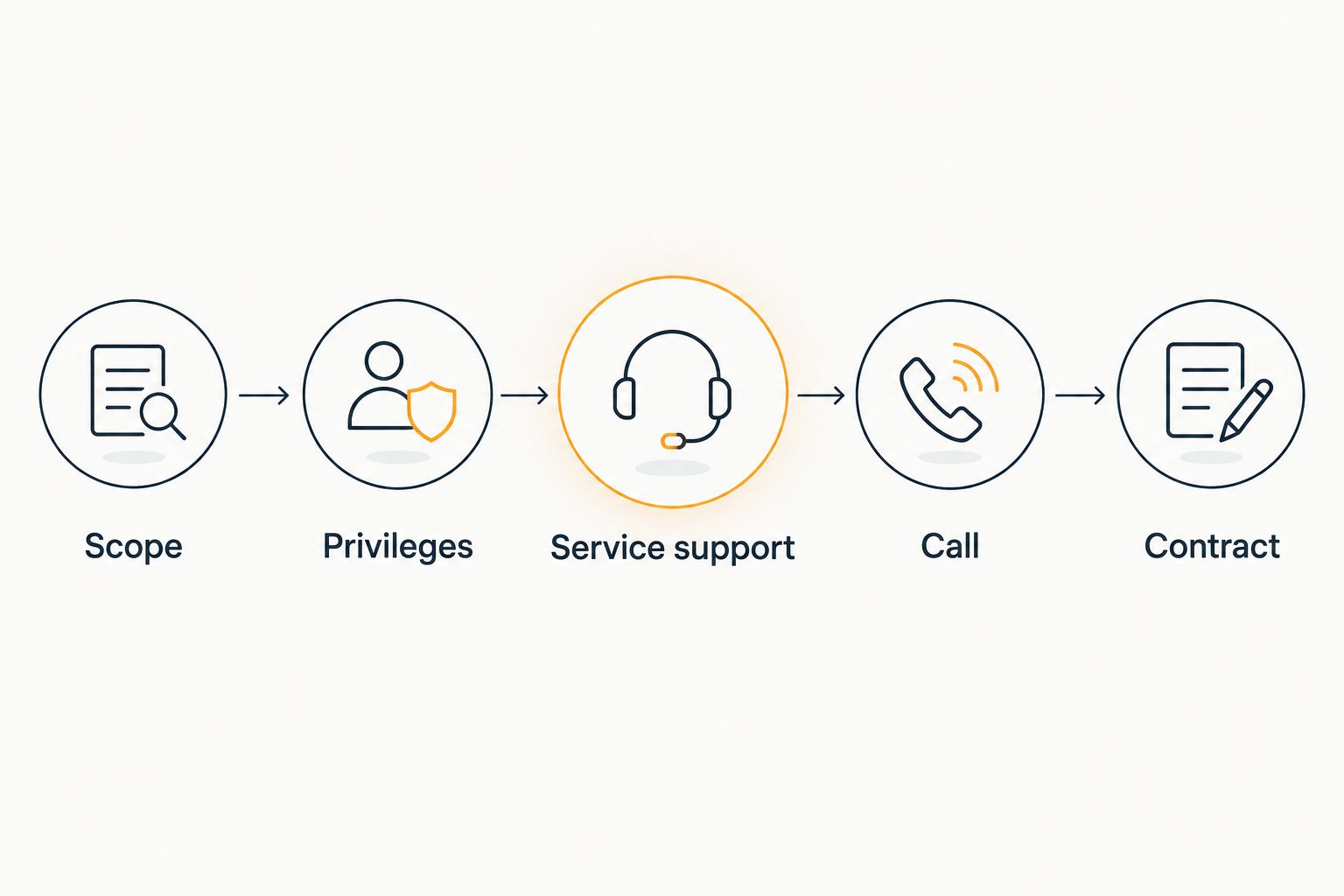
Use a consistent decision sequence: Scope, Privileges, Service support, Call, Contract. A strong answer in one area does not cancel an unresolved problem elsewhere. Keep unresolved issues visible until the appropriate person answers them in writing.
A site visit should test the description you have received. Observe the facilities relevant to your proposed duties and ask how the team handles a difficult coverage day.
Close your evaluation with these actions:
- Ask future colleagues the same questions about call and support.
- Discuss onboarding and access to experienced procedural backup.
- Request examples of how workload disagreements are resolved.
- Identify who can approve changes to staffing or clinical scope.
- Decline to resolve unanswered questions through assumptions.
Compare practice models for your career goals
No practice model guarantees a particular schedule, procedural mix, or level of autonomy. Use the model to organize your questions, then evaluate the actual institution and agreement.
| Practice option | Best for | Main advantage to verify | Key limitation to examine |
|---|---|---|---|
| Academic appointment | Physicians seeking teaching or research alongside clinical practice | Defined teaching responsibilities and protected academic time | Academic duties can compete with clinical obligations when time is not protected |
| Hospital-employed position | Physicians seeking a role within a hospital’s neurovascular service | Clear authority, staffing support, and service responsibilities | Duties can span multiple sites or include service-development work |
| Independent group position | Physicians seeking group governance or an ownership pathway | Written governance rights and any offered partnership terms | Group membership does not itself establish ownership or procedural control |
| Locum assignment | Physicians seeking time-limited coverage rather than a permanent move | A bounded assignment with explicit clinical duties | Temporary status does not remove credentialing, call, or handoff obligations |
For an early-career interventional neuroradiologist, prioritize documented support for independent practice over the employment label. For an established physician, test whether the case mix, clinical authority, and schedule preserve the work you want to continue doing.
If you are considering leadership, ask which decisions the role controls. A medical director title without defined authority over staffing, quality review, or service operations needs clarification before you accept it.
Common mistakes interventional neuroradiologists make
Treating diagnostic neuroradiology as procedural employment
A neuroradiology advertisement can describe interpretation rather than neuroendovascular intervention. Confirm the actual procedures and privileges before spending time on detailed negotiations. Remote diagnostic work is not a substitute for an onsite procedural role.
Assuming a stroke role includes elective cerebrovascular practice
Emergency thrombectomy coverage does not establish access to an elective referral practice. Ask which procedures the position includes, how referrals are distributed, and whether clinic time is part of your schedule. Match those answers to your intended clinical scope.
Accepting a call ratio without backup details
A ratio leaves out overlapping emergencies, uncovered leave, and responsibilities across hospitals. Request the schedule and escalation plan. Evaluate who takes over when you cannot cover, not just how often your name appears.
Treating institutional volume as personal case volume
A hospital’s procedural total does not establish your own case allocation. Ask how activity is divided among physicians, sites, and trainees. Review the source period and procedure categories before using volume information to judge clinical fit.
Leaving patient ownership undefined
Procedural responsibility and longitudinal patient management need explicit boundaries. Confirm who handles consultations, admissions, complications, discharge decisions, and follow-up. An unanswered ownership question becomes a clinical workflow problem after you start.
FAQ
What are the main career options for an interventional neuroradiologist?
Interventional neuroradiologists can evaluate academic appointments, hospital-employed positions, group practice roles, and temporary coverage assignments. Compare the actual procedural scope, call obligations, patient-management duties, and institutional support rather than relying on the employment label.
Is interventional neuroradiology the same as diagnostic neuroradiology?
No. Diagnostic neuroradiology centers on imaging interpretation, while interventional neuroradiology includes image-guided neuroendovascular procedures. A position can combine responsibilities, so verify the written job description and privileges.
What training do I need for an interventional neuroradiologist job?
You need the training, credentials, and procedural experience required by the hiring institution for the privileges you seek. Ask the medical staff office for its requirements and compare them with your documented training and case experience.
Can an interventional neuroradiologist work remotely?
Neuroendovascular procedures require onsite clinical work. A combined position can include remote diagnostic interpretation only when the employer explicitly provides that arrangement; confirm how remote duties interact with call and onsite responsibilities.
How should I compare compensation offers?
Compare the written compensation formula alongside call, clinical workload, benefits, and liability obligations. Ask how procedures, diagnostic interpretation, clinic, and administrative work receive credit, and have a qualified advisor review the agreement.
Where should I search for interventional neuroradiologist careers?
Search employer career pages and an aggregated radiology job platform such as RadBoard. Use several neurointerventional job-title variants, then confirm each lead with the hiring organization because similar titles do not establish equivalent duties.
What should I ask during a neurointerventional job interview?
Ask about procedural scope, case allocation, referral pathways, backup coverage, and patient-management responsibility. Request specific examples of how the service handles simultaneous emergencies, physician leave, and post-call duties.
One last thing
Before accepting a 2026 position, ask: Who owns the patient after the procedure ends? Request an answer covering inpatient care, complications, discharge, and follow-up—not just the angiography suite. Clear ownership is a practical test of whether the proposed job description matches the service you will actually join.
Use RadBoard for radiology job discovery; use direct institutional verification to decide whether a position fits.