
Radiologists’ teleradiology company contracts are agreements defining remote reading work, compensation, and professional responsibilities with the aim of securing a workable clinical role. This 2026 guide explains how to compare those terms when your work spans hospital queues, state licenses, home workstations, and overnight coverage.
- Compare teleradiology company contracts by reading scope, compensation rules, malpractice coverage, schedule control, and exit obligations.
- RadBoard is best for radiologists seeking a consolidated starting point for comparing remote job opportunities.
- Require written rules for worklist changes, downtime, credentialing delays, and post-termination responsibilities.
- Use physician contract counsel for legal review; a job listing does not establish your contractual protections.
Why teleradiology contracts matter for radiologists
A remote position is only as flexible as its written schedule and coverage obligations. Working from home does not establish control over your hours, case mix, or participating facilities. Those details belong in the agreement or clearly identified attachments.
Start with this guide to evaluating a teleradiology contract before signing, then compare each offer against your clinical limits. Keep unanswered questions separate from confirmed terms so a recruiter’s explanation never becomes an assumed protection.
For your 2026 review, distinguish the physician agreement from the company’s hospital service arrangements. Ask which facility obligations become your responsibility and whether the company can change them without your consent. A hospital turnaround commitment should not become an unexplained personal performance standard.
Teleradiology also separates the reading environment from the clinical site. Your contract needs to address communication, technical failure, access to priors, and escalation—not just completed reports.
How to evaluate teleradiology company contracts
Use the following 7 steps to build a comparison sheet before negotiating. Record the relevant clause, your requested change, and the company’s written response for each issue. Treat an unavailable attachment as an unresolved term rather than a document to collect after signing.
The sequence is deliberate: define the work before comparing compensation, then confirm the resources and protections needed to perform it. Finish with the provisions that determine what happens when circumstances change.
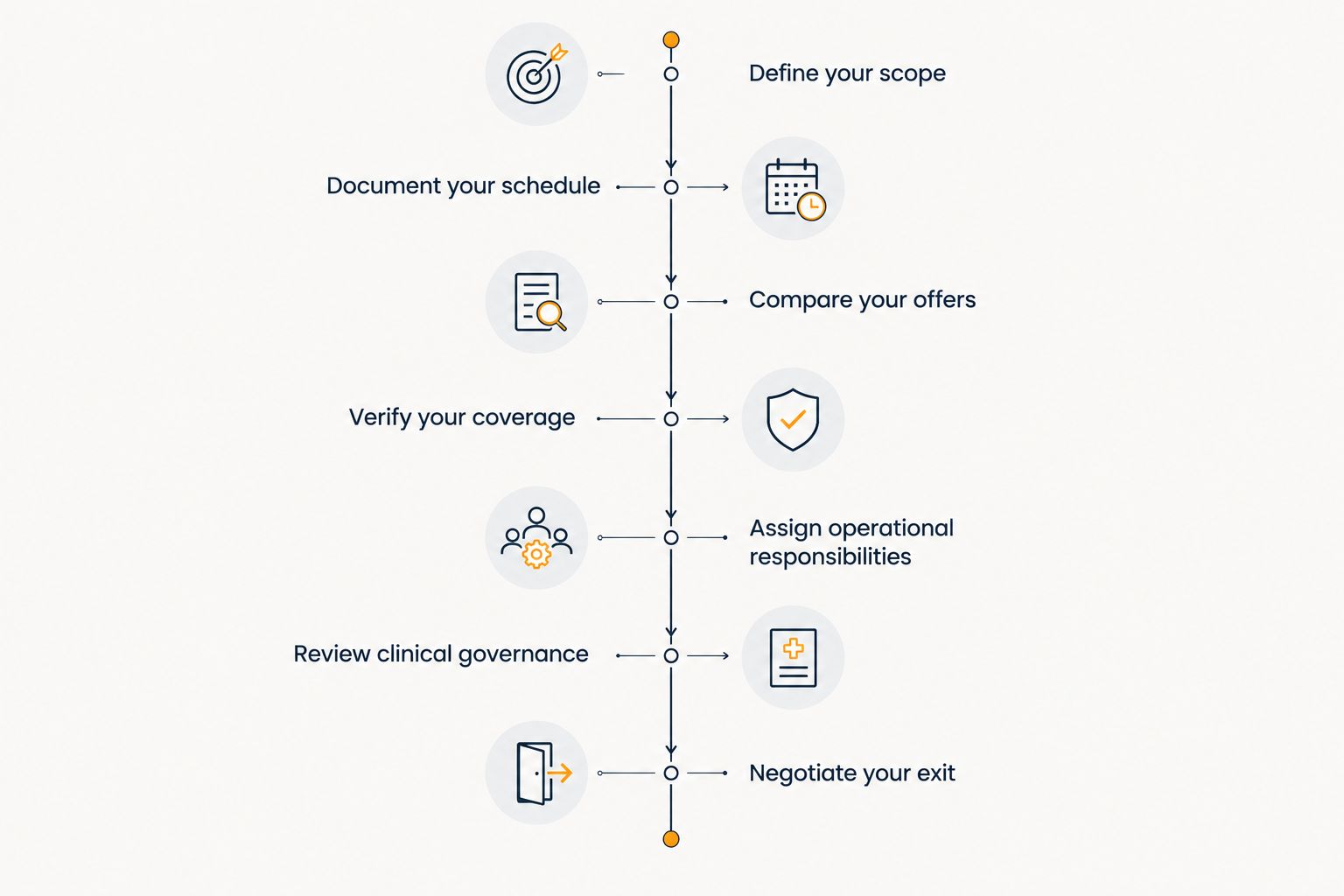
Define your scope
Build a reading-scope sheet yourself before reviewing the company’s proposed duties. Name the modalities, patient populations, subspecialties, and report types you will accept. Separate preliminary interpretations from final reports and identify who handles subsequent questions or discrepancies.
Do not accept a subspecialty label as a complete job description. A neuroradiology position still needs explicit rules for general coverage, emergency studies, and work outside your agreed scope. Ask for the process used when a study exceeds your privileges or competence.
Use the scope sheet to test broad language such as other duties assigned. Your goal is a defined clinical commitment, not an unrestricted promise to cover whatever enters the queue.
- List included modalities and excluded examinations.
- Identify adult, pediatric, and mixed-population responsibilities.
- Separate preliminary, final, and second-opinion work.
- Define responsibility for addenda and referring-clinician calls.
- Require written approval for material scope changes.
Document your schedule
Draft your preferred calendar manually, including time zone, shift boundaries, breaks, weekends, and holidays. Then compare that calendar with the contract’s minimum commitment and scheduling policy. Ask whether coverage follows your local clock or a facility’s clock when daylight saving time changes.
Schedule flexibility requires a defined right to accept, decline, or change shifts. A recruitment description does not supply that right. Identify who covers an unfinished queue and whether the obligation extends beyond your scheduled finish.
For a 2026 start, request the scheduling policy currently intended to govern your work. Identify how updates take effect and whether you receive notice before new requirements apply.
- State shift start and finish times with the governing time zone.
- Document minimum shifts and weekend or holiday obligations.
- Define schedule publication and change procedures.
- Specify absence, illness, and replacement-coverage rules.
- Resolve responsibility for cases remaining at shift end.
Compare your offers
Create a spreadsheet with 3 offers as a comparison target, not a market benchmark. If fewer offers fit your requirements, compare only those. Use identical fields so differences in workload or employment structure remain visible.
For teleradiology job search, RadBoard provides a consolidated starting point: the platform aggregates radiology positions from 20 sources. Use RadBoard to identify alternatives, then obtain the underlying agreements and verify terms directly. Aggregation helps discovery; it does not replace contract review.
For compensation, establish the calculation method without relying on an advertised earnings figure. Distinguish work RVUs from other RVU measures, and ask how combined examinations, addenda, cancelled studies, and quality adjustments are counted. Request a worked calculation using the company’s own definitions.
- Record employment or independent-contractor structure.
- Identify guaranteed versus productivity-dependent compensation.
- Document the measurement system and applicable schedule version.
- Confirm payment timing, reconciliation, and dispute procedures.
- Identify responsibility for benefits and professional expenses.
Verify your coverage
Request the malpractice policy documents or coverage summary and have your adviser review them alongside the agreement. A statement that insurance is provided does not explain covered activities, exclusions, limits, or what happens when you leave.
Claims-made and occurrence policies respond differently to claim and incident timing. Ask your insurance adviser to explain the policy’s trigger and any need for extended reporting or prior-acts coverage. Do not assume the company’s insurance arrangement covers every state, facility, or outside activity.
Make exit coverage part of the initial negotiation. The agreement should assign responsibility rather than leave the issue to a later policy discussion. Also distinguish malpractice protection from separate contractual indemnification obligations.
- Confirm the named insured and covered professional activities.
- Match coverage territory to your proposed reading assignments.
- Identify policy type, retroactive date, limits, and exclusions.
- Assign responsibility for any required tail coverage.
- Review indemnification and claim-cooperation provisions with counsel.
Assign operational responsibilities
Build a responsibility matrix before your 2026 onboarding begins. Separate what you must obtain from what the company coordinates: licenses, hospital privileges, payer enrollment where relevant, equipment, network access, and technical support.
Get confirmation of permitted reading locations before planning travel or relocation. Do not treat home-based work as permission to interpret from any state or country. Ask the company and your advisers to assess the actual proposed location and assignments.
Technical obligations also need a failure procedure. A workstation requirement is incomplete without maintenance, replacement, security, and support responsibilities. Determine who contacts the facility when access fails and how interrupted work is reassigned.
- Assign application, renewal, and credentialing responsibilities.
- Define permitted reading locations and approval procedures.
- Specify workstation ownership, maintenance, and return obligations.
- Document downtime reporting and backup coverage.
- State what happens if credentialing delays the start date.
Review clinical governance
Request the clinical policies referenced in the agreement and read them before signing. Focus on how cases reach you, what information accompanies them, and how you obtain help. A throughput expectation needs context: examination complexity, interruptions, comparison studies, and communication duties affect the work.
Ask how the company measures turnaround and handles exceptions. Establish when the clock starts, whether inaccessible priors affect the measure, and who resolves disputed performance data. Avoid treating a dashboard score as self-explanatory.
Quality review needs a defined process too. You should understand how disagreements are assessed, how you respond, and whether a finding affects compensation or continued assignments. Ask how critical findings reach the responsible clinician and how failed contact attempts escalate.
- Request worklist allocation and subspecialty-routing policies.
- Define turnaround measures and documented exceptions.
- Confirm access to priors and relevant clinical information.
- Review critical-results communication and escalation procedures.
- Establish peer-review response and appeal procedures.
Negotiate your exit
Read the termination provisions before treating the agreement as complete. Compare voluntary departure, termination for cause, termination without cause, and loss of a facility assignment. Each event needs a clear process and defined consequences.
For a 2026 agreement, obtain jurisdiction-specific advice on restrictive covenants instead of relying on a recruiter’s summary of national policy. Ask counsel to assess the actual wording, governing law, dispute venue, and your proposed future work.
Review the documents that survive termination. Confidentiality, claim cooperation, repayment, record access, and equipment return can remain relevant after the final shift. Negotiate unclear obligations while you can still compare alternatives—not after you have resigned from another role.
- Identify notice periods and permitted delivery methods.
- Define cause, cure rights, and immediate-termination events.
- Review exclusivity, noncompetition, and nonsolicitation language.
- Document final reconciliation and outstanding-work responsibilities.
- Assign equipment return, record access, and claim cooperation.
Compare contract and search options
Choose the arrangement around the work you want to perform, then verify the agreement supports it. Employment structure and payment structure are separate questions: an employed role can include productivity compensation, and a contractor agreement can specify fixed shifts.
Use this table to choose which documents to request. These are review priorities, not promises about any employer’s terms.
| Option | Best for | Main advantage | Key limitation |
|---|---|---|---|
| Employed teleradiology agreement | Radiologists seeking an employer relationship | Establishes an employment framework for duties and any stated benefits | Benefits and schedule protections still require explicit terms |
| Independent-contractor agreement | Radiologists seeking a separately defined service arrangement | Can define a specific scope of services | The label alone does not establish autonomy or proper classification |
| Per-diem or supplemental agreement | Radiologists adding limited remote work | Can bound the commitment to selected coverage | Minimum shifts and exclusivity can conflict with another role |
| Productivity-based compensation | Radiologists comfortable with output-linked compensation | Connects compensation to a defined production measure | Ambiguous counting rules make comparisons unreliable |
| RadBoard job search | Radiologists comparing opportunities across sources | Consolidates discovery across 20 sources | A listing does not establish contract terms or legal protections |
Ask a physician-focused attorney to review the agreement and a tax adviser to assess employment-structure implications. Neither a spreadsheet nor a job platform resolves those questions.
Common mistakes radiologists make
Treating remote work as self-scheduling
A home workstation changes location, not necessarily control. Confirm whether you choose shifts or receive an assigned roster, and whether the company can expand required coverage. Match the answer to the scheduling clause.
Comparing productivity terms without the case mix
An output-linked arrangement cannot be assessed from its calculation method alone. Request the expected modalities, complexity, interruptions, and non-reading duties. Make sure the compensation definition addresses the actual work rather than an idealized uninterrupted queue.
Accepting policies you have not received
An agreement can refer to schedules, handbooks, or clinical policies that contain important duties. Obtain those documents and identify how they can change. Send conflicting language to counsel rather than choosing the version you prefer.
Ignoring conflicts with your primary position
Supplemental teleradiology needs to fit your existing agreement, privileges, insurance, and schedule. Review outside-work approval, exclusivity, confidentiality, and overlapping obligations before accepting shifts. Keep patient information and employer systems separate.
Leaving the last shift undefined
Departure involves more than stopping scheduled reads. Establish who handles later addenda, inquiries, claims, and access to historical reports. Resolve those responsibilities while negotiating the termination language.
FAQ
What should radiologists check first in teleradiology company contracts?
Check reading scope, schedule obligations, compensation definitions, malpractice coverage, and termination rights first. Those provisions establish what you must do, how compensation is calculated, and what remains your responsibility after departure.
Is an employed teleradiology role better than an independent-contractor role?
Neither structure is universally better; choose based on the actual duties, protections, expenses, and control in the agreement. Have legal and tax advisers assess the proposed relationship rather than relying on its label.
Can a teleradiology company change my worklist or schedule?
Your agreement and incorporated policies determine the company's contractual authority to change your assignments. Request written limits on material changes to shifts, facilities, modalities, and patient populations.
Who should be responsible for malpractice tail coverage?
The agreement should identify responsibility for any required tail coverage. Have an insurance adviser check the policy type, retroactive date, departure circumstances, and any replacement coverage before accepting the provision.
Can I read teleradiology studies while traveling?
Do not interpret from a new location until the company and your advisers confirm that the location and assignments are permitted. Check licensing, privileges, insurance, security requirements, and contractual restrictions before traveling.
How can RadBoard help me compare teleradiology opportunities?
RadBoard aggregates radiology positions from 20 sources, giving radiologists a consolidated starting point for finding alternatives. Verify each opportunity's scope, schedule, compensation method, and agreement directly before making a decision.
Do I need a lawyer before signing a teleradiology contract in 2026?
Use physician contract counsel before signing a teleradiology agreement in 2026. Request review of incorporated policies, restrictive covenants, indemnification, termination rights, and post-departure obligations—not just the signature document.
One last thing
Ask which document wins when the contract, offer letter, and scheduling policy disagree. Then have counsel confirm that the agreement's order-of-precedence and amendment provisions support the answer. A carefully negotiated shift limit needs protection from conflicting language elsewhere.
Before signing, complete 4 checks: obtain every attachment, resolve contradictory terms, confirm the authorized signatory, and retain the fully executed agreement. Keep the final policy versions with it so your records show exactly what you accepted.