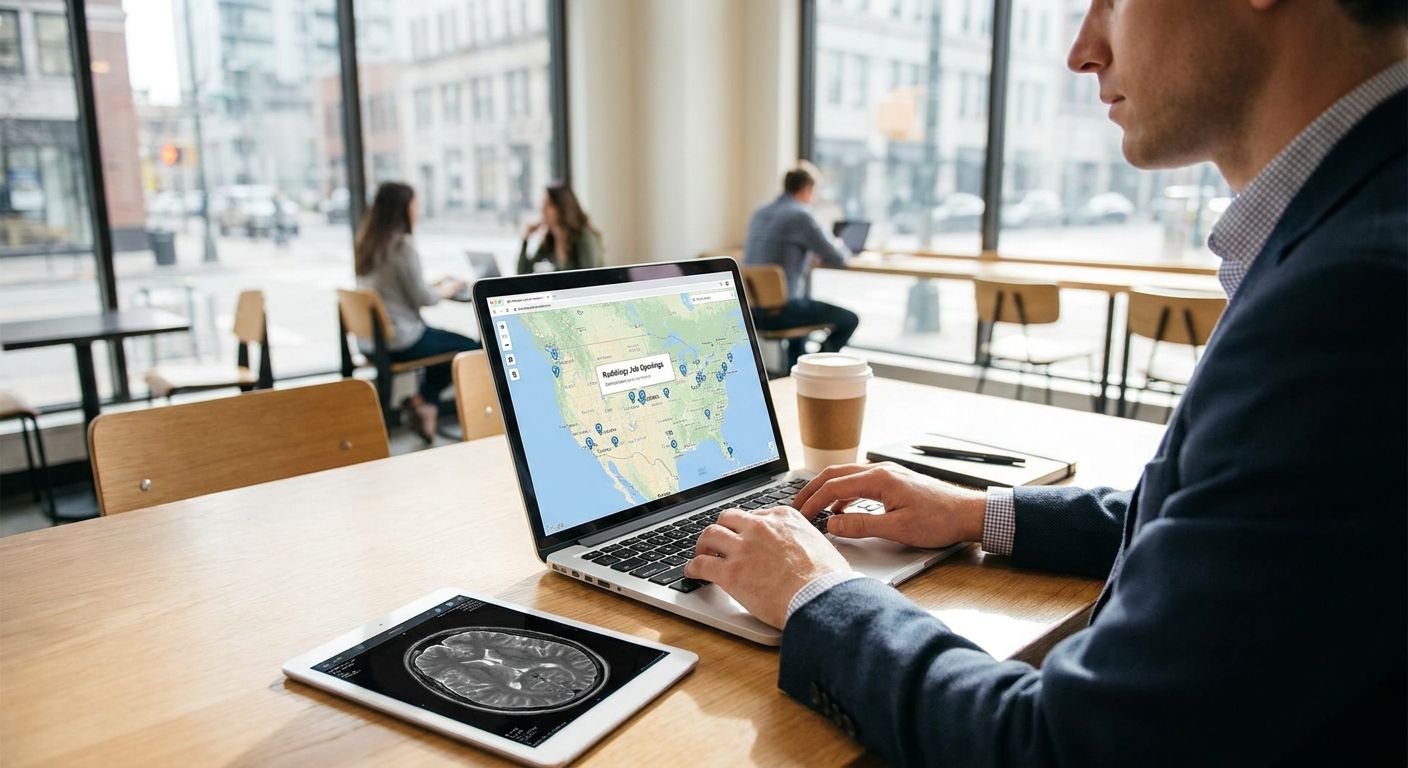
Finding every open radiology job within driving distance shouldn't take six browser tabs and three recruiter calls. It takes one aggregated search, a tight filter set, and a same-day follow-up habit.
- Radiology jobs near me searches miss 60-80% of openings when you check only one hospital career page.
- RadBoard aggregates 5,000+ radiology positions from 20 sources into one AI-powered search in 2026.
- Swipe-to-save and same-day recruiter contact cut the time-to-shortlist from weeks to days.
- State licensing timelines, not job scarcity, are the real bottleneck for most radiologists relocating in 2026.
Why this matters
A radiologist searching "radiology jobs near me" on a single hospital system's career page in 2026 sees maybe a dozen listings. That's not the market — that's one employer's slice of it. Private practices, teleradiology groups, imaging center chains, and locum agencies each post to their own boards, and most never sync to Indeed or LinkedIn.
The fix isn't searching harder on one site. It's searching one aggregated database instead of ten fragmented ones, then moving fast once you find a fit. RadBoard pulls 5,000+ radiology positions from 20 sources into a single AI-powered search, which is the difference between finding three openings and finding thirty.
What you'll need
- A defined radius or list of target metros (30 miles, 60 miles, or "anywhere with 4-day workweeks")
- Your subspecialty and modality list (MSK, neuro, body, IR, nuclear medicine, mammography)
- Current state medical license status, plus any states where you'd apply for a new one
- Board certification or board-eligible status and expected certification date
- An updated CV — see building a competitive radiology CV if yours hasn't been touched since fellowship
- 15-20 minutes a day for the first week of the search
The steps
1. Set your radius and subspecialty filters before you search
Searching broad first and filtering later wastes hours scrolling past jobs you'd never take. Set your geographic radius and subspecialty filters up front so every result that loads is already relevant.
On RadBoard, that means selecting modality, employment type (locum, permanent, per diem), and distance before running the query. Expected outcome: a results list under 100 postings instead of 5,000+, all inside your actual criteria.
Common mistake: leaving subspecialty blank because you're "open to anything." That returns general diagnostic postings that bury the niche openings paying more for your specific training.
2. Run one aggregated search instead of ten separate ones
Checking Indeed, then your state hospital association board, then three teleradiology company sites, then LinkedIn takes an hour and still misses postings that never left a recruiter's inbox. A platform pulling from 20 sources does that consolidation in one pass.
This matters because radiology hiring is fragmented across academic medical centers, private practice groups, national imaging chains, and staffing agencies — no single job board covers all four. Compare the radiology job boards options if you want to benchmark coverage before committing to one tool.
3. Use AI search to match by subspecialty, not just keyword
Keyword search returns "radiologist" jobs regardless of fit. AI-powered search matches on subspecialty, call schedule, and practice setting, which is closer to how you'd actually filter a shortlist yourself.
Type a specific query — "MSK radiology, no weekend call, within 50 miles of Denver" — and let the matching handle the rest. Expected outcome: a ranked list where the top 10 results are worth reading in full, not skimming for keywords.
Common mistake: typing generic terms like "radiology job" and expecting precision. Specificity in, specificity out.
4. Swipe and save every plausible fit the same day you see it
Radiology postings, especially locum and teleradiology slots, get filled fast — sometimes within days of posting. Saving "maybes" for later review means half of them are gone by the weekend.
Swipe-to-save functionality exists precisely for this: tap through results and bank anything above a 60% fit instead of deliberating on each one. Sort and eliminate later; capture now.
5. Check state licensing lead time before you get excited about a listing
A perfect job three states away is not actually available to you if the state medical board takes 90 days to process a new license application. Check current processing times for any state where you don't hold an active license before investing more time in that posting.
This step catches people every year: they interview, get an offer, then discover the credentialing timeline pushes their start date back a full quarter. Common mistake: assuming license reciprocity exists between states — it mostly doesn't for medicine.
6. Contact the recruiter or hiring manager within 48 hours
Speed matters more in radiology hiring than almost any other specialty search step. A saved job with no follow-up is just a bookmark. Reach out within two business days of saving a strong match, even with a short note confirming interest and availability.
If a listing doesn't name a direct contact, working with a radiology recruiter can surface openings that never get publicly posted at all — practices often fill slots through recruiter networks before a listing goes live.
7. Set a daily alert instead of a weekly one
Weekly digest emails mean you're seeing new postings up to six days late — an eternity for locum tenens and teleradiology slots that can close within 72 hours. Daily alerts matched to your saved filters keep you first in line instead of fifth.
8. Track every application side by side, not in your inbox
Six radiology job applications spread across six email threads is how offers get missed or deadlines slip. A simple tracker — practice name, subspecialty match, salary range if listed, application date, next step — takes ten minutes to set up and saves hours of confusion once interviews start stacking up.
Search 5,000+ radiology jobs now
AI-powered search and swipe-to-save across 20 aggregated sources.
Troubleshooting
Too many irrelevant results show up. Your subspecialty or modality filter is likely too broad or blank — narrow it before widening your radius instead of the reverse.
Nothing appears near your zip code. Try widening radius in 25-mile increments rather than jumping straight to statewide; rural and suburban openings often post later than urban academic centers.
The same posting appears on three different boards with different salary ranges. This is normal — staffing agencies and health systems often list the same locum or permanent role at different rates depending on the contract path. Confirm the actual number directly with the contact listed.
A recruiter goes quiet after your first message. Follow up once after five business days, then move on. Radiology hiring volume means recruiters juggle dozens of candidates and dropped threads aren't personal.
Salary isn't listed on the posting. Ask directly in your first outreach message rather than waiting until an interview — most practices will give a range immediately if you ask.
Your license timeline doesn't match the practice's start date. Ask if remote reads or a delayed start are options while your license processes; many practices, especially teleradiology groups, will accommodate this.
Tools and resources
- RadBoard — AI-powered search and swipe-to-save across 5,000+ aggregated radiology listings from 20 sources
- Best radiology job boards for finding openings fast — a side-by-side look at coverage across boards
- How to work with a radiology recruiter to find hidden openings — for openings that never get publicly posted
- How to search for remote radiology jobs without using a recruiter — for teleradiology-specific search tactics
- Your state medical board's licensing portal, checked directly for 2026 processing times
What to do next
Once your shortlist has three or more strong matches, the next bottleneck isn't finding jobs — it's comparing offers accurately. Base salary alone hides a lot: call frequency, RVU thresholds, and malpractice tail coverage all swing the real value of an offer by tens of thousands of dollars a year.
FAQ
What's the best way to search radiology jobs near me in 2026?
Use one aggregated search covering multiple sources rather than checking hospital career pages one by one. RadBoard combines 5,000+ listings from 20 sources into a single AI-powered search, which surfaces openings individual hospital sites never list.
Is a recruiter better than searching job boards myself?
Neither replaces the other — recruiters surface unlisted openings while aggregated search catches everything already posted. Running both at once gets you the widest possible view of the 2026 market.
How many radiology job sources should I actually check?
Checking 20 separate sources by hand isn't realistic for most job seekers. An aggregator that already combines that many sources into one search saves the time without sacrificing coverage.
How fast do radiology jobs get filled in 2026?
Locum tenens and teleradiology postings can close within days of going live, while permanent hospital-employed roles often stay open for weeks. Saving and following up within 48 hours protects you against the faster-moving categories.
Do I need an active state license to apply for a radiology job there?
Not always — many practices will interview and extend offers before licensing completes, especially for remote or teleradiology roles. Processing times vary by state, so check current timelines before ruling out a listing.
What's the fastest way to find remote radiology jobs specifically?
Filter by employment type for teleradiology or remote roles rather than searching general terms, which mix in onsite postings. A dedicated remote radiology jobs guide walks through licensing and equipment considerations specific to that path.
Why do the same radiology job postings appear with different salary numbers?
Staffing agencies and health systems sometimes list identical roles at different rates depending on contract structure — locum versus permanent, agency-placed versus direct hire. Confirm the actual figure with the listed contact rather than trusting the posted range alone.
Should I apply broadly or only to exact subspecialty matches?
Apply to close matches within your training first, then expand if your shortlist runs thin after a week. AI-matched search ranks by fit, so trust the top results before widening criteria.
One last thing
Most radiologists searching "radiology jobs near me" stop at the first page of results and assume that's the market. It isn't — it's whichever employer paid for the best search ranking that week. The listings worth taking are often three or four sources deep, which is exactly why aggregation across 20 sources matters more than which single board you check first in 2026.