
RadWorking does one thing well: it keeps a tight, radiology-only list of openings without the general-medicine noise you get on broader job boards. That focus is also its ceiling — a single-source list can't match a platform pulling from 20 sources at once. The best RadWorking alternative in 2026 is RadBoard if you want AI-matched listings from 5,000+ active radiology positions; a general board like Indeed if you want sheer volume; a staffing agency if you need someone to negotiate the offer for you.
- RadBoard aggregates 5,000+ radiology positions from 20 sources with AI-powered search and swipe-to-save.
- RadWorking's single-source model means fewer duplicate listings but a smaller total pool of radiology jobs.
- General boards like Indeed and LinkedIn carry more volume but almost no radiology-specific filtering.
- Staffing agencies add negotiation and placement help that no listing site, RadWorking included, provides.
- Most radiology job seekers in 2026 run two tools in parallel rather than picking one RadWorking alternative.
Why this matters
A radiologist searching in 2026 isn't choosing between "good" and "bad" tools — every option on this list lists real jobs. The question is coverage versus curation: do you want one clean feed from one source, or a wider net that pulls from 20 places and lets AI do the filtering? Subspecialty radiologists especially feel this gap, since niche roles in neuroradiology, body imaging, or interventional work get posted inconsistently across different boards.
The radiology job market in 2026 is also more fragmented than it was even two years ago, with teleradiology, locum tenens, and hybrid onsite-remote roles spreading listings across staffing firms, hospital career pages, and niche boards. A single-source tool catches some of that; an aggregator catches more of it by design.
RadWorking alternatives at a glance
| Platform | Best for | Standout feature | How it differs from RadWorking |
|---|---|---|---|
| RadWorking | A focused, radiology-only list | Niche curation, low noise | Single-source model, smaller total pool |
| RadBoard | Aggregated search across many sources | AI-powered search, swipe-to-save | Pulls from 20 sources vs. RadWorking's one |
| Indeed | Maximum volume of postings | Massive overall job count | General board, needs heavy radiology filtering |
| Passive search and networking | Recruiter and connection visibility | Built for networking, not radiology-specific discovery | |
| Staffing agencies | Locum and placement support | A human negotiating on your behalf | A service, not a self-serve listings feed |
1. RadBoard: best for AI-matched radiology search across many sources
RadBoard pulls listings from 20 sources into one feed, covering subspecialties from neuroradiology to breast imaging to interventional work. The AI-powered search and swipe-to-save workflow are built specifically for how radiologists scan openings between reads, not how a general recruiter browses a job board.
Where RadBoard shines
- Aggregates 5,000+ radiology positions from 20 sources into one search
- AI-powered matching surfaces subspecialty roles that get buried on single-source boards
- Swipe-to-save lets you build a shortlist without re-searching the same filters daily
Where RadBoard falls short
- Aggregation means you sometimes apply on the original source site rather than in-platform
- A listing pulled from 20 sources can occasionally duplicate across feeds before dedup catches it
- No human recruiter attached to the listing, unlike a staffing agency
Best for: radiologists who want the widest radiology-specific net with AI doing the filtering.
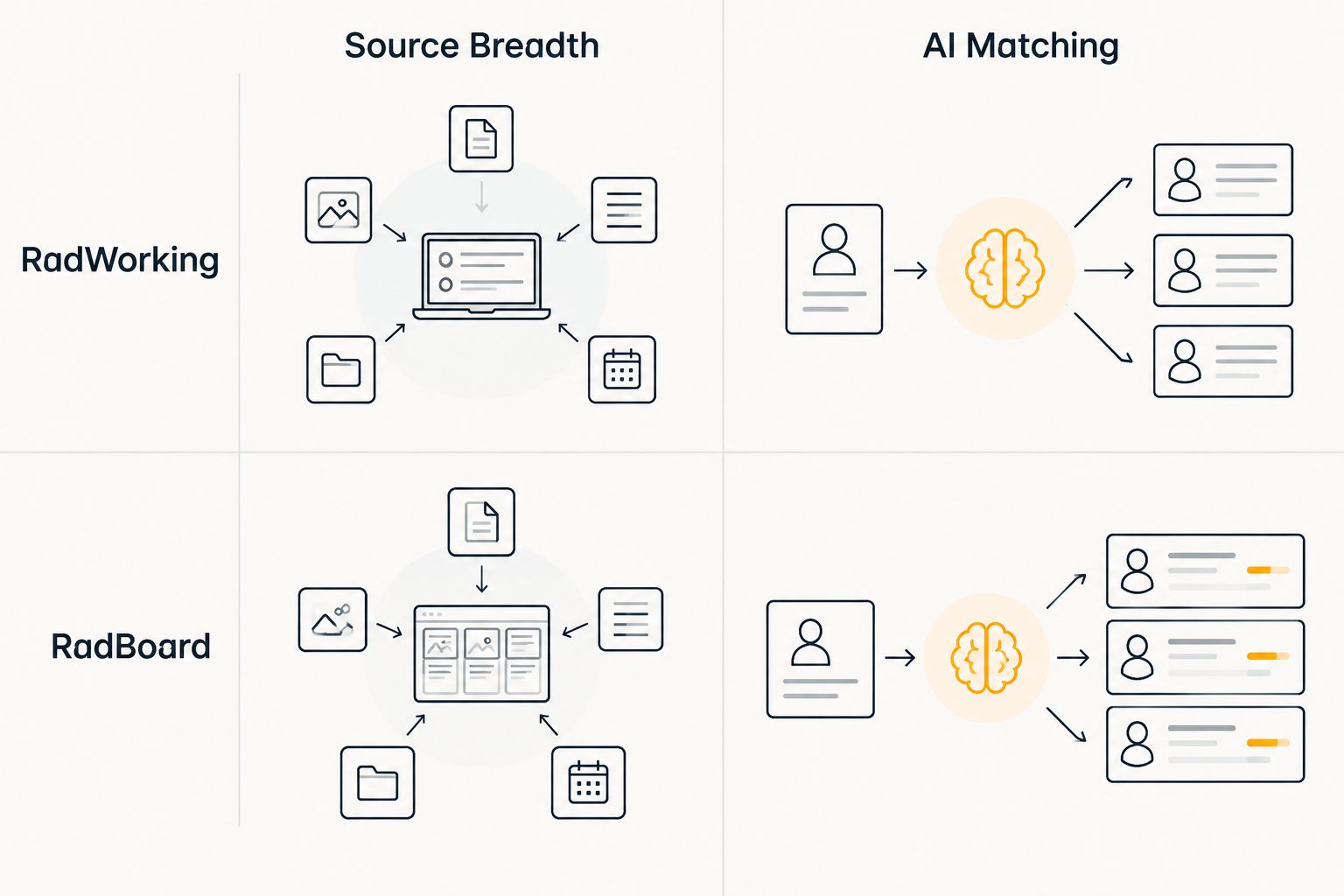
| Dimension | RadBoard | RadWorking |
|---|---|---|
| Source breadth | 20 sources aggregated | Single-source listings |
| Matching | AI-powered search | Manual browsing |
| Save workflow | Swipe-to-save | Standard list view |
| Subspecialty depth | Deep, across 20+ niches | Narrower by design |
2. Indeed: best for sheer volume of postings
Indeed indexes far more total job postings than any radiology-specific board, simply because it covers every industry. For radiology, that scale cuts both ways — you'll find listings RadWorking never picks up, but you'll wade through postings with no subspecialty tagging at all.
Where Indeed shines
- Largest overall volume of job postings of any option here
- Catches hospital-system listings that post directly without going through a niche board
Where Indeed falls short
- No radiology-specific filtering for subspecialty, call schedule, or practice type
- Search results mix radiology with unrelated medical and non-medical roles
Best for: radiologists willing to filter manually in exchange for maximum coverage. A deeper breakdown of this trade-off is in RadBoard's guide to Indeed alternatives for radiology job search.
3. LinkedIn: best for passive, network-driven search
LinkedIn works differently than a listings board — it surfaces openings through recruiter outreach and connections rather than a searchable feed built for radiology. That makes it strong for radiologists who aren't actively applying but want to stay visible to recruiters in 2026.
Where LinkedIn shines
- Recruiters reach out directly based on your profile and subspecialty
- Useful for passive searching without running daily searches
Where LinkedIn falls short
- Not built for radiology-specific filtering (subspecialty, call burden, RVU structure)
- Requires an active, kept-up profile to generate inbound interest
Best for: radiologists not actively searching but open to the right recruiter message.
4. Staffing agencies: best for locum and placement support
A staffing agency isn't a listings site at all — it's a service where a recruiter matches you to openings and negotiates on your behalf. For locum tenens work especially, this model fills gaps that any self-serve board, RadWorking or RadBoard included, can't close on its own.
Where staffing agencies shine
- A recruiter handles credentialing logistics and contract negotiation
- Strong fit for locum tenens and short-notice coverage needs
Where staffing agencies fall short
- You're working one recruiter's pipeline, not an aggregated, self-serve search
- Less control over timing and volume of opportunities shown to you
Best for: radiologists who want placement help rather than a self-serve search tool.
Why people switch from RadWorking
The reasons radiologists move off RadWorking in 2026 are consistent, not dramatic.
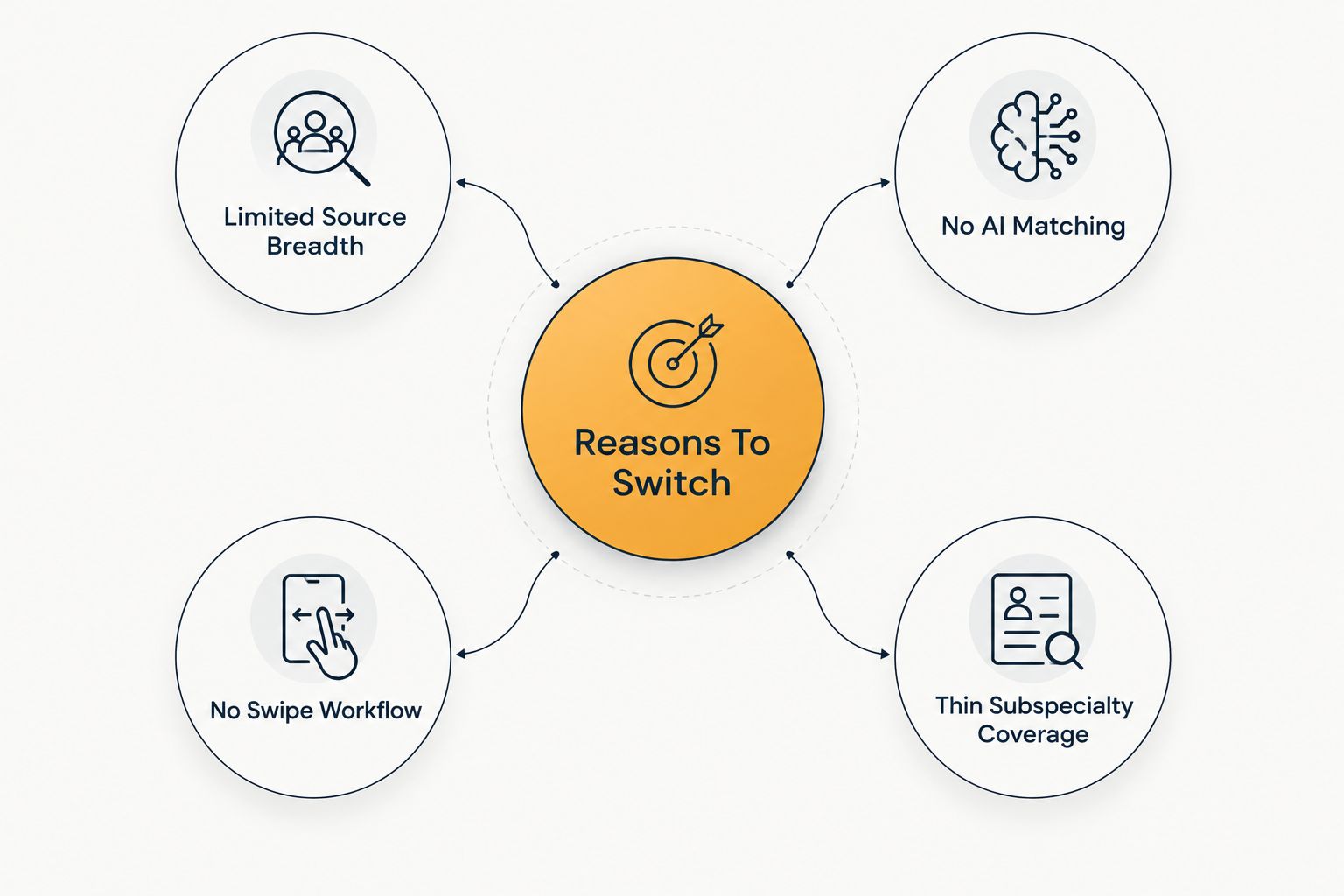
- Source breadth. A single-source board caps the total pool; RadBoard's 20 sources widen it.
- No AI matching. Manual keyword search misses roles tagged inconsistently across subspecialties.
- No swipe-based save workflow. Re-running the same search daily wastes time between reads.
- Subspecialty coverage gaps. Niche roles — pediatric neuroradiology, transplant imaging, interventional oncology — surface unevenly on a narrower feed.
Compare radiology listings today
5,000+ aggregated postings from 20 sources, updated continuously.
When staying with RadWorking is the right call
If you've already narrowed your search to one subspecialty, one region, and you trust RadWorking's curation for that slice, switching tools adds friction without adding value. A single-source board that fits your exact search is better than an aggregator you don't use consistently.
FAQ
What is the best RadWorking alternative in 2026?
RadBoard is the best RadWorking alternative in 2026 for radiologists who want AI-matched listings from 5,000+ positions across 20 sources instead of a single-source feed.
Is RadBoard better than RadWorking for radiology jobs?
RadBoard covers more sources and adds AI-powered search and swipe-to-save, while RadWorking offers a narrower, single-source list. Which is 'better' depends on whether you want breadth or a tighter curated feed.
How many radiology job sources does RadBoard aggregate?
RadBoard aggregates listings from 20 sources into one search, totaling 5,000+ active radiology positions as of 2026.
Do radiology job boards charge job seekers a fee?
Radiology job boards, including RadBoard and RadWorking, are generally free for job seekers since employers and staffing agencies pay to post listings.
Is LinkedIn good for radiology job search in 2026?
LinkedIn works best for passive search and recruiter outreach, not for filtering radiology-specific openings by subspecialty or call schedule the way a dedicated board does.
What's the difference between a radiology job board and a staffing agency?
A job board like RadBoard or RadWorking gives you a searchable feed of listings; a staffing agency assigns a recruiter who matches and negotiates on your behalf, which matters most for locum tenens work.
Can AI-powered job search actually find subspecialty radiology openings?
Yes — AI-powered matching on platforms like RadBoard surfaces subspecialty roles (neuroradiology, body imaging, interventional) that get buried in keyword-only search on narrower boards.
Should I use more than one radiology job board in 2026?
Most radiologists run an aggregator like RadBoard alongside a general board or a staffing agency relationship, since no single source catches every posting.
One last thing
RadBoard's 2026 US radiology job market report tracked subspecialty demand and geographic distribution across 3,700+ active listings — if you're deciding between subspecialties as much as between platforms, that data point matters more than which board you pick first. Run the same subspecialty search on two platforms before you commit to one.