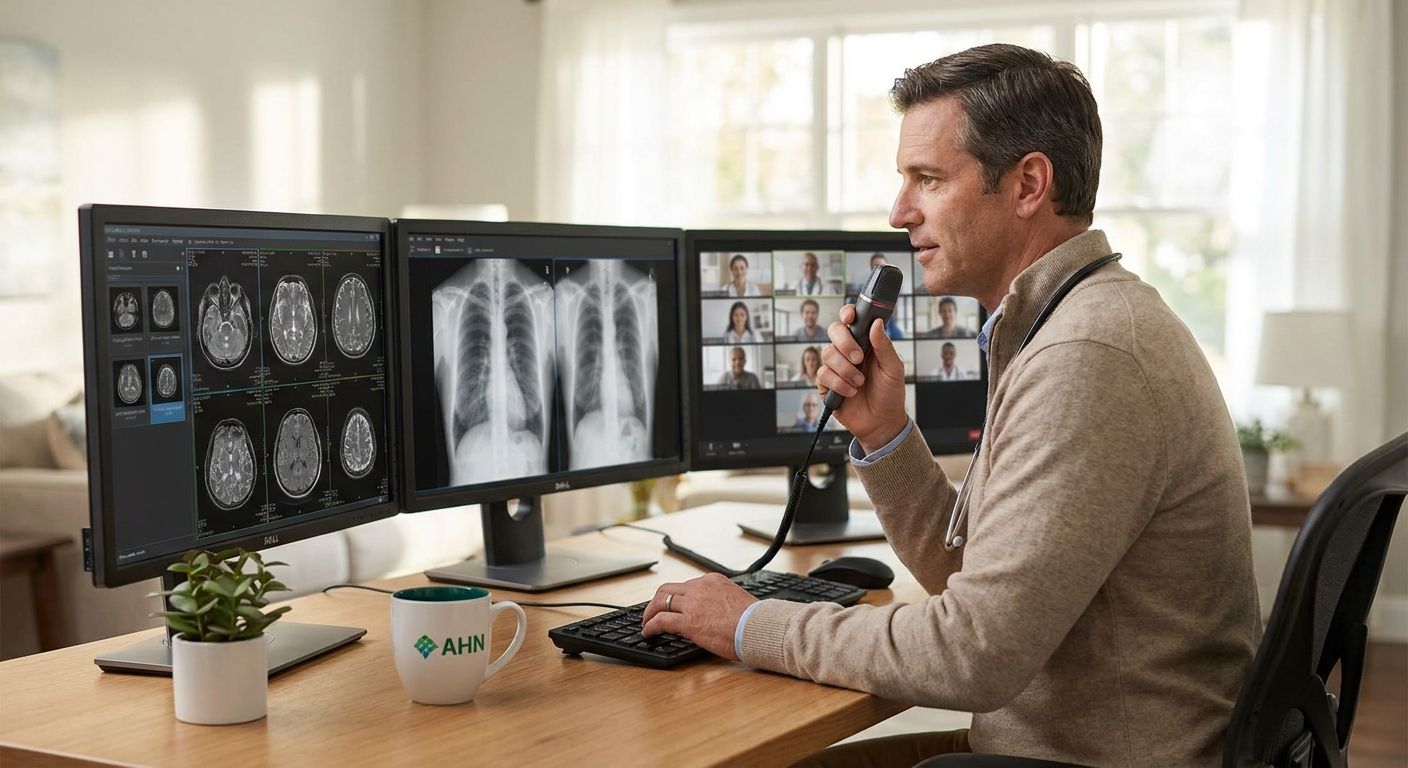
Allegheny Health Network posts radiology openings that range from on-site attending roles to hybrid teleradiology contracts, and picking the right one when you want to work remotely means reading the fine print on call coverage, licensing, and equipment stipends before you apply in 2026.
- AHN (Allegheny Health Network) radiology postings mix hybrid and fully remote reading roles across western Pennsylvania in 2026 — check call load before applying.
- Hybrid on-site-plus-remote reading is the safe pick for ahn remote jobs; a teleradiology partner contract is the wildcard.
- Multi-state licensing and home workstation stipends decide whether an AHN remote radiology role actually cuts your commute time.
- RadBoard tracks 5,000+ radiology jobs from 20 sources, including hospital-system postings like AHN's, updated for 2026.
Why this matters
AHN, part of the Highmark Health system based in Pittsburgh, runs a multi-hospital network across western Pennsylvania, and its radiology postings don't always spell out whether "remote" means a fully off-site contract or three reading days a week from home. Radiologists searching for ahn remote jobs in 2026 waste weeks applying to postings that turn out to require on-site onboarding, in-person call rotations, or state licenses they don't hold. Reading the arrangement type before you submit a CV saves that time. Search current radiology openings on RadBoard to see how a given posting is actually structured before you apply.
Who this is for
This guide is for board-certified or board-eligible diagnostic radiologists evaluating AHN or comparable hospital-system openings who want to reduce on-site days without leaving a salaried, benefits-backed position. It's built for physicians who already have (or are willing to get) a Pennsylvania license and want to know which remote arrangement type fits their subspecialty and call tolerance, not for physicians chasing a fully 1099 teleradiology lifestyle with zero facility ties.
What to look for in AHN remote jobs for remote-seeking physicians
Hybrid vs. fully remote definition
Job titles that say "remote" often mean two or three reading days from home with the rest on-site covering procedures or tumor boards. Confirm the exact split during the first screening call, because a "remote-friendly" listing that turns out to be 80% on-site defeats the purpose of the search.
Multi-site coverage across the network
A health system the size of AHN often pools radiology reads across several hospitals rather than tying a radiologist to one site. Ask whether a remote role covers a single facility's overnight backlog or rotates across the network's imaging volume, since multi-site coverage usually means more case variety but less predictable scheduling.
Licensing footprint
Most AHN radiology work sits inside Pennsylvania, but any cross-state teleradiology coverage arrangement requires a license in every state where the images originate. The Interstate Medical Licensure Compact speeds this up for eligible physicians, but it still takes weeks, not days, so confirm licensing requirements before you accept a start date.
Home workstation and equipment stipend
Diagnostic-quality monitors, a compliant home reading room, and a stable VPN connection aren't optional for remote radiology work. A posting that calls itself remote but leaves equipment costs to the physician is a red flag worth raising in negotiation.
Call and weekend coverage load
Remote doesn't always mean lighter call. Some hybrid arrangements shift weekend and overnight call onto the remote-capable radiologists specifically because they don't need to drive in. Get the call frequency in writing, not just verbally, before signing.
Compensation structure
RVU-based pay rewards volume but penalizes radiologists on lower-throughput remote shifts; a salaried base with an RVU bonus on top protects income during slower reading days. Ask which model applies to the specific remote arrangement, since hospital systems frequently run different comp models for on-site versus remote radiologists within the same department.
Top picks: remote arrangement types to target at AHN-style systems
The safe pick: hybrid attending with scheduled remote days
This arrangement keeps a base salary, benefits, and a defined split — commonly 2 to 3 remote days per 5-day week — while the physician still covers procedures and in-person meetings on-site. It suits radiologists who want fewer commute days without giving up the stability of employment. Verdict: Buy for anyone prioritizing income stability over full flexibility. For details on negotiating the home-office side of this arrangement, see how to negotiate home workstation stipends for teleradiology jobs.
The wildcard: teleradiology partner contract
Some hospital systems route overflow and overnight reads through a third-party teleradiology group rather than staffing it in-house. These contracts can be fully remote from day one but usually pay per-study or per-shift rather than a fixed salary, and volume can swing month to month. Verdict: Consider if you can tolerate income variability for full location independence. Review the fit against teleradiology jobs for radiologists who want remote flexibility before signing.
The high-volume pick: multi-site remote pool coverage
This model has one radiologist reading across several hospitals in the network rather than one facility, which usually means higher case counts and more subspecialty variety per shift. It works for radiologists who want to stay generalist and avoid getting locked into a single site's caseload. Verdict: Consider, and confirm which states the pooled sites sit in before accepting, since cross-state coverage triggers the licensing requirement covered above — see how to maintain multi-state licenses as a teleradiologist for the maintenance workload involved.
The niche pick: overnight remote shifts
Nighthawk-style overnight coverage is almost always fully remote by design, since hospitals don't want an in-house radiologist physically present at 3 a.m. for a handful of stat reads. It pays a premium in most markets but flips your schedule entirely. Verdict: Skip unless overnight hours already fit your life, and Buy if they do — the remote logistics are simpler than daytime hybrid roles because there's no on-site expectation at all.
What to avoid
- "Remote" postings with mandatory on-site onboarding weeks. A 4- to 8-week in-person ramp-up before the remote schedule kicks in is common and rarely disclosed upfront — ask directly.
- Stipend language that only covers hardware, not software licensing. PACS viewer licenses and dictation software subscriptions add real monthly cost that a "workstation stipend" may not include.
- RVU-only comp with no base floor on remote days. If remote shifts consistently pull lower volume than on-site shifts, RVU-only pay quietly cuts your income even though your hours didn't change.
Compare current radiology openings
Search AI-matched radiology jobs and swipe to save the ones that fit.
Verdict comparison
| Arrangement | Remote days | Licensing need | Comp model | Verdict |
|---|---|---|---|---|
| Hybrid attending | 2-3 per week | Single state (PA) | Salary + RVU bonus | Buy |
| Teleradiology partner contract | Full remote | Depends on coverage area | Per-study/shift | Consider |
| Multi-site remote pool | Full remote | Multi-state possible | Salary or RVU | Consider |
| Overnight remote shifts | Full remote | Single state (PA) usually | Shift premium | Buy (if hours fit) |
FAQ
Does AHN offer fully remote radiology jobs?
Allegheny Health Network postings in 2026 more commonly describe hybrid arrangements with scheduled remote reading days rather than fully remote roles. Fully remote coverage is more likely through a contracted teleradiology partner than a direct AHN hire.
What license do I need for AHN remote radiology jobs?
A Pennsylvania medical license covers most AHN-based reading work. Cross-state coverage through pooled or partner arrangements requires a license in every state where the imaging originates.
Is a hybrid radiology job better than a fully remote one?
Hybrid roles usually keep a salaried base and benefits, while fully remote contracts often shift to per-study or shift-based pay. The better fit depends on whether you value income stability or full location independence more.
How much does a home radiology workstation cost to set up?
Costs vary by monitor grade, VPN setup, and software licensing, which is why confirming what an employer's stipend actually covers matters before you accept a remote role.
Do remote radiology jobs pay less than on-site jobs?
Pay depends on the comp model, not the location. RVU-based remote roles can pay less during lower-volume shifts, while salaried hybrid roles keep income steady regardless of case count.
Can I find AHN radiology openings without a recruiter?
Yes — aggregator platforms pull hospital-system postings directly, so a recruiter isn't required to see what's open. RadBoard aggregates 5,000+ radiology jobs from 20 sources, including large health-system listings.
What's the biggest mistake radiologists make applying to remote hospital-system jobs?
Assuming a job titled remote is fully remote. Confirm the exact on-site day count and call schedule during the first screening call, not after signing.
One last thing
The Interstate Medical Licensure Compact cuts the time to add a second state license for eligible physicians, which matters more than it sounds like it should — multi-site remote pool coverage at hospital-system employers routinely spans more than one state, and a slow license application is the single most common reason a strong remote radiology candidate loses an offer window in 2026.