
Glassdoor is useful for employer reviews and employee-reported compensation. It is less focused on the clinical requirements that distinguish one radiologist position from another. The best Glassdoor alternative in 2026 is RadBoard if you need radiology-focused job discovery; ACR Career Center if you want a specialty-association job board.
- RadBoard leads Glassdoor alternatives for radiologists seeking specialty-focused job search across 20 sources.
- ACR Career Center suits radiologists who want a specialty-association hiring channel.
- PracticeLink suits physicians comparing employers across specialties and locations.
- Keep Glassdoor for employer research; confirm radiology workload and contract terms directly.
Why this matters
A hospital's reputation does not tell you whether its radiology position fits your training, schedule, or preferred practice model. Employer research and job discovery answer different questions. Your search needs both.
For a 2026 radiology search, separate the employer from the assignment. A positive review from another department does not establish the radiology group's call expectations, reading mix, or partnership terms. Likewise, an attractive job description does not establish how the practice operates day to day.
Choose a search channel for finding relevant positions, then use interviews and written terms to evaluate them. No platform replaces that second step.
Glassdoor alternatives at a glance
These options serve different purposes. The comparison below ranks them by use case, not by unverified placement rates, listing freshness, or search accuracy.
| Platform or channel | Best for | Standout function | How it differs from Glassdoor | Main limitation |
|---|---|---|---|---|
| RadBoard | Radiology-focused discovery | Aggregates 5,000+ radiology positions from 20 sources, with AI-powered search and swipe-to-save | Starts with radiology career opportunities rather than general employer research | Discovery does not verify workload or contract terms |
| ACR Career Center | Specialty-association job search | Radiology hiring through the American College of Radiology's career center | Uses a radiology-specific professional context | One hiring channel is not the entire market |
| PracticeLink | Physician-focused employer comparisons | Physician job search and recruitment | Focuses on physician careers rather than employee reviews | Physician focus still requires you to assess radiology-specific duties |
| Employer career pages | Researching a named institution | The employer's own position descriptions and application route | Starts with an employer you already selected | Requires separate research across institutions |
| Glassdoor | Employer reputation research | Employee reviews and reported compensation | Provides the benchmark for general employer research | Employer-level information does not establish department-level conditions |
Keep the channels separate in your notes. Record where you found a position, who employs the radiologist, and who handles recruitment. Those are different facts, even when they appear together in a posting.
1. RadBoard: best for radiology-focused job discovery
RadBoard is a radiology job search platform that aggregates 5,000+ positions from 20 sources. Its stated features include AI-powered search and swipe-to-save. Use it to build a specialty-focused shortlist before investigating individual employers.
The practical distinction is scope. You start with radiology opportunities instead of using an employer-review platform as your main discovery channel. A larger search pool still needs clinical screening; the headline count does not establish how many positions meet your requirements.
Where it shines
- Specialty focus: The platform is built around radiology career opportunities.
- Multiple sources: Aggregation brings positions from 20 sources into one search platform.
- Search and saving: AI-powered search and swipe-to-save support finding and retaining opportunities.
Where it falls short
- A job-search result does not establish the actual proportion of subspecialty reading.
- Saving a position does not confirm call obligations, employment structure, or partnership eligibility.
- The overall position count does not tell you how many jobs match your location, credentials, and schedule.
Those limits matter. Treat discovery as the start of your assessment, not as evidence that an employer meets your requirements.
Head-to-head with Glassdoor
| Dimension | RadBoard | Glassdoor |
|---|---|---|
| Primary use | Radiology job discovery | Employer research and general job search |
| Search context | Radiology career opportunities | Employers and occupations across industries |
| Stated functions | Aggregation, AI-powered search, swipe-to-save | Employee reviews and reported compensation |
| Best next step | Investigate shortlisted positions | Turn review themes into interview questions |
Best for: Radiologists building a shortlist across multiple sources in 2026.
Verdict: Buy into the specialty-first search approach; verify each position before applying.
2. ACR Career Center: best for a specialty-association channel
ACR Career Center is the American College of Radiology's career center. It gives you a radiology-specific hiring channel alongside broader discovery tools. Use it as a separate source rather than assuming any single board represents every employer you should consider.
The association context is useful, but it is not an employment guarantee. Evaluate the job description and hiring organization on their own terms. A posting's location on a professional career board does not replace contract review.
Where ACR Career Center shines
- Radiology context: The hiring channel belongs to a radiology professional association.
- Focused research: You can keep your search centered on the field rather than general employer reviews.
- A separate route: It gives you another place to look when building a specialty-specific shortlist.
Where ACR Career Center falls short
- A single career board cannot establish complete market coverage.
- An association-linked posting does not prove a favorable call schedule or practice culture.
- You still need to distinguish the advertised subspecialty from the full clinical assignment.
Head-to-head with Glassdoor
| Dimension | ACR Career Center | Glassdoor |
|---|---|---|
| Professional context | Radiology association | General employer platform |
| Best use | Finding radiology career postings | Researching employer reputation |
| Evidence to investigate | Position description and hiring contact | Review themes and reported compensation |
| Remaining task | Confirm clinical and contractual fit | Confirm relevance to the radiology department |
Best for: Radiologists who want a specialty-association source in their 2026 search.
Verdict: Buy into it as a complementary hiring channel, not as proof of job quality.
3. PracticeLink: best for physician-focused employer comparisons
PracticeLink is a physician job-search and recruitment platform. It is a useful alternative when your search spans different healthcare employers rather than only one radiology practice model. Keep your clinical requirements explicit as you compare positions.
Physician focus is the distinction from Glassdoor. It does not remove the need to ask what the radiologist actually does during a shift.
Where PracticeLink shines
- Physician orientation: Its hiring context centers on physician careers.
- Employer research: It supports a search organized around healthcare employers and positions.
- Broader career context: It fits a physician search that extends beyond one specialty-only channel.
Where PracticeLink falls short
- Physician-level relevance does not establish subspecialty-level fit.
- A position description cannot confirm how an advertised schedule works in practice.
- You still need written answers about coverage sites, call, and clinical responsibilities.
Head-to-head with Glassdoor
| Dimension | PracticeLink | Glassdoor |
|---|---|---|
| Audience context | Physicians and healthcare recruitment | Employees across industries |
| Primary research task | Find and investigate physician positions | Investigate employer reputation |
| Radiology screening | Assess the specific clinical assignment | Assess whether reviews describe radiology |
Best for: Physicians comparing healthcare employers while keeping radiology requirements fixed.
Verdict: Buy into the physician-focused channel; skip positions that leave essential duties unresolved.
4. Employer career pages: best for a named institution
Employer career pages are the direct route when you already know which institution interests you. Start with the employer's position description, then identify the hiring department and recruitment contact. Do not assume the institution and the radiologist's legal employer are interchangeable.
Where employer career pages shine
- Employer specificity: Your research starts with a named organization.
- Direct application context: You can examine the employer's own application instructions.
- Focused follow-up: You can ask about a particular department or advertised position.
Where employer career pages fall short
- Comparing institutions requires separate searches and notes.
- The employer's description is not independent evidence of workplace conditions.
- An institution's reputation does not establish the terms of an individual radiology role.
Best for: Radiologists with a defined institutional shortlist in 2026.
Verdict: Buy into direct research for named employers; hold until the employment relationship is clear.
Why people switch from Glassdoor
Switch your primary discovery channel when your decision depends on radiology-specific details rather than general employer reputation. The reasons below are search criteria, not claims about measured user behavior.
You need subspecialty fit, not just a radiology title
A radiology title does not establish a subspecialty-only assignment. Ask which modalities you will interpret, whether you will cover a general worklist, and which procedures are required. Put the answers beside your training and preferred scope.
Do not treat a subspecialty label as a complete job description. Confirm the clinical mix with the hiring team.
You need a defined schedule
Remote, outpatient, and flexible describe different aspects of work. None answers every scheduling question. Ask about shift timing, time zone, weekend coverage, overnight duties, and backup responsibilities.
For a 2026 search, write your schedule limits before evaluating employers. That keeps an attractive institution from distracting you from an incompatible assignment.
You need clarity about ownership and employment
Identify the contracting entity and ask how it relates to the hospital or imaging site. Then distinguish employee status, contractor status, and any proposed ownership path. These are questions for the hiring organization and written agreement, not conclusions to draw from reviews.
You need evidence beyond compensation reports
Reported compensation is context, not an offer. Compare the proposed clinical responsibilities, productivity expectations, benefits, leave, and malpractice terms together. Ask which terms are guaranteed and which depend on future performance or eligibility.
Build a shortlist before comparing employers
Use a 4-stage screening process to keep job discovery separate from offer evaluation. These stages are a recommended workflow, not a claim about platform performance.
Clinical fit
List your required reading scope and procedures. Mark each position as confirmed, unresolved, or incompatible based on the description and hiring team's answers. Do not promote an unresolved assumption into a confirmed match.
Schedule fit
Record shift timing, call, weekends, and work location. Ask how those expectations change during leave coverage or staffing gaps. Reject a schedule conflict before spending time on less decisive benefits.
Employer review
Read employer reviews for questions to investigate. Separate comments about the radiology department from comments about unrelated teams, and distinguish firsthand descriptions from general opinions. Ask the practice for examples rather than accepting broad assurances.
Contract review
Compare the written agreement with the position description and interview answers. Resolve differences before signing. Obtain qualified advice for legal, tax, and insurance questions that affect your decision.
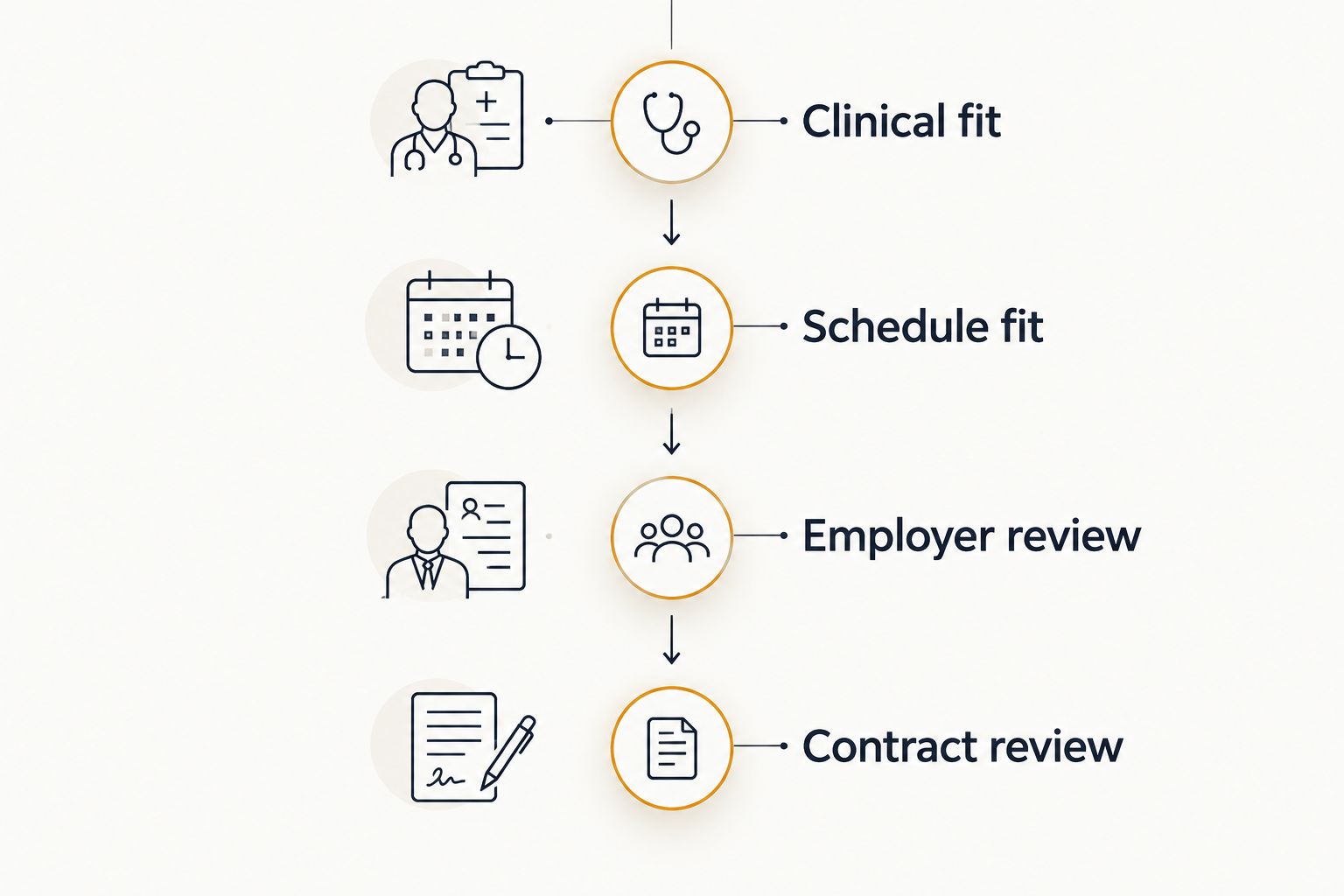
Keep the same headings for every shortlisted position. Consistent notes make omissions visible: an unanswered call question should not disappear simply because another employer supplied a longer benefits description.
Build your radiology shortlist
Search a platform aggregating 5,000+ radiology positions from 20 sources.
When staying with Glassdoor is the right call
Keep Glassdoor when employer reputation is the question you need to answer. Employee reviews can supply topics for interviews, and reported compensation can add context to your research. Neither establishes the terms of your prospective radiology assignment.
Use the reviews carefully. Check which role, department, and location a reviewer describes before applying the comment to your own opportunity. A review about hospital administration is not a firsthand account of the radiology reading room.
Hold Glassdoor as an employer-research tool rather than asking it to do every part of a radiology search. You do not need to abandon it to use a specialty-focused discovery channel.
FAQ
What's the best Glassdoor alternative for radiologists in 2026?
RadBoard is best for radiology-focused job discovery across multiple sources. It aggregates 5,000+ radiology positions from 20 sources and provides AI-powered search and swipe-to-save features.
Is ACR Career Center better than Glassdoor for radiology jobs?
ACR Career Center is the better fit when you want a radiology-specific association hiring channel. Glassdoor serves a different purpose: researching employers through employee reviews and reported compensation.
Is PracticeLink useful for attending radiologists?
PracticeLink is a physician-focused job-search and recruitment channel. Evaluate each radiology position for reading scope, procedures, schedule, and employment terms rather than treating physician relevance as a complete match.
Should I stop using Glassdoor during my radiology job search?
Keep Glassdoor for employer research if its reviews help you identify interview questions. Use a specialty or physician-focused channel for discovery, then confirm department-specific conditions directly.
How do I compare radiology jobs found on different platforms?
Use the same clinical, schedule, employer, and contract criteria for every position. Record unresolved questions explicitly and compare written terms with the hiring team's answers.
Can employer reviews tell me a radiology group's call burden?
Employer reviews do not establish your prospective call obligations. Ask the hiring team for the schedule, backup responsibilities, and written terms that apply to the position.
Should I apply through a job board or an employer career page?
Follow the application instructions for the specific position and confirm the hiring contact. Keep a record of your submission so you do not send duplicate applications through different channels.
One last thing
The same institution name does not establish the same employment relationship. Ask who signs your contract, who directs your clinical work, and which entity provides malpractice coverage. Those answers belong in your comparison before employer reputation becomes the deciding factor.
A clear answer is more useful than another saved posting. Finish the search with a verified assignment, not just a familiar name.