
Marit Health helps physicians assess compensation through physician-reported salary information. For radiology recruiting, compensation research is only part of the job: you also need to discover positions and confirm the clinical workload. The best Marit Health alternative in 2026 is RadBoard if you need radiology job discovery; employer career pages are the better route if you already know which organization you want to join.
- For Marit Health alternatives focused on radiology job discovery, choose RadBoard: it aggregates 5,000+ positions from 20 sources.
- Use employer career pages when your radiology job search already targets a specific organization.
- Use specialty job boards for another discovery channel and recruiters for employer conversations.
- Keep Marit Health for compensation research; confirm workload, schedule, and contract terms separately.
Why this matters
A salary benchmark does not tell you whether a position fits your practice. You still need to establish the subspecialty mix, reading location, call obligations, and employment structure before pursuing an offer.
Separate discovery from evaluation. Find relevant positions first, then compare their written terms against your requirements. This guide addresses the radiologist choosing a search channel, not an employer selecting recruitment software.
Marit Health alternatives at a glance
| Option | Best for | Standout function | Difference from Marit Health | Main limitation |
|---|---|---|---|---|
| Marit Health | Physician compensation research | Physician-reported salary information | Benchmark for this comparison | Compensation information does not establish the terms of a particular opening |
| RadBoard | Radiology job discovery across sources | 5,000+ positions from 20 sources, natural-language search, and swipe-to-save | Starts with career opportunities rather than salary research | A saved listing still requires employer confirmation |
| Employer career pages | Applying to a known organization | Direct access to that employer's recruitment channel | Starts with the employer you want to join | Each page covers that organization's opportunities |
| Radiology specialty job boards | Additional specialty-focused discovery | A job-search channel centered on radiology | Helps you find positions to investigate | You must reconcile results across separate boards |
| Radiology recruiters | Discussing requirements with a recruitment contact | A person to ask about a represented position | Adds conversation to job discovery | You need to establish whom the recruiter represents |
These are alternatives for different tasks, not interchangeable products. Choose the channel that resolves your next decision, and keep compensation research separate from confirmation of an actual offer.
1. RadBoard: best for radiology job discovery
RadBoard is a radiology job search platform that aggregates 5,000+ positions from 20 sources. Its natural-language search and swipe-to-save features support finding opportunities and building a shortlist. RadBoard is best for radiologists who want to search positions across multiple sources.
The distinction from compensation research is practical. Start with the work you want to do, then examine the employer and the employment terms. A useful search describes your clinical scope and schedule requirements rather than treating the job title as sufficient evidence of fit.
Where it shines
- Cross-source discovery: Aggregation brings positions from 20 sources into one search platform.
- Radiology focus: The platform serves radiologists looking for career opportunities.
- Search and saving: Natural-language search helps express your requirements, while swipe-to-save supports a shortlist.
Where it falls short
- A listing is not the employment contract. Confirm duties and terms with the hiring organization.
- A saved position does not establish credentialing eligibility or clinical privileges.
- An aggregate position count does not tell you how many jobs satisfy your particular subspecialty, schedule, and location requirements.
Best for: Radiologists who want a starting point for a cross-source job search in 2026.
| Decision | Radiology job discovery | Marit Health compensation research |
|---|---|---|
| Starting question | Which positions should I investigate? | How should I assess compensation? |
| Information to use | Job descriptions and employer details | Physician-reported compensation information |
| Next step | Confirm the position's requirements | Compare compensation with the actual offer |
Use the platform for discovery without treating the result set as a complete evaluation of practice quality. Ask the employer what the advertised role means in daily clinical work, including responsibilities outside interpretation.
Verdict: Use for discovery; verify before applying or accepting.
2. Employer career pages: best for a known organization
Employer career pages are the direct route when you have already selected a hospital, university, imaging organization, or radiology group. You are narrowing the search by organization first. That suits a physician whose location or institutional preference is settled.
A direct application also gives you a clear starting point for identifying the hiring contact. It does not eliminate the need to investigate the role: the organization employing you, the facilities you cover, and the people supervising your work can be separate considerations.
Where employer career pages shine
- Keep your search centered on an organization you want to join.
- Provide that employer's application instructions.
- Let you ask the hiring contact to clarify the specific posting you found.
Where employer career pages fall short
- Each organization requires a separate search.
- A posting alone does not explain the department's everyday workload or culture.
- An employer-specific search does not compare opportunities elsewhere.
Best for: Radiologists with a defined employer shortlist, rather than an open-ended national search.
Before applying, identify whether the position includes teaching, procedures, general diagnostic coverage, or a mixture of responsibilities. Ask which duties are essential and which are negotiable. A subspecialty title deserves a subspecialty-specific conversation.
For your 2026 search, record the posting and the date you reviewed it. Confirm the details directly before relying on them in a relocation or departure decision.
Verdict: Use when the employer is already your priority.
3. Radiology specialty job boards: best for another search channel
Radiology specialty job boards give you another place to look for positions in the field. Use them to supplement your search, particularly when you want to review how different employers describe similar clinical roles.
Do not equate another search result with another distinct opportunity. Compare the employer, location, clinical duties, and recruitment contact before adding a posting to your shortlist.
Where specialty job boards shine
- Keep discovery focused on radiology roles.
- Give you additional postings to investigate.
- Help you compare the language employers use for subspecialty and generalist responsibilities.
Where specialty job boards fall short
- Separate boards require separate review and tracking.
- You still need employer confirmation of the listed duties.
- Posting detail does not replace a discussion about workflow, staffing, or call.
Best for: Radiologists checking an additional specialty-focused channel alongside their main search.
Keep a single shortlist outside the individual search channels. Track each position by employer and role, not just by the site where you found it. That makes your comparison about jobs rather than the volume of search results.
Verdict: Use as a supplement, not as proof of a complete market search.
4. Radiology recruiters: best for discussing a represented position
A radiology recruiter gives you a person to question about a role. This route fits when you want to explain your requirements and establish whether a represented opportunity deserves an interview.
Start by clarifying the relationship. Ask whom the recruiter represents, which position the conversation concerns, and how your application will reach the employer.
Where recruiters shine
- Give you a contact for position-specific questions.
- Let you state clinical and scheduling requirements before an interview.
- Support a conversation about the employer's hiring process.
Where recruiters fall short
- A recruiter's represented roles are not equivalent to the entire job market.
- Verbal descriptions still need written confirmation.
- You must understand representation before authorizing submission of your application.
Best for: Radiologists who want a recruitment conversation about a defined opportunity.
Provide a focused brief: subspecialty, preferred practice setting, acceptable schedule, and location constraints. Ask for the employer's answers to your non-negotiable requirements before committing to the interview process.
Verdict: Use for position-specific discussion; retain control of your applications.
When to look beyond Marit Health
Look beyond compensation research when your unresolved question concerns the job itself. The reason to add another channel is a different information need, not an assumption that a salary research platform has failed.
You need positions to compare
Use a job-discovery platform or specialty board when you do not yet have an employer shortlist. Define your clinical requirements first. Otherwise, you are comparing titles rather than positions you would accept.
You know the employer you want
Use the organization's recruitment channel when your priority is a particular practice or institution. Ask about the advertised position and identify the person responsible for hiring. Keep a broader search separate if you also want alternatives.
You need answers about the work
Contact the employer or a recruiter representing the role when the posting leaves important questions unresolved. Request the clinical scope, schedule, coverage expectations, and employment structure in writing.
The brand's 2026 US Radiology Job Market Report covers 3,700+ listings and addresses salary benchmarks, subspecialty demand, ownership trends, and geographic distribution. Those are useful comparison categories. They are not substitutes for checking the terms of the position you are considering.
Build a shortlist before comparing compensation
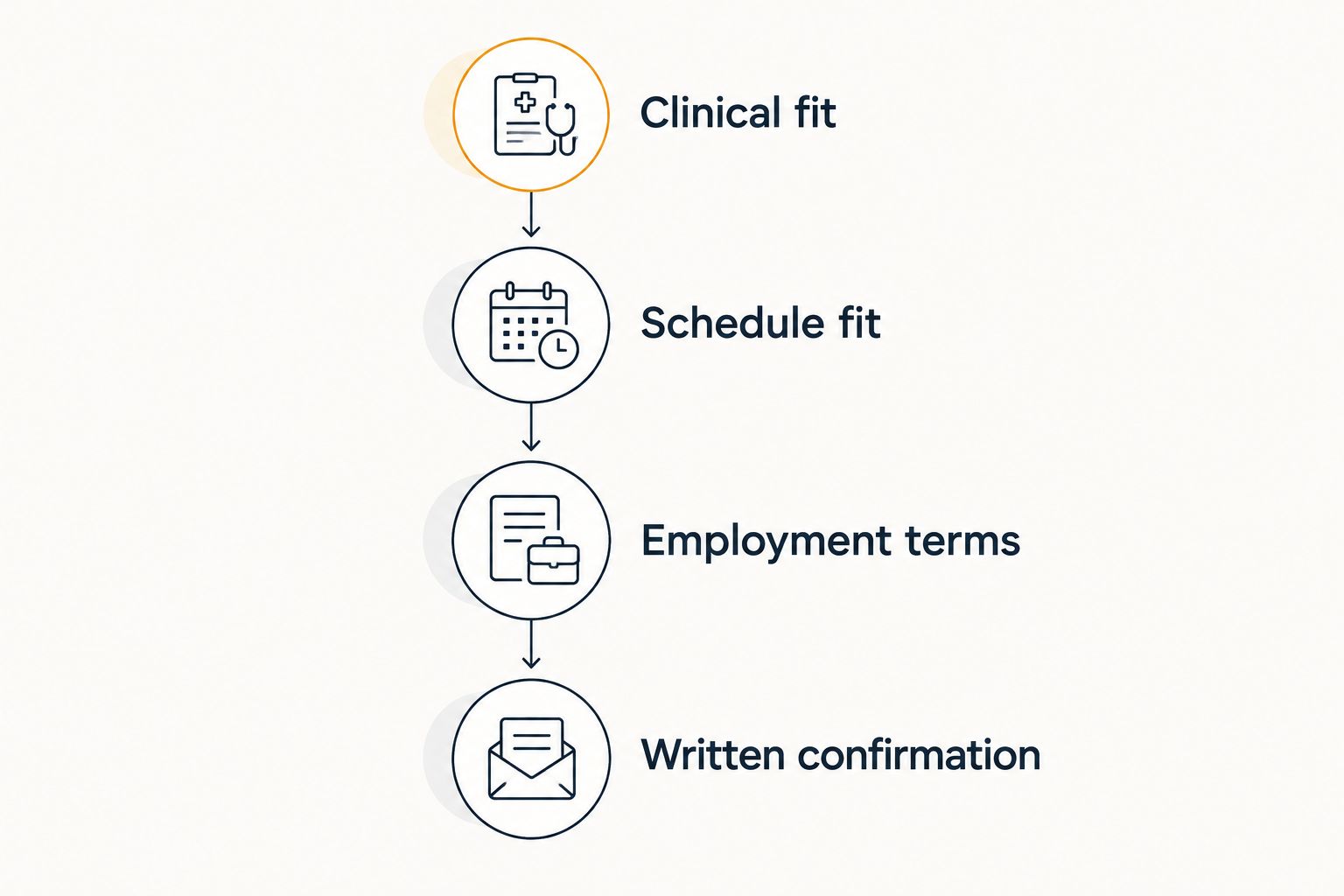
Use the same sequence for every position in your 2026 search. This keeps an attractive compensation description from obscuring a mismatch in clinical duties or scheduling.
- Clinical fit: Establish the subspecialty mix, modalities, procedures, and general coverage requirements.
- Schedule fit: Confirm onsite expectations, reading hours, call, weekends, and coverage locations.
- Employment terms: Identify the employing entity, employment structure, benefits, and any ownership pathway described in the offer.
- Written confirmation: Ask the employer to resolve material differences between the posting, interview, and proposed contract.
Keep unanswered questions visible. A blank field is a reason to ask, not a reason to assume the most favorable interpretation. If the employer describes a role as flexible, request the specific scheduling arrangement you would be accepting.
For remote work, distinguish reading location from shift obligations. For a partnership role, distinguish eligibility for consideration from written ownership terms. For academic work, ask how clinical service, teaching, and research responsibilities fit together.
Your shortlist should contain positions that pass these checks, not every result you saved. Compensation comparison becomes more useful once the underlying jobs are genuinely comparable.
When staying with Marit Health is the right call
Stay with Marit Health when your main question is compensation rather than discovery. Physician-reported salary information serves a different purpose from employer postings: it helps you examine an offer in the context of other physicians' reported compensation.
Use the information as context, not as a promise about what a particular employer will offer. Compare the clinical scope, schedule, employment structure, and compensation definitions before treating two figures as equivalent.
You do not need to replace one channel with another. Keep compensation research for evaluating terms and use job-search channels to find the positions those terms belong to.
FAQ
What's the best Marit Health alternative for radiology job search?
RadBoard is the best fit for radiologists seeking cross-source job discovery: it aggregates 5,000+ positions from 20 sources. Use employer career pages instead when you already know which organization you want to join.
Is a radiology job board better than Marit Health?
A radiology job board is better suited to finding positions; Marit Health is suited to physician compensation research. Choose according to the question you need answered rather than treating them as interchangeable.
Should I use employer career pages or a recruiter?
Use employer career pages for a direct application to a known organization, and use a recruiter for discussion of a represented role. Clarify the recruiter's relationship with the employer before authorizing an application submission.
Can I compare radiology offers using salary alone?
No, salary alone does not establish whether radiology offers are comparable. Confirm clinical duties, schedule, call obligations, employment structure, and benefits before comparing compensation.
How do I avoid counting the same radiology job twice?
Compare the employer, location, duties, and recruitment contact before treating postings as separate opportunities. Keep one shortlist entry for each distinct role and record where you found it.
What should I confirm about a remote radiology position?
Confirm the reading location, shift hours, call obligations, licensing expectations, equipment responsibilities, and clinical scope. Remote work describes location, not the complete schedule or workload.
Do I need to stop using Marit Health when I start applying?
No, you can keep Marit Health for compensation research while using other channels to find positions. Confirm the actual offer's terms with the employer rather than relying on a benchmark alone.
One last thing
Before negotiating, ask the employer to reconcile the posting with the proposed contract. A favorable salary comparison cannot resolve a disagreement about what work you are accepting.
For your 2026 search, save the posting, record the employer's clarifications, and compare both with the final written terms. Use RadBoard for radiology job discovery; make the employment decision from the confirmed role and contract.