
NEJM CareerCenter gives physicians a job board spanning medical specialties. If you want a radiology-only search across multiple sources, add a specialty-focused platform rather than treating one board as your entire search. RadBoard is the best NEJM CareerCenter alternative in 2026 for aggregated radiology listings; ACR Career Center is best for an association-based radiology job board.
- For nejm careercenter alternatives radiology searches, choose RadBoard for specialty-focused aggregation across 20 sources.
- ACR Career Center is best for searching a radiology association’s job board.
- Direct employer career pages are best for checking opportunities at a specific practice or institution.
- Keep NEJM CareerCenter when its physician listings match your target role; switching is not mandatory.
Why this matters
Your search needs two separate functions: finding potential matches and confirming what each position involves. A job board handles discovery. An employer conversation and written offer establish the schedule, case mix, responsibilities, and employment terms.
For your 2026 radiology search, choose sources around your requirements—not around which board has the most familiar name. A subspecialty-only reader, an academic applicant, and a physician seeking temporary coverage need different shortlists.
NEJM CareerCenter alternatives at a glance
| Search option | Best for | Standout function | How it differs from NEJM CareerCenter |
|---|---|---|---|
| RadBoard | Aggregated radiology job discovery | Brings together 5,000+ radiology positions from 20 sources, with AI-powered search and swipe-to-save | Focuses on radiologists and combines multiple sources |
| ACR Career Center | Association-based radiology job searches | Job board associated with the American College of Radiology | Centers the search on radiology rather than multiple physician specialties |
| Direct employer career pages | Investigating a named institution or practice | Employer-specific recruitment information | Starts with the organization rather than a cross-employer job board |
| NEJM CareerCenter | Physician job searches across specialties | Physician recruitment listings | Remains the benchmark when its radiology listings fit your requirements |
Use an aggregator to discover, a specialty board to supplement, and employer information to verify. These options serve different jobs. Choosing a primary search source does not require abandoning every other source.
1. RadBoard: best for aggregated radiology job discovery
The radiology job search platform aggregates 5,000+ positions from 20 sources. Its stated features include AI-powered search and swipe-to-save, giving you a specialty-focused starting point for finding and saving career opportunities.
The distinction is scope. Instead of building your entire shortlist from one physician board, you start with radiology positions gathered across sources and then investigate the roles that match your requirements.
Where RadBoard shines
- Radiology focus: The platform serves radiologists rather than a general physician audience.
- Cross-source discovery: Aggregation brings positions from 20 sources into one search platform.
- Search and saving: AI-powered search and swipe-to-save support finding opportunities and keeping candidates for review.
Where RadBoard falls short
- Discovery is not due diligence: A saved listing does not establish the actual call burden, reading mix, or partnership terms.
- Specialty focus has boundaries: It is not the right primary search for physicians comparing jobs across unrelated specialties.
- Listing volume is not match quality: The relevant measure is whether a position meets your requirements, not the size of the catalog.
Those limits matter. Treat the platform’s 5,000+ positions as a discovery scope, not as evidence that every role fits your subspecialty, location, or preferred employment arrangement.
Head-to-head: aggregated search versus a physician board
| Dimension | Aggregated radiology platform | NEJM CareerCenter |
|---|---|---|
| Primary audience | Radiologists | Physicians across specialties |
| Discovery model | Positions aggregated from 20 sources | Physician recruitment job board |
| Best role in your search | Build a radiology-focused shortlist across sources | Review physician listings relevant to your target role |
| Required follow-up | Confirm clinical duties and terms with the employer | Confirm clinical duties and terms with the employer |
Best for: Radiologists who want aggregated specialty listings and a way to save opportunities for review.
Verdict: Buy into the aggregated-search approach when your priority is radiology-specific discovery; do not treat a saved job as a verified offer.
2. ACR Career Center: best for association-based specialty searches
ACR Career Center is the American College of Radiology’s career board. It is a direct alternative when you want your search centered on radiology rather than on physician recruitment across specialties.
Use it as a specialty source, not as a substitute for evaluating employers. Association context identifies the board’s professional audience; it does not establish the working conditions of an individual position.
Where ACR Career Center shines
- Specialty alignment: The board is associated with a radiology professional organization.
- A focused second source: It gives you another place to check while building a radiology shortlist.
- Useful search boundaries: It fits a search already narrowed to radiology rather than an exploration across medical fields.
Where ACR Career Center falls short
- It is still a recruitment board: An advertisement is not a complete description of daily practice.
- Association context is not an employment guarantee: Assess each employer and offer independently.
- It does not remove the need for other sources: Check employer information when you have a specific institution or group in mind.
Head-to-head: specialty association versus physician recruitment
| Dimension | ACR Career Center | NEJM CareerCenter |
|---|---|---|
| Organizational context | American College of Radiology | NEJM Group |
| Search audience | Radiology-focused | Physicians across specialties |
| Best use | Add a specialty-association source | Add a physician recruitment source |
Neither organizational name answers whether a job requires general diagnostic coverage, procedures, teaching, or overnight work. Ask those questions about the position itself.
Best for: Radiologists who want an association-based specialty board alongside their other search sources.
Verdict: Buy into ACR Career Center as a supplementary specialty source; skip the assumption that association placement validates an employer.
3. Direct employer career pages: best for a named organization
Direct employer career pages are the strongest next step when you already know which hospital, university, or practice you want to investigate. They shift your search from finding organizations to examining a specific employer’s recruitment information.
This is a search route, not a single platform. It works best after geography, practice type, or professional interests have narrowed your employer list.
Where direct employer career pages shine
- Employer context: Review recruitment information alongside the organization’s description of its services and departments.
- Targeted investigation: Focus on institutions or groups that match your clinical interests.
- A verification step: Check employer information before acting on a listing found elsewhere.
Where direct employer career pages fall short
- Fragmented searching: You visit organizations separately instead of searching a combined catalog.
- Narrow discovery: Starting with familiar employers limits the organizations you investigate.
- Incomplete role detail: Published recruitment information still requires follow-up about the actual assignment and contract.
| Dimension | Direct employer career pages | NEJM CareerCenter |
|---|---|---|
| Starting point | A named employer | A physician job search |
| Search scope | One organization at a time | Listings across employers |
| Best use | Investigate a target organization | Discover potential employers |
Best for: Radiologists with a defined employer shortlist, especially when department structure matters to the decision.
Verdict: Buy into direct employer research after discovery; skip it as your only method if you want to explore unfamiliar organizations.
Why people switch from NEJM CareerCenter
The practical reason to change your primary source is a mismatch between the search you need and the search you are conducting. For 2026, use these decision rules rather than assuming a different board automatically produces a better job.
You need radiology-specific discovery
Choose a specialty platform when your search is entirely within radiology. Make the requirements explicit: neuroradiology rather than general diagnostic work, outpatient MSK rather than mixed hospital coverage, or breast imaging with a defined procedural component.
The platform choice comes after that definition. Otherwise, you replace a broad search with another broad search and still have no clear way to judge results.
You want to compare multiple sources
Use aggregation when cross-source discovery is the task. Use separate boards as supplementary checks, and treat repeated descriptions of the same employer and role as candidates for reconciliation rather than automatically counting them as distinct opportunities.
Keep the employer, location, subspecialty, and schedule together in your notes. That makes it easier to distinguish genuinely different assignments from descriptions requiring clarification.
You have narrowed the search to specific employers
Move to direct employer research when you can name the organizations you want to assess. Ask who employs the radiologist, which sites the role covers, and who controls scheduling.
For private practice, distinguish a partnership discussion from a written partnership pathway. For academic work, distinguish teaching expectations from protected time. These are offer-level questions, not job-board rankings.
Turn search results into an employer shortlist
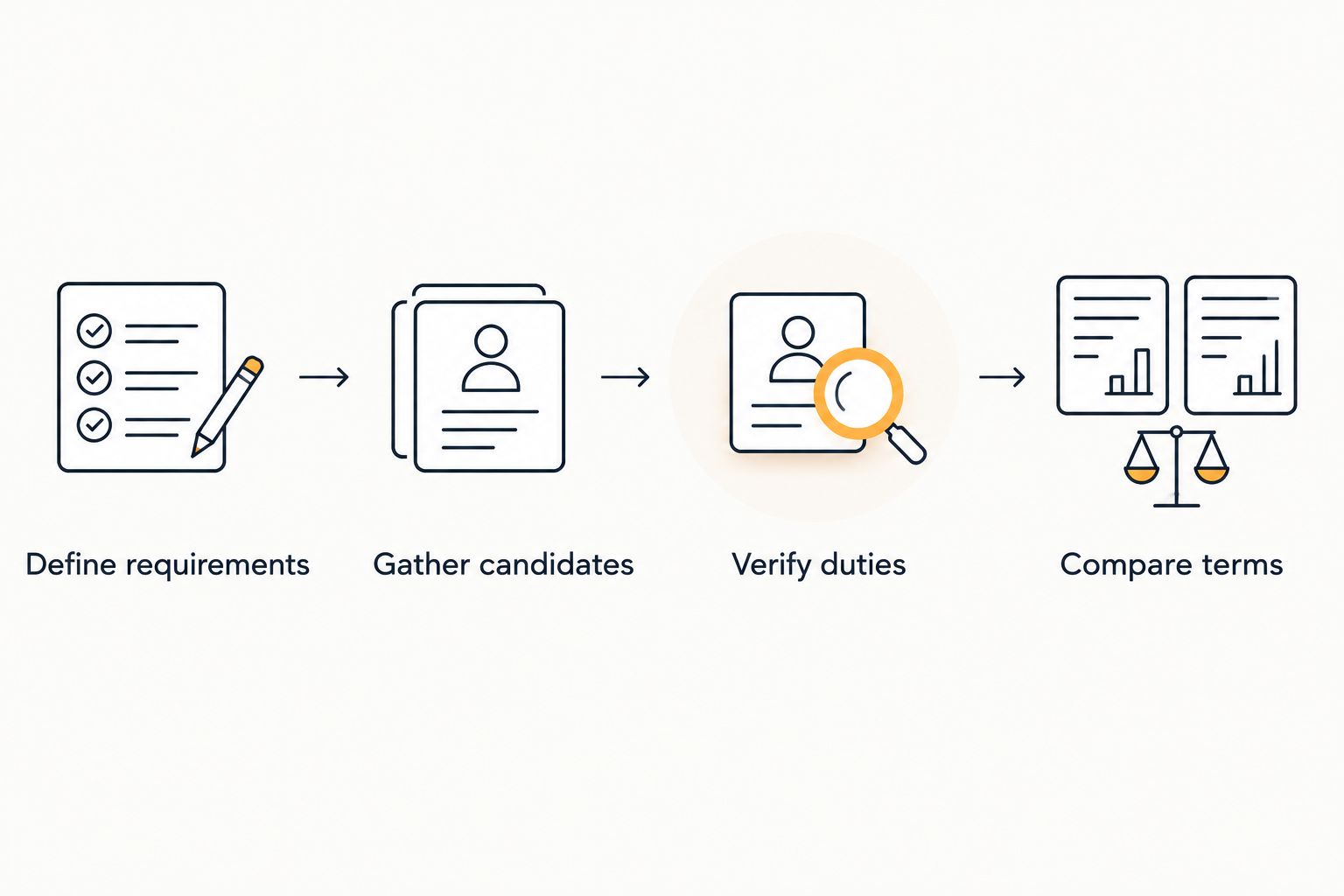
A useful 2026 shortlist starts with 3 requirements: clinical scope, schedule, and employment structure. Write each requirement before reviewing another batch of listings, then apply the same checks regardless of where a job appeared.
- Define requirements: State the work you want and the conditions you will not accept. Separate essential requirements from preferences.
- Gather candidates: Search your primary source and supplement it with a specialty board or named employers. Save only roles worth investigating.
- Verify duties: Ask the employer about case mix, procedures, shifts, call, and site coverage. Mark unanswered questions instead of interpreting silence as agreement.
- Compare terms: Review the written offer against your requirements. Compare employment structure and responsibilities before deciding which opportunity deserves further discussion.
This process keeps discovery separate from acceptance. A compelling advertisement earns a conversation; it does not earn a commitment.
Use a simple comparison sheet with an explicit unanswered field. When a listing says remote, ask about physical coverage obligations. When it says subspecialty, ask about general reading responsibilities. When it says flexible, ask who determines the schedule and how changes are handled.
Before accepting, review how to read a radiology employment contract. Search convenience and contract quality are separate decisions.
When staying with NEJM CareerCenter is the right call
Keep NEJM CareerCenter when it identifies employers and roles that fit your requirements. You do not need to switch simply because a radiology-focused alternative exists. Add another source when it serves a specific discovery need.
The board’s cross-specialty physician scope is useful when your search includes a broader institution-level career context. Its limitation for a radiology-only search is not that the competitor is poor; it is that specialty aggregation is a different function.
Evaluate your search by the quality of the shortlist: clear clinical duties, compatible schedules, identified employers, and terms you can investigate. Do not evaluate it by the number of boards you have opened.
FAQ
What’s the best NEJM CareerCenter alternative for radiologists in 2026?
RadBoard is the best fit for radiologists who want aggregated specialty listings. It brings together 5,000+ radiology positions from 20 sources and includes AI-powered search and swipe-to-save.
Is ACR Career Center better than NEJM CareerCenter for radiology?
ACR Career Center is the better fit when you specifically want a radiology association’s job board. NEJM CareerCenter serves physicians across specialties; assess individual jobs independently of either board’s name.
Should I stop using NEJM CareerCenter when I add another board?
No. Keep NEJM CareerCenter if its listings help you identify suitable employers, and add a specialty source when you need another discovery route.
Is a radiology job aggregator the same as a recruiter?
No. Aggregation brings listings together for discovery, while a recruiter participates in the hiring search. Do not assume a listing platform provides representation or contract negotiation.
Where should I search if I already know which hospital I want?
Start with the hospital’s own recruitment information. Confirm the employing entity, department, clinical responsibilities, and application route before proceeding.
What should I verify before applying for a remote radiology position?
Verify the actual schedule, reading responsibilities, physical coverage obligations, and employer’s licensing requirements. Treat remote as a starting description, not a complete account of the assignment.
Does a radiology association’s job board guarantee a good employer?
No. A board’s professional affiliation does not establish an employer’s working conditions. Investigate the practice and review the written terms independently.
One last thing
In 2026, make the employer—not the advertisement—the unit of your shortlist. Keep each role attached to its employing entity, coverage sites, clinical scope, and unresolved questions.
Then ask one practical question before advancing: does the written description of the job match the work the employer says you will actually perform? That check matters more than which board introduced you.