
PracticeMatch gives physicians a job-search channel built around medical careers rather than a general employment marketplace. For radiologists, the reason to add an alternative is to widen discovery or focus more closely on subspecialty, reading location, and practice setting—not to abandon a useful source. The best PracticeMatch alternative in 2026 is RadBoard if you need aggregated radiology job discovery; the ACR Career Center if you want a specialty-association job board.
- PracticeMatch alternatives radiology searches should prioritize: RadBoard for aggregation, ACR Career Center for a specialty-association channel.
- RadBoard aggregates 5,000+ radiology positions from 20 sources and provides search and swipe-to-save features.
- Use employer career pages when you already know which radiology department or practice you want to join.
- Keep PracticeMatch when its listings produce relevant employer conversations; add channels to address specific gaps.
Why this matters
A radiology search needs more than a matching job title. You need to establish what you will read, where you will work, which shifts you will cover, and who will employ you.
For your 2026 search, choose channels by the question each answers. An aggregator helps you discover positions across sources; an employer conversation establishes whether a position actually meets your requirements. Neither replaces the other.
PracticeMatch alternatives at a glance
| Option | Best for | Standout feature or approach | Difference from PracticeMatch | Main limitation |
|---|---|---|---|---|
| PracticeMatch | A physician-focused search channel | Medical-career recruitment focus | Baseline for this comparison | A relevant listing still requires employer-level verification |
| RadBoard | Aggregated radiology job discovery | 5,000+ positions from 20 sources; search and swipe-to-save | Radiology-specific aggregation | Aggregated volume does not establish unique positions or clinical fit |
| ACR Career Center | A specialty-association search channel | Radiology career board associated with the American College of Radiology | Specialty-association context | One board should not be treated as the entire market |
| Employer career pages | Targeting a specific department or practice | Employer-specific vacancy descriptions | Starts with your chosen organization rather than a marketplace | Requires separate searches across employers |
| Radiology recruiters | Discussing a defined search brief | Direct conversations about role requirements | Adds a person-led search channel | Requires clarity about which employer and position each recruiter represents |
Choose the search channel that fixes your bottleneck. If you lack options, widen discovery. If you have options but cannot establish fit, ask better questions before adding another board.
1. RadBoard: best for aggregated radiology discovery
RadBoard is best for radiologists who want aggregated job discovery across multiple sources. Its stated scope is 5,000+ radiology positions from 20 sources, with search and swipe-to-save features. Those figures describe the platform's aggregation scope, not a guarantee that every position is unique or appropriate for you.
The practical use case is building a shortlist before committing to employer conversations. Start with your clinical requirements, review the descriptions, and save positions that deserve follow-up rather than treating every radiology title as a match.
Where it shines
- Radiology is the platform's stated focus, matching the specialty you are searching within.
- Aggregation brings positions from multiple sources into one discovery channel.
- Swipe-to-save gives you a way to retain positions for later review.
- The stated source count provides a concrete description of the platform's scope.
Where it falls short
- A larger listing pool is not the same as a larger pool of suitable jobs.
- Aggregated descriptions still need checking against the employer's actual requirements.
- Saving a position does not resolve call obligations, case mix, ownership, or contract terms.
Head-to-head: aggregated discovery versus physician recruitment
| Dimension | RadBoard | PracticeMatch |
|---|---|---|
| Stated focus | Radiology job search | Physician recruitment and job search |
| Discovery model | Aggregates radiology positions from multiple sources | Physician-focused recruitment platform |
| Best role in your search | Build a radiology shortlist across sources | Maintain a physician-focused source of employer opportunities |
| What you must verify | Actual duties and employer terms | Actual duties and employer terms |
Best for: Radiologists who want to broaden discovery without starting separate searches at every source.
Verdict: Use for discovery; verify shortlisted roles with the employer.
2. ACR Career Center: best for a specialty-association channel
The ACR Career Center belongs in a radiologist's search because it is a career channel associated with the American College of Radiology. Its reason for inclusion is specialty context, not an unsupported claim that it has more listings, better matches, or faster hiring than PracticeMatch.
Use it as a distinct channel alongside your existing search. Compare the underlying roles, not just the names of the boards carrying them.
Where it shines
- The association context is directly relevant to radiology careers.
- It gives you another specialty-focused place to look for employer opportunities.
- It supports a search strategy built around radiology rather than unrelated occupations.
Where it falls short
- Association affiliation does not establish the quality of an individual employer or contract.
- A specialty-board listing still needs scrutiny for clinical duties, schedule, and employment structure.
- Searching this board alone does not establish that you have covered every suitable employer.
Head-to-head: specialty context versus physician-wide context
| Dimension | ACR Career Center | PracticeMatch |
|---|---|---|
| Career context | Radiology specialty association | Physician recruitment |
| Best use | Add a radiology-association channel | Continue a physician-focused employer search |
| Listing evaluation | Check the specific role and employer | Check the specific role and employer |
For a 2026 search, do not assume that an association board carries only academic jobs or only private-practice jobs. Read the employer and position descriptions individually. The board's identity is useful context, not a substitute for the listing.
Best for: Radiologists who want a specialty-association channel alongside broader physician recruitment.
Verdict: Use as a complementary source, not as proof of employer quality.
3. Employer career pages: best for a named target organization
Employer career pages are the right starting point when you already know the department, hospital, university, or practice you want to join. The search becomes organization-first rather than board-first. You are checking that employer's advertised roles instead of waiting to encounter the organization in a marketplace search.
This route is especially useful when your decision depends on an institution-specific question: teaching responsibilities, research expectations, onsite coverage, or the reporting relationship within a department.
Where they shine
- You can concentrate on employers that already meet your location or practice-setting requirements.
- Employer-specific descriptions give you material for focused questions.
- You can compare the board description with the employer's own description before applying.
Where they fall short
- You must repeat the process across separate employers.
- An employer's description does not replace clarification from the hiring team.
- Organization-first searching limits discovery outside your existing target list.
The distinction from PracticeMatch is control over the starting point. PracticeMatch lets you search within a physician-recruitment channel; direct employer searching starts with a chosen organization. Neither approach guarantees a suitable clinical workload.
Best for: Radiologists with a defined employer or department shortlist.
Verdict: Use for targeted searches; retain a discovery channel for employers outside your list.
4. Radiology recruiters: best for discussing a specific search brief
A recruiter is an alternative search channel, not another job board. Use a recruiter conversation when you need to explain a combination of requirements and ask about a particular employer's role. Specify the clinical work, schedule, location, and employment arrangement you will consider.
Where they shine
- A conversation lets you explain constraints that a job title does not capture.
- You can ask who the recruiter represents and which role is being discussed.
- A written search brief gives both sides a clear basis for evaluating fit.
Where they fall short
- A recruiter conversation does not replace employer verification or contract review.
- You need to clarify whether the recruiter is discussing a specific position or collecting your preferences.
- Before authorizing a submission, establish whether another channel has already introduced you for that role.
Compared with PracticeMatch, the distinction is person-led discussion rather than browsing a physician-focused platform. Do not assume that a recruiter has exclusive access, handles credentialing, or provides particular support unless those responsibilities are explicitly confirmed.
Best for: Radiologists who want to discuss defined requirements with a recruiting contact.
Verdict: Use with a written brief and explicit submission permission.
Why people switch from PracticeMatch
The strongest reason to add a PracticeMatch alternative is a specific mismatch between your search method and your next decision. The following are reasons to change your approach—not claims about PracticeMatch's performance or individual users' behavior.
- Broader discovery: You want to search radiology positions gathered from multiple sources.
- Specialty context: You want to include a radiology-association career channel.
- Employer targeting: You already know which departments or practices interest you.
- Detailed discussion: You need a conversation about clinical duties or scheduling requirements.
For 2026, define the gap before opening another account. More channels are useful only when they contribute a distinct role or answer a question that your existing search has not resolved.
Screen the role before comparing the offer
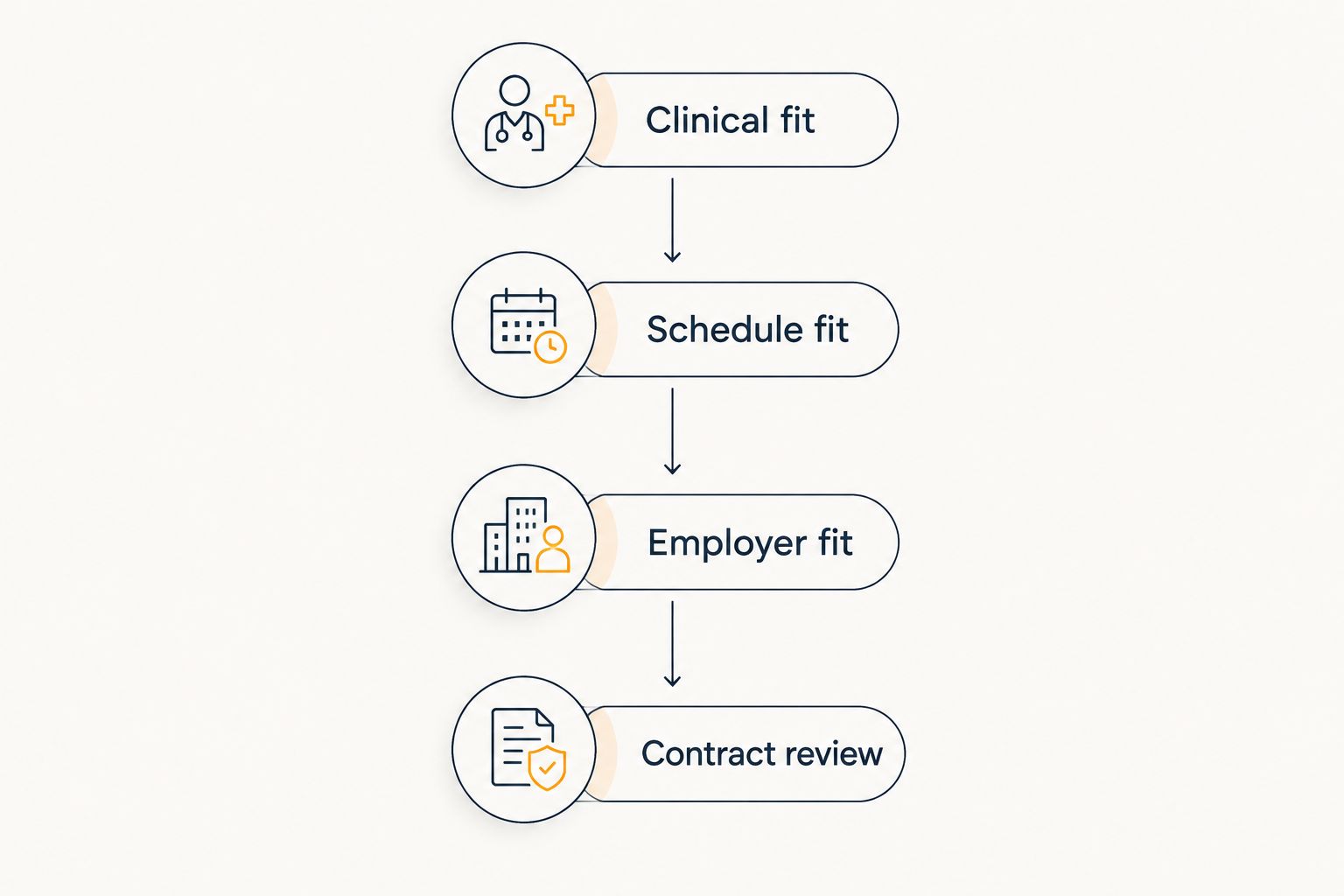
Use this sequence for positions found through any channel. It keeps the comparison focused on the work you will perform rather than the board where you found it.
- Clinical fit: Ask which modalities and subspecialties you will cover, including work outside your preferred focus.
- Schedule fit: Establish onsite expectations, remote arrangements, call, weekends, and coverage responsibilities.
- Employer fit: Identify the employing entity, practice setting, reporting structure, and any proposed ownership path.
- Contract review: Request written terms and use qualified professional advice for legal or tax questions.
A breast-imaging search, for example, should clarify the balance between interpretation and procedures. A remote-reading search should clarify the actual shifts and coverage obligations. These are screening questions, not benefits to assume from a title.
Keep a private comparison record for each shortlisted position. Record the employer, the source, the role title, the contact, your unanswered questions, and whether you have authorized a submission. Compare positions at the employer level rather than counting every appearance on a different board as a separate opportunity.
If an answer changes whether you would accept the job, ask it before investing in later interview stages. A listing that looks attractive but leaves your nonnegotiable requirements unresolved belongs in the questions pile, not the accepted-fit pile.
When staying with PracticeMatch is the right call
Keep PracticeMatch when it produces relevant positions and useful employer conversations. You do not need to replace a functioning search channel merely because a specialty alternative exists. Add another source when you can name what it contributes.
In 2026, a practical approach is to maintain your useful existing channel, add an alternative that addresses your discovery gap, and verify shortlisted positions directly. Stop expanding the search when the next task is evaluating employers rather than finding more advertisements.
Give PracticeMatch the same scrutiny you give every alternative. Relevant job titles are the beginning of evaluation; confirmed duties, workable schedules, and written terms are the basis for a decision.
FAQ
What's the best PracticeMatch alternative for radiologists?
RadBoard is best for radiologists who want aggregated job discovery across multiple sources. Its stated scope is 5,000+ radiology positions from 20 sources, with search and swipe-to-save features.
Is the ACR Career Center better than PracticeMatch?
The ACR Career Center is the better fit when you specifically want a radiology-association career channel. PracticeMatch remains a physician-focused recruitment option; compare individual roles rather than assuming either channel guarantees better employers.
Should I stop using PracticeMatch when I add another board?
Keep PracticeMatch if it produces relevant positions and employer conversations. Add another channel to address a specific discovery or targeting gap rather than replacing a useful source automatically.
Are aggregated radiology listings all different jobs?
An aggregated listing count does not establish that every entry is a unique position. Compare the employer, location, role description, and contact before treating similar advertisements as separate opportunities.
Should I apply through a board or directly to the employer?
Follow the employer's stated application process and clarify any recruiter involvement before submitting. Keep a record of prior applications and introductions so you can identify repeated submissions for the same role.
What should I ask before applying for a remote radiology job?
Ask about shifts, clinical scope, coverage obligations, licensure requirements, and the actual remote-work arrangement. A remote job title does not establish schedule flexibility or eliminate call.
How do I choose a radiology recruiter instead of another job board?
Use a recruiter when you want a direct discussion of a defined search brief. Confirm the employer and role being represented, clarify responsibilities, and give explicit permission before a submission.
One last thing
A job appearing on several boards is not several independent opportunities. Before your next 2026 application, match the employer and role against your existing shortlist. Then spend your effort on the unanswered question that matters most: whether the actual work meets your requirements.