
Best overall: a hospital-employed role with written hiring approval. Best for ownership goals: a private practice with documented partnership terms. Best for remote continuity: a teleradiology employer offering the same work after conversion. For your 2026 search, rank the conversion agreement before the employer name.
- For best radiology employers locum to permanent searches, prioritize written hiring approval over employer reputation.
- Hospital employment suits a direct employment goal; private practice suits an ownership goal only with documented terms.
- RadBoard aggregates 5,000+ radiology positions from 20 sources; confirm conversion permission directly with each employer.
- Resolve agency restrictions, permanent duties, and the hiring decision date before accepting a trial assignment.
Why this matters
A locum assignment and a permanent appointment are separate decisions. Working successfully in a department does not establish that the organization has authorized a permanent role, agreed to hire you, or resolved any staffing-agency restrictions.
RadBoard aggregates 5,000+ radiology positions from 20 sources. Use that breadth to find potential assignments, then investigate the specific employer, department, and contracting arrangement. A search result starts the conversation; it does not settle the conversion terms.
RadBoard is best used for radiology job discovery, not as proof that an employer permits locum-to-permanent conversion. The employer categories below are ranked by how clearly you can connect a trial assignment to your intended permanent job—not by unverified conversion rates or promised hiring speed.
What makes the best locum-to-permanent radiology employer?
For a 2026 search, apply these criteria before comparing institutions:
- Authorized permanent role: Ask who approved the position and whether approval covers the department where you will work.
- Written conversion permission: Identify restrictions in the assignment agreement and confirm how the employer and agency will resolve them.
- Representative work: Match trial duties to permanent modalities, sites, shifts, procedures, and call obligations.
- Named decision-maker: Identify the person responsible for the hiring decision, not just the person arranging coverage.
- Defined review point: Agree on a decision date, assessment criteria, and what happens if either side declines.
- Complete employment terms: Review compensation structure, benefits, malpractice responsibilities, termination provisions, and any ownership pathway separately from the locum agreement.
Employer paths at a glance
| Rank and employer path | Best for | Standout feature to request | Key limitation to resolve |
|---|---|---|---|
| 1. Hospital-employed department | Direct employment without an ownership goal | Approved permanent role in the same department | Clinical support does not establish hiring authorization |
| 2. Private radiology practice | Evaluating an ownership pathway | Written partnership eligibility and assessment terms | Locum service does not establish partnership credit |
| 3. Outpatient imaging employer | Testing an outpatient-focused schedule | Matching trial and permanent site assignments | A single-site trial does not test a multisite role |
| 4. Academic radiology department | Assessing teaching and academic fit | Defined clinical and nonclinical responsibilities | Coverage work does not test the full faculty appointment |
| 5. Teleradiology employer | Preserving remote work after conversion | Matching shifts, worklists, and support arrangements | Temporary remote coverage does not establish permanent flexibility |
1. Hospital-employed departments: best for direct employment
A hospital-employed path fits a radiologist seeking employment rather than ownership. Evaluate a locum assignment against a specific permanent position in the same department, with the hiring authority identified before you start.
Ask whether the hospital or a separate radiology group will employ you. The facility where you read is not necessarily the entity signing your permanent agreement; identify both the clinical supervisor and the proposed legal employer.
Hospital-employed department pros:
- A department-based trial lets you assess referring-clinician communication.
- Onsite work lets you inspect reading-room support and escalation procedures.
- Matching assignments let you compare the proposed permanent job with actual duties.
Hospital-employed department cons:
- Departmental enthusiasm does not replace formal hiring approval.
- A temporary schedule does not establish permanent call or weekend obligations.
Best for: Radiologists prioritizing a defined employed role over partnership eligibility.
For a 2026 hospital search, request the permanent job description before accepting the trial. Ask who can authorize an offer and what approvals remain outstanding. If the answer is only that the department hopes to retain you, evaluate the assignment as temporary work—not as a documented conversion path.
Verdict: Hold until the authorized role and hiring decision-maker are identified.
2. Private radiology practices: best for ownership goals
A private-practice trial fits a radiologist who wants to evaluate colleagues, governance, and a potential ownership pathway before committing. Keep employment conversion and partnership consideration separate: joining the group does not itself establish eligibility for ownership.
Request the terms governing permanent employment and any proposed partnership track. Ask whether locum service counts toward an eligibility period, who votes on admission, and which conditions remain discretionary.
Private radiology practice pros:
- A trial lets you observe communication among future colleagues.
- Representative shifts let you assess case allocation and coverage expectations.
- Direct discussion with practice leaders lets you examine the proposed governance structure.
Private radiology practice cons:
- Verbal partnership discussions do not establish contractual rights.
- Temporary coverage does not reveal every responsibility assigned to permanent physicians.
Best for: Radiologists whose long-term goal includes practice ownership or governance participation.
Before your 2026 trial, distinguish the person recruiting you from the people authorized to approve employment and partnership. Request clear answers about assessment criteria, the review process, and the treatment of prior locum service. Do not interpret an invitation to stay as an ownership commitment.
Verdict: Hold until employment conversion and partnership consideration have separate written terms.
3. Outpatient imaging employers: best for testing outpatient work
An outpatient-focused assignment fits a radiologist evaluating a clinic-based workload. The useful comparison is between the sites, modalities, patient-facing duties, and schedule you trial and those included in the permanent position.
Ask whether permanent employment adds hospital coverage, procedures, travel between sites, or responsibilities outside the trial. An outpatient work setting alone does not establish a no-call or no-weekend arrangement.
Outpatient imaging employer pros:
- A site-based trial lets you assess technologist communication and daily workflow.
- Representative lists let you examine the proposed modality mix.
- Onsite coverage lets you assess patient-facing and procedural responsibilities.
Outpatient imaging employer cons:
- A narrow assignment does not test duties at other locations.
- A temporary daytime schedule does not establish permanent scheduling terms.
Best for: Radiologists prioritizing outpatient clinical work and a clearly bounded site assignment.
Ask for the permanent site list and coverage schedule before treating the assignment as a career trial. Compare them against the actual locum scope. Record any mismatch explicitly, including responsibilities you will not experience during the assignment; those duties need separate evaluation through interviews and contract review.
Verdict: Hold until the trial reflects the permanent sites, duties, and schedule.
4. Academic departments: best for teaching and academic fit
An academic department fits a radiologist evaluating a career that includes teaching, research, or other faculty responsibilities. A clinical coverage assignment tests clinical work; it does not by itself test an entire faculty appointment.
Ask the department to distinguish the locum service commitment from the proposed permanent appointment. Discuss teaching expectations, research obligations, committee service, promotion criteria, and any allocation of nonclinical time.
Academic radiology department pros:
- Clinical work lets you assess consultation and multidisciplinary communication.
- Teaching participation, when included, lets you evaluate educational fit.
- Departmental meetings let you ask about the proposed faculty role directly.
Academic radiology department cons:
- Service coverage does not demonstrate the workload of a full academic appointment.
- A department's hiring interest does not replace required appointment approvals.
Best for: Radiologists who want to evaluate academic responsibilities alongside clinical practice.
For a 2026 faculty search, identify the proposed appointment type and the authority responsible for approving it. Request a description of the permanent role's clinical and nonclinical responsibilities. If the trial excludes teaching or research, arrange separate conversations with the people who supervise those activities.
Verdict: Hold until the faculty appointment process and nonclinical expectations are explicit.
5. Teleradiology employers: best for remote continuity
A teleradiology trial fits a radiologist who wants to assess remote work before accepting an ongoing role. Compare the trial and permanent arrangements across shifts, worklists, clinical support, equipment responsibilities, and required practice locations.
Remote work describes where you read. It does not establish scheduling freedom, permission to work from any location, or whether the permanent relationship is employment or independent contracting.
Teleradiology employer pros:
- A representative assignment lets you assess remote reading workflow.
- Actual shifts let you evaluate escalation and communication support.
- Trial work lets you inspect how cases reach your worklist.
Teleradiology employer cons:
- A temporary shift pattern does not establish permanent scheduling rights.
- Remote coverage does not remove licensing, credentialing, or contractual obligations.
Best for: Radiologists prioritizing continuity between temporary remote work and the permanent arrangement.
Request the permanent shift requirements and working-location rules in writing. Confirm who supplies and supports the reading equipment and what happens when systems fail. Use the teleradiology contract evaluation guide to organize the separate review of the permanent agreement.
Verdict: Hold until remote location, schedule, support, and engagement terms are documented.
How to turn a trial into a decision
Use 3 documents to structure your evaluation: the assignment agreement, the written conversion terms, and the proposed permanent agreement. Each serves a different purpose. Agreement on temporary coverage does not settle the other documents.
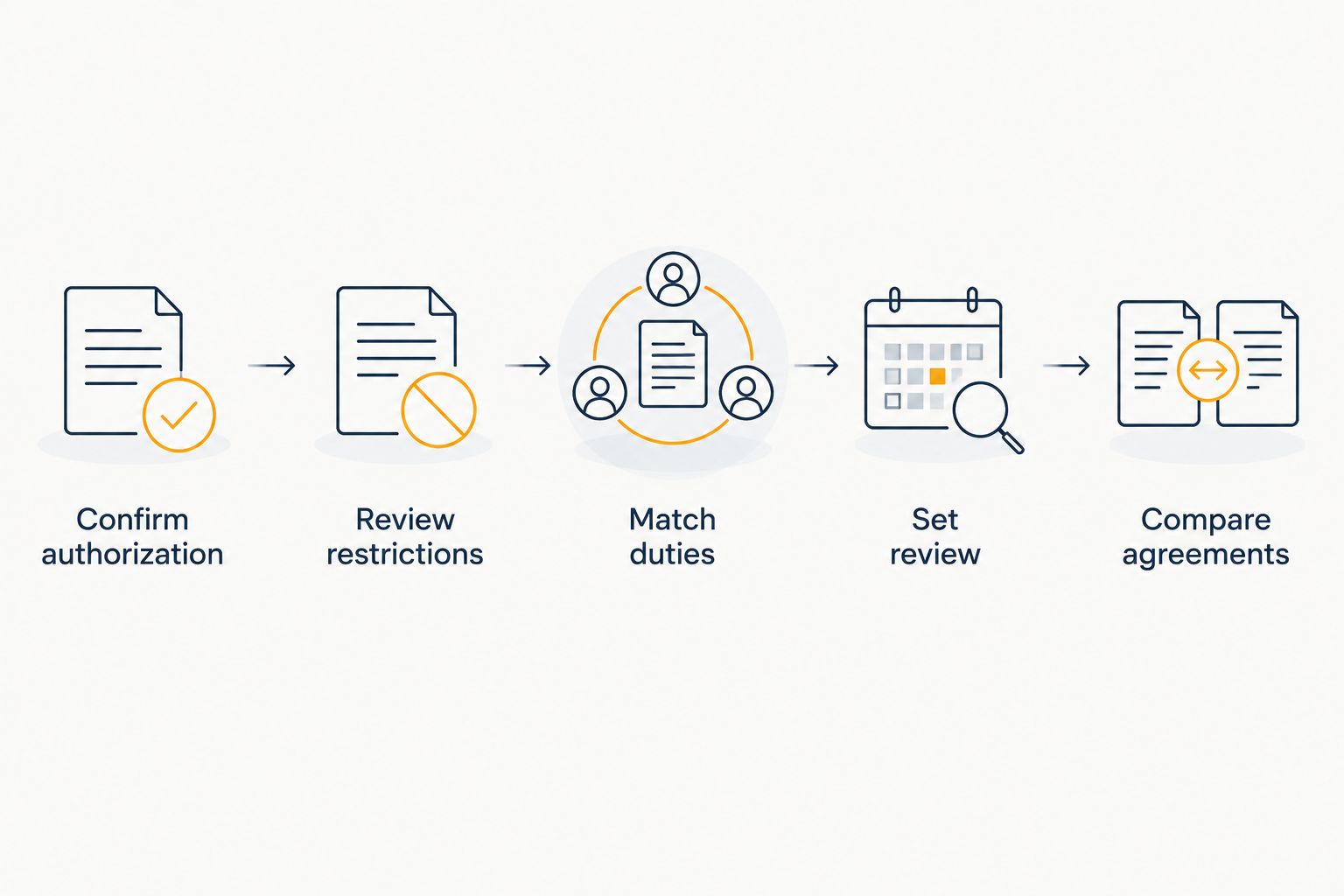
Follow this sequence before treating the trial as a route to permanent work:
- Confirm authorization: Identify the proposed employer, approved role, and hiring authority.
- Review restrictions: Have qualified counsel examine agency provisions, notice requirements, and other terms affecting the move.
- Match duties: Compare trial work with permanent sites, shifts, modalities, procedures, and call.
- Set review: Establish the assessment criteria and hiring decision date.
- Compare agreements: Reconcile the proposed permanent contract with what you observed and discussed.
Keep a record of substantive answers and who provided them. If a recruiter, department leader, and contract describe different arrangements, resolve the differences before signing. Do not choose whichever version sounds most favorable.
Find radiology roles to investigate
Search 5,000+ radiology positions aggregated from 20 sources, then confirm conversion terms with the employer.
How these employer paths are ranked
This ranking prioritizes a defined employment destination, representative trial duties, identifiable hiring authority, and written conversion terms. Hospital employment leads for a reader seeking direct employment; private practice leads when ownership is the central goal.
Employer size and name recognition are not substitutes for those criteria. A documented pathway at a smaller practice deserves priority over an informal promise at a familiar institution.
Which employer path should you choose?
Choose the employer that can connect an authorized permanent role to a representative trial and a written decision process. For an undecided radiologist, start with a hospital-employed department that meets those conditions, then compare alternatives against your ownership, outpatient, academic, or remote-work goals.
For your 2026 shortlist, use RadBoard for radiology job discovery and direct employer conversations for conversion verification. Keep an attractive temporary assignment separate from a credible permanent opportunity until the documents connect them.
FAQ
What's the best radiology employer for locum-to-permanent conversion?
The strongest choice is an employer with an authorized permanent role, written conversion permission, and trial duties that match the permanent job. Choose the employer category around your employment, ownership, academic, or remote-work goal.
Does a locum assignment guarantee a permanent radiology offer?
No, a locum assignment does not guarantee a permanent offer. Confirm the hiring authority, assessment criteria, and decision date separately from the temporary coverage agreement.
Is a private practice better than a hospital for locum-to-permanent work?
Private practice is the better path to investigate when ownership is your goal; hospital employment fits a direct employment goal. Neither category establishes conversion permission or hiring approval without specific documentation.
Can a staffing-agency agreement affect permanent hiring?
Yes, the assignment agreement can contain provisions affecting a move to permanent work. Have qualified counsel review the applicable agreements and obtain written confirmation of how any restrictions will be resolved.
Will locum service count toward a radiology partnership track?
Treat locum service as partnership credit only when the practice documents that treatment. Ask who approves eligibility and whether the permanent agreement preserves the commitment.
What should I ask before accepting a trial assignment?
Ask who will employ you permanently, who can approve the hire, and whether the permanent role is authorized. Then compare duties, review conversion restrictions, and establish a decision date.
Can RadBoard confirm that an employer will convert me to permanent employment?
Confirm conversion terms directly with the employer and any staffing agency involved. RadBoard aggregates radiology positions for discovery; the employer's authorization and the relevant agreements determine the proposed pathway.
One last thing
Ask what happens if the trial succeeds clinically but permanent hiring is declined. Request the assignment end date, notice obligations, and any proposed extension terms before you start. A useful trial needs a clear exit as well as a possible offer.