
Best overall: an employer with a written, dedicated AI education benefit and protected learning time. Best for clinical upskilling: an employer whose CME policy explicitly covers AI courses. Best for implementation work: an employer that funds role-specific training. Use RadBoard to search radiology positions, then compare the actual benefit terms—not the employer’s technology claims.
- Compare radiology employers offering AI training stipends by written eligibility, protected time, and approval requirements.
- Dedicated AI education funding is the best overall benefit structure when paired with protected learning time.
- RadBoard aggregates 5,000+ radiology positions from 20 sources; confirm training benefits directly with each employer.
- CME allowances and vendor onboarding are not interchangeable with a dedicated AI training stipend.
Why this matters
An employer’s use of AI does not establish that the employer pays for your education. A reading workflow, a software demonstration, a continuing medical education allowance, and a dedicated training benefit answer different questions.
For your 2026 job search, separate access to technology from support for learning it. The useful benefit gives you a defined route to an approved course, permission to attend, and a clear reimbursement process. A recruiting phrase such as professional development does not establish those terms.
RadBoard’s radiology job search platform aggregates 5,000+ positions from 20 sources. That breadth supports finding opportunities; the employer’s written policy establishes whether a particular opportunity includes training support. Use aggregation to build your shortlist and documentation to rank it.
What makes the best AI training benefit
Rank the benefit arrangement attached to your offer, rather than assuming that an academic center, hospital system, or private practice guarantees funding. These criteria distinguish usable support from a benefit that exists only in recruitment language:
- Explicit eligibility: The policy names AI education or confirms that your proposed course qualifies. General CME language requires course-specific confirmation.
- Protected learning time: Attendance fits the clinical schedule without an undefined obligation to make up every missed reading session.
- Relevant curriculum: Training addresses your goal: clinical interpretation, workflow evaluation, implementation, or informatics leadership.
- Approval clarity: You know who authorizes enrollment, what documentation is required, and whether approval happens before registration.
- Benefit independence: You know whether AI education has separate funding or competes with conferences and other professional development.
- Departure terms: Any repayment obligation, eligibility cutoff, or cancellation condition is disclosed before acceptance.
In 2026, your strongest offer is the one that satisfies your learning goal in writing. An employer’s reputation is not a substitute for those criteria.
AI training benefit arrangements at a glance
This ranking compares benefit structures to request and verify. It does not assign an unconfirmed stipend to a named employer. Each arrangement serves a different career goal.
| Rank and arrangement | Best for | Standout feature to verify | Key limitation |
|---|---|---|---|
| Dedicated AI education benefit | Structured development alongside clinical work | Separate funding plus protected learning time | A dedicated benefit still needs course eligibility and approval rules |
| CME allowance and conference stipend with explicit AI eligibility | Clinical radiologists adding focused AI education | Permission to select relevant external education | AI training shares the same allowance with other education |
| Role-specific implementation training | Radiologists taking responsibility for workflow deployment | Training tied to a defined clinical or operational assignment | Employer-specific instruction does not replace broader education |
| Project-linked education support | Radiologists pursuing informatics or research development | Education attached to a documented project and supervisor | Support depends on project scope and continuation |
1. Dedicated AI education benefit: best for structured development
A dedicated AI education benefit separates this training from your general professional development allowance. To rank first, the arrangement also needs usable learning time and written permission for the education you intend to pursue. A benefit label alone is insufficient.
Best for: Clinical radiologists who want a defined learning plan without diverting their entire CME allowance to AI education.
Dedicated AI education benefit pros
- Separates AI education from other professional development when the policy establishes independent funding.
- Supports a planned curriculum rather than relying exclusively on software onboarding.
- Makes approval, attendance, and reimbursement easier to compare when each is documented.
Dedicated AI education benefit cons
- Restrictive course eligibility limits your choice of curriculum.
- Funding without schedule protection leaves you responsible for finding study time.
- Renewal conditions require checking before you plan continuing education beyond the initial course.
Ask the employer whether the benefit covers external education, internal instruction, or both. Then identify the approving person and the process for selecting a course. Request confirmation for the actual curriculum you want—not just a general statement that education is supported.
For a 2026 offer, verify when eligibility begins and how the benefit interacts with clinical duties. If attendance requires coverage, identify who arranges that coverage. The practical question is whether you can complete the training under the proposed schedule.
Verdict: Hold until the employer documents eligible education, protected time, and approval terms; then prioritize this arrangement.
2. CME with explicit AI eligibility: best for clinical upskilling
A general CME allowance becomes relevant to AI training when the employer confirms that the proposed education qualifies. This arrangement suits a focused course or conference-based learning plan rather than a separate development track. It does not establish a dedicated AI stipend.
Best for: Practicing radiologists seeking targeted education related to their clinical work.
CME with explicit AI eligibility pros
- Gives you a route to external education when the chosen course is approved.
- Keeps AI learning within an existing professional development process.
- Supports course selection based on your subspecialty and immediate learning goals.
CME with explicit AI eligibility cons
- AI education competes with other uses of the same allowance.
- A course’s relevance to radiology does not establish employer reimbursement eligibility.
- Education funding does not automatically include paid attendance time.
Check educational accreditation separately from employer approval. An employer’s reimbursement decision and a course’s CME status are different determinations; neither establishes the other. If credit matters to your learning plan, review the course’s published accreditation statement.
Specify what you want to learn. Clinical AI education can address interpretation of performance evidence, recognition of failure modes, and evaluation of how a tool fits a reading workflow. Those goals differ from learning to operate a particular interface.
Before accepting a 2026 offer, ask whether attendance uses dedicated education leave or ordinary vacation. Also ask whether other professional development commitments draw from the same allowance. Choose this arrangement for focused clinical education, not as a substitute for an undefined long-term training program.
Verdict: Hold until the specific course and attendance arrangements receive written approval.
3. Role-specific implementation training: best for workflow responsibility
Role-specific training connects education to a defined assignment, such as evaluating a tool or supporting its introduction into clinical workflow. Its value depends on the responsibilities you will actually hold. Do not count a product demonstration as a complete education benefit.
Best for: Radiologists accepting responsibility for workflow evaluation, implementation, or ongoing oversight.
Role-specific implementation training pros
- Connects instruction to a concrete task within your job.
- Gives you a reason to clarify escalation procedures and clinical responsibilities.
- Supports applied learning when training includes supervised practice and feedback.
Role-specific implementation training cons
- Instruction focused on one system does not provide broad education across AI methods.
- Implementation duties add work unless the job description allocates time for them.
- Completion of onboarding does not establish readiness for every clinical use case.
Ask who provides the instruction and what successful completion means. Request the curriculum, the expected responsibilities afterward, and the route for raising concerns. Keep training expectations separate from assurances that a system is easy to use.
Your learning plan should address the intended workflow, known limitations, and handling of disagreement between tool output and your assessment. If you will evaluate performance, clarify access to the information needed for that responsibility. Do not accept an oversight title without a defined scope.
For a 2026 implementation role, document whether education occurs during onboarding or alongside a full clinical workload. Identify who owns operational decisions and who handles technical support. Training should prepare you for assigned duties, not quietly expand them.
Verdict: Skip arrangements that add implementation responsibility without documented training and allocated work time.
4. Project-linked education support: best for informatics development
Project-linked support attaches learning to a specific research, quality improvement, or informatics assignment. Assess it as part of the project’s work plan rather than as a general employee benefit. The relevant question is whether the education remains useful and accessible under the stated project conditions.
Best for: Radiologists pursuing a defined informatics or research objective with an identified supervisor.
Project-linked education support pros
- Connects coursework to a stated project objective.
- Creates a basis for requesting mentorship and feedback.
- Makes educational deliverables explicit when included in the work plan.
Project-linked education support cons
- Training eligibility is tied to the project rather than automatically extending to other interests.
- Changes to project scope require reassessing the learning plan.
- Additional project duties need separate schedule allocation.
Ask which education the project supports, who supervises your work, and what happens if the assignment changes. Clarify whether course completion is an expected deliverable and whether study time is included in your responsibilities. Avoid treating informal interest from a department leader as an approved benefit.
Distinguish clinical AI literacy from technical development. A project involving model evaluation, data handling, or research methods needs a curriculum matched to that work. A general introductory course is not interchangeable with task-specific preparation.
Verdict: Hold until the project scope, supervisor, education approval, and protected time are documented together.
How to verify an employer’s training offer
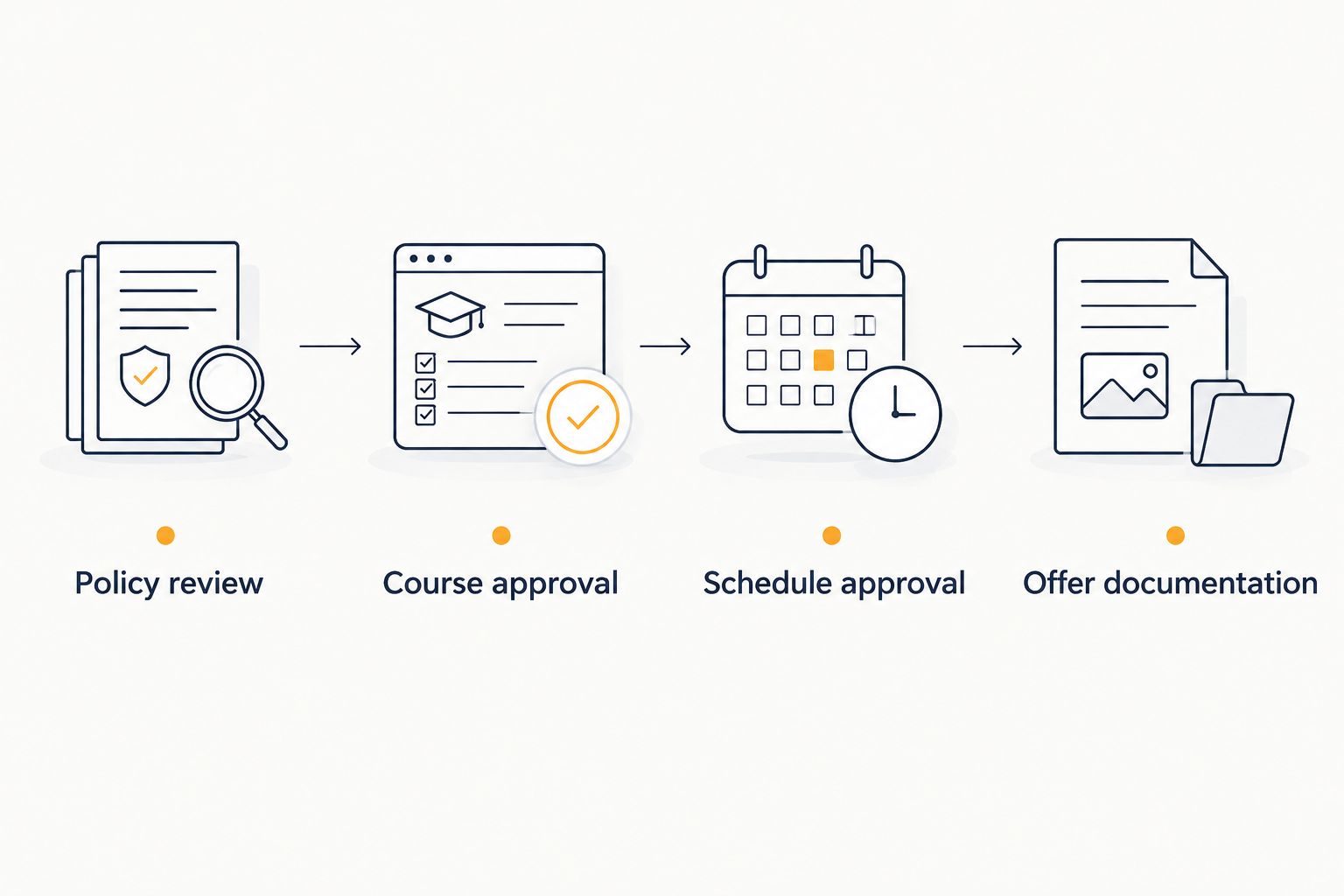
Use the same sequence for every employer on your shortlist. Consistency makes differences visible and prevents a persuasive interview from replacing a usable policy.
Policy review
Request the current education policy. Identify whether AI training is a dedicated benefit, an approved CME use, onboarding, or project support. Record the arrangement accurately rather than grouping everything under stipend.
Course approval
Send the proposed curriculum to the person authorized to approve it. Confirm eligibility before committing to enrollment. Ask what completion evidence or other documentation the employer requires.
Schedule approval
Ask the clinical leader how attendance and study fit the proposed workload. Confirm whether coverage, education leave, or another schedule adjustment is required. Funding approval and schedule approval solve different problems.
Offer documentation
Keep 3 documents together: the benefit policy, the course approval, and the schedule confirmation. Ask the employer to identify how those documents apply to your offer and resolve inconsistencies before you sign.
RadBoard supports radiology job discovery through AI-powered search and swipe-to-save features. Use search phrases that describe the benefit you want, then verify each saved opportunity through the sequence above. Search terminology is a starting point, not evidence of eligibility.
Find radiology positions to compare
Search 5,000+ radiology positions aggregated from 20 sources, then verify education terms with employers.
How the arrangements are ranked
The ranking prioritizes explicit eligibility, protected time, relevant curriculum, approval clarity, benefit independence, and disclosed conditions. Dedicated support ranks first because it separates the learning objective from general CME use—provided the written terms satisfy those criteria.
The remaining arrangements have distinct purposes. CME supports focused clinical education; implementation training prepares you for assigned workflow duties; project-linked support serves a defined informatics or research goal. None earns a recommendation solely because an employer uses AI.
Which employer should you choose?
Choose the employer that documents the education you want and the time to complete it. For an undecided reader, dedicated AI education support paired with protected learning time is the default arrangement to prioritize.
Keep the rest of the offer in view. Training support does not replace an acceptable clinical schedule, clearly defined responsibilities, or suitable employment terms. If AI education is central to your 2026 career plan, make its approval part of offer evaluation rather than a conversation deferred until onboarding.
RadBoard is best for radiologists who want to search aggregated radiology positions and save opportunities for benefit verification. The final employer decision belongs to the written offer, not the search result.
FAQ
What's the best way to compare radiology employers offering AI training stipends?
Compare written course eligibility, protected learning time, approval requirements, and benefit conditions. Prioritize an arrangement that supports your specific learning goal rather than an employer's general AI claims.
Does an employer using AI mean it offers a training stipend?
No. Access to an AI tool, product onboarding, and financial support for external education are separate arrangements that require separate confirmation.
Is a CME allowance the same as an AI training stipend?
No. A CME allowance supports AI education only when the employer approves that use, and it shares the allowance with other eligible education unless the policy states otherwise.
Which benefit structure is best for a practicing radiologist?
Dedicated AI education support with protected learning time is the strongest default structure. An explicitly approved CME course is a more focused option for a specific clinical learning goal.
What should I ask about paid time for AI training?
Ask how course attendance and study fit your clinical schedule. Confirm whether the arrangement includes education leave, coverage, or other schedule adjustments rather than assuming funding includes time.
Can vendor onboarding replace broader AI education?
Vendor onboarding does not replace broader AI education. It addresses a particular system, while broader learning addresses topics such as performance evaluation, limitations, and clinical workflow.
What should I get in writing before accepting a 2026 offer?
Get the applicable benefit policy, approval for your proposed education, and confirmation of the attendance schedule. Clarify eligibility conditions and any repayment obligation before relying on the benefit.
One last thing
Ask the course question before the stipend question: Is the education you want actually eligible? That answer exposes the difference between a named benefit and support you can use. Bring a curriculum to the offer discussion; a specific request produces a decision you can document.