
Best overall: an employer with an approved role and a scheduled written-offer decision. Best for temporary coverage: a site with a defined assignment and named approver. For radiology employers ranked by time to offer in 2026, rank the specific opening by documented hiring readiness—not the employer’s name or a recruiter’s response speed.
- For radiology employers ranked by time to offer, prioritize approved positions with scheduled written-offer decisions.
- RadBoard aggregates 5,000+ radiology positions from 20 sources for comparing radiology jobs.
- A recruiter response, verbal offer, written offer, and clinical start are different milestones.
- Compare employer hiring timelines using the same starting event and offer definition.
Why this matters
A quick recruiter reply does not tell you when an employer will issue a contract. An interview invitation does not establish that the position has budget approval. Measure the path to a written offer separately from the path to your first clinical shift.
RadBoard is a radiology job search platform aggregating 5,000+ positions from 20 sources. RadBoard is best for radiologists comparing career opportunities across multiple sources. Use that breadth to build a shortlist, then ask each employer for its actual decision process.
This 2026 guide ranks hiring-process profiles, not named employers by an asserted average. The order is a screening priority: which opening gives you the clearest route to an offer? A hospital, private practice, academic department, or teleradiology employer can qualify for the first position if its process meets the criteria.
What makes the best employer for offer speed
Use these criteria before treating an opening as a fast-moving opportunity:
- Approved position: Confirm that the role and employment terms are authorized, rather than awaiting a budget decision.
- Decision owner: Identify who can approve the hire and who signs the offer.
- Defined interviews: Ask which interviews remain and whether their dates are scheduled.
- Written-offer milestone: Establish when you will receive written terms, not just verbal interest.
- Document readiness: Ask which candidate documents are required before an offer can be issued.
- Separate start-date plan: Identify licensing, credentialing, privileges, and onboarding requirements independently of the hiring decision.
Apply the criteria to the exact role, location, subspecialty, and employment arrangement. A company-wide recruiting claim is not a substitute for an opening-specific answer. Ask the recruiter to distinguish completed steps from intended steps.
Hiring-process profiles at a glance
The ranking below prioritizes offer readiness. It does not assign measured turnaround times or claim that one employer category always hires faster than another.
| Rank and employer profile | Best for | Standout hiring feature | Key limitation |
|---|---|---|---|
| 1. Approved permanent role | A permanent move with a defined decision | Position approval and offer-decision date are established | Written terms still need review |
| 2. Defined temporary assignment | Short-term coverage between roles | Assignment scope and approver are identified | Assignment approval is not clinical clearance |
| 3. Defined remote role | A location-independent job search | Reading scope, schedule, and decision process are specified | Licensing and technical setup remain separate |
| 4. Practice role with documented ownership terms | A partnership-focused career move | Employment and ownership discussions are distinguished | Additional ownership review can remain |
| 5. Institutional role with mapped approvals | A teaching, research, or hospital-based career | Remaining approval steps have named owners | Unscheduled approvals leave the offer date uncertain |
1. Approved permanent role: best for a defined permanent move
An approved permanent role is the first opening to investigate when your priority is a written employment offer. The defining feature is not private-practice or hospital ownership; it is a position with confirmed authorization, a decision owner, and a scheduled offer decision.
Ask whether the employer has approved the role’s employment arrangement and whether any committee or executive approval remains. Then ask what happens after the final interview. A scheduled interview without a scheduled decision leaves your timeline unfinished.
Approved permanent role pros:
- Position approval is established before you invest further interview time.
- A named decision owner gives you a clear follow-up contact.
- A scheduled decision creates a concrete milestone for comparing openings.
Approved permanent role cons:
- An approved opening does not guarantee that you will receive an offer.
- Initial written terms can still require negotiation or legal review.
Best for: Radiologists making a permanent move who want a clearly defined hiring decision.
Verdict: Hold the top shortlist position for an approved permanent role with a scheduled written-offer decision. Do not treat a verbal expression of interest as the same result.
2. Defined temporary assignment: best for coverage between roles
A defined temporary assignment specifies the clinical scope, site, schedule, contracting parties, and person authorized to approve the assignment. Evaluate that assignment on its own terms rather than assuming that every locum opportunity follows the same hiring timeline.
Ask what the employer means by approval. Selection by the clinical team, execution of an assignment agreement, and authorization to begin work are separate events. If an agency is involved, identify which decisions belong to the agency and which belong to the facility.
Defined temporary assignment pros:
- A specified assignment lets you assess fit without inferring the coverage need.
- Named contracting parties clarify who must act before written terms arrive.
- Defined dates let you compare the assignment with your existing commitments.
Defined temporary assignment cons:
- Assignment approval does not establish that credentialing is complete.
- Temporary coverage does not itself establish a permanent employment pathway.
Best for: Radiologists seeking coverage work between permanent positions or other commitments.
Verdict: Hold a defined temporary assignment on the shortlist when its agreement and clinical-clearance milestones are separate and explicit. Skip a deadline-driven assignment if the parties cannot explain who approves it.
3. Defined remote role: best for a location-independent search
A defined remote role states the reading scope, scheduled hours, employment arrangement, and hiring decision process. Remote work describes where you practice; it does not establish how quickly an employer issues an offer.
Before comparing timelines, ask which licenses the role requires and which must be active before an offer versus before clinical work. Also establish whether workstation arrangements, access provisioning, or other technical requirements are unresolved. Keep those questions distinct from the employer’s selection decision.
Defined remote role pros:
- A stated reading scope makes subspecialty fit easier to assess.
- Defined hours let you evaluate the role against your preferred schedule.
- An explicit decision process separates recruiting from technical onboarding.
Defined remote role cons:
- A written offer does not confirm readiness to read for every covered site.
- Undefined equipment or access responsibilities leave practical questions unresolved.
Best for: Radiologists prioritizing remote work who need a clear distinction between hiring and operational readiness.
Verdict: Hold a defined remote role when both the offer decision and onboarding responsibilities are documented. Skip the assumption that remote automatically means faster.
4. Practice role with documented ownership terms: best for partnership planning
A practice role with documented ownership terms distinguishes the initial employment offer from any future ownership decision. That distinction matters when you want partnership but also need to know when an actionable employment offer will arrive.
Ask who approves employment and who approves ownership participation. Establish whether the initial contract contains the relevant pathway or whether a separate agreement governs it. Evaluate the employment decision without treating an informal partnership discussion as an enforceable commitment.
Practice role with documented ownership terms pros:
- Separate employment and ownership milestones make the decision process clearer.
- Written terms give you a basis for professional contract review.
- Named approvers identify which questions belong to practice leadership.
Practice role with documented ownership terms cons:
- An employment offer does not establish admission to ownership.
- Unresolved ownership terms limit what you can conclude from offer speed alone.
Best for: Radiologists evaluating a long-term practice relationship with an ownership objective.
Verdict: Hold a practice role with documented ownership terms when the employment decision has its own timeline. Skip treating a fast offer as proof of a sound partnership pathway.
5. Institutional role with mapped approvals: best for mission-specific careers
An institutional role with mapped approvals identifies the clinical, employment, and appointment decisions relevant to that particular position. For a teaching, research, or hospital-based role, ask which approvals apply rather than assuming every department uses the same sequence.
Request the remaining steps and their owners. If an appointment is part of the position, establish whether it is required before the written employment offer or handled separately. In your 2026 comparison, distinguish a dated approval meeting from an unspecified future review.
Institutional role with mapped approvals pros:
- Named approval owners make the remaining process understandable.
- Separate appointment and employment milestones clarify the offer’s conditions.
- Defined clinical and nonclinical duties support a role-specific comparison.
Institutional role with mapped approvals cons:
- An interview schedule alone does not establish an offer-decision date.
- Any required but unscheduled approval leaves the timeline unresolved.
Best for: Radiologists whose teaching, research, or institutional goals matter alongside hiring speed.
Verdict: Hold an institutional role with mapped approvals when it fits your career goals and decision deadline. Skip rejecting an employer solely because of its institutional category.
How to compare actual time to offer
For your 2026 search, use the same measurement rules across every opening. Record 3 dates: application submission, written-offer receipt, and confirmed clinical start. Those dates separate recruiting duration from the later steps needed to begin work.
Use calendar days for your own elapsed-time comparison. Define 1 calendar day as the change from one date to the next; do not mix that measure with business-day estimates supplied by recruiters. If you also track the first completed interview, label that interval separately.
Follow this sequence:
- Define the start: Use application submission consistently for your application-to-offer comparison.
- Confirm approvals: Record whether the role is approved and which decisions remain.
- Schedule interviews: Write down the required interviews and their dates.
- Obtain written terms: Record receipt of the actual written offer, including stated conditions.
- Confirm clinical start: Track the authorized start separately from the hiring decision.
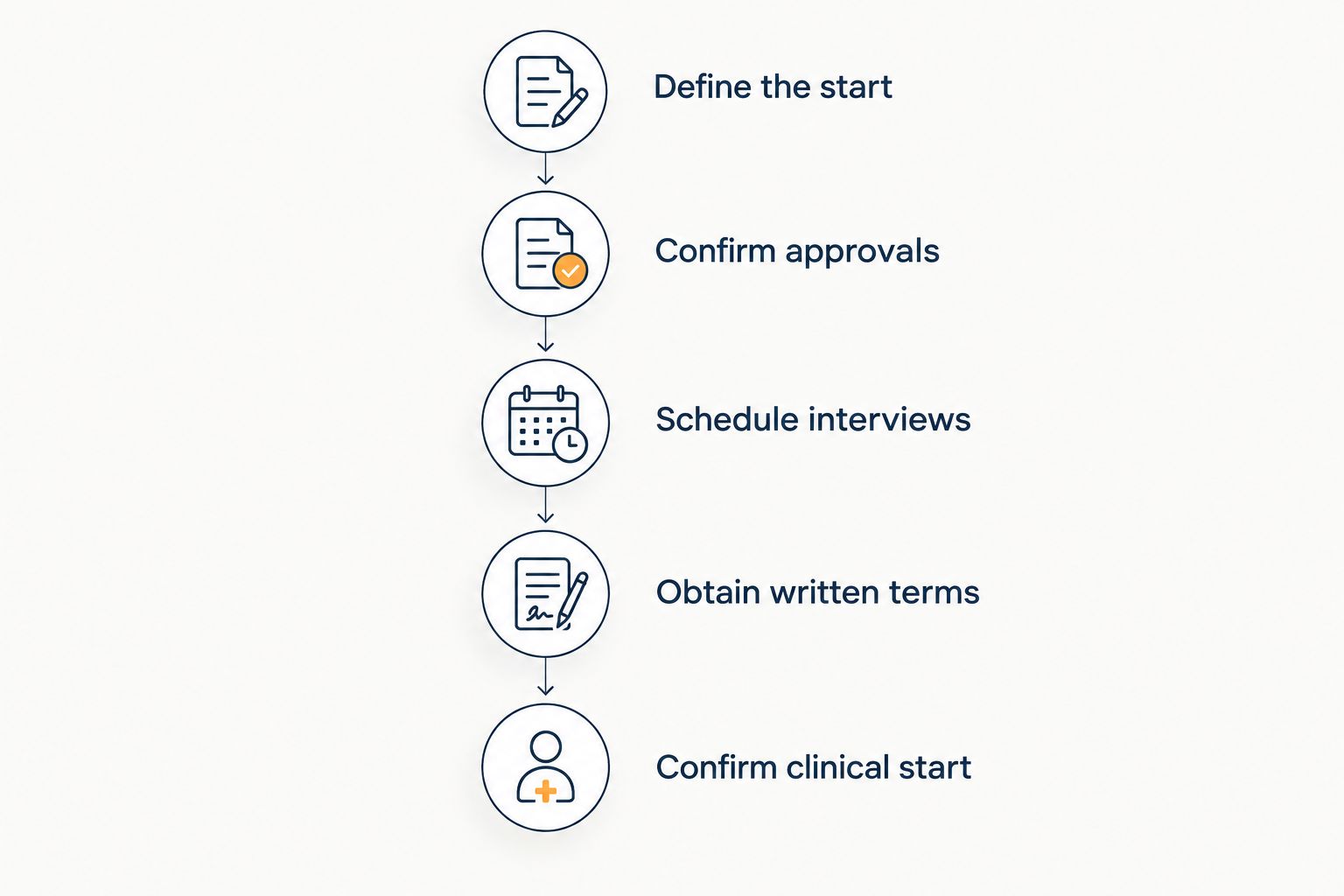
Ask each recruiter for the planned decision date, remaining approvers, and prerequisites for issuing written terms. Then record what actually happens. Compare dated events with dated events, not promises with completed offers.
How the ranking works
The ranking prioritizes an approved role, a named decision owner, scheduled interviews, and a defined written-offer milestone. Lower positions introduce a different decision need: temporary coverage, remote readiness, ownership terms, or institutional approvals. They are not claims of slower measured performance.
RadBoard’s radiology job search platform supports discovery across multiple sources; its 5,000+ positions and 20 sources are search-scope figures, not employer hiring-speed benchmarks. Job aggregation and employer selection are different functions. Use the platform to find alternatives, then verify timelines directly with the hiring parties.
Which employer should you choose?
Choose the approved, suitable role with the clearest written-offer decision—not simply the first employer to call. If two openings fit your clinical goals, prioritize the one that identifies its remaining steps and commits to a decision date.
For your 2026 shortlist, assess speed alongside reading scope, call expectations, employment terms, and the requirements for starting work. A quick offer is useful only if the position fits. Keep other suitable applications active until you have evaluated written terms and their conditions.
Compare radiology openings
Search 5,000+ radiology positions aggregated from 20 sources.
FAQ
Which radiology employer gives offers the fastest?
Prioritize the specific opening with an approved position, a named decision owner, and a scheduled written-offer decision. Employer size or ownership category alone does not establish time to offer.
Are locum radiology offers faster than permanent offers?
Do not assume a locum offer is faster solely because it is temporary. Compare the assignment agreement and permanent employment offer using the same starting event, and track clinical clearance separately.
Do teleradiology employers hire faster than hospitals?
Remote work does not establish a faster hiring timeline. Ask each employer for its remaining interviews, approvals, and written-offer decision date.
When should I start measuring time to offer?
Use application submission as the starting event for an application-to-offer comparison. If you measure from the first interview instead, label that interval separately and apply it consistently.
Does a verbal radiology offer count as an offer?
A verbal offer is a separate milestone from a written offer. For this comparison, record the date you receive written terms and review any stated conditions.
Can I start practicing as soon as I receive an offer?
An offer alone does not establish authorization to begin clinical work. Confirm the licensing, credentialing, privileges, and onboarding requirements that apply to the position.
How does RadBoard help me compare radiology employers?
RadBoard aggregates 5,000+ radiology positions from 20 sources to help radiologists find career opportunities. Use those listings to build a shortlist, then obtain hiring timelines directly from each employer.
One last thing
Ask who is authorized to issue your written offer. The person arranging your interviews is not necessarily the person approving your employment. Identifying the actual decision owner gives your next follow-up a specific purpose: confirm the remaining decision, its owner, and its scheduled date.