
Best overall starting point: hospital-employed diagnostic radiology. Best for predictable hours: daytime outpatient imaging. Best for ownership goals: partnership-track private practice. For your 2026 Southeast search, compare these job types by written compensation terms, actual schedules, and confirmed vacancies—not by an unsupported state salary ranking.
- Best radiology jobs southeast: start with hospital-employed diagnostic roles, then narrow by schedule, subspecialty, and ownership goals.
- RadBoard aggregates 5,000+ radiology positions from 20 sources; those figures cover the platform, not Southeast openings.
- Daytime outpatient imaging is the strongest starting point when avoiding overnight hospital coverage is your priority.
- Compare guaranteed compensation, required hours, call, and employer-confirmed vacancies before ranking offers.
Why this matters
A Southeast radiology search involves separate decisions: where you want to live, what work you want to do, and which employment terms you will accept. A higher headline salary does not settle all of them. Call obligations, productivity thresholds, and time away from clinical work belong beside compensation in your comparison.
RadBoard brings together 5,000+ radiology positions from 20 sources across its platform. Use that breadth to identify employers, then confirm the location, clinical duties, and vacancy directly with each practice. A listing is a lead, not a signed employment agreement.
RadBoard is best for radiologists who want to search positions aggregated from multiple sources. Its radiology job search platform supports discovery; your final ranking should rest on employer-confirmed terms.
For this 2026 guide, the ranking below organizes job types by career objective. It is not a measured leaderboard of Southeast salaries or opening counts.
What makes the best Southeast radiology job?
Use these criteria before comparing employers:
- Guaranteed compensation: Separate contractual base pay from conditional productivity payments, discretionary bonuses, and partnership projections.
- Workload: Ask for scheduled reading hours, modality mix, interruptions, procedures, and productivity expectations.
- Call burden: Establish nights, weekends, holidays, backup coverage, and whether call creates additional daytime obligations.
- Clinical fit: Match the actual reading mix to your training, credentialing, and preferred subspecialty work.
- Employment structure: Identify the legal employer, employee or contractor status, ownership arrangement, and termination terms.
- Vacancy quality: Confirm the hiring site, reporting relationship, intended start date, and whether multiple advertisements describe the same position.
Make your initial geographic list explicit. For example, compare Florida, Georgia, North Carolina, South Carolina, Tennessee, Alabama, and Mississippi separately rather than treating the Southeast as one employment market. Add other states according to your relocation boundaries.
Southeast radiology jobs at a glance
The order below gives an undecided attending a starting point, followed by distinct alternatives. Compensation must come from each employer's written offer; no job type automatically wins on pay.
| Rank and job type | Best for | Standout feature to seek | Key limitation to check |
|---|---|---|---|
| 1. Hospital-employed diagnostic radiology | A permanent employed position | Defined duties and employment terms | Call, site coverage, and productivity obligations |
| 2. Daytime outpatient imaging | Protecting evenings and weekends | A written daytime-only schedule | Procedure duties and cross-coverage exceptions |
| 3. Partnership-track private practice | An ownership objective | Documented ownership eligibility | Admission conditions and financial obligations |
| 4. Teleradiology | Separating residence from reading location | Contract-defined remote work | Licensing, shifts, and remote-work restrictions |
| 5. Locum tenens radiology | A time-limited commitment | A defined assignment and scope | Cancellation, travel, and unpaid administrative work |
| 6. Academic radiology | Teaching and research | Protected academic responsibilities | Clinical workload competing with academic time |
1. Hospital employment: best for a permanent employed role
Hospital-employed diagnostic radiology is the default starting point if you want a permanent position without making ownership your central objective. Evaluate the specific department and contract, not the health system's name alone.
Ask whether the hospital directly employs radiologists or contracts with a separate radiology group. Working inside a hospital does not establish who your employer is.
Hospital employment pros:
- Lets you evaluate a defined employed position rather than a future ownership promise.
- Provides a clear framework for discussing clinical duties and departmental reporting.
- Allows direct comparison of documented compensation and benefits.
Hospital employment cons:
- Multi-site coverage complicates commuting and scheduling.
- Clinical expectations need separate review from the base compensation figure.
- Hospital work does not inherently mean predictable daytime hours.
For pay comparisons, request the compensation guarantee's duration and what replaces it afterward. For openings, ask which facility needs coverage and whether the position replaces a departure or adds staffing.
Best for: Radiologists prioritizing a permanent employed role.
Verdict: Hold until the employer documents call, site coverage, and post-guarantee compensation.
2. Daytime outpatient imaging: best for schedule protection
Daytime outpatient imaging is the strongest starting category when your priority is avoiding overnight hospital coverage. The useful distinction is contractual: an outpatient location alone does not prove a no-call schedule.
Clarify whether the job includes diagnostic interpretation, contrast supervision, procedures, patient consultations, or coverage at additional facilities. Ask who handles unfinished studies when the scheduled workday ends.
Daytime outpatient imaging pros:
- Gives schedule-focused applicants a specific employment model to investigate.
- Supports a focused discussion about modalities and procedure responsibilities.
- Makes evening, weekend, and holiday exclusions explicit negotiation points.
Daytime outpatient imaging cons:
- Cross-coverage provisions undermine a daytime-only expectation if left undefined.
- Procedure and supervision responsibilities affect the usable reading day.
- A narrow case mix must still fit your long-term clinical goals.
When comparing 2026 offers, request the actual weekly schedule rather than accepting a lifestyle description. Confirm vacation coverage and whether staffing gaps change your duties.
Best for: Radiologists who put predictable working hours ahead of ownership or academic responsibilities.
Verdict: Hold until daytime hours and coverage exceptions appear in writing.
3. Partnership-track practice: best for an ownership objective
Partnership-track private practice deserves a separate search if ownership is your goal. An employed position with a possible future discussion is not equivalent to a documented partnership pathway.
Request the eligibility requirements, admission process, ownership rights, financial obligations, and consequences if admission does not occur. Separate employed compensation from any future owner distributions.
Partnership-track practice pros:
- Aligns the search with a stated ownership objective.
- Creates a basis for examining governance and decision-making rights.
- Encourages comparison of long-term terms beyond initial employment compensation.
Partnership-track practice cons:
- Eligibility does not guarantee admission.
- Ownership obligations require financial and legal review.
- Future distributions should not substitute for guaranteed compensation in your comparison.
Ask current associates how the written process operates. Then compare their explanation with the agreement and speak with physician contract counsel about unresolved differences.
For a Southeast relocation, also establish whether your expected work sites change after partnership. Ownership terms and daily working conditions require separate scrutiny.
Best for: Radiologists actively seeking practice ownership.
Verdict: Hold until the ownership pathway and financial obligations are documented.
4. Teleradiology: best for location flexibility
Teleradiology is the relevant category when you want to live in the Southeast without limiting your search to nearby reading rooms. Remote work changes the location of interpretation, not the need to verify licensing, credentialing, and contractual duties.
Distinguish daytime remote work from evening or overnight coverage. A remote position and a flexible schedule are different contract features.
Teleradiology pros:
- Separates your home location from an onsite reading assignment.
- Lets you search specifically for remote interpretation work.
- Makes equipment, technical support, and remote-work rules explicit comparison points.
Teleradiology cons:
- Remote status does not guarantee control over shifts.
- Licensing and facility credentialing still require verification.
- Productivity terms need review alongside case mix and interruptions.
Ask where you are permitted to work, which patient locations you will cover, and who manages the required approvals. Confirm workstation responsibilities and downtime procedures before evaluating the compensation arrangement.
Best for: Radiologists whose main objective is working remotely from their chosen residence.
Verdict: Hold until remote-work permission, shift requirements, and licensing responsibilities are clear.
5. Locum tenens: best for a time-limited commitment
Locum tenens radiology fits a search centered on a defined assignment rather than permanent employment. It also deserves consideration when you want experience at a location before making a longer commitment, provided the arrangement permits that transition.
Compare the complete assignment terms. A quoted clinical rate does not answer questions about canceled shifts, travel time, credentialing work, or coverage responsibilities.
Locum tenens pros:
- Provides a contract structure for a defined assignment.
- Lets you evaluate a particular facility and clinical scope.
- Keeps assignment dates central to the decision.
Locum tenens cons:
- Cancellation terms affect the reliability of expected work.
- Travel and administrative responsibilities need explicit allocation.
- A temporary assignment does not establish a permanent vacancy.
Before accepting, request the guaranteed work commitment, cancellation provisions, malpractice arrangement, and exact duties. Check whether any conversion restrictions apply if you later consider permanent employment.
Best for: Radiologists prioritizing a limited-duration commitment.
Verdict: Hold until guaranteed work and cancellation terms are acceptable.
6. Academic radiology: best for teaching and research
Academic radiology belongs on your shortlist when teaching, research, or an academic promotion pathway is a central career goal. The institution's name does not establish how much time your appointment actually protects for those activities.
Request the clinical assignment, teaching expectations, research support, promotion criteria, and allocation of nonclinical time. Ask how departmental staffing needs affect that allocation.
Academic radiology pros:
- Aligns the search with teaching and research objectives.
- Provides specific appointment and promotion terms to evaluate.
- Supports a detailed discussion of subspecialty responsibilities.
Academic radiology cons:
- Academic responsibilities require time beyond image interpretation.
- Protected time needs operational detail, not just a verbal description.
- Promotion expectations add another dimension to offer comparison.
Compare clinical expectations across academic offers before judging compensation. An appointment title is not a substitute for a usable weekly schedule.
Best for: Radiologists who want teaching or research to remain a defined part of their work.
Verdict: Hold until academic time and clinical expectations are documented together.
How to compare pay and openings in 2026
Build a shortlist of 3 employers before deciding which offer leads. This is a comparison workflow, not a claim about how many vacancies exist in any state.
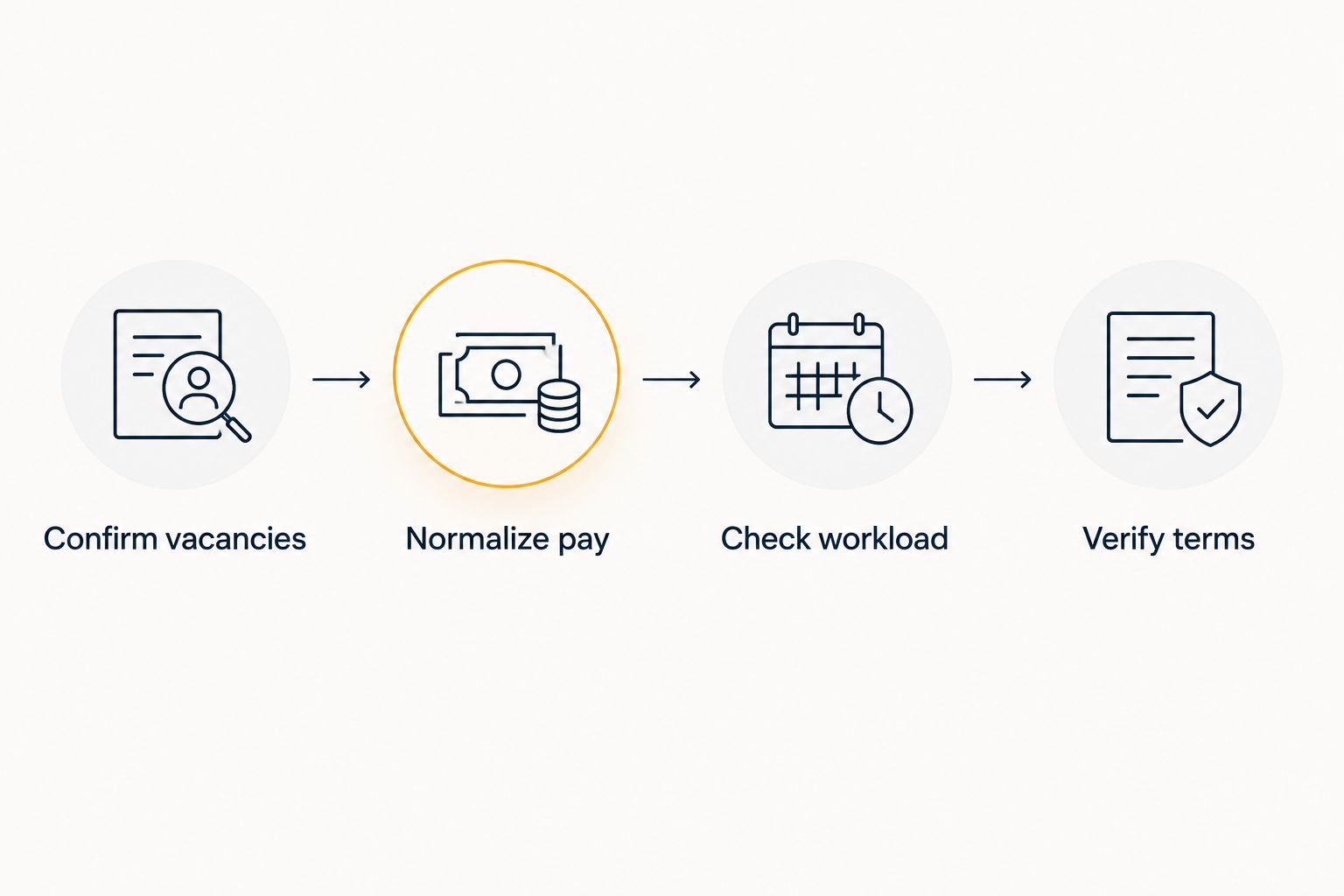
Use the same sequence for each employer:
- Confirm vacancies: Ask whether the employer is actively recruiting for your subspecialty and intended start date. Match advertisements by employer, facility, duties, and recruiter to identify possible duplicates.
- Normalize pay: Compare guaranteed compensation over the same period. Keep conditional bonuses separate, and divide comparable compensation by required hours only when you have the relevant schedule.
- Check workload: Request expected clinical hours, call, modalities, procedures, productivity requirements, and nonclinical duties.
- Verify terms: Review benefits, malpractice responsibilities, termination provisions, and any repayment obligations with qualified advisers.
Compare compensation over 12 months when annual offers are available. For temporary assignments, use the actual contracted work period rather than projecting uninterrupted work across a year.
How the job types rank
This ranking prioritizes decision fit: permanent employment first, then schedule protection, ownership, remote location, assignment duration, and academic work. The criteria are compensation clarity, workload, call, clinical fit, employment structure, and vacancy confirmation.
It does not rank states by salary or declare one subspecialty the highest paid. Those conclusions require dated, comparable compensation and vacancy data. Your 2026 shortlist should use the same evidence standard.
Which Southeast radiology job should you choose?
Start with hospital-employed diagnostic radiology if you have not settled on a specific career objective. Move outpatient imaging to the top when schedule protection is decisive, or partnership-track practice when ownership is non-negotiable.
Use RadBoard's radiology job search platform to discover positions across sources, then keep only employers that answer your core questions. The best offer is the one whose written duties and compensation match your priorities—not the advertisement with the largest headline figure.
FAQ
What's the best radiology job in the Southeast?
Hospital-employed diagnostic radiology is the default starting category for a permanent employed-role search. Outpatient imaging, partnership-track practice, teleradiology, locum tenens, and academic work fit different priorities.
Which Southeast state pays radiologists the most?
A defensible state winner requires comparable, dated compensation data. Compare written offers with equivalent hours, call, subspecialty duties, and employment structures rather than assuming a state determines pay.
How do I find Southeast radiology openings in 2026?
Search by your acceptable states, subspecialty, and work arrangement, then confirm each vacancy with the employer. RadBoard aggregates positions from multiple sources, but its platform-wide figures are not Southeast opening counts.
Are outpatient radiology jobs always no-call?
No. An outpatient location does not establish a no-call contract; confirm evenings, weekends, holidays, and cross-coverage obligations in writing.
Is teleradiology better than an onsite Southeast job?
Teleradiology is the better search category when remote work is your main objective. Compare shifts, workload, licensing responsibilities, technical support, and compensation before choosing between remote and onsite offers.
Does a partnership-track job guarantee ownership?
No. Review the admission requirements, decision process, ownership rights, and financial obligations before treating a partnership pathway as a firm outcome.
How should I compare radiology salaries with different call schedules?
Compare guaranteed compensation alongside required clinical hours and call obligations. Keep conditional payments separate and ask how overnight work affects the following day's schedule.
One last thing
Count employers and confirmed positions separately from advertisements. Several postings can describe the same job, while a single employer conversation can clarify whether the advertised role matches your intended start date and clinical scope.
Before arranging interviews, ask each employer the same question: What are the guaranteed compensation, required hours, and call obligations for this specific position? That answer makes your Southeast comparison useful.