
Best overall for radiology jobs with the most PTO and vacation time: an employed role with paid leave written into the contract. Best for long stretches away from work: a 7-on/7-off block schedule. Best for choosing when to accept assignments: locum tenens. Best for a shorter recurring workweek: a four-day schedule. Paid PTO and scheduled days off are different benefits; compare them separately before you sign.
- For radiology jobs with the most PTO and vacation time, choose an employed contract that states paid leave explicitly.
- A 7-on/7-off schedule creates predictable time away, but off-block days are not automatically paid PTO.
- Locum tenens lets you decline future assignments; confirm how time between contracts affects your income and benefits.
- A four-day workweek reduces scheduled workdays without necessarily adding vacation leave.
Why this matters in 2026
A radiology listing can promise flexibility while leaving the actual leave policy unanswered. A four-day workweek, a recurring off-block, and a paid vacation bank all create time away from the reading list, but they differ in pay, control, and how far ahead you can plan.
Use RadBoard to search radiology positions, then request the written schedule and leave terms for each role you consider. RadBoard describes its platform as aggregating 5,000+ positions from 20 sources. Those search numbers help you find openings; they do not establish which employer has the most PTO. That comparison requires the terms attached to individual offers.
What makes the best radiology job for time off?
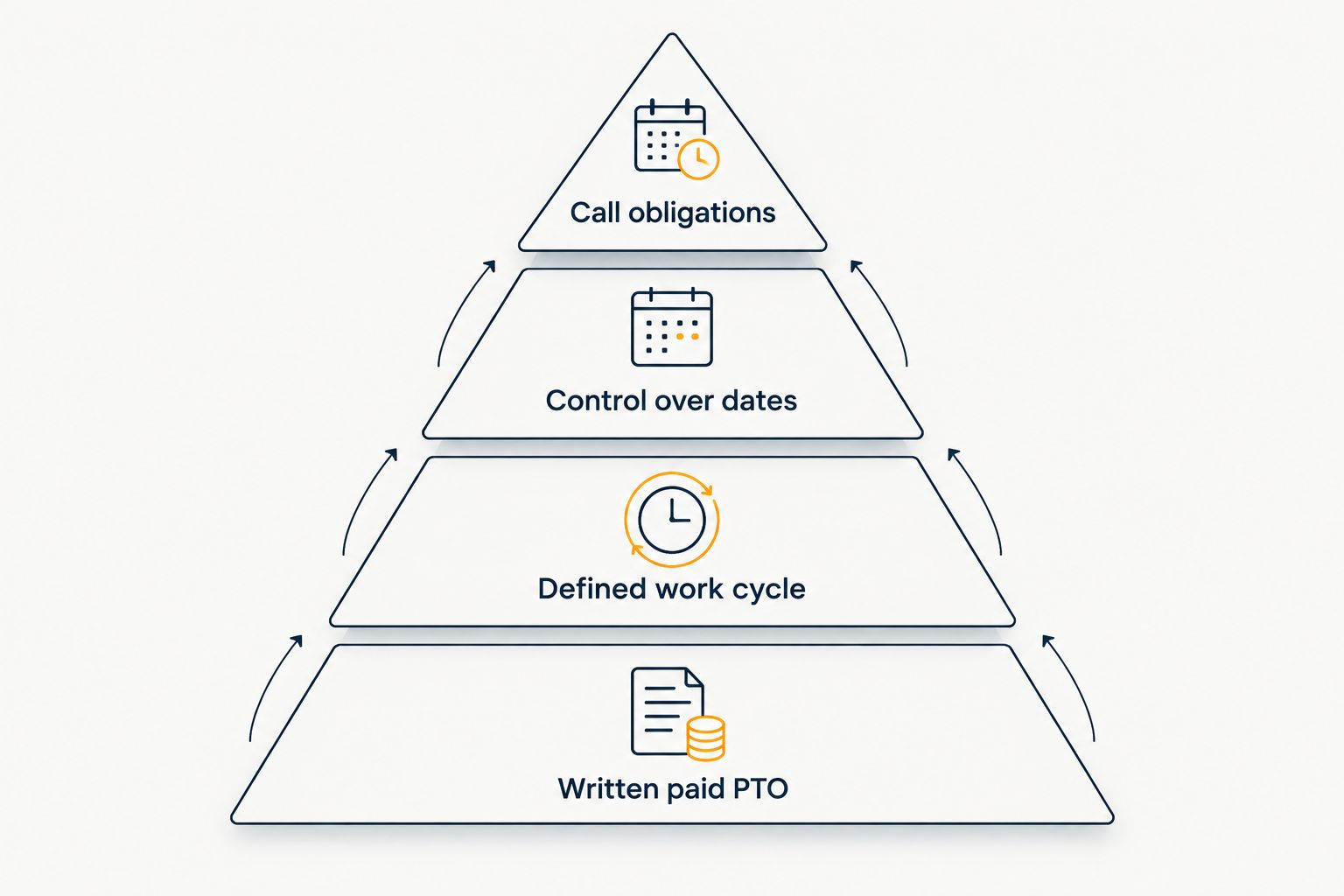
In 2026, rank a role by the time you can actually use, not by the size of a benefit mentioned in a recruiter’s summary. These criteria keep paid leave distinct from scheduling flexibility:
- Written paid PTO: Ask for the annual leave entitlement, when it becomes available, and the approval process. A verbal description does not settle what the contract provides.
- A defined work cycle: Count both scheduled workdays and scheduled days away. For block roles, establish whether the off-block is protected from routine coverage requests.
- Control over dates: Find out who approves leave, how far ahead you must request it, and whether other radiologists compete for the same weeks.
- Call obligations: Check whether nights, weekends, holidays, or backup call interrupt an otherwise attractive schedule.
- Coverage arrangements: Ask who handles your cases while you are away and whether you must arrange or repay coverage.
- Employment terms: Compare paid leave, unpaid gaps, benefits eligibility, and workload expectations as separate contract items.
The best vacation policy is the one that states both your leave entitlement and how you can use it. A role with frequent days off can still be a poor fit if those days are subject to call. A contract with paid PTO can still disappoint if your requested dates are routinely denied.
For every 2026 offer, put the proposed calendar next to the contract. Mark the days you work, the days you are free of scheduled work, and the days you can take as paid leave. Then mark call separately. This simple comparison exposes the difference between an appealing rotation and usable vacation.
Radiology time-off options at a glance
The ranking below compares types of roles, not verified openings or employers. No uniform PTO amount applies to every job in a category; the signed terms decide the result.
| Rank | Option | Best for | Standout feature | Key limitation |
|---|---|---|---|---|
| 1 | Employed radiology role with written paid PTO | Paid vacation with defined terms | Leave can be assessed directly in the offer | Approval and coverage rules still matter |
| 2 | 7-on/7-off radiology jobs | Predictable extended breaks | Recurring on-block and off-block | Off-block time is not automatically paid PTO |
| 3 | Locum tenens radiology jobs | Choosing gaps between assignments | Freedom to accept or decline future work | Gaps between assignments are not necessarily paid |
| 4 | Radiology jobs with four-day workweeks | A recurring weekday free | Fewer scheduled workdays each week | A shorter week does not guarantee more vacation |
1. Employed radiology role: best for paid vacation
An employed role takes first place only when the contract specifies paid leave and explains how to request it. That gives you an entitlement you can compare across offers, rather than an assumption based on a department’s schedule. The relevant document is the proposed agreement and any incorporated leave policy, not the listing headline.
Employed-role pros:
- A written PTO entitlement gives you a direct basis for comparing offers.
- An established request process tells you when and how to reserve dates.
- You can examine paid leave alongside call, holidays, and coverage in one offer.
Employed-role cons:
- Approval can depend on staffing and competing leave requests.
- A stated leave amount does not show whether preferred weeks are available.
- Call or makeup-work expectations can reduce the practical value of time off.
Best for: A radiologist who wants vacation time expressly provided as an employment benefit.
Ask the employer to show you the clause defining leave, the policy governing requests, and the coverage plan for absences. If the agreement refers to a separate handbook, obtain that handbook before you compare the offer with another role. In 2026, do not treat a recruiter’s description of a generous policy as a substitute for the operative document.
Ask a working radiologist in the group how the policy functions in practice: who covers a vacationing colleague, how simultaneous requests are resolved, and whether routine messages or protocol questions reach physicians on leave. Those answers do not replace the contract. They tell you whether its written benefit is usable.
Verdict: Buy only when paid leave and its approval rules appear in the documents you receive. Otherwise, hold the offer open while you request them.
2. 7-on/7-off schedule: best for predictable extended breaks
A 7-on/7-off role alternates a scheduled work block with a scheduled off-block. That pattern makes it easier to see when longer stretches away from routine work occur. It does not tell you whether the employer provides paid vacation in addition to those off-blocks.
7-on/7-off pros:
- The recurring cycle gives you a clear planning framework.
- Off-blocks create stretches without scheduled routine shifts.
- A calendar makes it straightforward to compare call against time away.
7-on/7-off cons:
- An off-block is not the same as an accrued paid-leave entitlement.
- The on-block’s hours and case workload need close review.
- Backup call can interrupt an off-block if the agreement requires it.
Best for: A radiologist who values recurring stretches away from scheduled reads more than a conventional weekly pattern.
Before accepting, ask for an actual schedule showing work blocks, holidays, nights, and backup responsibilities. Clarify how vacation is handled: does leave replace an on-block, or must you arrange a swap? Ask whether the off-block is free from meetings, inbox coverage, and nonurgent consultations. Those details determine whether the calendar delivers the break you expect.
Compare a complete cycle rather than a single appealing week. A week away carries a different value if the preceding work block includes demanding coverage or if the following block limits when you can travel. The schedule needs to fit your preferred way of working as well as your plans for time off.
Verdict: Buy for predictable breaks when the off-block is protected; hold if the contract leaves call or vacation treatment unclear.
3. Locum tenens: best for choosing gaps between assignments
Locum tenens work separates time away from a standing employment leave policy. You accept assignments that fit your calendar and leave space between contracts when you do not want to work. That control is useful, but time without an assignment should not be counted as paid PTO unless a specific agreement says otherwise.
Locum-tenens pros:
- You can assess each assignment against dates you already intend to keep free.
- A defined assignment makes its scheduled work period easier to inspect.
- You can decline future work that conflicts with a planned break.
Locum-tenens cons:
- Time between contracts does not itself provide vacation pay.
- Benefits and employment terms depend on the particular arrangement.
- Assignment dates, call, and cancellation terms require individual review.
Best for: A radiologist who prioritizes control over which assignments to accept.
For each opportunity, request the shift calendar, call expectations, assignment end date, and terms for changing or canceling shifts. Check whether credentialing and other pre-start requirements affect the dates you intend to work. Then compare the full arrangement with an employed offer instead of comparing only the visible days off.
In 2026, the useful question is not how much PTO a locum role advertises. It is whether you can reserve the time you need and still accept enough work on terms that suit you. An open calendar gives you choice; it does not convert an unpaid gap into an employment benefit.
Verdict: Buy for calendar control if unpaid gaps fit your plans; skip it as a substitute for paid PTO.
4. Four-day workweek: best for a recurring weekday free
A four-day radiology workweek reduces the number of scheduled workdays in a typical week. It can give you a reliable weekday for appointments or personal commitments without using vacation leave. It does not, by itself, establish the role’s annual PTO entitlement.
Four-day-workweek pros:
- A recurring weekday free can simplify regular commitments.
- You can compare the proposed weekly calendar before accepting.
- The schedule may preserve vacation leave for longer absences if the offer includes it.
Four-day-workweek cons:
- The remaining workdays need examination for hours and workload.
- Call or rotating coverage can occupy the nominal day off.
- A shorter workweek does not establish more paid vacation.
Best for: A radiologist who wants less scheduled work during ordinary weeks, rather than the longest uninterrupted breaks.
Ask whether the free day is fixed or rotates and whether meetings, procedures, or backup duties fall on it. Request the annual PTO policy separately. If you want a full week away, establish how leave is deducted when your normal workweek has four scheduled days; do not assume the answer from the listing.
A shorter week and a longer vacation solve different problems. If you mainly need dependable time for recurring obligations, this option can outrank a block schedule for you. If you want extended travel, compare how easily each employer approves consecutive days away.
Verdict: Buy for a genuinely protected weekday; hold if the schedule compresses the same obligations into longer days without meeting your goal.
How the 2026 ranking works
Paid leave ranks first because the search is specifically about PTO and vacation time. A written entitlement answers that question more directly than a calendar with unscheduled days. Block scheduling ranks next for predictable stretches away, locum tenens follows for control over future commitments, and the four-day week serves readers who need frequent shorter breaks.
This is a decision framework, not a claim that one named employer offers more vacation than another. There are no employer-specific PTO figures in the information provided for this guide. To identify the strongest individual offer, compare its written leave terms, schedule, call duties, and coverage rules against the same details in your other offers.
Which radiology job should you choose?
Choose an employed radiology job with documented paid PTO if paid vacation is your priority. Ask for the governing documents before you rank employers. If your priority is time away rather than paid leave specifically, choose a protected 7-on/7-off schedule for recurring longer breaks or locum tenens for more control over which assignments you accept. Choose a four-day week when the value lies in a dependable day free during ordinary weeks.
Keep a separate line in your offer comparison for each of these items: paid PTO, scheduled days away, call during time away, approval requirements, and who covers your work. Never add off-block days to PTO days and call the total vacation. That calculation describes time away from scheduled shifts, not necessarily paid leave you control.
FAQ
Which radiology jobs have the most PTO and vacation time?
Start with employed radiology jobs that state paid leave in the contract. Compare the entitlement, approval rules, and call obligations in each actual offer; a job type alone does not establish the highest PTO amount.
Does a 7-on/7-off radiology job include paid vacation?
A 7-on/7-off schedule does not automatically include paid vacation. Ask whether paid leave is available in addition to the off-block and how leave affects scheduled work blocks.
Are days between locum tenens assignments considered PTO?
Days between locum tenens assignments are not automatically paid PTO. Review the specific contract for pay, benefits, assignment dates, and any leave terms.
Does a four-day radiology workweek give you more vacation?
A four-day workweek gives you fewer regularly scheduled workdays, not necessarily more vacation. Request the annual leave policy separately and check whether call occupies the free day.
What should I ask about radiology vacation during an interview?
Ask for the written PTO policy, the approval process, and a sample schedule. Also ask who covers cases and call while you are away.
How do I compare a block schedule with paid PTO?
List paid leave and scheduled off-blocks in separate columns. Then compare call, workload, and control over the dates; off-block time is not automatically paid leave.
Can I negotiate PTO in a radiology offer?
You can ask an employer to change the proposed leave terms before signing. Request any agreed entitlement and approval conditions in writing so the final documents reflect the offer you accepted.
One last thing
Before signing a 2026 radiology offer, ask one precise question: Can I see the calendar and policy that govern the time I will actually be away? If the employer supplies a rotation but no leave policy, you know the schedule, not the PTO. If it supplies a PTO figure but no coverage rules, you know the entitlement, not whether you can use your preferred dates.