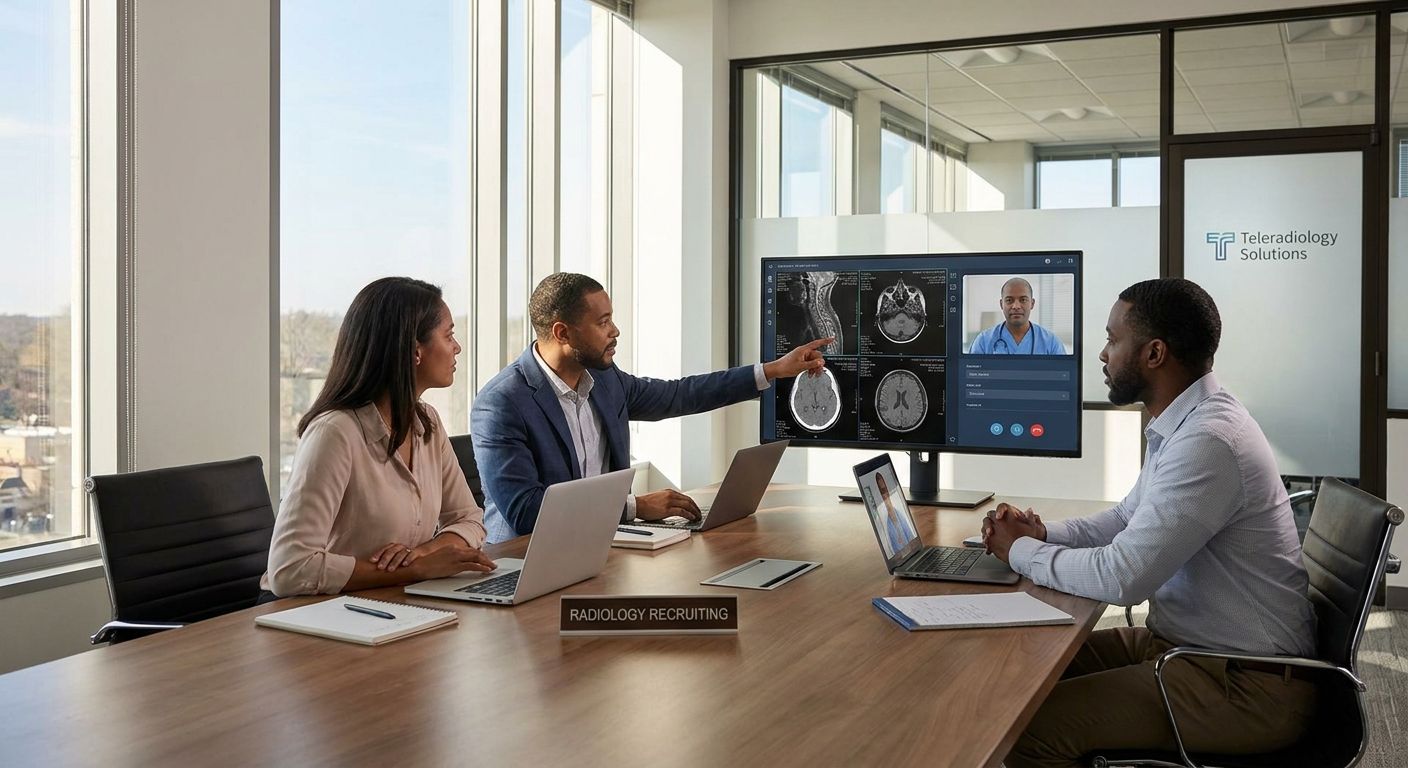
Teleradiology recruiting firms range from national networks that place thousands of radiologists a year to boutique shops that fill three or four seats at a time, and picking the wrong one costs you leverage on pay, licensing support, and read volume. This 2026 ranking breaks down the firms actually placing radiologists into remote and hybrid teleradiology roles, with a verdict on who each one fits.
- vRad, now under the Rayus Radiology brand, is the largest of the teleradiology recruiting firms for high-volume overnight and ER reads in 2026 -- Buy.
- StatRad wins on subspecialty matching for neuro and MSK radiologists chasing niche reads -- Buy.
- USARAD Holdings fits radiologists who need heavy multistate licensing support built into the placement -- Consider.
- Radiology Partners' teleradiology arm suits radiologists who want group affiliation and RVU-based pay -- Hold.
- Direct Radiology fits radiologists who want a smaller, boutique caseload over volume -- Consider.
Why this matters
RadBoard's own job data shows 5,000+ radiology positions aggregated from 20 sources in 2026, with 3,700+ active listings at any given time. A meaningful share of those postings run through a recruiting firm before they ever hit a job board, which means the firm you sign with shapes which openings you even see.
Teleradiology recruiting firms are not staffing agencies in the locum tenens sense. Most work on retained or contingency contracts with hospitals and teleradiology companies, meaning the facility pays the fee, not the radiologist. That distinction matters when you're evaluating whether a firm's advice is actually in your interest or the client's.
RadBoard functions as the aggregator layer above all of this. For radiologists who'd rather skip a middleman entirely, RadBoard surfaces teleradiology openings directly from source postings across the 20 channels it tracks.
How we ranked
Each firm below is evaluated on five criteria: subspecialty coverage, contract transparency (1099 vs. W2), licensing and credentialing support, read-volume and shift-type mix, and how fast candidates typically get to an offer. The ranking draws on aggregated postings data, publicly available firm positioning, and patterns visible across thousands of teleradiology listings tracked in 2026. No firm on this list paid for placement, and rankings reflect fit for radiologists, not recruiter convenience.
The ranked list
1. vRad (Rayus Radiology) -- the incumbent
vRad is one of the oldest names in US teleradiology, now operating under the Rayus Radiology umbrella. It covers general diagnostic, emergency, and a broad subspecialty mix, with both night and day shift blocks available.
What it does: places radiologists into overnight and weekend coverage pools for hospitals that can't staff onsite 24/7. Contracts run a mix of W2 and 1099, depending on the coverage type and shift structure.
Why now: 2026 postings show consistent overnight demand as rural and community hospitals continue outsourcing after-hours reads rather than hiring onsite nighthawk staff. Volume here is the draw, not niche subspecialty matching.
Verdict: Buy for radiologists who want maximum shift volume and don't mind a large-group structure over a boutique feel.
2. StatRad -- the subspecialty specialist
StatRad built its reputation on matching radiologists to reads inside their actual subspecialty rather than dumping general diagnostic volume on everyone. Neuro, MSK, and body imaging reads make up a larger share of its mix than at the bigger volume shops.
What it does: pairs hospital and outpatient clients that need subspecialty coverage with radiologists trained specifically in that read type, reducing the general-diagnostic grind common at high-volume firms.
Why now: subspecialty-only reading has become a bigger ask from radiologists in 2026, and StatRad's model is built around exactly that request.
Verdict: Buy for fellowship-trained radiologists who want reads matched to training, not a mixed bag.
3. USARAD Holdings -- the licensing heavy-lifter
USARAD Holdings differentiates on the administrative side of teleradiology: multistate licensing, credentialing, and privileging support that most radiologists underestimate until they're three states deep in paperwork.
What it does: coordinates licensing across the states where its client facilities operate, which matters because a single teleradiology contract can require active licenses in five or more states simultaneously.
Why now: multistate coverage keeps expanding as hospital systems consolidate reading pools across regions, and radiologists without a firm handling the paperwork lose weeks of onboarding time.
Verdict: Consider if the licensing burden is the thing holding you back from a multistate contract.
4. Radiology Partners Teleradiology -- the scale play
Radiology Partners runs one of the larger private-equity-backed radiology group structures in the US, with a teleradiology division that feeds into its broader practice network.
What it does: places radiologists into W2 roles tied to RVU-based compensation, with access to the group's broader case mix and internal subspecialty referral network.
Why now: RVU-based pay structures remain a common ask in 2026 for radiologists who want upside tied directly to volume, and this firm's group affiliation gives that structure more stability than a solo 1099 contract.
Verdict: Hold until you've compared the RVU structure against a straight hourly or per-study rate from a smaller shop -- group affiliation cuts both ways on autonomy.
5. Direct Radiology -- the boutique shop
Direct Radiology runs leaner than the volume players, with a smaller roster and closer matching between radiologist and facility.
What it does: places radiologists into lower-volume, often daytime or partial-coverage contracts rather than the high-throughput overnight pools common at larger firms.
Why now: radiologists prioritizing schedule control over maximum shift volume in 2026 are gravitating toward smaller firms that don't require night-heavy blocks.
Verdict: Consider if you want a smaller caseload and more say over which facilities you cover.
Comparison table
| Firm | Best for | Contract type | Licensing support | Verdict |
|---|---|---|---|---|
| vRad (Rayus Radiology) | High-volume overnight/ER | W2 and 1099 mix | Limited | Buy |
| StatRad | Subspecialty matching | 1099 | Moderate | Buy |
| USARAD Holdings | Multistate coverage | 1099 | Heavy | Consider |
| Radiology Partners Teleradiology | RVU-based group pay | W2 | Employer-driven | Hold |
| Direct Radiology | Lower-volume, boutique | 1099 | Light | Consider |
Skip the recruiter, search direct
5,000+ radiology jobs from 20 sources, updated daily on RadBoard.
Where to source a firm
- Get the read-volume guarantee in writing before signing -- verbal promises about shift count don't hold up when the facility cuts hours.
- Ask who covers licensing costs -- some firms absorb multistate license fees, others pass them straight to the radiologist.
- Compare RVU pay against flat-rate offers from the same facility whenever a firm pitches an RVU structure -- the math only favors you at certain volume levels.
Radiologists who want to vet a contract line by line before signing with any of these firms should walk through RadBoard's guide on how to evaluate a teleradiology contract before signing.
What to avoid
- A firm that won't name the facility or health system before you sign an exclusivity agreement -- that's a sign the posting is recycled or unverified.
- Any recruiter charging the radiologist a placement fee -- standard practice in 2026 has the hiring facility covering recruiter costs, not the candidate.
- Firms that quote a flat rate without disclosing expected study volume per shift -- rate per study means nothing without the volume number attached.
FAQ
What are the best teleradiology recruiting firms in 2026?
vRad (Rayus Radiology), StatRad, USARAD Holdings, Radiology Partners' teleradiology division, and Direct Radiology are the most active teleradiology recruiting firms placing radiologists in 2026. Each fits a different priority, from shift volume to subspecialty matching to licensing support.
Is vRad still hiring radiologists in 2026?
Yes, vRad continues placing radiologists into overnight and weekend teleradiology coverage under the Rayus Radiology brand in 2026. It remains the highest-volume option among teleradiology recruiting firms for general diagnostic and ER reads.
How much do teleradiology recruiting firms charge radiologists?
Reputable teleradiology recruiting firms charge the hiring facility, not the radiologist, for placement. If a firm asks you to pay a fee upfront, treat that as a red flag rather than standard practice.
Can I skip a recruiting firm and apply directly to teleradiology jobs?
Yes, many teleradiology openings post directly to job boards without a recruiting firm involved. RadBoard aggregates 5,000+ radiology jobs from 20 sources, letting radiologists search and apply without going through a recruiter.
What's the difference between a teleradiology recruiting firm and a staffing agency?
A recruiting firm typically places radiologists into permanent or long-term teleradiology contracts, while a staffing agency focuses on locum tenens and short-term coverage gaps. Some firms, like USARAD Holdings, do both.
Do teleradiology recruiting firms help with multistate licensing?
Some do and some don't. USARAD Holdings is built specifically around licensing and credentialing support, while volume-focused firms like vRad offer less hands-on help with multistate paperwork.
How long does it take to get placed through a teleradiology recruiting firm?
Placement timelines in 2026 typically run 4 to 12 weeks depending on how many states you're licensed in and how specific your subspecialty requirements are. Multistate licensing is usually the longest bottleneck, not the interview process.
Is StatRad better than vRad for subspecialty radiologists?
StatRad generally offers better subspecialty matching for neuro, MSK, and body imaging radiologists, while vRad offers higher shift volume across general diagnostic and ER reads. The right pick depends on whether you're optimizing for read relevance or total shift count.
One last thing
The biggest variable across these firms isn't the recruiting firm's name -- it's whether you've already got active licenses in the states your target facilities sit in. Radiologists who line up multistate licensing before contacting any of these firms consistently move through placement faster than those who start the licensing process after signing a contract.