
Best overall: permanent-placement recruitment tied to a named sponsoring employer. Best for academic careers: direct university recruitment. Best for broad discovery: RadBoard, a radiology job search platform aggregating 5,000+ positions from 20 sources. For your 2026 search, choose the recruitment route by who will file the petition, which immigration pathway applies, and whether the actual radiology assignment qualifies.
- The best radiology staffing agencies for visa sponsorship identify the petitioning employer before arranging interviews.
- RadBoard is best for radiology job discovery, not immigration approval or legal representation.
- Permanent placement connects you with an employer; the recruiting agency is not automatically your visa sponsor.
- J-1 waiver and H-1B sponsorship searches require different employer screening questions.
Why this matters
A recruiter can introduce you to a radiology practice without being the entity that employs you or files your immigration petition. Those roles are separate. Treat sponsorship as an employer-and-position question, not an agency-brand promise.
The strongest recruitment route connects your immigration status with a specific employer, worksite, clinical scope, and feasible start date. An attractive schedule does not resolve a petitioning-employer mismatch. Neither does a recruiter saying the practice is “open to international candidates.”
RadBoard is best for radiologists who want to compare career opportunities across multiple sources before contacting employers. Its aggregation supports discovery; confirm sponsorship directly with the hiring organization and its immigration counsel.
What makes the best radiology staffing agency for sponsorship?
Use these criteria before comparing recruiters in 2026. They test the proposed placement, rather than the size of an agency’s marketing footprint.
- Named petitioner: The recruiter identifies the legal entity expected to employ you and file the petition. A hospital affiliation alone is insufficient.
- Pathway fit: The employer distinguishes H-1B sponsorship from a J-1 waiver placement. These are not interchangeable commitments.
- Radiology-specific assignment: The recruiter documents diagnostic versus interventional duties, subspecialty expectations, call, and reading locations.
- Counsel access: The employer provides a route to immigration counsel before you rely on a proposed start date or sign restrictive terms.
- Worksite clarity: The employer identifies onsite facilities, remote reading locations, and any planned rotation across sites.
- Written responsibilities: The offer addresses petition coordination, licensing, credentialing, and what happens if employment cannot begin as planned.
A practical screening question is: “Which entity will file my petition for this radiology position, and who can confirm the proposed pathway?” Ask it before discussing interview travel, moving arrangements, or partnership expectations.
Recruitment routes at a glance
This ranking separates job discovery from employer recruitment and temporary staffing. Each route serves a different decision; none substitutes for an individual immigration assessment.
| Recruitment route | Best for | Standout function | Key limitation |
|---|---|---|---|
| Permanent-placement agency | Employer-matched attending searches | Coordinates recruitment for an identified permanent position | The agency introduction does not establish employer sponsorship |
| Direct university recruitment | Faculty and academic career searches | Connects the appointment with institutional recruitment | University affiliation alone does not establish H-1B cap exemption |
| Direct hospital or group recruitment | Physicians with a defined employer shortlist | Reduces distance between the candidate and hiring organization | Each employer must assess its own position and immigration pathway |
| RadBoard | Comparing radiology opportunities across sources | Aggregates 5,000+ positions from 20 sources | A job listing is not confirmation of sponsorship eligibility |
| Locum staffing agency | Temporary coverage after authorization review | Organizes assignment-specific coverage | A temporary assignment is not automatically compatible with your status |
1. Permanent-placement agencies: best for employer matching
Permanent-placement recruiters connect physicians with employers seeking an ongoing attending appointment. For a sponsorship search, the useful deliverable is not a long list of practices. It is an identified position whose employer will discuss your immigration requirements before advancing the application.
Give the recruiter your subspecialty, training completion date, licensure status, and immigration pathway. Then ask for confirmation from the employer, rather than relying on a recruiter’s summary of previous placements. A practice’s earlier sponsorship experience does not establish that your assignment qualifies.
Permanent-placement agency pros:
- Provides a contact who coordinates employer introductions and interviews.
- Lets you screen clinical scope and immigration requirements together.
- Supports comparison of permanent roles without treating each introduction as a separate search.
Permanent-placement agency cons:
- The recruiter is not necessarily the petitioning employer.
- A recruiter’s interpretation is not a legal eligibility determination.
- Restricting your search to one agency excludes employers outside its represented searches.
Before accepting representation, ask which organizations will receive your CV and require permission before submission. Duplicate submissions create confusion about who represents you; they do not strengthen the employer’s immigration assessment.
Best for: Radiologists seeking a permanent attending role across several employers.
Verdict: Buy into this recruitment route only after the agency identifies the employer and obtains position-specific sponsorship confirmation.
2. Direct university recruitment: best for academic careers
Direct academic recruitment connects you with the department and institutional hiring process for a faculty appointment. Choose this route when teaching, research, or an academic subspecialty practice is central to your career plan. Do not choose it solely because a facility has a university name.
USCIS identifies institutions of higher education and certain related or affiliated nonprofit entities among categories of H-1B cap-exempt employers. The qualifying entity matters. Ask institutional counsel to evaluate the actual petitioner, appointment, and employment arrangement.
Direct university recruitment pros:
- Places clinical and academic duties in the same appointment discussion.
- Gives you a direct route to the institution’s recruitment contacts.
- Allows petitioner and affiliation questions to be resolved for the specific role.
Direct university recruitment cons:
- Academic appointments include duties beyond image interpretation.
- A university-affiliated worksite does not, by itself, establish cap exemption.
- Immigration approval, faculty appointment, and clinical privileges remain separate requirements.
For a 2026 academic search, request the proposed legal employer’s name alongside the faculty title. Also ask where you will read, perform procedures, and take call. Those details belong in both the clinical discussion and counsel’s review.
Best for: Radiologists pursuing a genuine faculty career rather than using an academic label as an immigration shortcut.
Verdict: Buy into direct academic recruitment when the appointment fits your career and counsel confirms the employer’s pathway.
3. Direct employer recruitment: best for a defined shortlist
Contact hospitals and radiology groups directly when you already know the geographic area or practice setting you want. This route puts your questions closer to the hiring organization. It does not remove the need for legal review.
Clarify whether the hospital employs its radiologists or contracts with a separate group. A position located inside a hospital can have a different legal employer. Ask the hiring contact to identify that entity before describing sponsorship as part of the offer.
Direct employer recruitment pros:
- Connects you with the organization making the hiring decision.
- Supports detailed questions about worksites, call, and clinical responsibilities.
- Lets you assess sponsorship alongside the actual employment agreement.
Direct employer recruitment cons:
- You coordinate each application and follow-up yourself.
- Hospital recruiters and contracted groups can have different responsibilities.
- Employer interest does not establish petition approval or a lawful start date.
For waiver-related positions, identify every proposed clinical location. Ask counsel whether the intended duties and sites support the specific waiver pathway, including any program rules relevant to specialty physicians. Do not assume that an underserved patient population alone establishes eligibility.
Best for: Physicians with a defined employer or geographic shortlist.
Verdict: Buy into direct recruitment when the legal employer answers sponsorship questions before you commit to the role.
4. RadBoard: best for broad radiology job discovery
RadBoard aggregates radiology positions from multiple sources and offers search and swipe-to-save features. Use the platform to identify opportunities, save relevant positions, and build a shortlist for employer screening. It is a job search platform, not a staffing agency or immigration adviser.
Start with clinical fit, then investigate sponsorship. A position matching your subspecialty or preferred location still needs employer confirmation of the immigration pathway. Keep the job advertisement and the employer’s written answers together so you can compare the proposed role accurately.
RadBoard pros:
- Brings radiology opportunities from 20 sources into one search platform.
- Supports discovery across an aggregated catalog of 5,000+ positions.
- Offers swipe-to-save functionality for retaining opportunities during your search.
RadBoard cons:
- Aggregation does not establish that an employer sponsors physicians.
- A listing does not determine your individual immigration eligibility.
- You still need employer, licensing, and credentialing confirmation.
Best for: Radiologists building a broad opportunity shortlist before approaching recruiters or employers.
Verdict: Buy into discovery here; hold any employment commitment until the employer confirms the proposed pathway.
5. Locum staffing agencies: best for authorization-reviewed coverage
Locum staffing agencies arrange temporary physician assignments. Treat this route as an assignment-specific question, not a shortcut around sponsorship requirements. The employer, sites, duties, and existing work authorization all require review.
Temporary coverage becomes a relevant option only after counsel evaluates whether you can perform the proposed work. A state medical license and hospital privileges do not independently authorize employment under immigration law.
Locum staffing agency pros:
- Organizes recruitment around a defined coverage assignment.
- Lets you examine the exact facility, schedule, and clinical duties.
- Provides a contact for assignment coordination.
Locum staffing agency cons:
- Work authorization does not automatically extend to every assignment.
- Additional employers or worksites require immigration assessment.
- Temporary staffing is not a substitute for a qualifying waiver service commitment.
Best for: Physicians whose counsel has assessed the specific temporary employment arrangement.
Verdict: Hold until authorization is confirmed; skip assignments that depend on starting work before that review.
Screen your immigration pathway before interviews
J-1 waiver searches
For 2026 planning, separate the waiver request from the subsequent employment petition. USCIS guidance on the Conrad 30 program describes a service requirement of at least 3 years, generally involving 40 hours per week of qualifying clinical practice. State program criteria and the proposed position require individual review.
Ask whether the employer is pursuing a state Conrad 30 waiver or another applicable waiver route. Then have counsel assess the radiology duties and service locations. Specialty recruitment needs position-specific answers, not assumptions drawn from primary-care placements.
H-1B searches
Ask whether the proposed petition is subject to the H-1B annual cap or qualifies for an exemption. USCIS guidance distinguishes these categories; an employer’s hospital status alone does not settle the question.
Also distinguish immigration processing from medical licensure and hospital credentialing. Coordinate them, but do not treat progress in one process as permission to bypass another. Your proposed start date needs to account for every required authorization.
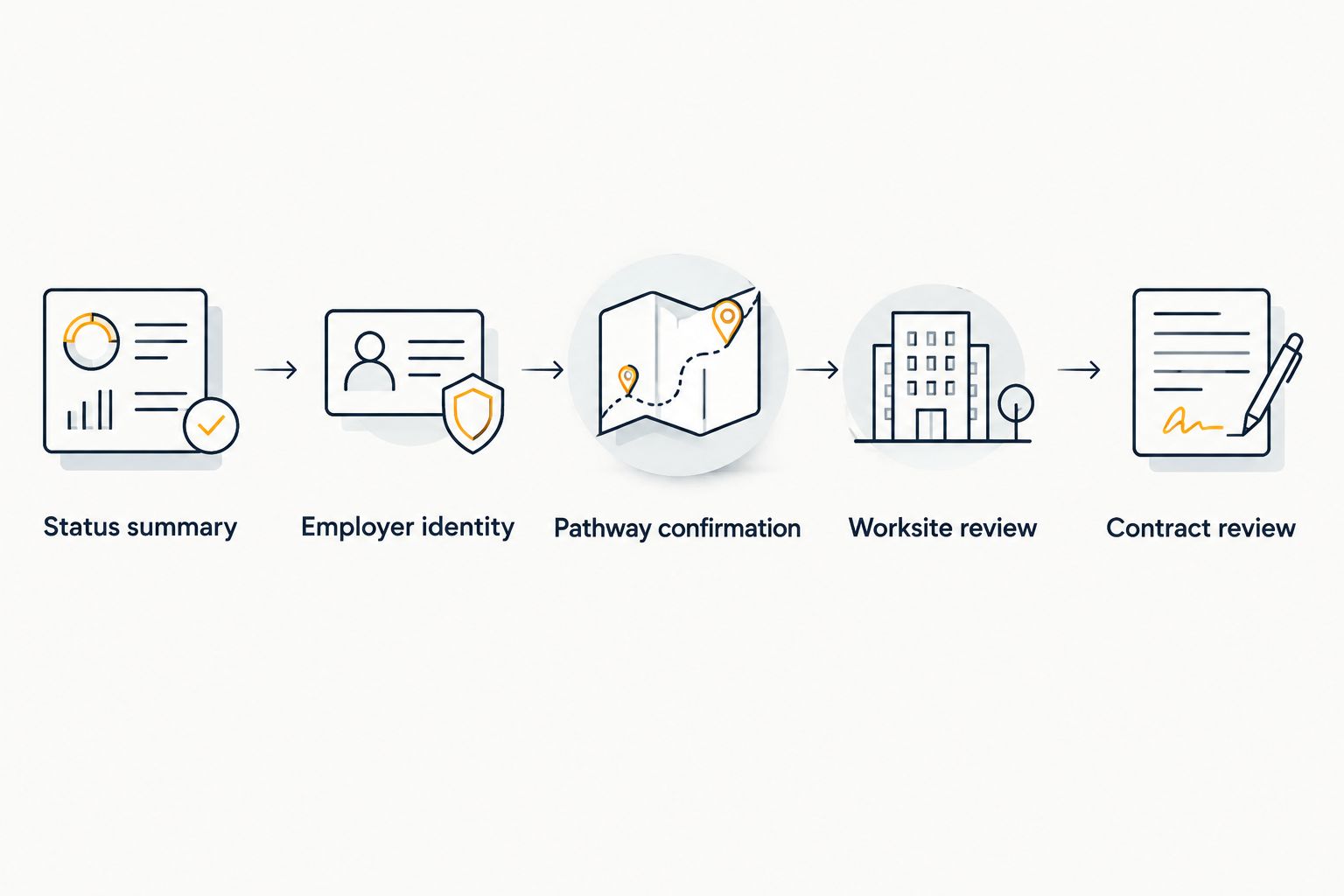
A practical screening sequence for 2026
Use the same sequence for every opportunity. Consistency makes employer answers comparable and stops clinical interviews from outrunning immigration review.
- Status summary: Prepare your current immigration category, training completion date, subspecialty, and licensure status. Send sensitive documents through the employer’s designated secure process.
- Employer identity: Obtain the legal employer’s name and distinguish it from the facility name, recruiting agency, and practice brand.
- Pathway confirmation: Request employer confirmation that it will consider the specific immigration route your appointment requires.
- Worksite review: Document onsite facilities, remote reading locations, procedures, and additional coverage obligations.
- Contract review: Have qualified counsel review immigration-dependent terms before you sign or leave your current position.
Ask who is responsible for each process and what written conditions govern the start date. Review termination, repayment, and relocation obligations with employment counsel as well as immigration counsel. A contract should explain what happens if the appointment cannot start as planned.
How these routes are ranked
The ranking prioritizes employer identification, pathway confirmation, worksite clarity, and access to the people responsible for the appointment. Permanent placement is the default recruitment route for a broad attending search; direct academic recruitment serves a distinct faculty goal.
Discovery platforms help you find positions. Temporary staffing addresses coverage. Neither function, by itself, establishes sponsorship.
Which recruitment route should you choose?
For your 2026 search, start with permanent-placement recruitment and a parallel employer shortlist. Move academic appointments into a separate track when teaching or research is part of your intended career.
Choose the recruiter who produces a named employer and a position-specific answer. Do not choose on a general sponsorship claim. Before advancing an offer, require a clear petitioner, defined worksites, counsel review, and an authorization-dependent start plan.
FAQ
What's the best radiology staffing agency for visa sponsorship?
Choose the agency that identifies a specific employer willing to assess sponsorship for your proposed radiology position. Agency reputation does not replace employer confirmation or individual immigration review.
Does a staffing agency automatically sponsor my H-1B visa?
No. A recruitment agency can introduce you to a separate employing organization; identify the actual petitioner for the proposed job.
Can a radiologist pursue a Conrad 30 J-1 waiver?
A radiologist needs a position that satisfies the applicable waiver program and state criteria. Have immigration counsel assess the specialty duties, employer, and service locations before relying on the placement.
Are university-affiliated radiology jobs automatically H-1B cap-exempt?
No. Cap exemption depends on the qualifying petitioner and applicable employment arrangement, not simply the facility's university affiliation.
Can I accept locum radiology work while on a sponsored visa?
Accept only after immigration counsel confirms that the specific employment arrangement is authorized. Review the employer, assignment sites, duties, and any existing service obligations.
Does a radiology job listing prove that visa sponsorship is offered?
No. Obtain written employer confirmation for the specific position and pathway; the advertisement alone does not establish eligibility.
What should I ask before signing a sponsored radiology offer?
Ask who will petition, which pathway applies, where you will work, and what conditions govern your start date. Have qualified counsel review immigration-dependent and termination terms before signing.
One last thing
The name on the hospital entrance is not necessarily the name on your petition. Radiology services can be delivered by a separate employing group. Resolve that distinction before treating a hospital’s recruitment message as a sponsorship commitment.
Your next move is specific: ask for the legal employer’s name, the proposed pathway, and a contact authorized to confirm both. Keep that answer with the position description. It is more useful than a recruiter’s general assurance.