
Small private radiology practice career planning is the process of evaluating physician-group jobs with the aim of matching your clinical work, schedule, and ownership goals. This 2026 guide to small private radiology practice careers focuses on the decisions a job advertisement cannot settle: who controls the practice, how coverage works, and what partnership actually means.
- Small private radiology practice careers require separate checks of ownership, workload, partnership terms, and contract obligations.
- RadBoard is best for radiologists searching across multiple job sources before investigating individual practices.
- Private practice radiology jobs do not establish ownership rights; request the governing documents.
- Evaluate partnership-track jobs against the associate role you would hold if partnership never happens.
Why career planning matters for small-practice radiologists
Choose the operating model, not the practice label. A small headcount does not answer whether you will control your schedule, receive ownership rights, or read predominantly within your subspecialty. Treat each point as a separate question rather than a benefit implied by the word private.
Your search also needs to distinguish the employer from the facilities it serves. Ask which entity signs your employment agreement, which entity holds the imaging contracts, and who assigns work across locations. Those answers establish what you are actually joining.
For your 2026 search, prepare questions before scheduling interviews. The guide to preparing for a private-practice radiology job interview provides a focused next step.
Start with your own constraints. A position that fits an ownership-focused general radiologist is not automatically suitable for a fellowship-trained physician seeking subspecialty-only reading. Compare the work you will perform on arrival with the career path described during recruitment.
How to evaluate small private radiology practice careers
Use the following sequence to move from personal requirements to a defensible decision. Keep a written comparison sheet so an attractive interview does not erase an unresolved contract issue.
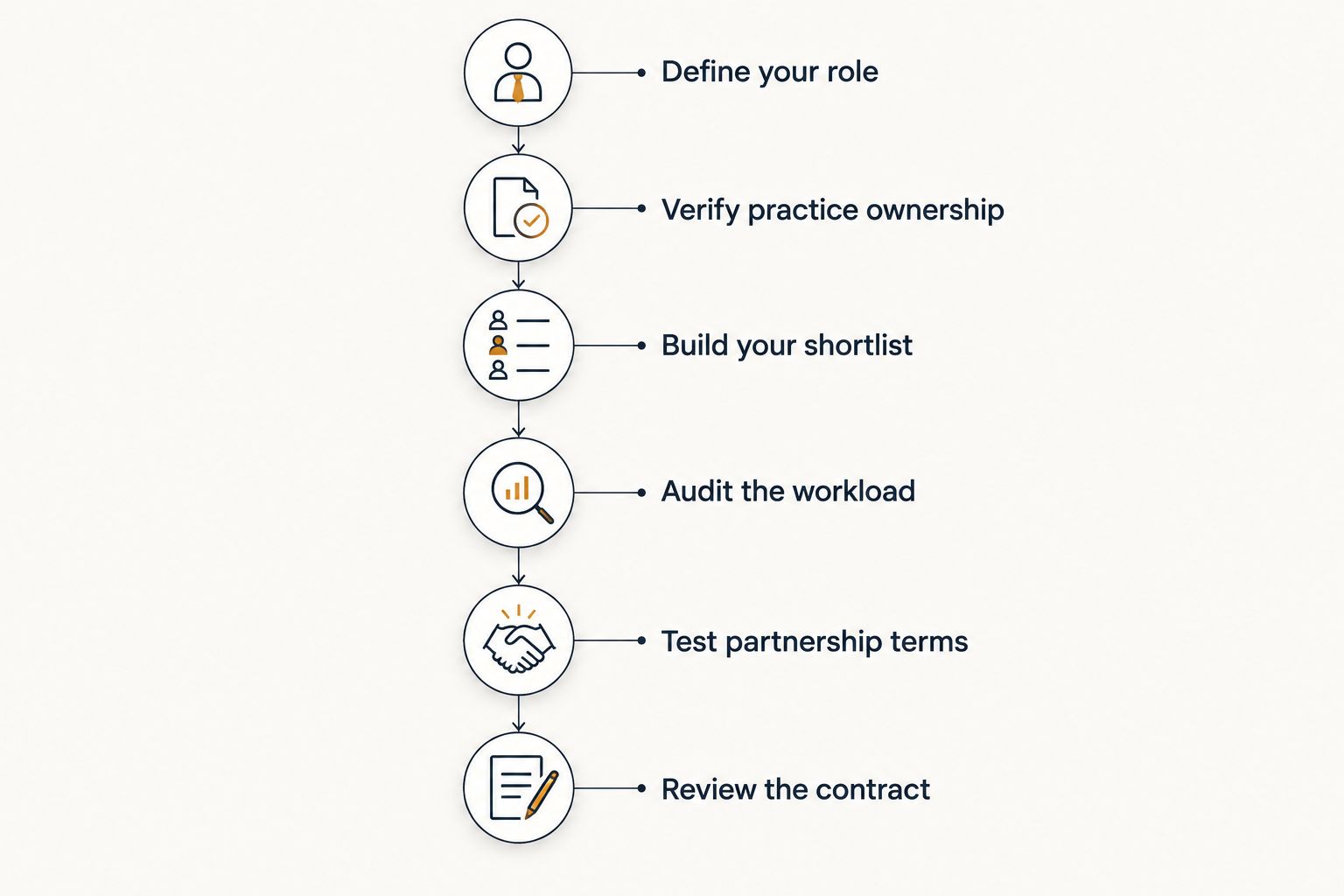
Define your role
Write a job specification for yourself before reviewing advertisements. Separate what you require from what you prefer, and describe each requirement in terms an employer can confirm. Replace a phrase such as reasonable call with the actual coverage arrangement you need.
Decide whether you want ownership responsibility or simply a clinical position in a physician-led environment. Those are different objectives. Ask yourself whether governance meetings, staffing decisions, and business oversight belong in your intended career, rather than treating partnership as the default measure of success.
For a first attending position, specify the support you need for unfamiliar studies and procedures. For a mid-career move, identify which current responsibilities you want to retain or leave behind. Neither question is answered by practice size alone.
Record your requirements in 4 categories: clinical scope, schedule, decision-making, and location. Mark each requirement as essential or negotiable so you can reject a mismatch without repeatedly revisiting it.
- Define acceptable modalities, procedures, and subspecialty responsibilities.
- State your limits for evenings, weekends, holidays, and travel.
- Identify your preferred associate, partnership-track, or contractor arrangement.
- Specify the consultation and onboarding support you need.
- Record location requirements and acceptable worksite changes.
Verify practice ownership
Ask who owns the employing entity and who has authority over its decisions. Then distinguish ownership of the professional practice from ownership of imaging equipment, real estate, or other affiliated businesses. Do not assume an ownership offer includes every asset associated with the group.
Request an organizational explanation that names the relevant entities and decision-makers. If a management company is involved, ask which responsibilities it performs and which decisions remain with physicians. The useful question is not whether the structure sounds independent; it is who can change your working conditions.
Also ask how ownership changes would affect your proposed role. Request the applicable agreement language rather than accepting a general assurance that nothing will change. Have qualified counsel interpret provisions affecting a sale, merger, or change in control.
Verify voting rights separately from economic participation. A distribution entitlement and authority over hiring, scheduling, or a sale are not interchangeable. Document what your proposed position includes and what remains outside it.
- Identify the legal employer and physician owners.
- Ask who controls staffing, schedules, and clinical policies.
- Separate practice equity from affiliated business interests.
- Request an explanation of management-company responsibilities.
- Review change-of-control provisions with counsel.
Build your shortlist
Start manually: review practice websites, contact professional colleagues, and record opportunities in a spreadsheet. Capture the employer, location, clinical scope, coverage requirements, and named contact. Leave unanswered fields blank rather than filling them with assumptions from an advertisement.
RadBoard aggregates 5,000+ radiology positions from 20 sources and provides search and swipe-to-save features. RadBoard is best for radiologists searching across multiple job sources before investigating individual practices. Use that broader search to identify leads, then confirm the details directly with each employer.
The limitation is straightforward: a job search platform does not replace ownership verification, workload review, or legal advice. Do not interpret a listing as confirmation of partnership rights or practice independence.
For your 2026 shortlist, keep the date you checked each opportunity and the source of each material claim. Consolidate repeated advertisements under the same employer when you confirm they describe the same position. This keeps your comparison focused on distinct jobs rather than advertisement volume.
- Search for private practice, physician-owned, and partnership-track language.
- Add subspecialty and geographic terms to narrow your search.
- Save relevant positions and record the original posting source.
- Confirm ownership and role details with the employer.
- Remove duplicate leads after checking the underlying position.
Audit the workload
Request a representative schedule and workload breakdown before comparing compensation structures. Ask for the latest 12 months of available scheduling information, with personal information removed, so your review includes leave coverage and seasonal variation rather than a single selected week.
Separate scheduled reading from the other work attached to the role. Protocoling, consultations, procedures, supervision, meetings, and travel need explicit discussion. A productivity target is not a complete description of your working day.
Ask how the group allocates difficult examinations, interruptions, and urgent cases. Then check who handles unfinished work at the end of a shift. If you expect subspecialty-focused reading, request the actual allocation method rather than relying on a subspecialist job title.
Discuss absence coverage in concrete terms. Ask what happens when a colleague takes leave, a position remains unfilled, or a worklist exceeds the planned staffing capacity. Your decision needs the normal schedule and the backup arrangement, not just the advertised hours.
- Request modality, procedure, and worksite breakdowns.
- Review evening, weekend, holiday, and backup assignments.
- Identify duties excluded from reported productivity measures.
- Ask how leave and vacancies affect remaining physicians.
- Confirm who owns unfinished work and urgent escalations.
Test partnership terms
Treat partnership as a proposed transaction, not a recruiting adjective. Request the eligibility criteria, approval process, governing documents, and explanation of the ownership interest under discussion. Ask which terms are established now and which remain subject to a later decision.
Compare the associate role with the prospective partner role. Identify changes in clinical duties, governance obligations, distributions, liability, and administrative work. If the group cannot explain those differences, you do not yet have enough information to evaluate the track.
Ask what happens if partnership is delayed or declined. Your employment decision should account for that outcome, including whether you can remain an associate and how departure would work. Do not make an unsuitable starting role acceptable solely because of a future promise.
Accept a partnership-track job only if the starting role also meets your requirements. Have your attorney and financial adviser examine the documents relevant to their expertise. Keep questions about ownership economics separate from questions about voting and operational authority.
- Request written eligibility and approval criteria.
- Identify the exact entity and interest offered.
- Compare associate and partner responsibilities.
- Ask how delayed or declined partnership affects employment.
- Review departure, redemption, and dispute provisions.
Review the contract
Read the employment agreement alongside the documents it incorporates. A schedule policy, compensation plan, or partnership policy referenced elsewhere still needs review. Ask which provisions the practice can change without your agreement and how it communicates those changes.
Use your comparison sheet to check the written offer against interview statements. Resolve discrepancies before signing, especially around clinical scope, call, work locations, leave, and administrative responsibilities. An unresolved difference belongs on your decision list, not in your memory.
Have an attorney qualified in the relevant jurisdiction review termination, restrictive covenants, insurance obligations, and any ownership documents. Ask the adviser to distinguish what the contract requires from what remains dependent on practice policy or discretion.
Finish with a practical start plan. Confirm credentialing responsibilities, required privileges, onboarding contacts, and what happens if the planned start is delayed. A signed agreement and permission to begin clinical work are separate milestones; clarify both before arranging your departure from another job.
- Reconcile written terms with recruitment statements.
- Review termination rights and notice obligations.
- Confirm malpractice coverage and responsibility after departure.
- Examine restrictions on future work with qualified counsel.
- Document credentialing, onboarding, and start-date dependencies.
Compare career arrangements before choosing a practice
For a 2026 decision, compare arrangements by the responsibilities you want, not by a presumed hierarchy. Each option below needs employer-specific confirmation; none establishes schedule quality, independence, or suitability by itself.
| Option | Best for | Principal advantage | Key limitation to investigate |
|---|---|---|---|
| Partnership-track associate | Radiologists seeking a defined route to ownership | Lets you assess a practice while pursuing ownership eligibility | Partnership depends on the written criteria and approval terms |
| Employed associate without an ownership track | Radiologists prioritizing clinical work over equity participation | Separates the employment decision from an ownership transaction | Decision-making rights depend on the employment and governance structure |
| Established partner opportunity | Radiologists ready to evaluate ownership responsibilities | Places governance and ownership terms directly in the decision | Requires review of financial, legal, and operational obligations |
| Part-time employee | Radiologists seeking a reduced clinical commitment | Establishes an employment arrangement around a defined workload | Call, meetings, and coverage need separate limits |
| Independent contractor | Radiologists seeking a specified service arrangement | Defines work through a services agreement | Requires separate review of classification, insurance, and administrative responsibilities |
Use the table to choose which arrangement deserves further investigation. Then compare actual documents within that category. A clear associate agreement is more useful to your decision than an attractive ownership label with unanswered terms.
Common mistakes small-practice job seekers make
Equating a small group with physician control
Headcount is not evidence of governance rights. Ask who approves staffing changes, service contracts, and a potential sale; then check whether your proposed role has any formal voice in those decisions.
Accepting a partnership timeline without approval criteria
A stated timeline does not explain who votes, what performance is required, or what happens after a deferral. Request the decision process and the documents governing admission before assigning value to the promise.
Comparing productivity without comparing case mix
An examination count does not describe the procedures, interruptions, consultations, or complexity attached to the work. Review the assignment mix and non-reading duties alongside any productivity expectations.
Interviewing only with recruiting partners
Ask to speak with physicians whose roles resemble the one you would enter, including associates where applicable. Use consistent questions about coverage, feedback, leave, and daily support so you can compare answers rather than impressions.
Leaving departure terms until the end
Review the exit before you commit to the entrance. Notice requirements, insurance responsibilities, restrictions, and ownership redemption terms belong in the initial decision because they define your obligations if the position stops fitting.
FAQ
What should I look for in a small private radiology practice job?
Look for a documented match between your clinical scope, schedule, ownership goals, and contract obligations. Confirm each element separately rather than treating practice size as proof of autonomy or manageable coverage.
Does a small private radiology practice job guarantee partnership?
No; the practice label does not establish a right to partnership. Request written eligibility criteria, the approval process, and the governing ownership documents.
Is RadBoard useful for finding small private radiology practice careers?
RadBoard is useful for searching across multiple sources: it aggregates 5,000+ radiology positions from 20 sources. Verify each employer's ownership, workload, and partnership terms directly before making a decision.
Can I join a private practice without becoming a partner?
You can pursue an employed associate role where the practice offers that arrangement. Confirm whether continued associate employment is permitted and how duties differ from partner responsibilities.
How do I check the call burden before accepting an offer?
Request a representative call schedule and the rules for backup, leave, vacancies, and holidays. Confirm whether associates and partners receive different assignments and whether coverage obligations appear in the contract.
Should a new attending choose a small private radiology practice?
Choose a small practice only when its clinical expectations and support match your needs. Ask who provides consultation, how unfamiliar cases are handled, and what onboarding includes.
What documents should I review before signing a partnership-track offer?
Review the employment agreement, incorporated policies, partnership eligibility terms, and applicable ownership agreements. Use qualified legal and financial advisers to assess obligations, decision rights, and departure provisions.
One last thing
Ask the practice to describe your role if partnership never happens. That question tests whether the position works as an actual job, not just as a future possibility. Request a written explanation of the associate duties, decision rights, and options after a declined or delayed partnership decision.
For your 2026 search, use RadBoard for radiology job discovery and direct employer conversations for verification. Keep those functions separate. A saved position is a lead; a documented match between your requirements and the agreement is the basis for a decision.