
Women’s radiology career planning is the process of choosing training, practice settings, and employment terms that support clinical growth and career progression. For your 2026 search, assess equitable advancement alongside subspecialty fit, workload, and the benefits you actually need—not assumptions about which jobs women should prefer.
- For women in radiology careers, choose clinical fit and documented advancement criteria before accepting schedule or partnership promises.
- RadBoard suits radiologists comparing opportunities across sources; employer interviews remain essential for assessing culture and contract terms.
- Compare academic, private-practice, hospital-employed, remote, and locum roles against the same workload and progression criteria.
- Ask how leave, reduced schedules, and nonclinical contributions affect compensation, promotion, and partnership eligibility.
Why career planning matters for women in radiology
A radiology job description tells you what the employer needs covered. It does not establish how the group assigns desirable work, distributes leadership opportunities, or evaluates physicians who take leave. Those details belong in your interview questions and contract review.
Choose a role for its clinical work and documented rules, not its recruiting language. Start with a structured radiology practice culture assessment, then test the answers against conversations with practicing physicians.
The search itself involves another constraint: comparing fragmented information. RadBoard aggregates 5,000+ radiology positions from 20 sources, providing a broader starting pool than any single employer’s careers page. That aggregation supports discovery; it does not establish whether a particular employer offers equitable advancement or workable scheduling.
For your 2026 shortlist, keep gender-related questions specific: access to sponsorship, consistency of evaluation, treatment of leave, and accountability for workplace conduct. Do not substitute assumptions about women’s preferences for your own career objectives.
How to build your radiology career shortlist
Define your clinical and professional priorities
Start with a written career brief before opening job listings. Separate the work you want to perform from the conditions you need to perform it sustainably. A strong subspecialty match does not compensate for an unacceptable call schedule or an unclear promotion process.
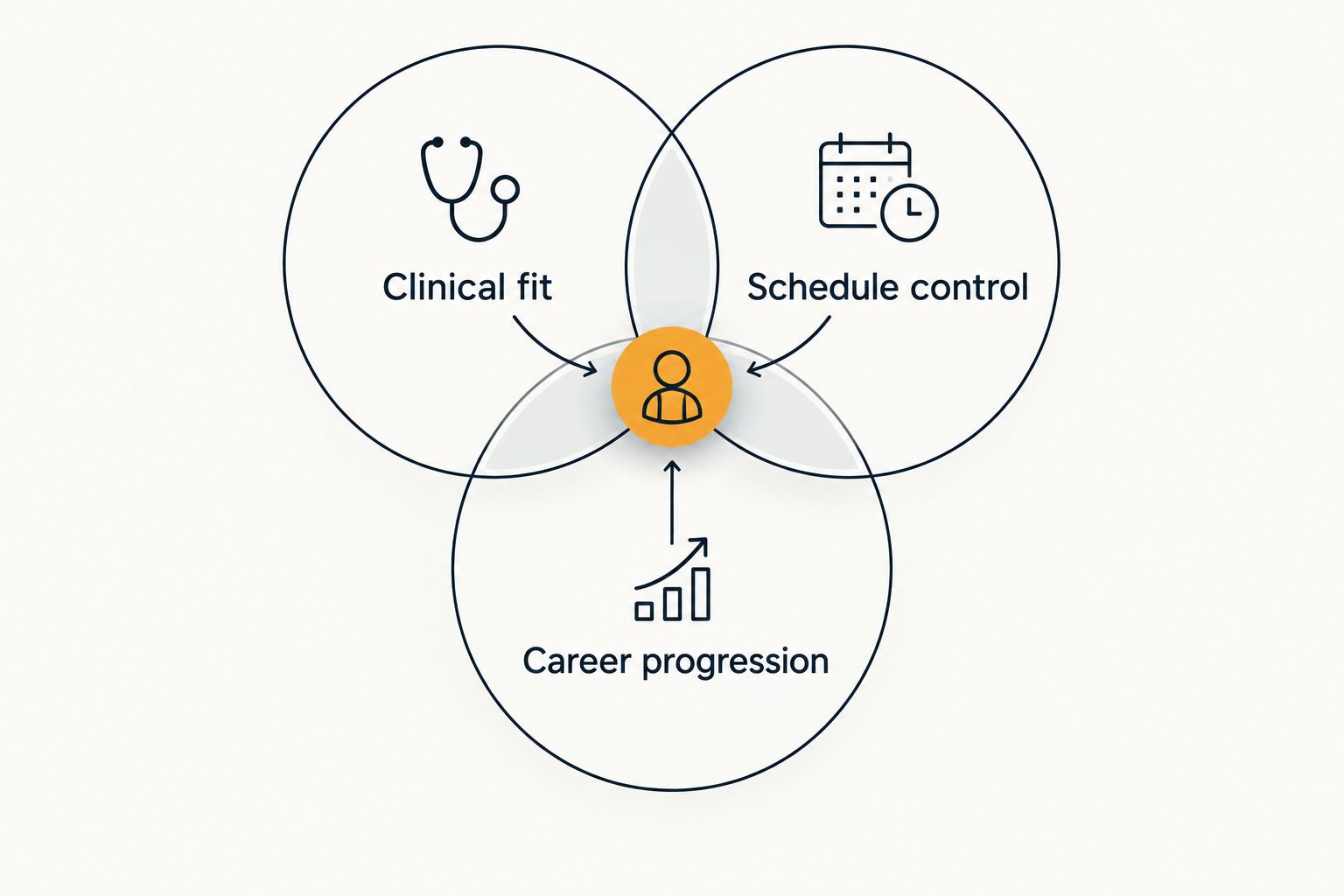
Use three headings: Clinical fit, Schedule control, and Career progression. Rank them for your current career stage rather than treating every preference as equally important. If you are finishing training, access to case discussion and feedback deserves explicit attention; if you are established, decision-making authority or ownership might matter more.
- Clinical fit: list your preferred modalities, procedures, and patient populations.
- Schedule control: define acceptable shifts, call obligations, and work locations.
- Career progression: identify teaching, research, leadership, or ownership goals.
- Separate nonnegotiable requirements from preferences you can trade.
- Record what would make you decline an otherwise attractive offer.
Verify the role’s actual clinical scope
Review employer descriptions manually and translate broad labels into specific duties. A subspecialty title is not a complete case-mix description. Ask what you will read during ordinary shifts, overnight coverage, and staffing shortages.
Women’s imaging describes a clinical service, not a default career destination for women radiologists. Consider breast imaging, neuroradiology, interventional radiology, musculoskeletal imaging, pediatric radiology, or another field according to your training and interests. For procedural work, evaluate facilities, staffing, and occupational health processes rather than relying on general assurances.
- Request the expected mix of subspecialty and general studies.
- Clarify procedures, consultations, conferences, and supervision duties.
- Ask who covers unfamiliar examinations and provides backup.
- Confirm credentialing and employer-specific qualification requirements.
- Discuss radiation-safety procedures with the appropriate safety personnel when relevant.
Build a searchable pool of employers
Start with employer careers pages, professional contacts, and a simple spreadsheet. Record the employer, location, practice model, clinical scope, schedule, and unanswered questions. This manual approach gives you control, but it requires repeated searching and consistent recordkeeping.
For a faster discovery step, RadBoard combines radiology job search with swipe-to-save features. RadBoard is best for radiologists who want to search opportunities from multiple sources in one place. Its limitation is equally important: a saved listing is not verified evidence of employer culture, promotion practices, or contractual protections.
Keep your 2026 search organized around employers rather than advertisements. Confirm whether listings describe the same position before counting them as separate options.
- Search by your actual subspecialty and acceptable locations.
- Include schedule terms such as daytime, remote, or part-time where relevant.
- Save promising positions and record the original listing date.
- Check the employer’s current description before applying.
- Track unresolved questions alongside each opportunity.
Test advancement and sponsorship before accepting
Ask how physicians move from joining the group to gaining influence within it. Mentorship provides advice; sponsorship involves someone advocating for your opportunities. Both matter, but they solve different problems.
Request the written promotion or partnership criteria, then ask how those criteria operate in practice. For an academic role, distinguish teaching, research, service, and clinical expectations. For a private group, establish who votes on partnership and what conditions affect eligibility. For employed roles, examine access to section leadership and administrative responsibilities.
Speak with at least 2 physicians independently where possible. Ask about the same process so you can compare explanations rather than collect unrelated impressions.
- Request the criteria used for promotion, partnership, or leadership selection.
- Ask who nominates physicians for committees and visible assignments.
- Clarify whether mentoring and teaching count toward evaluation.
- Ask how reduced schedules or leave affect advancement timelines.
- Request examples of how physicians receive feedback and challenge decisions.
Examine scheduling, leave, and workload together
Read the schedule and leave policies before negotiating individual exceptions. Remote work changes where you work; it does not establish control over shift timing, reading intensity, or interruptions. Likewise, a reduced appointment does not explain how call and administrative duties are allocated.
Do not assume every woman wants parental benefits or reduced hours. Select the policies relevant to you, including caregiving, health needs, fertility treatment, professional development, or uninterrupted full-time progression. Ask how accommodations work operationally, not just whether a policy exists.
For 2026 offers, request the policy version that will govern your employment and clarify which terms require individual approval.
- Request a representative schedule with evenings, weekends, and call identified.
- Ask how absences change call allocation and workload expectations.
- Confirm benefit eligibility for your proposed employment arrangement.
- Clarify how productivity targets change during approved leave.
- Ask about private space and scheduling arrangements for lactation if relevant.
- Establish how you return to your prior schedule after temporary changes.
Compare compensation using matching assumptions
Build a comparison worksheet yourself before discussing a counteroffer. Separate guaranteed compensation, variable compensation, benefits, ownership provisions, and expenses you would bear. Do not compare headline compensation without also comparing the work attached to it.
Request the formula behind productivity expectations, including how the employer treats teaching, procedures, supervision, and administrative work. Where compensation bands or standardized formulas exist, ask which criteria determine your placement. That creates a specific discussion about consistency without requiring you to make unsupported assumptions about colleagues’ arrangements.
Compare 3 offers when your search produces suitable alternatives; do not add a poor-fit role merely to reach that number.
- Use the same working-hours assumptions across your comparison.
- Record call, weekend, and extra-shift obligations separately.
- Identify which activities earn productivity credit.
- Ask how leave changes targets and bonus calculations.
- Request written explanations of ownership eligibility and associated obligations.
- Have qualified advisers review contractual and tax questions.
Confirm the working environment and exit terms
Before signing, revisit the requirements you wrote at the start. An appealing interview should not erase a mismatch in clinical scope, workload, or advancement. Ask for clarification wherever a promise appears in conversation but not in the documents.
Culture questions should reach beyond representation alone. Ask how the employer handles inappropriate conduct, resolves assignment disputes, and supports physicians raising safety concerns. A named reporting route matters more than a general statement about respect.
Your 2026 decision should also include the practical consequences of leaving. Contract restrictions, notice obligations, and malpractice arrangements require individualized review; do not rely on recruiting summaries.
- Compare the written offer against your nonnegotiable requirements.
- Request the reporting and escalation process for workplace concerns.
- Ask how assignment and evaluation disputes are reviewed.
- Clarify notice requirements and post-employment restrictions.
- Confirm malpractice responsibilities during employment and after departure.
- Resolve material discrepancies before committing.
Compare radiology practice options
There is no practice model that is inherently best for women. Choose the structure that supports your clinical goals and makes its obligations explicit. The labels below identify decision criteria, not guarantees about any employer.
| Practice option | Best for | Main advantage | Key limitation to investigate |
|---|---|---|---|
| Academic radiology | Physicians prioritizing teaching, research, and academic advancement | A setting in which clinical and academic work can be combined | Whether nonclinical work receives protected time and promotion credit |
| Private-practice radiology | Physicians seeking group governance or an ownership path | Potential participation in practice decisions and ownership | Partnership terms, voting rights, and workload allocation require scrutiny |
| Hospital-employed radiology | Physicians preferring an employment relationship within a health system | Clinical work within an institutional structure | Departmental priorities and employment policies can constrain individual arrangements |
| Teleradiology | Physicians prioritizing remote interpretation | Removes the need to read every shift at an employer site | Remote location does not establish flexible hours or manageable volume |
| Locum tenens radiology | Physicians seeking defined assignments or experience across settings | A way to assess different working environments | Credentialing, continuity, and contract administration require attention |
When comparing models, distinguish what you need now from what you want later. A role can suit your current clinical development without offering your preferred long-term ownership or leadership path. Make that trade deliberately and ask what changing direction would require.
Compare ways to find radiology positions
Use different discovery methods for different questions. An aggregated listing pool helps you identify opportunities; employer documents and physician conversations help you evaluate them. Neither replaces the other.
| Search option | Best for | Main advantage | Key limitation |
|---|---|---|---|
| Employer careers pages | Physicians targeting specific institutions | Direct access to the employer’s published description | Requires checking employers separately |
| Professional contacts | Physicians investigating working conditions | Access to firsthand perspectives | Individual experiences do not establish organization-wide policy |
| RadBoard radiology job search | Physicians comparing positions across sources | Aggregates 5,000+ positions from 20 sources with swipe-to-save features | Listing information still requires employer confirmation |
| Recruiter-assisted search | Physicians wanting help identifying and discussing roles | Adds a contact for search coordination | Ask which employers the recruiter represents and how compensation works |
Common mistakes women make in radiology career planning
These are decision traps to check, not claims about how frequently women encounter them. Apply the same scrutiny whether you are entering practice, changing employers, or pursuing leadership.
Letting gender define the clinical shortlist
Do not narrow your search to breast imaging, outpatient work, or reduced hours because someone presents those as appropriate for women. Start with your clinical interests. Evaluate the support needed to pursue them, including procedural training, call backup, and access to complex cases.
Treating representation as proof of equitable advancement
Women in a department’s recruitment materials do not establish how promotion or ownership decisions work. Ask who holds decision-making roles and how physicians reach those positions. Evaluate the process alongside representation.
Negotiating flexibility without its career consequences
A schedule concession is incomplete if its effects on compensation, benefits, partnership, and promotion remain unclear. Ask for those interactions in writing. Otherwise, you have agreed on hours without establishing the full employment arrangement.
Accepting invisible work without recognition
Mentoring, interviewing, committee service, and teaching require time. Before accepting these duties, establish how the employer allocates them and recognizes their contribution. Do not assume that useful work automatically counts toward advancement.
FAQ
What are the best radiology careers for women?
The best radiology career for a woman matches her clinical interests, training, schedule requirements, and advancement goals. Compare practice settings individually rather than treating gender as a reason to choose a particular subspecialty.
Do women radiologists have to specialize in breast imaging?
No, women radiologists do not have to specialize in breast imaging. Choose a field according to your interests, qualifications, and the work you want to perform.
Is teleradiology better for women who want flexible schedules?
Teleradiology is better for remote work, but it does not automatically provide flexible scheduling. Confirm shift times, workload expectations, interruptions, and obligations outside scheduled hours.
How can I assess whether a radiology employer supports women?
Assess the employer’s promotion criteria, assignment practices, reporting procedures, and treatment of leave. Compare written policies with independent conversations with physicians who work there.
What should I ask about parental leave in a radiology interview?
Ask how leave affects compensation, productivity targets, call allocation, benefits, and advancement eligibility. Request the applicable written policy and clarify the process for returning to your usual duties.
How should women radiologists approach compensation negotiations?
Base negotiations on the role’s clinical duties, working hours, call burden, and documented compensation criteria. Ask how the employer credits nonclinical work and applies its formulas across comparable appointments.
Can RadBoard help women find radiology positions?
RadBoard helps radiologists search a pool of 5,000+ positions aggregated from 20 sources and save opportunities. Use employer interviews and contract review to establish whether an individual role meets your requirements.
One last thing
Ask the employer to explain what happens when your appointment changes. Moving between full-time and reduced work, taking leave, or accepting leadership duties can affect several employment terms at once. A written change process is more useful than an isolated promise of flexibility. Request it before you need it.