
Nuclear medicine physician career planning is the process of matching molecular imaging, radionuclide therapy, and clinical responsibilities to your qualifications and professional goals. This 2026 guide explains how to compare practice settings, verify eligibility, assess treatment infrastructure, and evaluate offers without confusing a job title with its actual scope.
- Nuclear medicine physician careers require matching credentials to PET/CT, SPECT, therapy, and any general radiology responsibilities.
- RadBoard is best for radiologists comparing nuclear medicine career opportunities across multiple job sources.
- Evaluate theranostics jobs by treatment infrastructure, patient-care responsibilities, and authorized-user requirements—not the title alone.
- Compare academic, hospital-employed, private-practice, locum tenens, and industry roles against your preferred clinical scope.
Why career planning matters for nuclear medicine physicians
A nuclear medicine job title does not establish the work you will perform or the privileges you will receive. A position advertised around PET/CT can include general diagnostic imaging, while a molecular imaging position can combine interpretation, treatment consultations, and follow-up care.
Start with the clinical scope. The guide to nuclear medicine radiologist jobs for PET and SPECT readers addresses interpretation-focused searches; use the steps below to distinguish those roles from therapy-centered positions.
Your 2026 search should answer two separate questions: Does the employer accept your training pathway, and does the actual workload support the career you want? Neither answer follows automatically from a specialty label.
Unlike a reading-only search, a therapy-focused search also requires questions about patient management, radiation safety, treatment facilities, and clinical backup. Resolve those issues before comparing offers.
Build your nuclear medicine career search
Define your preferred clinical scope
Write your ideal job description before reviewing advertisements. Separate work you want to perform from work you are qualified to perform but do not want as a regular responsibility.
Nuclear medicine includes diagnostic imaging and therapeutic applications of radiopharmaceuticals. Those activities overlap clinically, but they create different schedules and patient-care obligations. PET/CT interpretation is not interchangeable with managing a radionuclide therapy service.
Create a 1-page scope statement for your 2026 search. Treat it as a decision document, not an application attachment: its purpose is to prevent an attractive title from obscuring an unsuitable workload.
- Specify the PET/CT, SPECT, and other nuclear medicine studies you want to interpret.
- State whether you want diagnostic work, radionuclide therapy, or both.
- Identify acceptable general radiology responsibilities separately.
- Define your preferences for consultations, teaching, research, and leadership.
- Mark onsite attendance, travel, and call requirements as acceptable or unacceptable.
Verify your credentials against the actual duties
Ask the employer to review your qualifications against the proposed scope before arranging extensive interviews. Board certification, state licensure, hospital privileges, and radioactive-materials authorization address different requirements.
The American Board of Nuclear Medicine and the American Board of Radiology provide distinct certification pathways. Do not assume an employer treats those pathways as interchangeable for every assignment, particularly when the job includes diagnostic CT interpretation or broad radiology coverage.
For work involving licensed radioactive material, confirm the applicable Nuclear Regulatory Commission or Agreement State requirements. Board certification alone is not a substitute for confirming the authorization required for the proposed duties. Ask the facility's radiation safety officer and credentialing team to identify the documentation they need.
- Send an accurate summary of completed training and current certifications.
- Ask which qualifications are required rather than preferred.
- Identify privileges needed for diagnostic interpretation and therapeutic work.
- Confirm authorized-user requirements for the specific activities involved.
- Request a written list of credentialing gaps before committing to a start date.
Search by clinical function, not just specialty title
Start manually with employer career pages and a spreadsheet. Search for nuclear medicine physician, molecular imaging physician, PET/CT physician, and theranostics physician, then inspect the duties rather than relying on the search result headline.
RadBoard provides another search route, aggregating 5,000+ radiology positions from 20 sources and offering search and swipe-to-save features. That total describes the broader radiology collection, not the number of nuclear medicine openings or positions matching your credentials.
RadBoard is best for radiologists comparing nuclear medicine career opportunities across multiple job sources. Use the platform for discovery, then confirm clinical scope and application details with the employer. Aggregation does not establish your eligibility for a position.
| Search option | Best for | Advantage | Key limitation |
|---|---|---|---|
| Employer career pages | Physicians targeting specific institutions | Direct review of the employer's published requirements | Requires separate searches across employers |
| RadBoard | Radiologists comparing opportunities across sources | Aggregates radiology positions and supports saving opportunities | The overall collection is not a nuclear medicine vacancy count |
| Direct professional outreach | Physicians investigating a defined clinical niche | Supports specific questions about scope and service development | A conversation does not establish an opening or an offer |
- Search both specialty names and clinical functions.
- Record the employer, location, duties, and application contact.
- Check whether similar advertisements describe the same position.
- Confirm that the employer is still recruiting before investing interview time.
- Save the original description so you can compare it with the eventual contract.
Test the clinical infrastructure behind the position
A therapy-centered role needs more than an interpretation workstation. Ask how the practice handles referrals, patient assessment, treatment delivery, radiation safety, and follow-up.
For a diagnostic role, investigate the reading environment, technologist support, prior-study access, and communication with referring clinicians. For combined roles, establish who covers the reading list while you are seeing patients or supervising treatment.
Evaluate the service that exists, not only the service the employer intends to build. In a 2026 interview, separate current responsibilities from proposed expansion. A development role requires agreement about support, authority, and how success will be assessed.
- Request a sample clinical schedule covering imaging and treatment duties.
- Ask who handles patient eligibility assessment and treatment counseling.
- Confirm nursing, technologist, medical physics, and radiation safety support.
- Identify responsibility for urgent clinical questions and treatment complications.
- Ask how radiopharmaceutical supply interruptions affect scheduling and coverage.
- Establish which resources are operational and which remain proposed.
Compare workloads using the same definitions
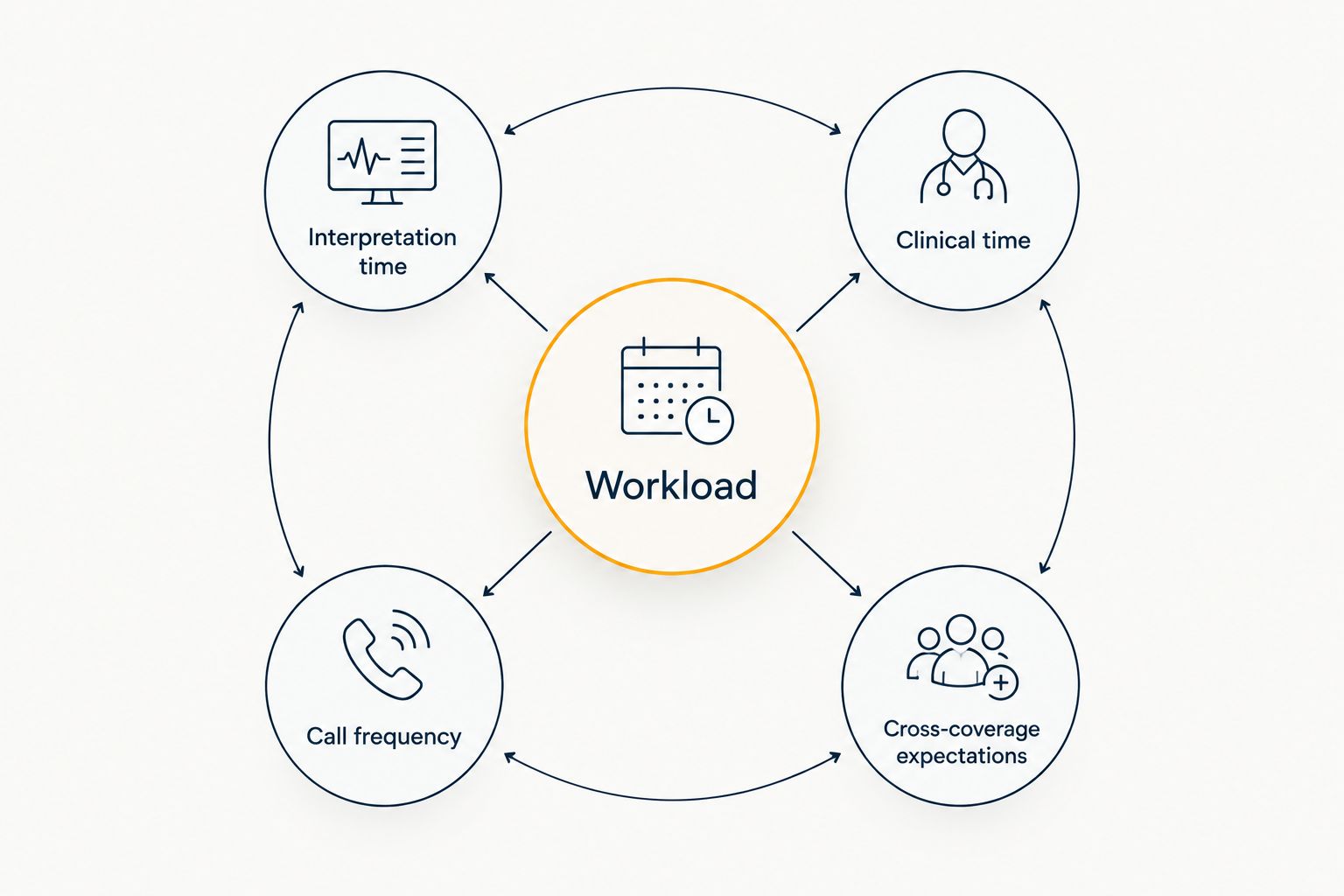
Ask each employer to describe workload in terms you can compare. A study count alone does not capture consultations, protocol decisions, supervision, teaching, or therapy-related documentation.
Choose 3 representative roles for an initial side-by-side review. This is a search exercise, not a market benchmark: the purpose is to expose differences that disappear when you compare titles alone.
Ask for a representative 1-week schedule, including time outside the reading room. If productivity measures apply, request the method used to credit treatment visits, multidisciplinary meetings, and other assigned work. Do not assume that non-interpretive responsibilities receive separate recognition.
- Separate interpretation time from patient-facing clinical time.
- Record call frequency, weekend duties, and cross-coverage expectations.
- Ask how absences and unfilled shifts change your workload.
- Identify whether teaching and research have scheduled time.
- Request the productivity definitions used for the proposed position.
Match the practice setting to your career objective
Compare settings by the work and professional development you want. An academic title does not establish protected research time, and a private-practice title does not establish an ownership opportunity.
For a therapy-focused career, ask how the service connects with oncology, endocrinology, referring physicians, and the broader treatment team. For an interpretation-focused career, determine how much of the assignment remains within nuclear medicine.
Nonclinical roles require a separate assessment. Clinical expertise is relevant to research and product development, but you must still establish the role's scientific, operational, or regulatory responsibilities. Choose the setting that supports your intended work, not the setting with the most appealing label.
- Ask how the position supports your preferred clinical focus.
- Request written teaching, research, or service-development expectations.
- Identify mentorship and backup for unfamiliar responsibilities.
- Clarify promotion, leadership, or ownership criteria where relevant.
- Discuss how the role would change if referral patterns or staffing change.
Review the offer against the promised scope
Compare the written offer with the advertisement, interview notes, and sample schedule. Resolve discrepancies before signing, especially when the job combines interpretation, treatment, leadership, or service development.
For a 2026 offer, review compensation structure alongside workload definitions, benefits, leave, malpractice arrangements, termination terms, and outside-work restrictions. Have a qualified attorney review contractual obligations and a qualified adviser assess tax questions where needed.
Ask who controls changes to your clinical assignment. A position built around nuclear medicine can become a broader coverage role if the agreement leaves duties undefined. Written clarity matters more than an informal assurance.
- Confirm the employing entity, practice sites, and reporting relationship.
- Match the stated duties to your agreed clinical scope.
- Review productivity measures and treatment-related responsibilities together.
- Establish malpractice coverage and responsibility after employment ends.
- Clarify notice requirements, restrictive provisions, and outside clinical work.
- Obtain written confirmation of material commitments before accepting.
Compare nuclear medicine career settings
These are career pathways to investigate, not a ranking of employers. The best fit depends on your credentials, preferred patient contact, and tolerance for duties outside your core specialty.
| Career option | Best for | Potential advantage | Key limitation to investigate |
|---|---|---|---|
| Academic nuclear medicine | Physicians seeking teaching and research | Combines clinical work with scholarly activity | Protected time and promotion expectations require explicit agreement |
| Hospital-employed practice | Physicians seeking an integrated clinical service | Connects imaging and therapy with hospital-based care | Duties can extend across departments or sites |
| Private-practice radiology group | Appropriately qualified physicians seeking group practice | Offers a route to combine subspecialty work with broader practice | General radiology coverage and ownership terms vary |
| Locum tenens nuclear medicine | Physicians seeking defined temporary assignments | Allows comparison of different clinical environments | Each assignment requires scope and credentialing review |
| Theranostics-focused service | Physicians seeking treatment-centered work | Emphasizes radiopharmaceutical treatment and patient management | Requires scrutiny of staffing, facilities, and clinical responsibilities |
| Industry or clinical research | Physicians seeking work beyond routine clinical practice | Applies specialty knowledge to scientific or product-related work | Requires role-specific skills beyond clinical interpretation |
No practice setting wins on every criterion. Use the table to narrow your search, then test the specific employer's schedule, support, and contract against your priorities.
Common mistakes nuclear medicine physicians make
Treating PET/CT and general radiology eligibility as identical
A nuclear medicine position can include duties outside your training or intended privileges. Ask who interprets the diagnostic CT component and which additional modalities the assignment includes; resolve the scope before applying broadly.
Accepting a theranostics title without a service plan
Treatment responsibilities require a clear patient-care workflow. Ask who manages referrals, counseling, treatment-day care, follow-up, and urgent questions, then confirm which responsibilities belong to you.
Comparing interpretation counts while ignoring clinical work
A reading list does not describe the full job when consultations, treatments, supervision, and meetings are also assigned. Put those duties into the same schedule before judging workload.
Assuming specialty work will remain protected
An interview promise is not a durable scope agreement. Clarify whether general coverage can replace nuclear medicine sessions and who approves changes to your assignment.
Using an aggregate listing count as a specialty demand measure
A broad radiology collection does not establish nuclear medicine demand in your preferred location. Count distinct, suitable employer opportunities in your own shortlist rather than treating every search result as a separate match.
FAQ
What are the main nuclear medicine physician career options?
Nuclear medicine physicians can investigate academic, hospital-employed, private-practice, locum tenens, therapy-focused, and industry roles. Eligibility depends on the duties, training requirements, privileges, and authorizations attached to each position.
Can a nuclear medicine physician work in a radiology group?
A nuclear medicine physician can work in a radiology group when the position's requirements and privileges match the physician's qualifications. Confirm whether the assignment includes general radiology or diagnostic CT interpretation beyond the nuclear medicine scope.
Is dual board certification required for every nuclear medicine job?
Dual board certification is not a universal requirement for every nuclear medicine position. Ask the employer to identify required certifications and explain how those requirements relate to the actual clinical duties.
Can nuclear medicine physicians work remotely?
Some interpretation responsibilities can be performed remotely when licensing, privileges, technology, and employer requirements permit. Do not assume remote interpretation also covers the onsite responsibilities of a treatment service.
What should I ask before accepting a theranostics job?
Ask about patient selection, treatment responsibilities, authorized-user requirements, staffing, facilities, and follow-up coverage. Distinguish the operating service from proposed expansion and obtain clear expectations for both.
How should I compare nuclear medicine physician job offers?
Compare clinical scope, schedule, call, support, productivity definitions, compensation structure, and contractual obligations. Review interpretation and patient-care responsibilities together rather than judging the offer by a headline figure.
Is RadBoard useful for nuclear medicine physician careers?
RadBoard is useful for radiologists searching across multiple job sources and saving career opportunities. Its broader radiology listing collection does not establish how many nuclear medicine positions match your credentials, location, or preferred duties.
One last thing
Ask every finalist employer: Who covers my reading list while I am seeing a therapy patient? The answer exposes how the practice handles competing clinical responsibilities. A clear coverage plan tells you more about the working day than a specialty title alone.