An emergency radiologist career is a physician career focused on urgent diagnostic imaging, with the aim of supporting timely emergency care. This 2026 guide explains how to choose among hospital, academic, remote, and temporary roles by examining case mix, coverage responsibilities, schedules, and contract terms.
- Build your emergency radiologist career around case mix, clinical backup, and shift sustainability—not the job title alone.
- RadBoard suits radiologists comparing opportunities across sources; verify emergency coverage requirements directly with each employer.
- Compare emergency radiology jobs by reporting responsibility, staffing, schedule, and contract terms.
- Treat remote work and schedule flexibility as separate questions; confirm both before accepting teleradiology jobs.
Why emergency radiology career planning matters
Emergency radiology work combines image interpretation with urgent communication, prioritization, and handoffs. A position described as emergency coverage does not, by itself, tell you whether you will read trauma studies, cover inpatient examinations, supervise trainees, or manage several hospital worklists.
Start with the actual responsibilities in emergency radiology jobs, not the specialty label. Your strongest match is the position whose clinical scope, support, and schedule fit your capabilities and constraints.
For your 2026 search, separate employment structure from working conditions. Hospital employment does not specify night coverage, and remote work does not specify control over shifts. Evaluate the work you will perform before comparing the employment model.
How to build an emergency radiologist career
Use these seven steps to move from career preferences to a defensible offer decision. Keep a written comparison sheet: an unanswered question about backup, workload, or reporting responsibility should remain visibly unresolved rather than becoming an assumption.
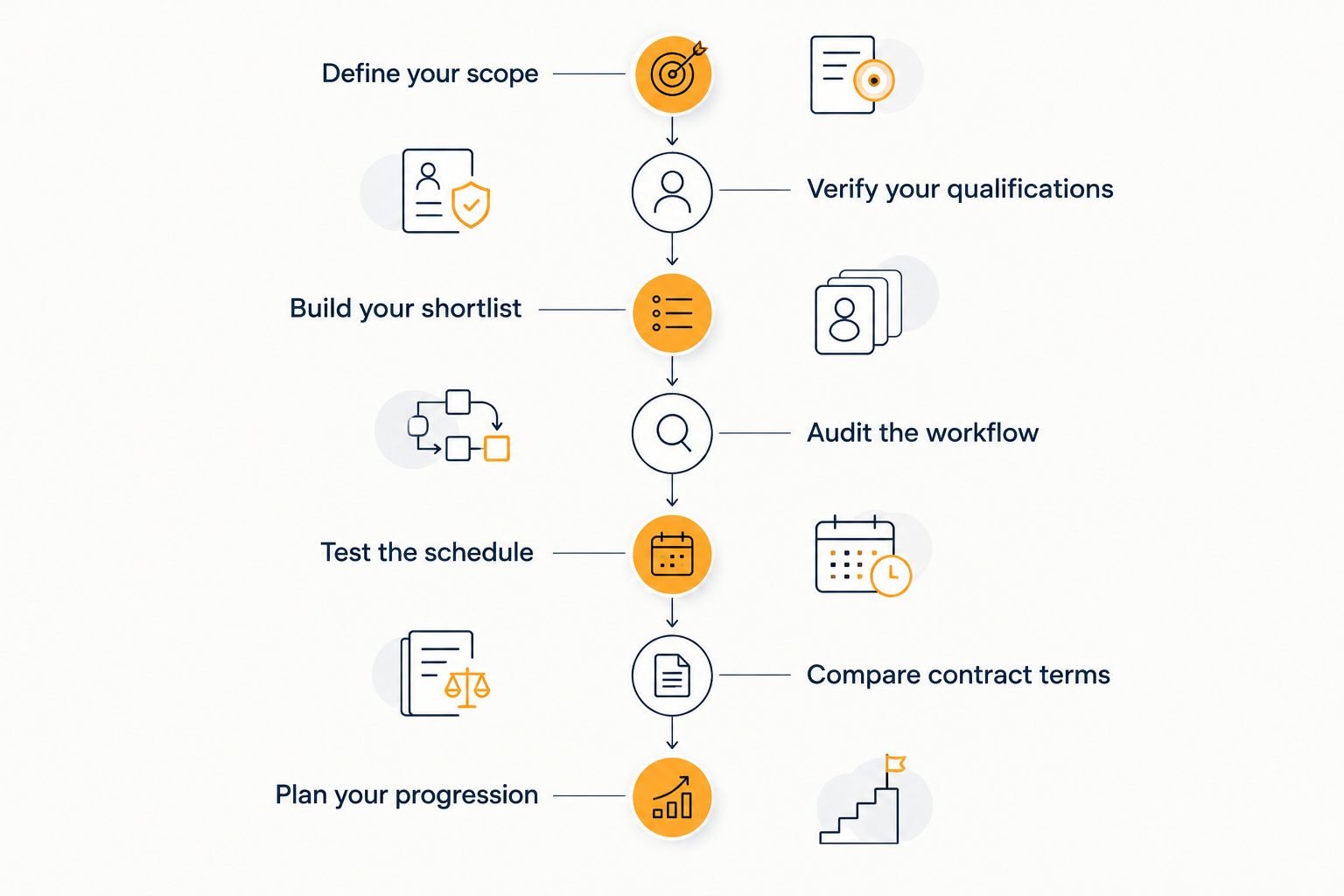
Define your scope
Write a clinical scope statement before searching. Specify whether you want adult emergency imaging, pediatric emergency work, trauma coverage, or a mixed emergency and inpatient assignment.
Separate diagnostic interpretation from procedural responsibilities. Reading vascular imaging does not establish an interventional role, and an emergency department assignment does not establish who performs procedures or handles onsite contrast reactions. Ask the employer to describe responsibilities rather than inferring them from the service name.
Your scope statement should also distinguish work you perform independently from work requiring consultation. This gives recruiters a usable brief and helps you reject mismatched roles before interviews.
- List the modalities and body regions you will cover independently.
- State whether pediatric imaging belongs in your desired scope.
- Identify procedures and onsite duties you will accept.
- Record 3 nonnegotiables, such as clinical scope, location, and shift pattern.
Verify your qualifications
Compare your documented training and experience with each employer's requirements. Emergency radiology fellowship training, board status, recent clinical practice, and hospital privileges are distinct questions; do not treat one as a substitute for another.
If you are finishing training, ask how the practice supports your transition to independent coverage. If you are changing subspecialties, describe recent emergency imaging experience accurately rather than presenting older exposure as current proficiency.
For remote or multisite positions, request the actual licensing and credentialing requirements. Confirm eligibility before committing to a start date. The employer's onboarding plan should identify responsibilities for applications, documentation, and outstanding approvals.
- Update your CV with relevant rotations, fellowships, and current practice scope.
- Prepare a de-identified case summary without patient information.
- Confirm board-status, licensure, and privilege requirements directly.
- Ask who coordinates credentialing and tracks unresolved items.
Build your shortlist
The manual approach is a spreadsheet built from employer career pages and recruiter conversations. Record the employer, hospital sites, clinical scope, shifts, reporting responsibility, and unresolved questions. Group duplicate advertisements under the same underlying position.
For broader discovery, RadBoard aggregates 5,000+ radiology positions from 20 sources and provides search and swipe-to-save features. Those figures describe the platform's overall radiology coverage, not the number of emergency radiology positions.
RadBoard is best for radiologists who want to compare radiology jobs across multiple sources. Its value is discovery; an aggregated listing does not establish current staffing, credentialing eligibility, or the terms you will receive. Confirm those details with the employer during your 2026 search.
- Search emergency radiology, trauma radiology, overnight coverage, and emergency department coverage.
- Save positions matching your scope statement, not every relevant title.
- Check whether similar listings describe the same assignment.
- Track employer-confirmed details separately from advertisement language.
Audit the workflow
Request a walkthrough of an ordinary shift and a difficult shift. Ask how examinations enter the worklist, how priorities change, and who responds when urgent studies arrive while you are discussing another critical finding.
Distinguish preliminary from final interpretation. Establish who receives discrepancy notifications, who contacts treating clinicians, and who owns unresolved communication at handoff. A turnaround expectation without a staffing and escalation explanation is an incomplete description of the job.
Workload assessment also needs more than an examination count. Ask for modality mix, study complexity, interruptions, and simultaneous site coverage. Review representative de-identified workload information where available; do not substitute a recruiter's adjective for operational detail.
- Request worklist and reporting-system demonstrations.
- Confirm preliminary versus final reporting responsibilities.
- Identify subspecialty backup and the escalation route.
- Ask how critical-result communication and shift-end handoffs are documented.
Test the schedule
Translate the proposed schedule into your local time and your household calendar. For remote work, distinguish the employer's stated coverage zone from where you will physically read. Ask how daylight saving changes affect the assignment.
A block schedule is not a complete schedule description. You also need shift duration, consecutive shifts, weekend and holiday allocation, extra coverage expectations, and recovery time. Do not assign value to time off until you understand whether meetings, administrative work, or additional coverage occupy it.
For a 2026 offer, request a representative calendar rather than relying on a verbal description. Remote location does not equal flexible scheduling.
- Map proposed shifts onto a full calendar month.
- Mark protected recovery time and family commitments.
- Ask who covers sickness, vacancies, and unexpected absences.
- Confirm how schedule changes are approved and communicated.
Compare contract terms
Start with a side-by-side worksheet before negotiating individual clauses. Separate guaranteed compensation from productivity-dependent compensation, and ask how the employer defines credited work. Compare equivalent clinical commitments rather than headline compensation alone.
Emergency coverage also requires clear boundaries around additional shifts, site expansion, and changes in case mix. Have a healthcare employment attorney review the agreement, including termination, restrictions, malpractice coverage, and any responsibility for tail coverage.
If you are considering independent contracting, obtain tax and insurance advice specific to your circumstances. Do not treat an employee offer and a contractor offer as equivalent because their headline compensation looks similar.
- Request the complete compensation formula and payment conditions.
- Clarify additional-shift obligations and schedule-change provisions.
- Review malpractice coverage, exclusions, and post-departure responsibilities.
- Obtain written clarification of promises that affect your decision.
Plan your progression
Choose the next role with a subsequent role in mind. Emergency radiology progression can involve clinical specialization, teaching, quality improvement, operations, or leadership; identify which work you want to develop rather than relying on a promotion title.
Ask who controls protocols, peer learning, staffing decisions, and workflow improvement. If you want academic work, confirm how teaching and research responsibilities fit into your assigned time. If you want leadership, ask what authority accompanies the responsibility.
Set a personal review after your first 90 days. This is a planning checkpoint, not a performance benchmark: compare the actual assignment with the schedule, scope, and support described during recruitment.
- Select one development priority beyond reading volume.
- Identify a clinical mentor or operational contact.
- Document relevant teaching, quality, and service contributions.
- Reassess clinical scope, recovery time, and career direction regularly.
Compare emergency radiology career options
These options describe different work arrangements, not a ranking of employers. A hospital role can be academic, and a private practice role can include remote coverage; compare the actual assignment when categories overlap.
| Option | Best for | Main advantage | Key limitation to investigate |
|---|---|---|---|
| Hospital-employed emergency radiology | Radiologists seeking an institutional clinical role | A direct employment relationship with the hospital or system | Employment status alone does not define staffing, backup, or scheduling authority |
| Academic emergency radiology | Radiologists prioritizing teaching and scholarly work | A setting in which to pursue clinical and educational responsibilities | Confirm protected time and promotion requirements rather than assuming them |
| Private practice emergency coverage | Radiologists interested in group practice and its business structure | An opportunity to assess participation in practice operations | Ownership, partnership, and workload terms require separate verification |
| Emergency teleradiology | Radiologists prioritizing a remote reading location | Removes onsite attendance from the interpretation role when the assignment permits | Remote location does not establish flexible hours or a narrow worklist |
| Locum tenens emergency coverage | Radiologists seeking defined temporary assignments | A way to evaluate a specific assignment without choosing permanent employment | Each assignment needs its own scope, onboarding, and coverage review |
Choose the arrangement that fits your clinical scope and schedule first. Then investigate its specific advantages. A promised career path has little practical value if the underlying shift assignment is unsuitable.
Common mistakes emergency radiologists make
Treating emergency coverage as trauma-only work
Do not infer case mix from the department name. Ask whether the assignment includes nontraumatic emergencies, inpatient studies, pediatric examinations, or overflow from other services, and identify which categories require consultation.
Comparing workload through counts alone
A study total does not describe interruptions, complexity, or communication duties. Request the workload context and ask whether productivity expectations account for teaching, consultation, and critical-result calls.
Assuming overnight backup is immediately available
A named consultant is not a complete escalation plan. Ask how backup is contacted, what happens when that person is unavailable, and whether the role requires independent final interpretation before consultation occurs.
Accepting a remote role without testing operations
Review workstation responsibilities, access to prior studies, technical support, and downtime procedures before starting. A remote assignment still needs a clear path for clinical communication and unresolved cases at the end of your shift.
Leaving future scope changes undefined
Ask how the practice introduces new sites, modalities, or patient populations. Request written clarification of how material changes to the assignment are discussed and approved; do not assume the initial worklist defines the permanent role.
FAQ
What's the best emergency radiologist career path for a new attending?
The best emergency radiologist career path for a new attending matches demonstrated clinical competence with defined backup and a sustainable schedule. Compare onboarding, independent reporting expectations, and access to consultation before choosing an employment model.
Do I need an emergency radiology fellowship to get an emergency radiology job?
Check each employer's stated fellowship, experience, and credentialing requirements rather than assuming a universal rule. Ask whether emergency radiology fellowship training is required or preferred and how the practice evaluates relevant experience.
Can I work remotely as an emergency radiologist?
Emergency teleradiology is a career option, but the specific assignment determines eligibility and duties. Confirm licensing, hospital privileges, reporting responsibility, technical requirements, and fixed coverage hours directly with the employer.
Is hospital emergency radiology better than teleradiology?
Hospital emergency radiology and teleradiology serve different working preferences; neither arrangement establishes the quality of the individual job. Compare onsite responsibilities, communication, backup, and schedule control using the same questions.
How should I compare emergency radiology compensation?
Compare compensation against equivalent clinical hours, shift patterns, reporting duties, and employment structures. Review guaranteed and productivity-dependent components separately, along with benefits, insurance responsibilities, and additional coverage obligations.
Where should I search for emergency radiology positions in 2026?
Use employer career pages, recruiter conversations, and RadBoard to discover radiology opportunities. Confirm emergency-specific scope and terms with each employer rather than treating the job advertisement as the final description.
What should I ask during an emergency radiology interview?
Ask the interviewer to walk through staffing, case mix, urgent communication, backup, and handoffs during a difficult shift. Request a representative schedule and clarify who can change your sites, duties, or coverage hours.
One last thing
Ask a prospective colleague to describe the last shift when the service fell behind. Focus on what happened next: who helped, which work was deferred, and how unresolved cases changed hands.
That conversation tests the operating model behind the advertisement. Use RadBoard for radiology job discovery, then use direct clinical conversations and written terms to decide whether a position deserves your signature.