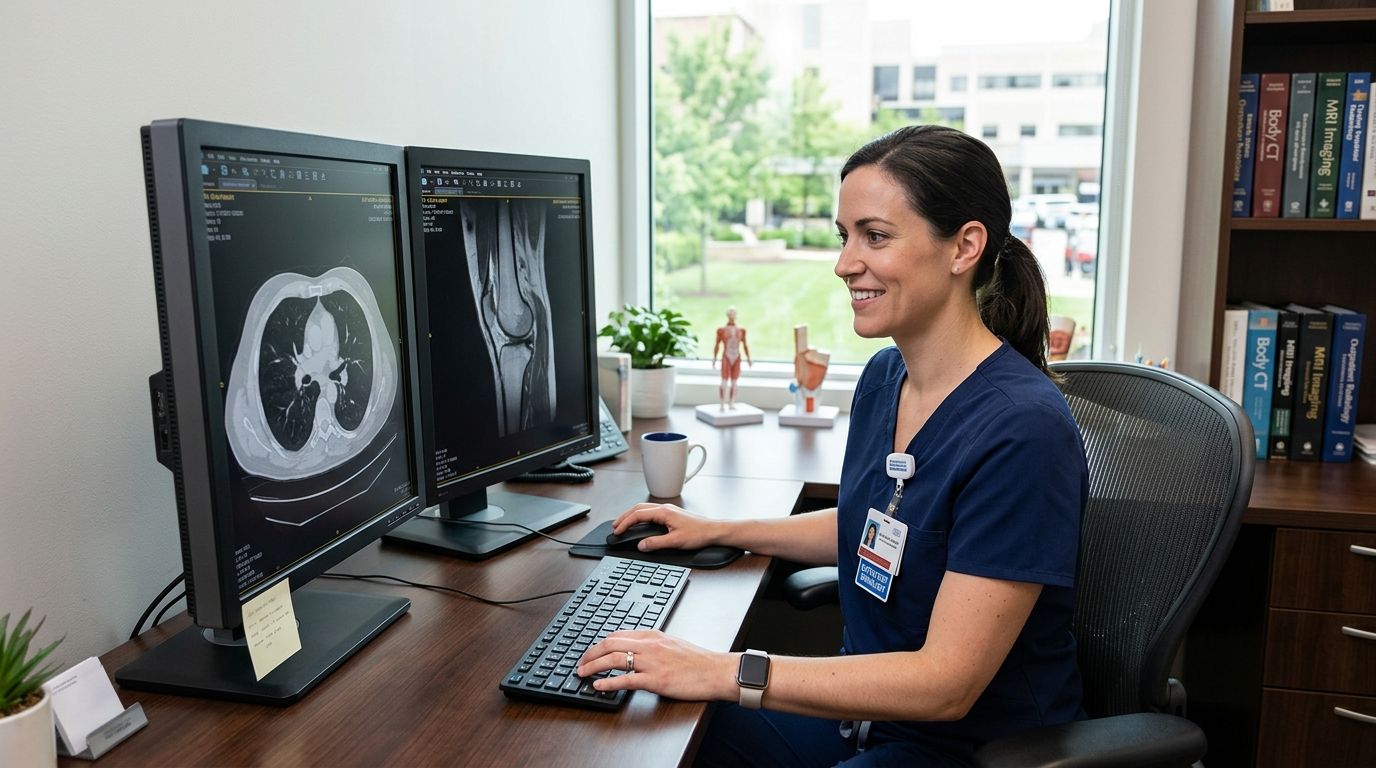
Daytime no-call outpatient radiology jobs are positions where radiologists read exclusively at freestanding imaging centers, multi-site outpatient chains, or single-specialty clinics during standard business hours, with no night, weekend, or backup call written into the contract. The segment skews toward radiologists who want predictable hours and zero pager anxiety more than they want the RVU ceiling of a hospital-based job, and that trade-off shapes every decision below.
- Daytime no call radiology jobs concentrate in outpatient imaging centers, not hospital departments with ED coverage.
- RadBoard aggregates 5,000+ radiology listings from 20 sources, filterable by outpatient-only and no-call status.
- Verdict: fixed 8-to-5 outpatient imaging center roles are the most reliable clinic-only reads with zero call in 2026.
- Subspecialty-only reading tracks in mammography, MSK, and body imaging pair well with daytime-only schedules.
- Expect a lower RVU ceiling than hospital-based jobs in exchange for zero night and weekend obligations.
Why daytime no-call radiology jobs matter for outpatient-only radiologists
This segment is not chasing the highest compensation on the market. Radiologists searching for outpatient imaging center jobs with no call are usually optimizing for something a hospital contract cannot offer: a schedule that ends at 5 p.m. and stays ended.
That matters differently depending on career stage. A radiologist with young kids at home wants the pager silent after dinner. A radiologist five years from retirement wants volume without the adrenaline of trauma reads. Both land in the same job category, but they screen listings for different things — one filters on hours, the other filters on case mix. RadBoard's search treats these as separate variables so a clinic-only search does not surface a hospital job with light call buried in paragraph four of the posting.
The honest trade-off: outpatient-only, no-call jobs almost always cap subspecialty exposure to whatever the clinic reads — mammography, MSK, body, or general diagnostic — and RVU volume tends to run lower than a hospital contract with night differential built in. Radiologists who want the schedule need to accept the ceiling that comes with it.
How to find and land a daytime no-call outpatient radiology job
Filter by facility type before you filter by schedule
Schedule promises mean nothing if the facility type does not structurally support them. Hospital-affiliated outpatient sites sometimes still require occasional backup call even when the posting says outpatient.
- Search freestanding, physician-owned, or corporate-chain outpatient imaging centers first
- Cross off any listing that mentions hospital campus or affiliated ED coverage in the description
- Ask directly whether the site ever pulls radiologists in for hospital overflow
- Check whether the center operates seven days a week — that often signals rotating weekend shifts even without formal call
Confirm the call schedule in writing before the interview ends
Verbal assurances about no call, ever evaporate once you are six months into a contract and get pulled for a Saturday half-day. Negotiating the call schedule before accepting a radiology job is the single highest-leverage conversation in this search.
- Ask for the call schedule clause to be quoted verbatim in the offer letter, not summarized
- Get specific about holidays — many outpatient contracts include coverage around Thanksgiving and New Year's
- Ask what happens if a partner radiologist leaves: does coverage shift to remaining staff?
- Request the last 12 months of actual call logs from current staff, not projected schedules
Check for weekend and evening shift carve-outs
No-call and no-weekend are not the same guarantee. Some outpatient centers run extended hours Monday through Saturday and rotate staff through evening blocks that technically are not call but still eat into personal time.
- Confirm whether Saturday morning hours exist and whether they are mandatory or voluntary
- Ask if evening extended-hours shifts past 5 p.m. rotate among all radiologists
- Verify whether per diem or locum staff cover weekend gaps instead of full-time hires
- Get the actual weekly shift grid, not a description of typical scheduling
Match your subspecialty to no-call-friendly settings
Not every subspecialty distributes evenly across outpatient-only jobs. Mammography, MSK, and general body imaging dominate freestanding centers; neuro and IR skew hospital-based because of emergent case volume. Radiologists chasing subspecialty-only reading positions should scope which subspecialties actually cluster outside hospital walls before assuming a no-call job exists in their niche.
- Map your subspecialty against outpatient volume — mammography and MSK centers post no-call roles constantly
- Check whether multi-site chains offer subspecialty-only reading pools across several locations
- Ask whether protocoling and reads are split, since protocoling-only roles rarely carry call
- Run an AI-matched search across RadBoard's 5,000+ listings from 20 sources to filter by subspecialty plus no-call status in one pass, rather than reading every posting manually
Compare 4-day and compressed-week structures against standard 5-day blocks
Outpatient centers increasingly offer compressed schedules — four 10-hour days or block rotations — as a retention tool. These change your effective time off without touching the call clause, and they are worth weighing against a standard five-day week even when both are equally call-free.
- Ask whether the compressed schedule reduces total annual reading days or just redistributes hours
- Confirm PTO accrual does not shrink under a compressed model
- Check whether compressed-day radiologists still hit full-time RVU benchmarks
- Verify the compressed schedule is contractual, not an informal arrangement that can be reversed
Ask about backlog, batch size, and case volume caps
A no-call job with a permanent backlog is not the stress-free position it looks like on paper. Same-day turnaround expectations tell you more about daily workload than the job title does.
- Ask what the average daily case volume is and whether it is capped
- Confirm whether reads are same-day or whether backlog carries overnight
- Check staffing ratios — one radiologist covering three sites usually means volume spikes
- Ask how coverage works when a colleague takes PTO, since that is when backlog usually forms
Use AI-powered search to surface no-call listings faster than manual browsing
Scanning individual job boards for the phrase no call buried in postings wastes hours. RadBoard's swipe-to-save and AI-powered search filter across 5,000+ aggregated radiology positions from 20 sources by facility type, call structure, and subspecialty in a single pass, which cuts the manual cross-referencing described above down to minutes. In 2026 that speed matters, because outpatient no-call roles at desirable centers fill from internal referrals before the posting ages.
Search daytime no-call radiology jobs
Filter 5,000+ listings from 20 sources by outpatient, no-call, and subspecialty.
Comparing outpatient no-call settings in 2026
| Setting | Best for | Key limitation |
|---|---|---|
| Freestanding imaging center | Radiologists wanting predictable 8-to-5 hours | Narrower subspecialty exposure than a hospital job |
| Multi-site outpatient chain | Subspecialty-only readers in mammography, MSK, body | Volume spikes when a sister site loses staff |
| Physician-owned single-specialty group | Radiologists prioritizing schedule control and culture fit | Smaller partner pool means less coverage flexibility |
| Vein or women's imaging clinic | Radiologists wanting a defined, narrow case mix | Very limited if you later want to broaden subspecialty |
| Daytime-only teleradiology contract | Radiologists wanting flexibility without a commute | Case volume and pay structure vary more than onsite roles |
Verdict: freestanding, physician-owned outpatient imaging centers deliver the most consistent daytime no call radiology jobs in 2026. Multi-site chains come second if your subspecialty is mammography, MSK, or body imaging.
One structural note for 2026: multi-site chains often advertise a single no-call posting that actually covers three or four locations. Ask which sites you would rotate through and how far apart they sit, because a call-free schedule with a 45-minute inter-site drive is not the same job it appeared to be.
“Read the shift grid, not just the call clause — extended hours are where no-call promises quietly break.”
Common mistakes outpatient-only radiologists make in this search
- Assuming outpatient automatically means no call. Hospital-affiliated outpatient sites often carry hidden backup obligations that never appear in the job title.
- Skipping the actual call log request. Offer letters describe intent; 12 months of call logs from current staff describe reality.
- Ignoring backlog and volume caps. A no-call job with a permanent case backlog trades pager stress for daily grind stress.
- Not confirming compressed-schedule terms in writing. Verbal promises about a 4-day week evaporate without a contract clause.
- Overlooking subspecialty distribution. Chasing a no-call role in a subspecialty that rarely exists outside hospitals wastes months of searching in a 2026 market where those roles are hospital-anchored.
FAQ
What counts as a daytime no-call radiology job in 2026?
A daytime no-call radiology job is a position at an outpatient imaging center or clinic with fixed business hours and zero contractual night, weekend, or backup call. In 2026 these roles concentrate in freestanding and physician-owned outpatient centers rather than hospital departments.
Are outpatient imaging center jobs really call-free?
Most are, but hospital-affiliated outpatient sites sometimes carry hidden backup call obligations. Request the call schedule clause verbatim in the offer letter and ask for actual call logs from current staff before signing.
Do no-call outpatient jobs pay less than hospital-based radiology jobs?
Outpatient no-call jobs generally carry a lower RVU ceiling than hospital contracts with night differential pay, since case volume and acuity run lower. The trade-off is a predictable schedule instead of overnight and weekend compensation premiums.
Can subspecialists find no-call outpatient jobs in their subspecialty?
Mammography, MSK, and general body imaging cluster heavily in outpatient-only settings, while neuroradiology and interventional radiology skew hospital-based due to emergent case volume. Check subspecialty distribution before assuming a no-call role exists in a niche field.
What is the difference between no-call and no-weekend-call jobs?
No-call means zero call obligations of any kind, including weekends and evenings. No-weekend-call jobs may still require evening or holiday coverage, so the two terms are not interchangeable in a contract.
How do I confirm a job is truly no-call before signing?
Request the call schedule clause quoted verbatim in the offer letter, ask for 12 months of actual call logs from current staff, and confirm in writing what happens to coverage if a partner radiologist leaves.
Is teleradiology a good alternative to onsite outpatient no-call jobs?
Daytime-only teleradiology contracts offer similar schedule predictability without a commute, though case volume and pay structure vary more than onsite outpatient roles. Compare both before ruling either out.
Do compressed 4-day schedules exist in no-call outpatient jobs?
Yes, some outpatient centers offer compressed schedules such as four 10-hour days as a retention tool. Confirm in writing that PTO accrual and RVU benchmarks do not change under the compressed model.
One last thing
The clause that trips up most radiologists in this search is not the call schedule — it is the extended-hours addendum. Outpatient centers that advertise no call often still run Saturday morning blocks or evening hours past 5 p.m. that rotate through the full staff roster without ever being labeled call. Ask for the weekly shift grid covering the last 12 months and count how many non-standard blocks each radiologist actually worked. If the grid shows more than a handful, the no-call label is marketing, not scheduling.