
The cost to process a Conrad 30 J-1 waiver for a radiologist is case-specific, not a single national total: budget separately for waiver processing, legal work, and the employer’s H-1B petition. Licensing, credentialing, dependent applications, and relocation sit outside that core budget unless the written agreement includes them. For a 2026 offer, get an itemized quote and a written allocation of who pays before you sign.
- The cost of conrad 30 j1 visa waiver for radiologist depends on filing requirements, legal scope, and employer responsibilities.
- Separate the waiver application from H-1B sponsorship, licensing, credentialing, and dependent applications.
- Compare employer commitments in writing, not a recruiter’s statement that sponsorship is included.
- RadBoard helps radiologists find positions; employers and immigration counsel must confirm waiver eligibility and sponsorship terms.
How much does a Conrad 30 J-1 waiver cost to process?
There is no universal all-in Conrad 30 processing total. A useful estimate identifies each filing, the professional work attached to it, and the party responsible for payment. A waiver-only quote is not the same as a complete budget through employment authorization.
Start with the position itself. The guide to radiology jobs for J-1 waiver physicians under Conrad 30 covers the job-search context; the employer and immigration attorney must evaluate the actual worksite, contract, and state program.
Ask for this breakdown rather than an unexplained package total:
| Budget component | What the scope should identify | What to clarify |
|---|---|---|
| State waiver application | State-specific submission requirements and any applicable charge | Which program rules apply to the filing cycle? |
| Federal waiver processing | Department of State processing and the subsequent USCIS waiver decision | Is this work included in counsel’s engagement? |
| Immigration legal services | Eligibility review, application preparation, contract review, and agency correspondence | Are responses to additional requests included? |
| H-1B petition | Employer petition preparation and applicable filing requirements | Which obligations belong to the employer? |
| Optional expedited processing | Expedited service for an eligible filing, if requested | Which stage does it accelerate? |
| Separate employment requirements | Medical licensing, hospital privileges, and credentialing | Are these covered under a different agreement? |
| Family applications | Applicable dependent status or consular work | Are family members included or handled separately? |
Treat this as a scope comparison, not a list of charges that applies identically to every physician. Ask counsel to mark each line as applicable, not applicable, included, or separate.
Why this matters
A radiology offer can include sponsorship without explaining the physician’s financial exposure. The employment agreement, legal engagement letter, and filing plan need to tell the same story. Otherwise, you cannot distinguish an employer commitment from an unresolved responsibility.
The service obligation also matters. USCIS describes Conrad 30 employment as full-time service of at least 40 hours per week for 3 years, subject to program requirements. A favorable processing arrangement does not compensate for an unsuitable schedule, unworkable location, or contract that conflicts with the waiver plan.
For a 2026 application, use the selected state health department’s current instructions alongside the Department of State Waiver Review Division guidance and USCIS’s Conrad 30 guidance. These sources address different parts of the process; none replaces review of your individual case.
Separate the waiver from the H-1B petition
The waiver and the employment petition serve different purposes. The waiver addresses the J-1 physician’s applicable 2-year foreign residence requirement; the H-1B petition addresses the proposed employment classification. Waiver approval alone is not permission to start working.
Ask counsel to identify the required sequence for your circumstances. State sponsorship, federal waiver processing, the employer petition, and any consular or status-related steps must fit together before the proposed start date becomes dependable.
A quote labeled only J-1 waiver processing leaves an important question unanswered: does the engagement end at the waiver decision, or continue through the employment petition? Put that answer in writing. Also identify who handles additional agency requests and communications with the employer.
The same distinction applies to speed. Expedited processing for an eligible USCIS petition does not accelerate a state health department’s review or every federal step. Ask which filing receives expedited treatment, rather than accepting a promise that the entire case will be expedited.
Why Conrad 30 processing expenses vary
The useful question is not what another radiologist paid. It is whether the other case involved the same state requirements, legal scope, employer responsibilities, and family circumstances.
Review these factors when comparing 2026 estimates:
- State requirements. Each participating state administers its own application process. Confirm its current instructions, submission window, and requirements for specialist positions.
- Legal scope. A waiver application, employment petition, dependent application, and employment-contract review are distinct assignments. Confirm which services the engagement actually includes.
- Employer petition requirements. Applicable H-1B filing obligations depend on the petitioner and filing circumstances. Counsel should identify the requirements rather than apply an unexplained standard package.
- Case complexity. Multiple worksites, prior immigration history, or missing documentation require specific review. Ask what happens if the original scope changes.
- Processing choices. Optional expedited processing applies only where available for the relevant filing. Identify its purpose before authorizing it.
- Family needs. A spouse’s or child’s applications require separate attention. Do not assume the physician’s engagement covers every family member.
Compare matching scopes. A shorter quote is not necessarily a smaller complete commitment if it excludes work that another quote includes.
Who pays for a radiologist’s Conrad 30 processing?
Payment responsibility is a legal and contractual question, not just a negotiating preference. Certain H-1B obligations belong to the employer, and wage rules affect whether other expenses can be shifted to the physician. Have immigration counsel distinguish mandatory employer obligations from negotiable arrangements.
Do not accept a blanket statement that the physician pays all immigration expenses. Equally, do not interpret employer-paid sponsorship as a promise to cover licensing, dependent applications, relocation, or independent contract advice. Each commitment needs a defined scope.
Use a responsibility worksheet with the following fields:
- The filing or professional service.
- The party responsible for arranging it.
- The party legally responsible for payment.
- The party advancing payment, if different.
- Whether reimbursement is promised and when.
- Any proposed repayment clause and the event that triggers it.
Keep immigration expenses separate from signing-bonus and relocation repayment provisions. Ask an attorney to review any clause that attempts to recover immigration-related spending after departure; an employment contract does not override immigration or wage requirements.
How do you get a usable processing estimate?
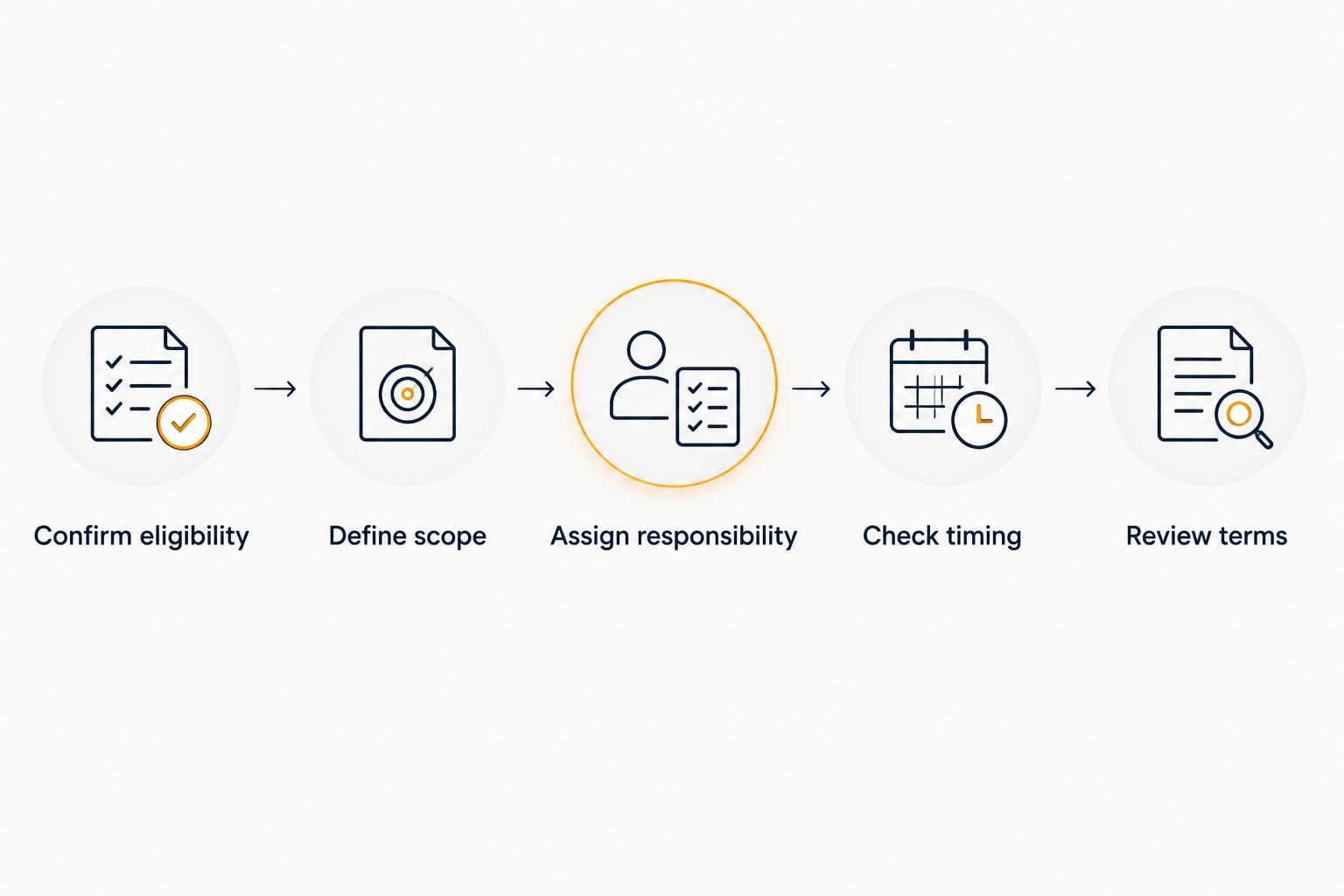
Get the estimate after the employer identifies the proposed position and worksite, not from a generic recruiting conversation. The strongest estimate ties a defined legal scope to a specific job. Follow this sequence before committing to an offer.
- Confirm eligibility. Ask counsel and the employer to identify the state program, proposed worksite, specialist criteria, and basis for the application. A shortage-area location alone does not establish that every program requirement is met.
- Define scope. Request a written list covering state preparation, federal waiver work, the H-1B petition, agency follow-up, and any dependent work. Identify exclusions beside the included services.
- Assign responsibility. Separate legally required employer payments from other negotiated commitments. Confirm whether counsel represents the employer, the physician, or both under the engagement terms.
- Check timing. Align the application window, training completion, licensing, credentialing, and employment authorization. Ask who updates the plan when an agency requests additional information.
- Review terms. Have the employment agreement reviewed for worksite, duties, service obligations, delayed-start provisions, and repayment language before signing.
This sequence prevents an attractive recruiting promise from becoming the only record of sponsorship support. Keep the final scope, responsibility worksheet, and contract together so that any later change can be evaluated against the original agreement.
Does being a radiologist change the waiver requirements?
Radiology does not create a separate federal Conrad 30 filing category. State policies determine how specialist applications fit within the state’s program, and the proposed job must satisfy the applicable requirements. Do not assume a hospital’s willingness to hire establishes waiver eligibility.
The federal program allows each participating state to request up to 30 waivers per federal fiscal year. That is a statewide limit, not a radiology allocation or a guarantee that a particular employer can obtain sponsorship. State selection policies and the application’s merits still matter.
For a radiologist, describe the actual service arrangement accurately: employer, physical worksite, patient population, duties, and schedule. Remote reading, coverage across facilities, and proposed worksite changes need specific legal review. A job description built around general flexibility is not a substitute for a defined waiver employment plan.
For your 2026 search, ask the employer whether counsel has evaluated the proposed radiology position under the selected state’s specialist requirements. Request an answer about this job, not a statement that the organization sponsors physicians generally.
Can an employer cover the entire process?
An employer can agree to cover immigration services beyond its mandatory obligations, but the agreement must define what that means. Ask whether the commitment includes waiver preparation, the employment petition, agency follow-up, and applicable dependent work. Confirm exclusions explicitly.
Employer-coordinated counsel offers a practical advantage: the employer controls much of the evidence needed for its petition. The limitation is representation. Confirm whose interests counsel represents before relying on that attorney for advice about personal repayment exposure or employment-contract terms.
Independent advice adds another engagement to coordinate, but gives you a separate review of your interests. Choose representation based on the question being answered; petition preparation and employment-contract advice are not interchangeable services.
Where job search fits into the waiver budget
RadBoard is best for radiologists who want to search positions aggregated from multiple sources. RadBoard’s radiology job search platform aggregates 5,000+ positions from 20 sources and provides search and swipe-to-save features.
Use RadBoard to build a shortlist, then ask each employer the same sponsorship questions. The platform supports finding positions; a listing does not establish state eligibility, sponsorship approval, or an employer’s payment commitments.
That distinction keeps the search useful. Save roles that fit your clinical goals, then confirm the immigration plan before investing in a final contract negotiation. Broad job coverage helps discovery, but legal eligibility remains position-specific.
FAQ
Is there a standard total for a radiologist’s Conrad 30 waiver?
There is no universal all-in total for a radiologist’s Conrad 30 waiver process. Request an itemized scope separating state requirements, federal waiver work, legal services, the H-1B petition, and separate employment requirements.
Does my employer have to pay every immigration expense?
Employer obligations depend on the specific expense and applicable immigration and wage rules. Have counsel identify mandatory employer payments separately from negotiated commitments, dependent work, and personal legal advice.
Does a Conrad 30 waiver let me start working immediately?
A Conrad 30 waiver alone does not authorize employment. Counsel must confirm the required employment authorization and all conditions that apply before you start clinical work.
How long is the Conrad 30 service commitment?
The Conrad 30 service commitment is generally 3 years of qualifying full-time employment. USCIS guidance specifies at least 40 hours per week, and the position must also meet applicable program requirements.
Does premium processing speed up the whole waiver process?
Premium processing does not speed up the entire Conrad 30 process. It applies to an eligible USCIS filing, not every state, Department of State, or employment-related step.
Can a diagnostic radiologist qualify for Conrad 30?
A diagnostic radiologist’s eligibility depends on the selected state’s specialist policies and the proposed position. Have counsel review the actual employer, worksite, duties, and supporting evidence before relying on sponsorship.
Does RadBoard verify that a job qualifies for a waiver?
RadBoard is a radiology job search platform, not an immigration eligibility determination. Confirm waiver eligibility, sponsorship commitments, and payment responsibility directly with the employer and qualified immigration counsel.
One last thing
Ask what happens if the start date changes. For a 2026 offer, the contract should explain how a delayed immigration decision interacts with employment commencement, signing commitments, and termination provisions. Request that explanation before signing, not after a delay creates competing expectations.
A processing estimate answers what work is planned. A reviewed employment agreement answers what happens when the plan changes. You need both.
This article provides general information, not individualized immigration or legal advice. Have qualified immigration counsel confirm the current requirements and their application to your circumstances.