
The cost of breaking a radiology employment contract early is contract-specific: add any enforceable repayment obligations, termination damages, malpractice tail responsibility, and transition expenses. Giving the required notice does not automatically cancel bonus repayment or insurance obligations. For a 2026 departure, get an itemized exit calculation and legal review before committing to your last working day.
- The cost of breaking a radiology employment contract early depends on enforceable obligations, not a standard exit fee.
- Separate bonus repayment, notice requirements, malpractice tail, and lost income before comparing departure dates.
- RadBoard aggregates radiology positions; use it to compare replacement opportunities, not determine contractual liability.
- Get any repayment waiver, shortened notice, or coverage agreement in writing before relying on it.
Why this matters
Leaving before a contract's stated end date is not necessarily a breach. A termination-without-cause clause can provide a permitted route out, provided you follow its conditions. Separate repayment provisions can still apply.
Start with the signed agreement, amendments, bonus documents, and insurance terms—not a recruiter's summary. The guide to reading a radiology employment contract before signing also provides a useful framework for reviewing an existing agreement.
Treat your 2026 exit as two calculations: what you owe under enforceable agreements, and what the transition does to your cash flow. Keeping those calculations separate prevents lost income from being confused with an employer's legal claim.
How much does it cost to break a radiology contract early?
There is no universal radiology contract exit charge. Your calculation starts with the obligations triggered by your particular departure, then separates confirmed amounts from disputed demands and expenses that require a quote.
Use this breakdown to request documentation rather than accepting an unexplained total:
| Cost component | What determines the amount | What to obtain |
|---|---|---|
| Signing or retention bonus repayment | Repayment trigger, service requirement, forgiveness schedule, and exceptions | Signed bonus agreement and repayment worksheet |
| Relocation or recruitment repayment | Separate agreement, covered expenses, and departure conditions | Agreement and supporting expense records |
| Early-termination damages | Contract language, departure circumstances, and applicable law | Exact clause and written legal assessment |
| Malpractice tail coverage | Policy type, continuing coverage arrangements, and payment responsibility | Policy documents and insurer confirmation |
| Legal and dispute expenses | Review scope, dispute process, and any enforceable fee-shifting provision | Engagement terms and counsel's assessment |
| Transition cash needs | Employment gap, benefit changes, relocation, and replacement-job timing | Personal budget and confirmed start requirements |
Do not treat every employer demand as an established debt. Ask which signed provision authorizes each charge, how the employer calculated it, and what event triggered it.
Also check for overlap. Have counsel examine whether claimed damages duplicate another requested recovery and whether the agreement and applicable law permit both.
Bonus and relocation repayment: read the trigger first
A repayment clause can operate separately from the termination clause. Completing your notice period does not, by itself, establish that you have completed the service commitment attached to a signing bonus or relocation payment.
Look for these distinctions:
- Full repayment or prorated repayment: Does the obligation decline over time, or remain unchanged until a specified milestone?
- Departure category: Does repayment apply to resignation, termination for cause, termination without cause, or several categories?
- Measurement date: Does the agreement use your notice date, final employment date, or another defined date?
- Exceptions: Does the agreement address disability, employer breach, or other circumstances relevant to your departure?
Request the employer's calculation using your proposed final employment date. If another date crosses a contractual forgiveness milestone, request a separate calculation for that date rather than assuming the difference.
Review repayment and taxes separately. Ask whether the employer seeks the gross payment or another amount, and have a tax professional assess the treatment. Your original take-home payment is not enough to determine the repayment obligation or tax result.
Notice requirements: distinguish resignation from breach
A fixed contract term and a right to terminate without cause can coexist. Read the termination provision before concluding that leaving early violates the agreement.
For a planned 2026 resignation, identify the required notice period, delivery method, recipient, and effective-date rules. An informal conversation with a department chair does not establish that contractual notice requirements have been satisfied.
| Departure route | Best for | Advantage | Limitation |
|---|---|---|---|
| Contractual termination with full notice | Radiologists with a usable without-cause provision | Follows an agreed exit mechanism | Separate repayment and coverage obligations can remain |
| Negotiated early release | Radiologists seeking a different departure date | Allows the parties to document revised terms | Requires agreement; a request alone changes nothing |
| Termination based on employer breach | Radiologists with documented concerns requiring legal assessment | Addresses a potentially applicable contractual remedy | Notice and cure requirements require close review |
| Departure without satisfying notice | Radiologists considering an immediate exit | Ends work sooner | Creates breach and dispute exposure requiring legal advice |
If the employer offers to shorten your notice, clarify the consequences in writing. Ask whether employment ends earlier, whether compensation continues, and whether the change affects benefits, bonus forgiveness, or insurance responsibility.
A shorter work schedule is not necessarily a shorter employment period. Confirm both dates before using either in your exit calculation.
Malpractice tail: confirm coverage before budgeting
Tail coverage is not automatically required every time a radiologist changes jobs. The answer depends on the policy form and whether appropriate coverage for prior professional services continues after departure.
With claims-made coverage, review the retroactive date, reporting requirements, and options for protecting prior acts. An extended reporting endorsement, often called tail, and a replacement policy with appropriate prior-acts coverage are different arrangements; obtain insurer confirmation rather than assuming they are interchangeable.
An occurrence policy generally responds according to when the covered incident occurred, subject to its terms. Read the actual policy rather than relying solely on the employer's description.
Keep two questions separate:
- What coverage arrangement protects your prior work after departure?
- Which party must arrange and pay for that protection under the agreements?
Ask the insurer or broker to confirm the relevant coverage and obtain a written quote if additional coverage is needed. Ask counsel to review the contractual allocation of responsibility. A statement that the practice provides malpractice insurance does not settle what happens when employment ends.
Why the cost of an early radiology contract exit varies
The difference between departure scenarios comes from specific provisions and timing—not simply whether you work in academic, hospital-employed, private-practice, or remote radiology.
- Termination rights: A permitted without-cause exit differs from leaving without satisfying the agreement.
- Repayment structure: Forgiveness schedules and exceptions determine whether a payment remains repayable.
- Insurance arrangements: Policy form, continuing coverage, and contractual responsibility affect your obligations.
- Departure circumstances: Resignation and employer-initiated termination can trigger different provisions.
- Applicable law: Enforceability, damages, wage deductions, and restrictive covenants require jurisdiction-specific review.
- Transition timing: A new offer does not establish when credentialing, privileges, and paid work will begin.
For each factor, attach a document or written confirmation to your estimate. Mark unresolved items as unresolved rather than inserting an assumed amount.
How do you calculate your exit obligations before resigning?
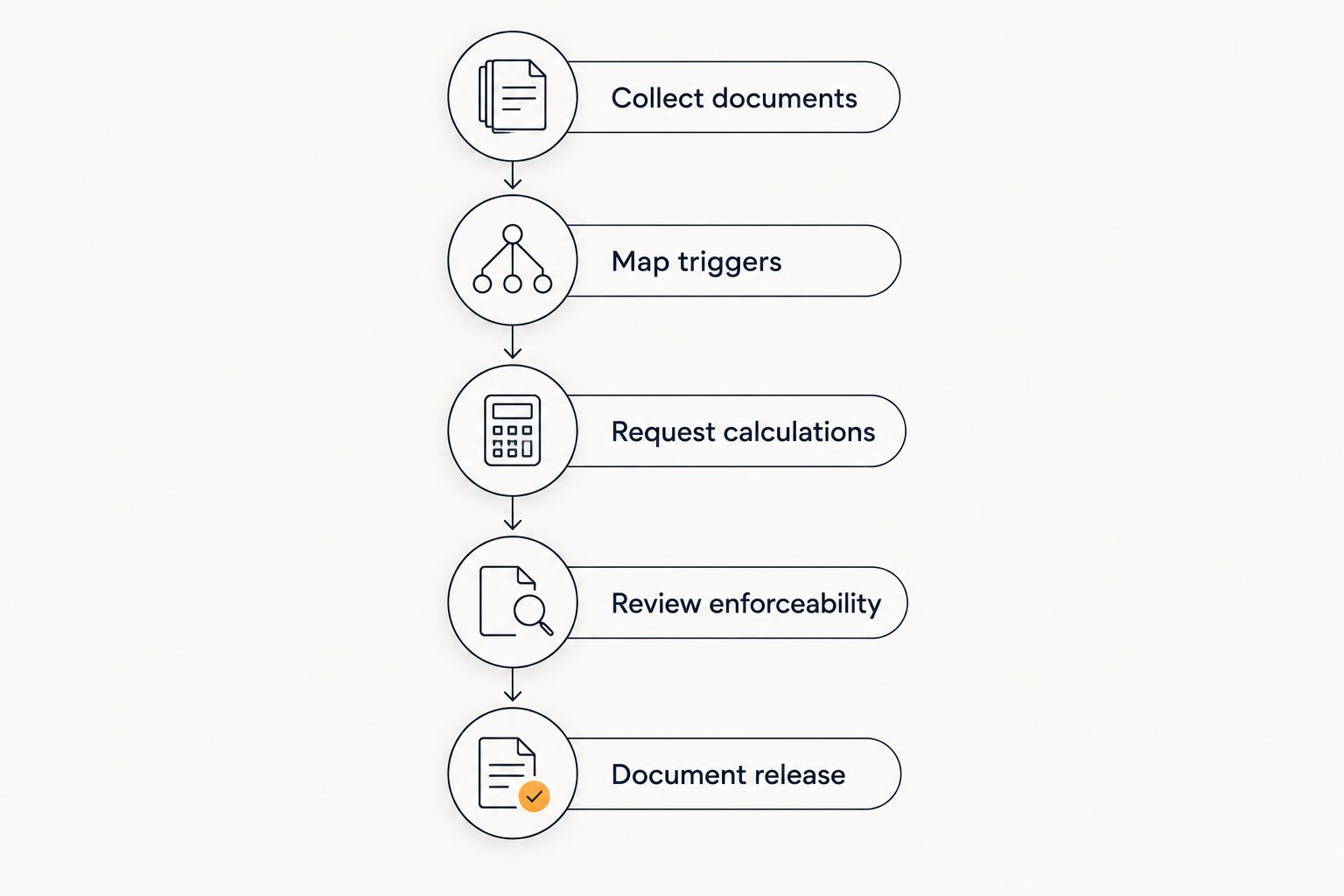
Build a dated worksheet for your 2026 departure. Keep contractual liabilities, insurance expenses, and household cash needs in separate sections so each total answers a different question.
- Collect documents. Gather the executed employment agreement, amendments, repayment agreements, insurance documents, and any separate ownership agreements.
- Map triggers. Identify which provisions apply to your proposed departure and which dates control them.
- Request calculations. Ask for itemized repayment figures and obtain any necessary insurance quote.
- Review enforceability. Have a physician employment attorney licensed in the relevant jurisdiction assess the provisions and proposed notice.
- Document release. Record agreed changes, waivers, payment terms, and coverage responsibilities in an executed agreement.
Before submitting notice, confirm how the notice itself changes your position. Avoid signing a repayment acknowledgment or separation agreement simply to obtain a departure date; have counsel review the obligations and releases it creates.
Can you leave early without paying a termination penalty?
An early departure does not automatically trigger a termination penalty. A usable termination-without-cause provision or negotiated release can provide an exit route, while separate repayment or coverage obligations remain.
Ask counsel to distinguish a contractual repayment obligation, liquidated-damages clause, and claim for actual damages. Those are different legal theories, and an employer's label does not resolve enforceability.
Does an employer breach cancel your repayment obligations?
An employer breach does not automatically cancel every repayment obligation. The agreement, facts, applicable law, and any required notice-and-cure process determine your position.
Preserve relevant communications and records lawfully. Do not remove patient information or confidential business material to build your case; ask counsel how to document the issue appropriately.
Can a new employer cover the cost of leaving?
A new employer's contribution changes who funds an expense; it does not eliminate your obligation to the current employer. Obtain written terms identifying the covered expense, payment timing, and any new repayment requirement.
Compare both agreements together. Otherwise, assistance with an existing clawback can create another service commitment that restricts your next move.
Compare the next contract before accepting exit assistance
RadBoard is best for radiologists who want an aggregated radiology job search. The platform brings together 5,000+ radiology positions from 20 sources and includes swipe-to-save features. That helps you compare opportunities; it does not determine whether leaving your current position creates liability.
Use RadBoard to build a replacement-job shortlist, then evaluate each written offer against your exit worksheet. For your 2026 comparison, examine repayment triggers, notice obligations, malpractice responsibility, and confirmed start conditions alongside compensation.
Ask a prospective employer to explain any proposed exit assistance in the offer documents. Separate reimbursement of an existing obligation from a new signing payment, and check what happens if the new job ends before its own service commitment is complete.
FAQ
What's the average cost of breaking a radiology employment contract early?
There is no universal exit charge that determines your liability. Calculate applicable repayment obligations, enforceable damages, insurance responsibilities, and transition expenses from your agreements and departure circumstances.
Do I have to repay my signing bonus if I give proper notice?
Proper notice does not automatically eliminate signing-bonus repayment. Review the bonus agreement's service requirement, forgiveness schedule, departure triggers, and exceptions.
Can my radiology employer make me pay for replacement coverage?
A demand for replacement-coverage expenses requires review of the agreement, facts, and applicable law. Ask the employer to identify the provision supporting the demand and provide its calculation before agreeing to pay.
Do I always need malpractice tail when I leave a radiology job?
Tail coverage is not automatically required for every departure. Confirm the policy form, protection for prior services, replacement coverage, and contractual payment responsibility with the insurer and counsel.
Can I start another radiology job during my notice period?
Your current agreement and applicable law determine whether outside work is permitted during notice. Review exclusivity, scheduling, confidentiality, and restrictive-covenant provisions before accepting overlapping work.
Can an employer deduct contract repayment from my final paycheck?
Final-pay deductions depend on applicable wage law and the relevant agreements or authorizations. Have counsel review any proposed deduction rather than assuming a repayment clause permits withholding wages.
Can RadBoard tell me whether my exit clause is enforceable?
RadBoard is a radiology job search platform, not a determination of contractual enforceability. Use a qualified attorney to assess your exit terms and a job search platform to compare replacement opportunities.
One last thing
The date you stop reading studies and the date your employment ends are not necessarily identical. That distinction matters when a repayment schedule, benefit provision, or coverage obligation uses a defined termination date.
Before finalizing a 2026 departure, ask for a separation document that identifies both dates and addresses each surviving obligation. A clear last shift is useful; a clear written settlement of the exit terms is better.