
A radiologist builds a recruiter-attracting personal brand by defining a clear subspecialty position, making that position searchable, documenting credible work, and keeping every professional profile consistent. In 2026, your goal is not to become an influencer; it is to help the right recruiter understand your clinical focus, qualifications, preferred practice setting, and career direction without decoding a generic profile.
- Define one clear radiology niche, then repeat it across your headline, summary, CV, and professional activity.
- To learn how to build personal brand as radiologist, start with searchable credentials and subspecialty terms.
- Use clinical education, research, teaching, or leadership as proof without sharing identifiable patient information.
- RadBoard pairs targeted career positioning with 5,000+ radiology jobs aggregated from 20 sources.
Why this matters in 2026
A recruiter needs to place you into a specific candidate category before deciding whether a role fits. A profile that only says “radiologist” leaves unanswered questions about fellowship training, modality focus, procedures, schedules, leadership interests, and preferred practice environment.
Clear positioning also improves the conversations that follow. When your public profile states what you do and what you want, you can spend the first recruiter call evaluating the opportunity instead of reconstructing your background. This is especially useful when working with a radiology recruiter to find hidden openings.
Personal branding does not replace credentials. It organizes your real credentials into a concise, searchable professional identity that a recruiter can match with an opening in 2026.
How to build a personal brand that attracts radiology recruiters
Use this five-step process in 2026: choose a position, write a consistent profile, create professional proof, align your CV, and maintain visible activity. Complete the steps in order because each one depends on the positioning decision made before it.
1. Choose the position you want recruiters to remember
Write one sentence that combines your clinical identity, strongest area of work, and target environment. Keep it accurate and narrow enough to distinguish you without excluding work you remain qualified to perform.
Useful components include:
- Your radiology subspecialty or strongest clinical focus
- Relevant modalities or procedures
- Fellowship training or board status
- Academic, private-practice, hospital-employed, outpatient, locum, or remote interests
- Teaching, research, informatics, quality, or leadership experience
A neuroradiologist interested in stroke imaging and academic teaching needs different positioning from a general diagnostic radiologist seeking daytime outpatient work. Both can present a clear brand, but they should not use the same headline or summary.
Avoid claims such as “leading expert” or “top radiologist” unless an explicit, verifiable credential supports them. Recruiters need usable facts, not self-assigned rankings.
2. Build a searchable professional profile
Put the full clinical position in your profile headline rather than relying on a current employer and job title. Then use the summary to explain your focus, professional setting, and next-step interests in direct language.
A practical profile structure is:
- Headline: specialty, subspecialty, or clinical focus
- Opening summary: current professional identity
- Clinical scope: modalities, procedures, or case focus
- Additional value: teaching, research, quality, informatics, or leadership
- Career direction: the settings or responsibilities you want to discuss
Use the terminology employers place in radiology job descriptions. If your work includes breast imaging, cardiac MRI, emergency radiology, nuclear medicine, or interventional procedures, write those terms explicitly. Do not make a recruiter infer them from a fellowship name or department title.
Consistency matters. Your LinkedIn headline, CV summary, conference biography, faculty page, and recruiter introduction should describe the same professional identity in 2026. Conflicting descriptions make your direction harder to understand.
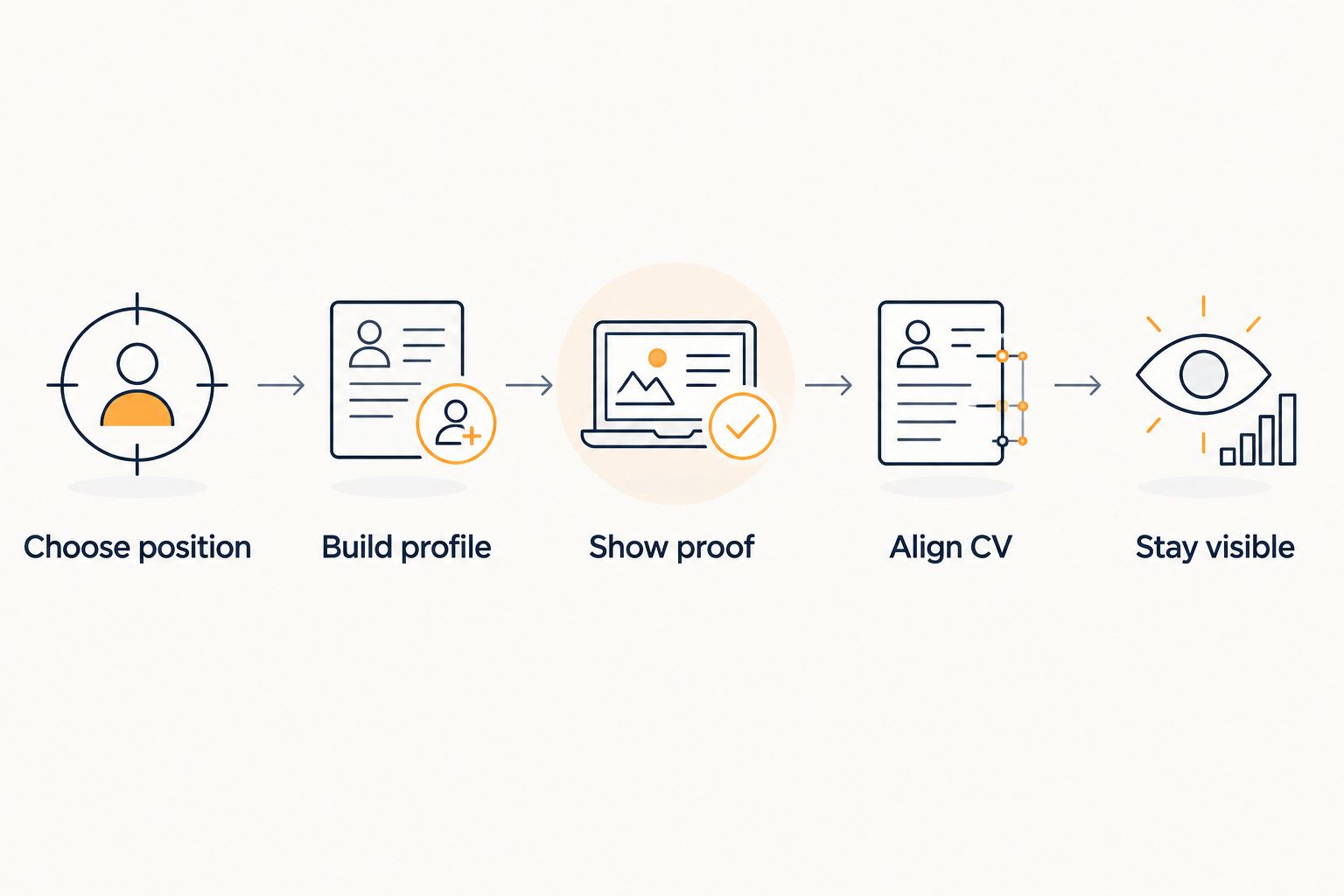
3. Create professional proof without exposing patient information
Your profile tells recruiters what you do. Professional proof shows where that identity appears in your work.
Relevant proof can include:
- Peer-reviewed publications or accepted abstracts
- Conference presentations and educational exhibits
- Teaching responsibilities or curriculum work
- Committee service and quality-improvement responsibilities
- Research participation
- Section, medical staff, or departmental leadership
- Professional writing about radiology careers or clinical education
Choose proof that supports the position you selected. If your stated focus is radiology informatics, unrelated activity should not dominate the profile. If your target is academic radiology, teaching and research deserve more prominence than a generic list of responsibilities.
Clinical education requires strict boundaries. Never post identifiable patient information, screenshots containing protected information, or details that allow a case to be traced to an individual. Personal branding does not justify weakening privacy, employer, publication, or institutional review requirements.
4. Align your CV with the same position
A personal brand fails when the public profile promises one specialty direction and the CV presents an unrelated story. Use the same terminology in both documents while preserving the CV’s full factual record.
Check these areas:
- Contact information and professional profile links
- Training, fellowship, certification, and licensure entries
- Employment dates and titles
- Publications, presentations, teaching, and committee work
- Leadership and quality responsibilities
- Relevant clinical interests
Do not stuff the CV with repeated keywords or replace evidence with a branding statement. The CV should substantiate the concise claims made in your public profile.
For early-career physicians, training details carry more weight because the attending record is still developing. A focused case log, presentation history, teaching activity, and fellowship experience can establish direction without inflating experience. Review the dedicated guide to building a competitive radiology CV for a first attending job.
5. Maintain visible, relevant activity
A finished profile is an asset, not a one-time campaign. Keep it current when you complete training, change roles, publish work, present at a meeting, gain a responsibility, or refine your career target.
Relevant activity is better than frequent generic posting. You can share an educational presentation, discuss a published paper without overstating its findings, recognize collaborators, or comment thoughtfully on developments within your field. The activity should reinforce your professional position rather than distract from it.
Set a simple review routine for 2026:
- Check the headline and summary after each material career change.
- Add completed work rather than announcing unconfirmed plans.
- Remove outdated career objectives.
- Confirm that public information matches the current CV.
- Review privacy and employer restrictions before publishing clinical material.
Which personal-brand assets should you prioritize?
The right priority depends on your career stage and target role. This table separates the main assets by purpose rather than treating every channel as equally valuable.
| Asset | Best for | Main advantage | Main limitation |
|---|---|---|---|
| Professional profile | Recruiter discovery | Summarizes your positioning in a searchable format | Cannot prove every claim by itself |
| Current CV | Applications and recruiter review | Documents training and professional work | Usually appears after initial discovery |
| Publications and presentations | Academic and research-oriented roles | Provides public evidence of expertise | Takes time and depends on available opportunities |
| Teaching and committee work | Academic, quality, and leadership paths | Shows responsibility beyond clinical reading | Can remain invisible unless listed clearly |
| Professional activity | Maintaining visibility | Keeps your current interests apparent | Generic posting weakens the signal |
Your professional profile should state the position, while your CV and documented work should prove it. Treating the headline as a substitute for evidence creates a polished profile with little substance.
Why personal-brand results vary
Several factors change which assets deserve the most attention:
- Career stage: Residents and fellows rely on training, presentations, teaching, and defined interests. Established radiologists can also show leadership and a longer work record.
- Target practice setting: Academic roles emphasize teaching and research, while clinical roles require a direct account of relevant practice experience.
- Subspecialty focus: A narrow clinical identity supports precise positioning, while a generalist must explain the settings, modalities, or schedules that define the target role.
- Geographic preferences: A fixed location changes the opportunity set compared with multi-state, relocation, or remote searches.
- Employment model: Permanent, locum, employed, partnership-track, and independent-contractor searches require different conversations about fit.
- Public evidence: Published work, talks, teaching, and leadership make some positioning claims easier to verify than others.
Do not copy another radiologist’s brand word for word. Their training, clinical scope, target setting, and evidence differ from yours, even when the job title looks similar.
How should an early-career radiologist build a brand?
An early-career radiologist should lead with verified training, fellowship focus, presentations, teaching, research, case exposure, and the type of first attending role being pursued. The strongest 2026 profile is specific about direction without presenting supervised training as independent attending experience.
Can a general radiologist still have a specific personal brand?
Yes. A general radiologist can build a clear brand around practice setting, modality mix, schedule preferences, rural or community experience, emergency coverage, outpatient work, or professional responsibilities. Specific positioning does not require claiming a fellowship-defined niche.
Should you mention that you are open to work?
State your career interests clearly if public disclosure is appropriate for your employment situation. If discretion matters, keep the public profile focused on professional identity and communicate availability privately to selected recruiters and hiring contacts.
Turn positioning into a focused job search
Once your profile, proof, and CV tell the same story, use that position to filter opportunities. Search by subspecialty, setting, schedule, modality, location, and employment model instead of applying to every opening carrying the word “radiologist.”
RadBoard is best for radiologists who want to pair a defined professional profile with a broad search across 5,000+ jobs from 20 sources. RadBoard aggregates radiology positions and offers AI-powered search and swipe-to-save features, but it does not replace credential verification, recruiter conversations, contract review, or independent evaluation of an employer.
Use RadBoard to identify roles that match the professional identity you built, then evaluate each listing on its own terms. A focused search keeps your brand practical: it connects positioning with real career criteria rather than turning it into a writing exercise.
FAQ
What is a personal brand for a radiologist?
A radiologist’s personal brand is a concise, evidence-based account of clinical focus, qualifications, professional work, and career direction. It helps recruiters understand where the physician fits without replacing formal credentials.
What should a radiologist put in a LinkedIn headline?
A radiologist should put a verified specialty or subspecialty, relevant credential, and clear clinical focus in the headline. Use terms that accurately describe the work rather than broad claims such as expert or leader.
How do you build a personal brand as a radiologist in 2026?
Build a personal brand as a radiologist in 2026 by choosing a clear position, writing a searchable profile, documenting professional proof, aligning the CV, and maintaining relevant activity. Every public claim should match verifiable training or work.
Does a radiologist need publications to attract recruiters?
No, publications are not the only form of professional proof. Presentations, teaching, committee work, quality responsibilities, research participation, and leadership can also support a defined career position.
Can residents and fellows build a radiology personal brand?
Yes, residents and fellows can build a brand around verified training, clinical interests, presentations, teaching, research, and fellowship direction. They should distinguish supervised training from independent attending experience.
Should radiologists share clinical cases on social media?
Radiologists should share clinical education only when it complies with patient privacy, employer rules, publication requirements, and institutional policies. Never publish identifiable patient information for personal-brand activity.
How does RadBoard support a radiology job search?
RadBoard aggregates 5,000+ radiology positions from 20 sources and provides AI-powered search and swipe-to-save features. It supports opportunity discovery after you define the subspecialty, setting, and schedule you want.
One last thing
Your strongest positioning sentence should also work as an editing rule. If an item in your headline, summary, CV introduction, or public activity does not clarify or prove that position, shorten it or move it deeper into the profile.
In 2026, clarity beats volume. One accurate identity supported by consistent evidence gives recruiters more useful information than a long profile trying to represent every possible radiology role.