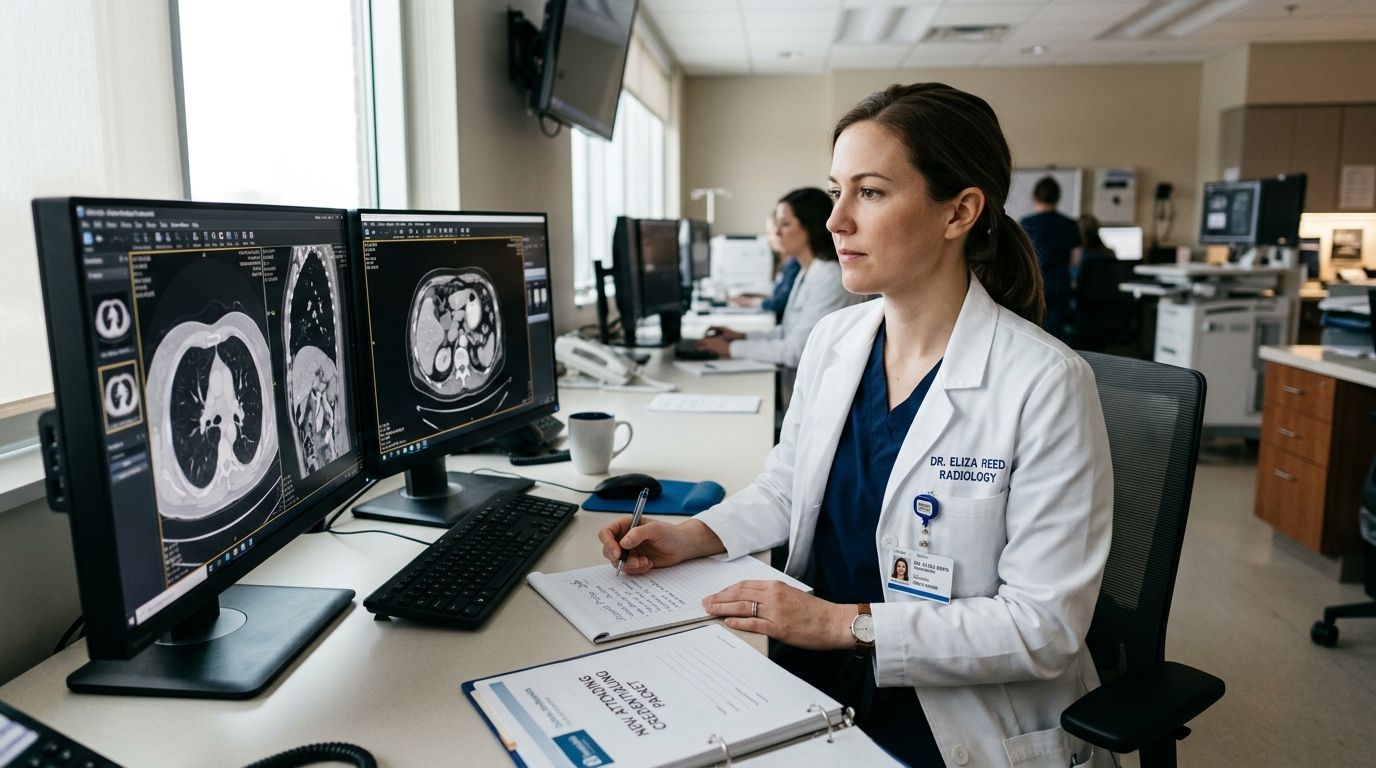
Hospital privileging for a new attending radiologist typically takes 60 to 120 days from application submission to full clinical approval, with provisional or temporary privileges sometimes available in 15 to 30 days at hospitals that offer them. The part most first-time attendings underestimate: primary source verification and the credentials committee's meeting calendar set the pace, not your CV, and one missing malpractice certificate or delayed reference letter can push you into a second committee cycle that adds another 30 days.
- Getting hospital privileges as a new radiology attending runs 60 to 120 days on average in 2026.
- Provisional privileges let you start reading cases in 15 to 30 days at hospitals that grant them.
- Credentials committees meet monthly at most facilities, so one missing document adds a full cycle.
- Board-eligible applicants face extra committee scrutiny compared to board-certified ones.
- Multi-hospital systems require separate privileging at each site, not one approval covering all of them.
Why this matters
A radiology job offer means nothing clinically until the medical staff office signs off. You can accept a position, relocate, and still sit for six to eight weeks before you're allowed to dictate a single report. That gap hits your bank statement if the contract doesn't guarantee salary during credentialing, which is exactly the kind of detail worth checking before you build a competitive radiology CV and start applying in 2026.
Hospitals treat privileging as risk management, not paperwork. Every step exists to verify that the person about to read a chest CT at 2 a.m. actually holds the license, training, and clean malpractice history they claim to hold.
How to get hospital privileges as a new attending radiologist
The process runs through medical staff services. Most of it can be worked in parallel rather than waiting for each step to finish before the next starts.
| Step | Who drives it | Typical turnaround |
|---|---|---|
| Credentialing application submitted | You | 1-2 weeks to assemble |
| Primary source verification | Medical staff office | 3-8 weeks |
| Malpractice certificate and loss-run report | Your carrier | 1-3 weeks |
| Department chair review and privilege request | Radiology chair | 1-2 weeks |
| Credentials committee review | Committee, meets monthly | Up to 30 days wait |
| Medical Executive Committee vote | MEC, meets monthly | Up to 30 days wait |
| Board of Trustees sign-off | Hospital board | 1-4 weeks |
- Submit the credentialing application — CAQH profile, active state medical license, DEA registration, board certification or board-eligibility documentation, and a current CV.
- Primary source verification — the hospital contacts your residency and fellowship programs, state licensing boards, and the National Practitioner Data Bank directly rather than accepting copies from you.
- Malpractice insurance and claims history — your carrier issues a certificate of insurance and a loss-run report covering your claims history.
- Department chair review — the radiology chair reviews your file and requests specific privileges: CT, MRI, mammography, fluoroscopy, interventional procedures.
- Credentials committee review — a standing committee reviews the completed file.
- Medical Executive Committee approval — the MEC votes on recommending privileges to the board.
- Board of Trustees sign-off — the formal grant, usually the fastest step once the MEC has approved.
Steps 2 and 3 are where delays cluster. A fellowship program slow to answer verification requests, or a carrier that takes three weeks to issue a loss-run report, stalls the whole file even when everything else is ready.
Provisional privileges: 15 to 30 days
Some hospitals grant provisional or temporary privileges once primary source verification clears but before the full committee cycle completes. This is the single fastest path to your first read as a new attending in 2026. Not every facility offers it, and the grant usually excludes higher-risk categories like interventional procedures until full approval lands.
Full privileges: 60 to 120 days
Full privileging covers every procedure category the department chair requested and clears every committee step above. Staffing agencies that specialize in getting credentialed fast for locum tenens radiology often compress this by pre-verifying documents before a specific hospital request arrives, which is why locum credentialing sometimes beats permanent-hire timelines.
Why privileging timelines vary
- Board-certified vs. board-eligible status — board-eligible physicians awaiting certification draw extra committee questions and sometimes a privilege grant tied to a certification deadline.
- State license age — a brand-new license takes longer to verify than one active for years, especially in states outside the Interstate Medical Licensure Compact.
- Committee meeting frequency — where credentials committees meet monthly, landing one day after the agenda cutoff costs 30 days.
- Multi-site systems — covering several hospitals in one system usually means a separate file per site, not one approval that transfers.
- Malpractice claims history — any prior claim, including a dismissed one, adds review time while the committee requests details.
- Scope of privileges requested — adding interventional or procedural privileges on top of diagnostic reading adds another layer of departmental sign-off.
“Your file does not move faster because your CV is strong; it moves faster because the third parties holding your records answered quickly.”
How long does hospital credentialing take for a new radiologist?
Hospital credentialing for a new radiologist takes 60 to 120 days on average in 2026, measured from application submission to final board approval. Primary source verification and committee meeting calendars drive that timeline, not how fast you fill out forms.
Can you start working before privileges are approved?
You can start working before full privileges are approved only when the hospital grants provisional or temporary privileges, typically available in 15 to 30 days once verification clears. Without that option you cannot dictate reports, bill, or perform procedures at that facility until the board signs off.
What is the difference between credentialing and privileges?
Credentialing is the verification process — confirming your license, training, and history are real and current — while privileges are the specific list of procedures the hospital authorizes you to perform. A radiologist can be fully credentialed and still lack privileges for breast biopsy or myelography if the chair never requested that category.
Where the job search fits
A growing share of 2026 radiology postings flag expected privileging timelines in the description itself, especially at systems staffing radiology positions covering multiple hospital sites. RadBoard aggregates 5,000+ radiology positions from 20 sources, so filtering for employers that name credentialing support upfront is faster than discovering the gap after you sign.
Search radiology jobs by site and setting
5,000+ radiology positions from 20 sources. Search with AI, swipe to save.
FAQ
How long does it take to get hospital privileges as a new attending radiologist?
Full hospital privileges take 60 to 120 days on average in 2026, from application submission through board approval. Provisional privileges, where offered, can start in 15 to 30 days.
Can a radiologist start reading cases before privileges are granted?
Only with provisional or temporary privileges, typically granted in 15 to 30 days once primary source verification clears. Without them, no clinical work is authorized until the board signs off.
What is the difference between credentialing and privileging in radiology?
Credentialing verifies your license, training, and claims history are real and current. Privileging is the hospital's authorization of specific procedures, requested by the radiology department chair.
Does malpractice history slow down radiology privileging?
Yes, any prior claim adds committee review time even when the claim was dismissed. Loss-run reports from your malpractice carrier are a standard part of the verification file.
Is credentialing the same at every hospital in a health system?
No, most multi-hospital systems require separate privileging at each site rather than one approval covering the system. A radiologist covering three hospitals usually completes three files.
Do board-eligible radiologists face a longer privileging process?
Board-eligible applicants draw additional committee scrutiny compared with board-certified radiologists and sometimes get a privilege grant tied to a certification deadline. Passing boards on schedule converts it to a standard grant.
Which documents delay radiology privileging the most?
Malpractice loss-run reports and fellowship program verification responses cause the most delay, because both depend on a third party replying to the hospital. One late document can cost a full 30-day committee cycle.
Does locum tenens credentialing move faster than permanent hospital privileging?
Locum credentialing often moves faster because agencies pre-verify documents before a specific assignment request arrives. Permanent hospital privileging still waits for the committee cycle regardless of how complete the file is.
One last thing
The biggest lever a new attending controls is submission timing. Start your CAQH update, malpractice loss-run request, and fellowship verification the week you sign the offer letter, not the month before your start date — no committee step can begin until verification is complete, and every day you shave off verification comes straight off the 60-to-120-day window.