
Planning a multi-state locum radiology year for maximum take-home pay means sequencing three to five assignments around license reciprocity, credentialing lead time, and 1099 tax exposure — not chasing whichever posted day rate looks highest. The number that quietly wrecks take-home pay isn't the rate on the contract; it's the unpaid weeks lost waiting on a license or a credentialing file between assignments.
- A multi-state locum radiology year works best with 3 to 5 sequenced assignments, not scattered single-week gigs.
- License and credentialing lag — not the day rate — is what erodes take-home pay across states.
- The Interstate Medical Licensure Compact (IMLC) covers roughly 40 member states in 2026 and speeds up licensing.
- 1099 status shifts tax withholding and quarterly filing burden onto the radiologist working multiple states.
- RadBoard aggregates locum and travel radiology openings from 20 sources so you can compare states before signing.
Why this matters
A locum year isn't one job — it's four to six overlapping projects running at once: licensing, credentialing, contracting, travel, and taxes, spread across the states with the strongest locum demand. Radiologists who plan that sequence in advance work more billable weeks per year than radiologists who chase the highest posted day rate and sort out logistics after signing.
Sequencing state assignments correctly adds working weeks. Chasing rate alone just adds paperwork. A 2026 locum year built around three to five assignments, with licensing and credentialing started before the current contract ends, produces more consistent income than a year built around whichever single offer paid the most per day.
How to plan a multi-state locum radiology year
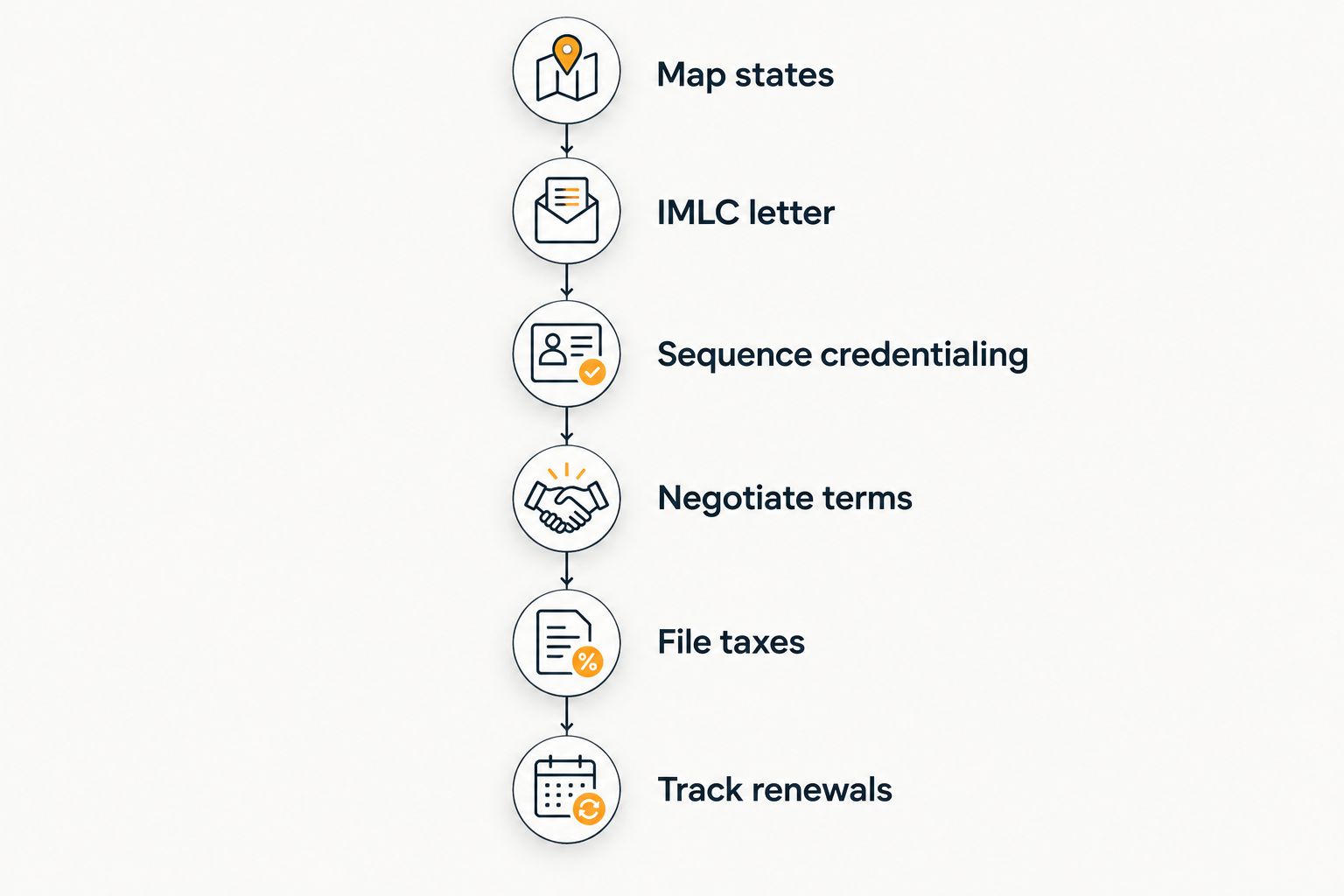
The planning order matters more than any individual decision inside it. Work through these steps roughly in this sequence, starting three to six months before your first assignment begins.
- Map target states by reciprocity and demand, not rate alone. Some states process out-of-state applications in weeks; others take a full quarter. Pick states where demand and licensing speed both work in your favor before you look at day rates.
- Apply for your IMLC Letter of Qualification before you need it. The Interstate Medical Licensure Compact covers roughly 40 member states in 2026. A Letter of Qualification issued by your state of principal licensure lets you request expedited licenses in every compact state instead of filing from scratch each time.
- Sequence assignments so credentialing overlaps instead of stacking. Start the next state's hospital credentialing file while you're still finishing the current assignment. Maintaining active licenses across multiple states is a running task across the year, not a one-time setup.
- Negotiate the terms around the rate, not just the rate. Travel reimbursement, housing, and malpractice tail coverage move take-home pay more than an extra percentage point on the day rate. A lower rate with tail coverage included often beats a higher rate that leaves you buying your own tail when the contract ends.
- Structure your taxes before the first paycheck lands. Multi-state 1099 work generally means filing across more than one state's tax rules plus your home state. Underpayment penalties from skipped quarterly estimates erase real income fast, and they're avoidable with planning done in month one, not month eleven.
- Track license renewals and CME deadlines in every state you hold a license in, not just the one you're currently working. A lapsed license in a state you planned to return to next quarter stalls the whole schedule.
Laid out across a calendar year, this stops looking like six separate tasks and starts looking like one pipeline: it opens months before the first assignment and doesn't close until the last state tax return is filed.
Why take-home pay varies across a multi-state locum year
Same specialty, same number of shifts, different take-home totals — the gap almost always comes from one of these:
- License reciprocity and IMLC participation — states inside the compact process new licenses faster than states requiring a full standalone application.
- Hospital-specific credentialing turnaround — every facility runs its own credentialing committee timeline, independent of your state license status.
- State income tax exposure — working days in a state generally creates a filing obligation there, on top of your resident state return.
- Malpractice tail requirements between contracts — occurrence-based and claims-made policies handle a gap between assignments differently, and tail costs left unaddressed cut directly into what you actually keep.
- 1099 vs. W-2 classification — W-2 locum work withholds tax automatically; 1099 work puts quarterly estimates and self-employment tax on you.
- Travel and housing terms — whether these are built into the contract or left for you to cover changes the real value of the day rate.
How many states should a locum radiologist plan for in one year?
Three to five states is the range that keeps most locum radiologists moving without losing weeks to onboarding paperwork at every single stop. Fewer than three limits how much you can diversify demand and rate; more than five usually means more time spent on licensing admin than on reading cases.
Is 1099 or W-2 better for a multi-state locum radiology year?
1099 status is the more common structure for locum radiology work, and it shifts tax withholding, quarterly estimates, and often licensing costs onto the radiologist. W-2 locum arrangements withhold tax automatically and sometimes include benefits, but usually at a lower headline rate — run both structures through the same math before comparing offers side by side.
How long does credentialing take when adding a new state?
Credentialing timelines run on the hospital system's calendar, not the radiologist's, and they vary widely by facility. Starting the file the moment a contract is verbally agreed — before it's even signed — is what keeps a multi-state year from stalling mid-quarter.
Finding the next assignment before the current one ends is what actually keeps this sequence moving instead of stalling. RadBoard aggregates locum, travel, and permanent radiology openings from 20 sources into a single AI-powered search, so scanning multiple states for an opening that fits the next slot in your calendar doesn't mean checking 20 separate job boards one at a time.
Compare locum openings across states
5,000+ radiology jobs from 20 sources in one AI-powered search.
FAQ
How many states should I plan to work in during one locum radiology year?
Three to five states is the practical range for a 2026 locum year — enough to diversify demand and rate without losing more time to licensing admin than to reading cases.
What is the IMLC and how does it help locum radiologists?
The Interstate Medical Licensure Compact (IMLC) is an agreement among roughly 40 member states in 2026 that speeds up licensing for physicians who already hold a license in a compact state. A Letter of Qualification from your home state lets you request expedited licenses in any other member state.
Is 1099 or W-2 better for multi-state locum radiology work?
1099 status is more common in locum radiology and shifts tax withholding and quarterly estimates onto you, while W-2 arrangements withhold automatically and sometimes include benefits at a lower rate. Compare both structures using the same after-tax math before choosing.
How do I avoid credentialing delays between states?
Start the next assignment's credentialing file while the current one is still active instead of waiting until the contract ends. Overlapping the timelines is what prevents unpaid gaps between states.
Does malpractice tail coverage transfer between locum states?
No — tail coverage is tied to the policy from a specific contract, not to you personally. Confirm whether the outgoing contract includes tail coverage before you sign the next one.
How does state income tax work when I work in multiple states in one locum year?
Working days in a state generally creates a nonresident filing obligation there, in addition to your resident state return. Reciprocity agreements between some neighboring states can reduce double taxation, but they don't apply everywhere.
What's the biggest mistake radiologists make planning a multi-state locum year?
Chasing the highest posted day rate instead of sequencing assignments to avoid credentialing gaps. A slightly lower rate paid across a full working calendar outperforms a higher rate interrupted by unpaid downtime.
Can RadBoard help me find multi-state locum radiology assignments?
Yes — RadBoard aggregates radiology openings, including locum and travel assignments, from 20 sources so you can compare multiple states in a single AI-powered search instead of checking each job board separately.
One last thing
Radiologists who get the most out of a multi-state locum year rarely chase the highest day rate — they eliminate dead time between assignments. A lower rate paid across a full working calendar beats a higher rate interrupted by unpaid credentialing gaps, and the credentialing calendar is the one variable you can actually control the day you start planning next year's states.