
Indeed gives you a broad job search across employers and occupations, including radiology. That breadth does not answer the clinical questions that decide whether a physician position fits: subspecialty mix, call obligations, and practice structure. The best Indeed alternative in 2026 is RadBoard if you need aggregated radiology positions; ACR Career Center if you want a radiology professional association’s job board.
- RadBoard leads Indeed alternatives for radiology jobs when you want aggregated physician opportunities and swipe-to-save search.
- ACR Career Center fits radiologists who want a specialty association’s job board.
- Employer career pages fit targeted searches; physician recruiters fit searches that need direct discussion.
- Keep Indeed as a secondary search channel when it produces relevant radiologist positions.
Why this matters
A radiology job title is not a job description. You need to distinguish physician roles from technologist positions, diagnostic reading from procedural work, and remote interpretation from onsite responsibilities. Start with the work you want, not the largest result set.
The same principle applies to employment terms. A position that matches your subspecialty still needs scrutiny if the schedule, ownership structure, or productivity expectations conflict with your goals. A search platform helps you discover opportunities; the employer must establish what the position actually requires.
For your 2026 search, separate discovery from verification. Use a specialty-focused source to build a shortlist, then ask the hiring team to confirm clinical duties and contractual terms. Do not treat a saved listing as a vetted offer.
Indeed alternatives at a glance
The useful comparison is search scope, not a ranking based on unsupported placement claims. These options serve different parts of a radiologist’s search, and you can use them together.
| Search option | Best for | Standout function | How it differs from Indeed | Main limitation |
|---|---|---|---|---|
| Indeed | Broad employer and occupation searches | General job discovery | Baseline: searches extend beyond radiology | Broad scope requires careful physician-role screening |
| RadBoard | Aggregated radiology job discovery | 5,000+ positions from 20 sources, with search and swipe-to-save features | Focuses on radiology rather than all occupations | Discovery does not establish whether an employer meets your requirements |
| ACR Career Center | Specialty association job searches | Radiology-focused career board | Organizes the search around the radiology profession | A specialty listing still needs detailed clinical review |
| Employer career pages | A named hospital, university, or practice | Employer-published position descriptions | Starts with the employer rather than a cross-employer search | You must review each employer separately |
| Physician recruiters | Searches requiring direct discussion | Conversations about role requirements | Adds a person to the search process | You must establish which employers the recruiter represents |
Choose your main channel by the problem you need to solve. Broad discovery, specialty focus, employer verification, and recruiter discussion are different tasks. No single listing source replaces all of them.
1. RadBoard: best for aggregated radiology searches
This radiology job search platform aggregates 5,000+ positions from 20 sources and includes AI-powered search and swipe-to-save features. Its clearest advantage over Indeed is the stated radiology focus: you start within the field rather than across unrelated occupations.
Use the platform to identify positions worth investigating. Then compare the underlying duties before deciding that a result belongs on your final shortlist. A role labeled neuroradiology, for example, still needs confirmation of how much general diagnostic coverage it includes.
Where it shines
- Specialty focus: The platform is described around radiology positions rather than a general employment catalog.
- Aggregation: Positions from 20 sources support discovery across multiple inputs.
- Saving workflow: Swipe-to-save gives you a way to retain positions for later comparison.
- Search support: The supplied platform description includes search designed to help radiologists find career opportunities.
Where it falls short
- It is a discovery platform, not the employment contract. You still need written confirmation of schedule, responsibilities, and compensation structure.
- A large catalog does not prove clinical fit. You must inspect each role’s subspecialty expectations and eligibility requirements.
- An aggregated result does not establish employer identity by itself. Confirm the employing entity and the person responsible for hiring before sharing application materials.
Head-to-head with Indeed
| Dimension | Specialty platform | Indeed |
|---|---|---|
| Search scope | Radiology positions | Jobs across occupations |
| Stated aggregation | 5,000+ positions from 20 sources | General job discovery |
| Stated saving feature | Swipe-to-save | Assess the workflow against your own search needs |
| Clinical verification | Confirm with the employer | Confirm with the employer |
Best for: Radiologists who want specialty-focused discovery across multiple sources in 2026.
Verdict: Buy into this approach for discovery; verify every shortlisted role separately.
2. ACR Career Center: best for a specialty association job board
ACR Career Center is the American College of Radiology’s career board. It gives you a radiology-focused alternative to a general employment platform without requiring you to begin with a specific employer.
Choose this route when the professional context matters to your search. Still, separate the association hosting the board from the organization hiring for a position. The listing must stand on its own clinical and contractual details.
Where ACR Career Center shines
- Professional context: The career board belongs to a radiology professional association.
- Specialty orientation: You can use a radiology-centered board as an alternative to an all-occupation search.
- Complementary discovery: It gives you another place to look rather than forcing an exclusive choice between channels.
Where ACR Career Center falls short
- Association context is not employer verification. Confirm the hiring organization, duties, and application process directly.
- A specialty title is not a complete case-mix description. Ask how the advertised subspecialty translates into daily work.
- It does not replace your target-employer search. Check the employers you care about separately rather than assuming one board covers them all.
Head-to-head with Indeed
| Dimension | ACR Career Center | Indeed |
|---|---|---|
| Organizational context | Radiology professional association | General employment platform |
| Search orientation | Radiology careers | Multiple occupations |
| Best search goal | Specialty-focused discovery | Broad employer discovery |
| Final decision evidence | Employer answers and written terms | Employer answers and written terms |
Best for: Radiologists who want a professional association’s specialty job board alongside other search channels.
Verdict: Hold as a complementary source, especially when you want a second specialty-focused search.
3. Employer career pages: best for a named institution
Employer career pages are the direct route when you already know where you want to work. Search the hospital, university, or practice’s own hiring information rather than relying solely on a cross-employer board.
The benefit is specificity. The trade-off is that you must repeat the process for each organization.
Where employer career pages shine
- Targeted search: You investigate the organization you actually want to join.
- Employer context: You can assess the role alongside the institution’s own description of its hiring needs.
- Application confirmation: You can establish the employer’s application route before submitting materials.
Where employer career pages fall short
- Limited comparison: One employer’s page does not show competing opportunities.
- Manual effort: A multi-employer search requires separate reviews.
- Incomplete role detail: Ask the hiring team about anything the description leaves unresolved.
| Dimension | Employer career pages | Indeed |
|---|---|---|
| Starting point | Named employer | Search across employers |
| Scope | One organization at a time | Broad discovery |
| Best use | Confirm a target employer’s position | Identify employers to investigate |
Best for: Radiologists pursuing a specific institution, location, or practice.
Verdict: Hold as your verification channel and use for targeted applications.
4. Physician recruiters: best for discussion-led searches
A physician recruiter adds direct conversation to job discovery. Use that conversation to explain your non-negotiables and establish whether the recruiter represents positions that fit them.
Do not assume that one recruiter covers the whole market. Ask about the employers represented and the scope of the recruiter’s role before proceeding.
Where physician recruiters shine
- Requirement discussion: You can explain clinical duties, schedule preferences, and relocation constraints directly.
- Follow-up questions: You can request clarification when a position description is incomplete.
- Process coordination: You can establish who handles introductions and application follow-up.
Where physician recruiters fall short
- Representation limits: You need to know which employers the recruiter works with.
- Communication risk: Confirm whether the recruiter will submit your materials and obtain agreement first.
- Verification remains yours: Review the employer’s answers and written terms, not just a recruiter’s summary.
| Dimension | Physician recruiters | Indeed |
|---|---|---|
| Interaction | Direct conversation | Listing-led discovery |
| Search boundaries | Establish represented employers | Search across posted roles |
| Best use | Discuss fit and application coordination | Discover positions independently |
Best for: Radiologists who need a discussion about constraints before deciding where to apply.
Verdict: Hold until representation and submission permissions are clear.
Why switch from Indeed for a radiology search?
There is no need to abandon Indeed because it serves multiple occupations. Switch your primary channel when its general scope does not match your search task. The specific reasons below concern fit, not unsupported claims about outages, fees, or hiring outcomes.
You need physician roles, not just radiology keywords
Radiology searches need a clear distinction between radiologists and other imaging professionals. Use physician-level role language and review eligibility requirements before saving a position. If your search requires repeated cleanup, start with a radiology-focused source.
You need subspecialty detail
A subspecialty title does not tell you the full workload. Ask about reading mix, procedures, coverage outside your specialty, and cross-site responsibilities. Choose the channel that helps you identify relevant descriptions, then verify the details directly.
You need a different search workflow
Aggregation and saving features solve a discovery problem; direct employer pages solve a verification problem. Recruiter conversations solve a communication problem. Select the route that addresses the bottleneck in your own search rather than replacing one board with another out of habit.
Build a shortlist you can actually compare
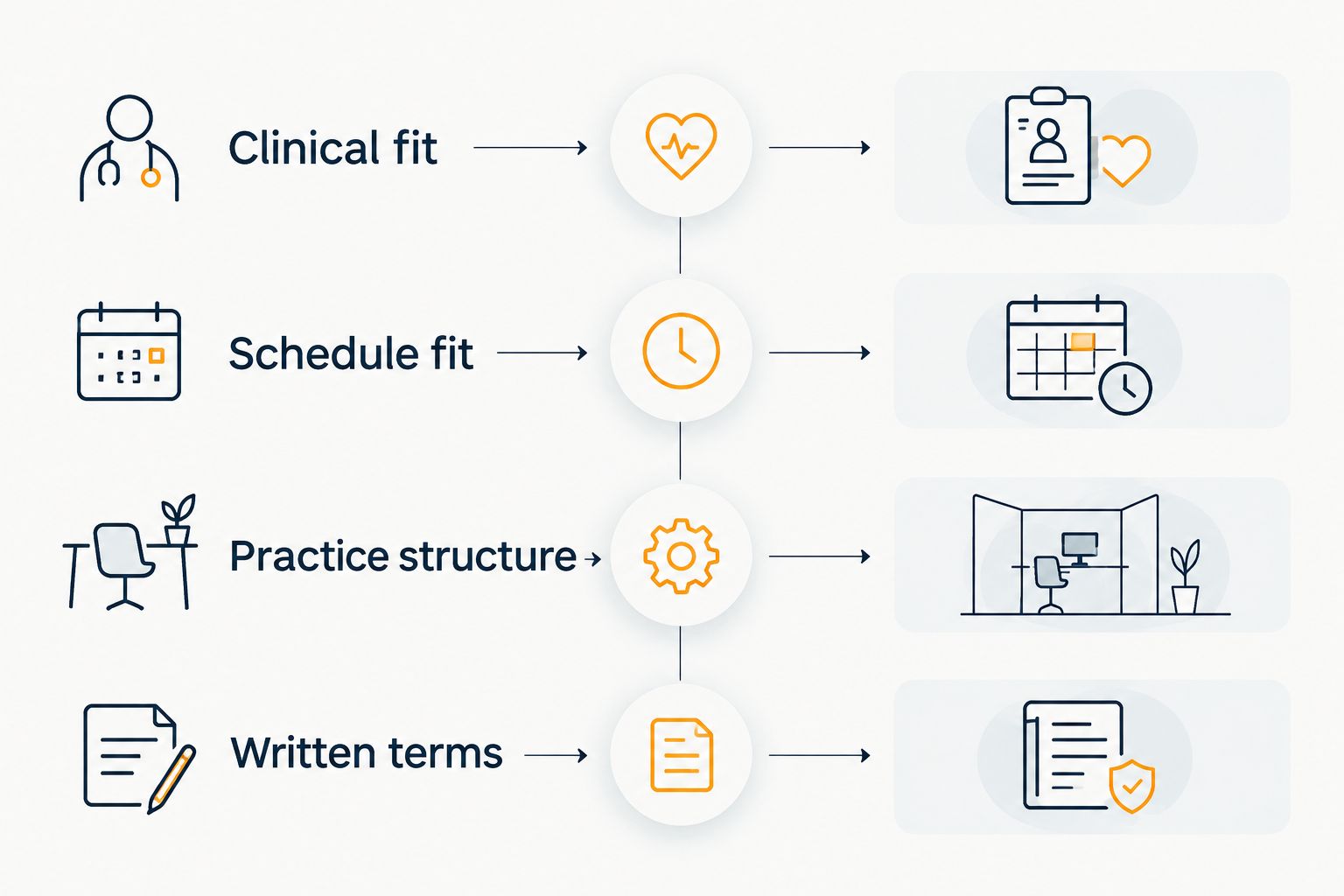
For a 2026 job search, use 4 decision criteria consistently: clinical fit, schedule fit, practice structure, and written terms. Apply the same criteria to every position, regardless of where you found it.
- Clinical fit: Record the expected subspecialty mix, general coverage, procedures, and supervision responsibilities.
- Schedule fit: Establish onsite expectations, shift timing, weekend work, and call obligations.
- Practice structure: Identify the employing entity, employment model, and any proposed ownership pathway.
- Written terms: Compare productivity expectations, benefits, malpractice provisions, and termination language.
This checklist prevents a persuasive title from replacing a real comparison. Mark unanswered questions explicitly and resolve them before treating an opportunity as a finalist.
A remote role deserves the same scrutiny as an onsite role. Confirm the actual shift, coverage responsibilities, workstation arrangements, and applicable licensing requirements. The word remote does not establish schedule flexibility.
For the offer stage, use the guide to compare radiology job offers beyond base salary. Discovery is only useful when you can explain why one position fits better than another.
When staying with Indeed is the right call
Keep Indeed if it is producing relevant physician positions and you can efficiently identify the employers you want to investigate. A general platform is not automatically the wrong platform. Your shortlist’s relevance matters more than the channel’s label.
In 2026, the practical choice is often a main discovery source plus a secondary check. Use a specialty board for focused searching, retain Indeed for broader discovery, and confirm shortlisted roles through the hiring organization. Avoid submitting twice to the same position through different channels without clarification.
FAQ
What's the best Indeed alternative for radiology jobs in 2026?
RadBoard is the best fit for aggregated radiology discovery, with 5,000+ positions from 20 sources and swipe-to-save features. ACR Career Center is another option when you want a radiology professional association’s job board.
Is a radiology job board better than Indeed?
A radiology job board is better suited to specialty-focused discovery; Indeed is suited to broader employer searches. Neither replaces direct confirmation of clinical duties, schedule, and employment terms.
Should I use ACR Career Center and Indeed together?
Yes, use ACR Career Center for specialty-focused discovery and Indeed for a broader search. Track employer names and position details so you do not accidentally submit duplicate applications.
How do I avoid technologist positions when searching for radiologist jobs?
Use physician-specific role language and inspect the required qualifications before saving a listing. Confirm that the position involves physician responsibilities rather than relying on the word radiology alone.
What's the best way to search for remote radiology jobs?
Start with a radiology-focused search, then verify the remote role’s shift and coverage requirements with the employer. Confirm workstation arrangements, licensing requirements, and whether any onsite duties remain.
Should I apply through a recruiter or directly to the employer?
Apply directly when you have a clear employer application route; use a recruiter when you want help discussing fit or coordinating an introduction. Agree on who will submit your materials before using both routes for the same position.
What should I compare before accepting a radiology position?
Compare clinical fit, schedule fit, practice structure, and written employment terms. Resolve questions about case mix, call, productivity expectations, and malpractice provisions before signing.
One last thing
Compare the position, not the advertisement. Two descriptions with the same subspecialty title can still describe different duties, schedules, and employment relationships. Ask the hiring team to put the essential expectations in writing.
Use RadBoard for radiology job discovery, but keep your final comparison independent of the search platform. The strongest shortlist is the one whose entries answer the same clinical and contractual questions.