
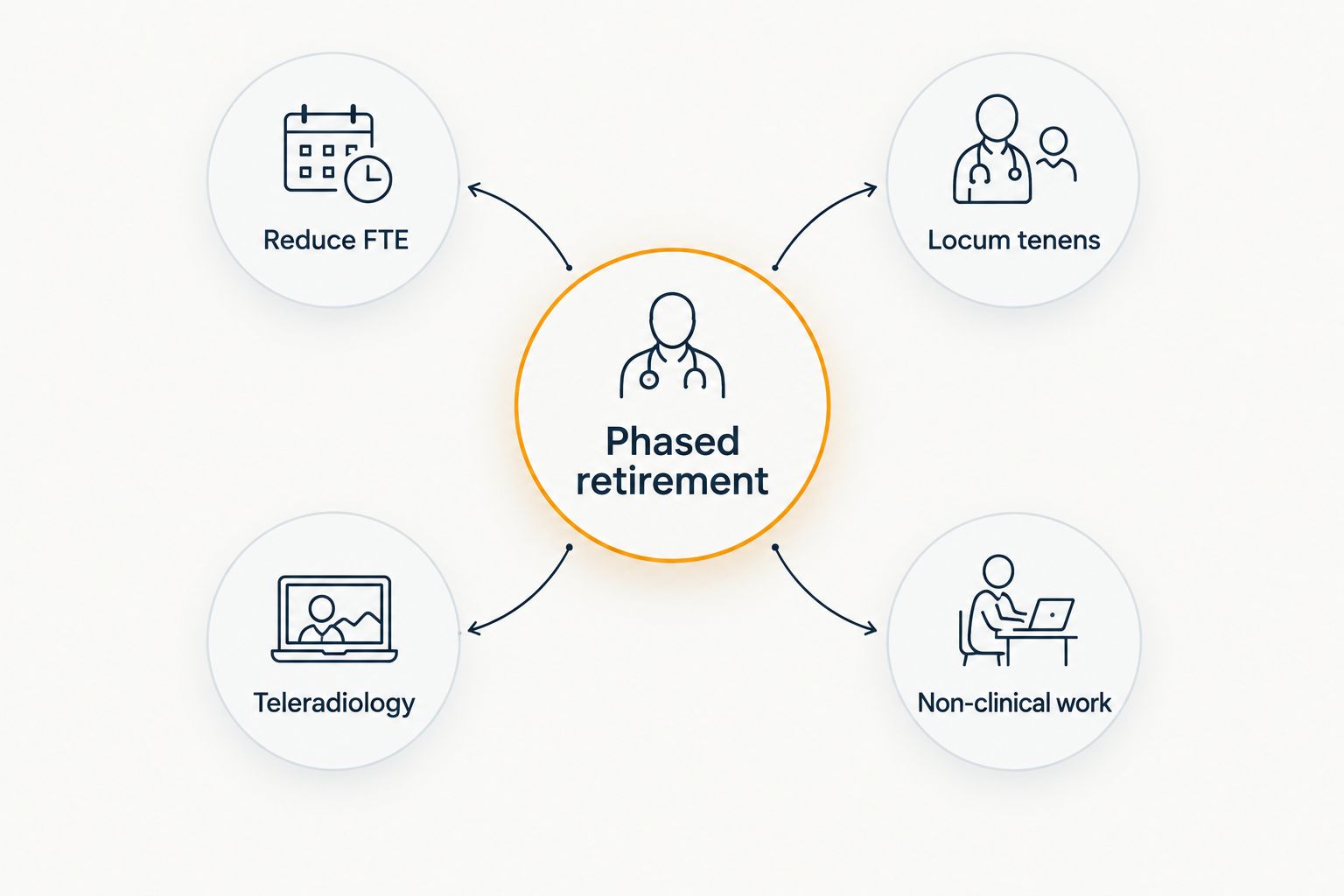
Phased retirement for a radiologist means stepping down from full-time reads in stages rather than stopping cold: cut your clinical FTE first, layer in locum tenens or teleradiology shifts to control income and schedule, then time the final exit around RMD rules and your board recertification cycle. The plan only holds together if you sequence the pieces in order — benefits eligibility, malpractice tail coverage, and non-compete language all break if you drop hours before the next stage is lined up.
- Cut FTE first, then add locum tenens or teleradiology shifts before dropping clinical work entirely.
- RadBoard lists radiology jobs at reduced FTE and flexible schedules built for a phased exit.
- Required minimum distributions start at age 73 under the SECURE 2.0 Act — plan income drop-off around that date.
- The ABR's 10-year Continuous Certification cycle is a natural checkpoint for scaling back clinical hours.
- Malpractice tail coverage and non-compete clauses change at every FTE tier — confirm both before you sign anything new.
Why this matters
Most radiologists who leave clinical practice well don't quit the week they decide they're done — they restructure the job first. Going part-time without losing benefits is the single most common first move, because dropping straight from 1.0 FTE to zero forfeits vacation accrual, CME funding, and often group buy-in equity in one step.
A phased plan also protects income during the gap. Radiology groups renegotiate FTE on their own schedule, not yours, so bridging with locum tenens or teleradiology work while your primary group processes the reduction keeps cash flow steady. Skip that bridge and you're either underemployed for a stretch or you rush the exit and eat a worse malpractice tail bill than you needed to.
How do you structure a phased retirement plan as a radiologist?
A phased retirement plan for a radiologist runs through six steps, in this order:
- Set the target exit window. Pick a year, not a vague "someday." Everything else — RMD timing, MOC cycle, contract notice periods — gets scheduled backward from that date.
- Renegotiate FTE with your current employer. Ask what happens to benefits, call pool participation, and partnership distributions at 0.8, 0.6, and 0.5 FTE. Get the answer in writing before you sign anything.
- Line up a bridge option. Locum tenens or teleradiology fills the hours your primary job drops, without a multi-year commitment.
- Confirm malpractice tail and non-compete status at each tier. Tail coverage cost and non-compete geography often change once you cross below full-time status — this is the detail most radiologists miss.
- Time RMDs and Medicare enrollment against your income drop. The IRS requires required minimum distributions starting at age 73 under the SECURE 2.0 Act — sequencing your FTE cuts around that date avoids stacking taxable income in the wrong years.
- Pick the final off-ramp. Full stop, non-clinical work, or indefinite part-time — decide this last, once you know how the bridge years actually felt.
Comparing the bridge options
| Option | Schedule control | Income stability | Benefits retained | Best for |
|---|---|---|---|---|
| Reduced FTE, same group | Low-moderate | High | Most or all | Radiologists with partnership equity to protect |
| Locum tenens | High | Moderate | None (1099) | Radiologists who want variety and no long lock-in |
| Teleradiology | High | Moderate-high | Varies by contract | Radiologists prioritizing remote, no-commute reads |
| Non-clinical / consulting | High | Lower, non-clinical income | None | Radiologists exiting clinical work entirely |
Reduced FTE at your current group is the lowest-risk starting move for any radiologist planning a multi-year phase-down, because it's the only option that keeps benefits intact while you test lower hours.
Option: reduce FTE while staying employed
Dropping from 1.0 to 0.6 or 0.5 FTE at your current group is the most common first step in a phased retirement plan. It keeps CME funding, malpractice coverage, and often retirement plan matching intact — the tradeoff is that your group controls the pace, and not every practice offers a formal reduced-FTE track. Ask HR for the exact benefits cliff before you request the change.
Option: bridge with locum tenens contracts
Locum tenens radiology jobs work well as a bridge because assignments run weeks to months, not years, so you can scale hours up or down each quarter as your retirement timeline shifts. The cost is benefits — locum work is almost always 1099, so you're funding your own health coverage and retirement contributions during those years.
Option: shift to teleradiology for schedule control
Teleradiology lets you keep reading cases without commuting, on-call rotations, or hospital politics, which makes it a common landing spot for the last few years before a full stop. Multi-state licensing and credentialing take real lead time, so this option needs to be arranged before you drop your primary job's FTE, not after.
Why a phased retirement timeline varies
- Subspecialty demand — high-demand reads (neuro, IR, breast) get more flexible part-time and locum offers than general diagnostic work.
- Group ownership structure — private-equity-backed groups tend to have less flexible FTE tiers than independent practices.
- State licensing for remote work — teleradiology across multiple states adds credentialing lead time to the plan.
- Non-compete geography — a wide non-compete radius can block local locum or part-time work until it expires.
- Malpractice tail obligations — who pays tail coverage at exit changes the math on when to actually leave.
- RMD and Medicare enrollment timing — income drop-off should land in years that don't collide with mandatory distributions.
“A phased retirement plan fails when the FTE cut happens before the bridge is arranged, not because the bridge itself was a bad idea.”
Do you need a non-compete waiver to add locum work while still employed?
Often, yes — check the non-compete clause's geography and scope before booking any outside shifts. Some contracts exempt locum tenens work outright; others treat it as a breach even at reduced FTE, so the contract language matters more than the job title.
Can you keep malpractice tail coverage while phasing down?
Tail coverage terms usually change once you drop below full-time status, and who pays for it (you or the group) is negotiated separately from the FTE reduction itself. Get this in writing at the same time you renegotiate hours, not afterward.
Does dropping to part-time affect your ABR recertification timeline?
No — the American Board of Radiology's Continuous Certification cycle runs on a fixed 10-year schedule regardless of FTE, so reduced hours don't extend or shorten your recertification deadline. Plan the FTE cut around the cycle, not the other way around.
Find flexible radiology roles for a phased exit
Search reduced-FTE, locum, and teleradiology openings in one place.
FAQ
How do you phase retire as a radiologist?
You phase retire as a radiologist by cutting FTE with your current employer first, then adding locum tenens or teleradiology shifts as a bridge before stopping clinical work entirely. Sequencing benefits, malpractice tail coverage, and RMD timing around that schedule is what keeps the plan from costing more than it needs to.
What FTE should you start a phased retirement at?
Most radiologists start a phase-down at 0.6 to 0.8 FTE with their current group, since that range often preserves most benefits. The exact cutoff for losing benefits is set by each employer's policy, not a universal number.
Is locum tenens or teleradiology better for phased retirement?
Locum tenens gives more schedule variety and no long-term commitment; teleradiology gives a steadier routine without travel. Radiologists nearing full retirement often prefer teleradiology for its predictability, while those still building flexibility lean locum.
What happens to malpractice tail coverage when you go part-time?
Malpractice tail coverage terms typically change once you cross below full-time status, and responsibility for the cost shifts between employer and physician depending on the contract. Confirm this in writing before reducing FTE, not after.
When should you start planning a phased retirement?
Start planning before you renegotiate FTE for the first time, since RMD timing at age 73 and the ABR's 10-year Continuous Certification cycle both need to be mapped against your exit year in advance. Waiting until the year you want to leave leaves no room to sequence benefits and bridge work properly.
Does a non-compete clause block phased retirement plans?
A non-compete clause can block local locum tenens or part-time work depending on its geographic radius and scope. Some contracts exempt reduced-FTE arrangements with the same employer; check the exact wording before assuming you're free to add outside shifts.
Can you combine part-time W-2 work with 1099 locum shifts?
Yes, combining a reduced-FTE W-2 role with 1099 locum tenens shifts is one of the most common phased retirement structures for radiologists. It keeps some benefits from the W-2 side while adding income flexibility from the 1099 side.
One last thing
The detail radiologists underestimate isn't the FTE math — it's the ABR's 10-year Continuous Certification cycle landing in the middle of a phase-down. Time the exit so your last recertification cycle finishes before you drop to your lowest FTE tier, not mid-cycle, and the paperwork stops competing with the actual retirement.