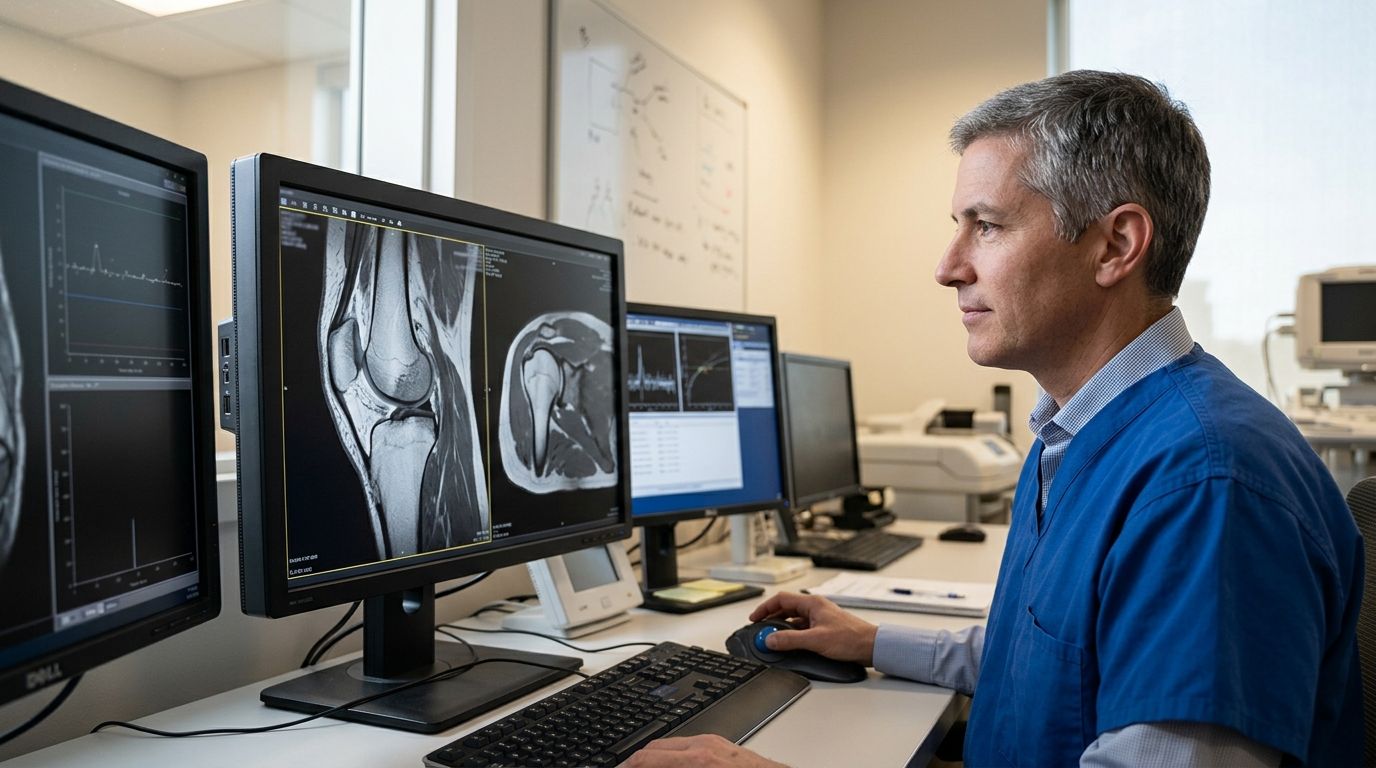
Locum tenens MSK MRI coverage is short-term orthopedic imaging work with the aim of keeping MRI interpretation available during staffing gaps, leave, or temporary demand. These assignments require you to evaluate the MSK case mix, workflow, credentialing path, and contract terms instead of treating the opening like a general diagnostic radiology shift.
- Locum tenens MSK MRI jobs cover temporary orthopedic imaging needs across onsite, remote, and hybrid settings.
- Confirm the modality mix, daily workflow, credentialing status, malpractice terms, and compensation structure before accepting an assignment.
- RadBoard aggregates 5,000+ radiology positions from 20 sources and supports AI-powered search and swipe-to-save.
- Direct contracts provide more control; staffing agencies provide more administrative support but add another party to negotiations.
Why locum tenens MSK MRI jobs matter
MSK MRI assignments are narrower than general diagnostic radiology coverage. The facility may need interpretation of extremity MRI, spine MRI, postoperative imaging, sports-related studies, or a mixture of orthopedic cases. The listing title alone rarely answers how concentrated the work is.
Your first task is to separate true subspecialty coverage from a general diagnostic role carrying an MSK label. A position can emphasize orthopedic imaging while still including radiographs, CT, emergency work, or call. Confirming the case mix before applying protects both your schedule and the facility's coverage plan.
The RadBoard radiology job search brings 5,000+ positions from 20 sources into one platform. Its 2026 US Radiology Job Market Report analyzes 3,700+ active listings across salary benchmarks, subspecialty demand, ownership trends, geographic distribution, and AI adoption. Those figures make broad discovery easier, but every 2026 locum opportunity still requires individual contract and workflow review.
How to evaluate MSK MRI locum assignments
Define the orthopedic imaging work you will accept
Start with your own clinical scope. Write down the modalities, body regions, procedures, and practice settings you are prepared to cover before opening a job board or contacting a recruiter. This manual step prevents a broad search from producing a shortlist filled with assignments that do not match your training or current practice.
Distinguish diagnostic interpretation from procedural coverage. An opening centered on MRI interpretation is materially different from one that also expects arthrograms, injections, fluoroscopy, or onsite consultation. Do not let a general MSK title blur that boundary.
Use this scope for your 2026 search:
- List the MRI body regions you routinely interpret
- Separate diagnostic reading from image-guided procedures
- Mark whether you will cover radiographs, CT, or call
- Choose onsite, remote, or hybrid work
- Record the states where you can currently practice
- Set the assignment lengths and schedules you will consider
Verify the case mix and daily workflow
Ask the facility or recruiter for a written description of the expected work. You need enough detail to understand whether MSK MRI is the core responsibility or one component of a broader diagnostic list. A precise case description is more useful than a title containing orthopedic imaging coverage.
Review how studies reach your worklist and how results return to referring clinicians. Ask whether the assignment uses a dedicated orthopedic queue, a shared hospital queue, or a mixed outpatient list. Also establish who handles protocol questions, urgent findings, prior examinations, and direct clinician communication.
Check these points before discussing a start date:
- Modalities and body regions included in the worklist
- Expected balance between MRI and other imaging
- Whether procedures are part of the assignment
- PACS, reporting, and communication systems
- Access to prior studies and outside examinations
- Call, weekend, and overflow responsibilities
Search across more than one source
Once the scope is clear, search manually across facility career pages, staffing agency listings, professional contacts, and radiology job boards. Use specific combinations such as locum MSK MRI, orthopedic MRI coverage, remote MSK radiology, and temporary musculoskeletal radiologist. Add your preferred state or work setting when the results are too broad.
The faster path is to use the RadBoard platform to search listings aggregated from 20 sources. Its AI-powered search and swipe-to-save features help you separate possible matches from positions that do not fit. The related guide to locum tenens musculoskeletal radiology jobs provides a broader view of sports imaging assignments beyond MRI-only coverage.
Build a repeatable 2026 search process:
- Search both MSK and musculoskeletal terminology
- Add MRI, orthopedic, sports, spine, or extremity modifiers
- Filter by onsite, remote, or hybrid setting
- Save positions that match your defined clinical scope
- Record the original source and date of each listing
- Remove duplicate listings before comparing terms
Confirm licensing, credentialing, and privileges
An attractive schedule is irrelevant if the administrative path cannot support the proposed start date. Ask which state licenses, facility credentials, payer enrollments, and clinical privileges must be active before work begins. Do not assume that a license alone clears you to read for a hospital or imaging center.
Request a written checklist and identify who owns each step. The facility, staffing agency, and physician can have separate responsibilities. Keep copies of submitted documents and track unresolved items in one place so that repeated requests do not delay the file.
Complete these checks before committing:
- Confirm the required state license status
- Request the full credentialing document list
- Match requested privileges to the actual assignment scope
- Identify the credentialing contact and escalation path
- Verify that the proposed start date follows final approval
- Track expiring licenses and professional documents
Review malpractice and contract responsibility
Determine who supplies professional liability coverage and what happens after the assignment ends. The contract should identify the coverage structure, responsible party, applicable work locations, and any obligations that survive termination. If the language is unclear, obtain qualified legal or insurance advice before signing.
Also identify the contracting entity. A staffing agency agreement can sit between you and the facility, while a direct engagement places negotiation with the practice or health system. The number of parties affects communication, amendments, cancellation, and dispute handling.
Review these contract items together:
- Named contracting parties and covered work locations
- Professional liability coverage and tail responsibility
- Assignment start, end, extension, and cancellation terms
- Scope changes and approval requirements
- Travel or remote-work responsibilities when applicable
- Restrictions that continue after the assignment
Compare workload and compensation structure
Do not compare offers by a headline figure alone. Establish how the assignment defines a workday, shift, study, RVU, overtime period, or coverage block. Then connect that unit to the expected worklist, schedule, administrative duties, and procedure requirements.
Ask what happens when the actual case mix differs from the description. The agreement should address added modalities, extra call, schedule extensions, or procedural work rather than leaving those changes to an informal conversation after the assignment starts. Evaluate tax classification and business expenses with qualified professionals based on the final contract.
Use the same comparison fields for every 2026 offer:
- Compensation unit and payment schedule
- Expected workload and included modalities
- Call, weekend, overtime, and overflow treatment
- Travel, lodging, and remote-work responsibilities
- Cancellation and early-termination consequences
- Administrative work outside interpretation time
Test the technical and communication workflow
Remote and hybrid MSK MRI assignments depend on access, image quality, comparison studies, reporting tools, and a clear escalation path. Onsite work also requires workflow preparation because each facility organizes queues, protocol questions, and clinician communication differently. Resolve these points before your first scheduled coverage period.
Ask for system access early enough to identify missing credentials or incompatible tools. Never use patient information outside approved systems when testing access. The facility should provide the authorized process for technical support and urgent clinical communication.
Finish with a workflow readiness check:
- Confirm PACS and reporting access through approved systems
- Identify technical support during scheduled coverage
- Verify how prior studies and outside imaging appear
- Learn the process for urgent findings and consultations
- Confirm who handles protocol and scheduling questions
- Document the approved backup process for access failures
Search MSK MRI locum openings
Compare 5,000+ radiology positions aggregated from 20 sources.
Comparing MSK MRI coverage options
No single sourcing model wins for every radiologist. Your best option depends on whether you prioritize administrative support, direct control, broad discovery, or an existing professional relationship. Compare the limitations before deciding where to concentrate your 2026 search.
| Option | Best for | Main advantage | Key limitation |
|---|---|---|---|
| Direct facility contract | Radiologists who want direct communication and contract control | Fewer intermediaries between physician and facility | You manage more of the negotiation and administrative follow-up |
| Staffing agency assignment | Radiologists who want coordination support | An agency can coordinate communication, paperwork, and logistics | The agency adds another party to contract discussions |
| Aggregated job search | Radiologists comparing openings across multiple sources | Broad discovery without checking every source separately | The platform does not replace contract, credentialing, or legal review |
| Professional referral | Radiologists with an established clinical network | Context can come directly from people familiar with the practice | Available opportunities depend on the reach of your network |
RadBoard is best for radiologists who want to compare locum tenens MSK MRI jobs across multiple sources before contacting an agency or facility. It speeds up discovery, while the physician remains responsible for verifying the clinical scope, active status, credentials, and contract.
Common mistakes MSK radiologists make
Treating an MSK title as a complete job description
A title does not define the modalities, procedures, call expectations, or daily worklist. Ask for the clinical scope in writing and compare it with your own practice boundaries before applying.
Accepting a start date before approvals are clear
Licensing, credentialing, and privileging are separate checkpoints. A proposed date is not the same as authorization to work, so tie your commitment to the facility's documented approval process.
Comparing compensation without comparing workload
A compensation unit has little meaning without the schedule, case mix, expected output, administrative duties, and cancellation terms. Put every offer into the same comparison format before selecting one.
Leaving procedures and cross-coverage undefined
An MRI-focused assignment can expand if the agreement uses broad language. Specify whether radiographs, CT, fluoroscopy, arthrograms, injections, general call, or overflow reading are included.
Assuming remote work removes location requirements
Remote interpretation still depends on licenses, credentials, privileges, approved systems, and the locations involved in the work. Confirm those requirements for the actual assignment instead of relying on the remote label.
FAQ
What are locum tenens MSK MRI jobs?
Locum tenens MSK MRI jobs are temporary radiology assignments focused on musculoskeletal MRI interpretation and related orthopedic imaging coverage. The exact case mix, work setting, procedures, and schedule vary by facility and contract.
What is the best way to find locum tenens MSK MRI jobs in 2026?
The best search combines direct facility listings, staffing agencies, professional referrals, and an aggregated radiology job platform. RadBoard collects 5,000+ radiology positions from 20 sources, making it useful for broad discovery before direct verification.
Do MSK MRI locum assignments include procedures?
Some assignments include procedures, while others are limited to diagnostic interpretation. Confirm whether arthrograms, injections, fluoroscopy, or other image-guided work appears in the written scope.
Can locum MSK MRI radiologists work remotely?
Remote MSK MRI work is possible when the assignment supports remote interpretation and the physician satisfies its licensing, credentialing, privileging, security, and technical requirements. Procedural responsibilities require a separate onsite plan.
How should I compare two MSK MRI locum offers?
Compare the case mix, schedule, workload definition, compensation structure, malpractice terms, administrative support, cancellation language, and credentialing path. Use the same fields for both offers so a headline term does not hide a material difference.
What should I ask before accepting orthopedic imaging coverage?
Ask what studies and procedures are included, how the worklist is assigned, which systems you will use, and who handles urgent communication. Also confirm licensing, privileges, malpractice coverage, contract parties, and the approved start date.
Is a staffing agency better than a direct MSK MRI contract?
A staffing agency is better when you value coordination support, while a direct contract is better when you prioritize direct communication and control. Neither model removes the need to review the assignment scope and final agreement.
One last thing
The most useful 2026 shortlist is not the longest one. Keep only openings that state or confirm the clinical scope, work setting, credentialing path, and contract structure you can accept. A smaller verified list gives you a clearer basis for comparison than dozens of listings sharing the same MSK MRI label.