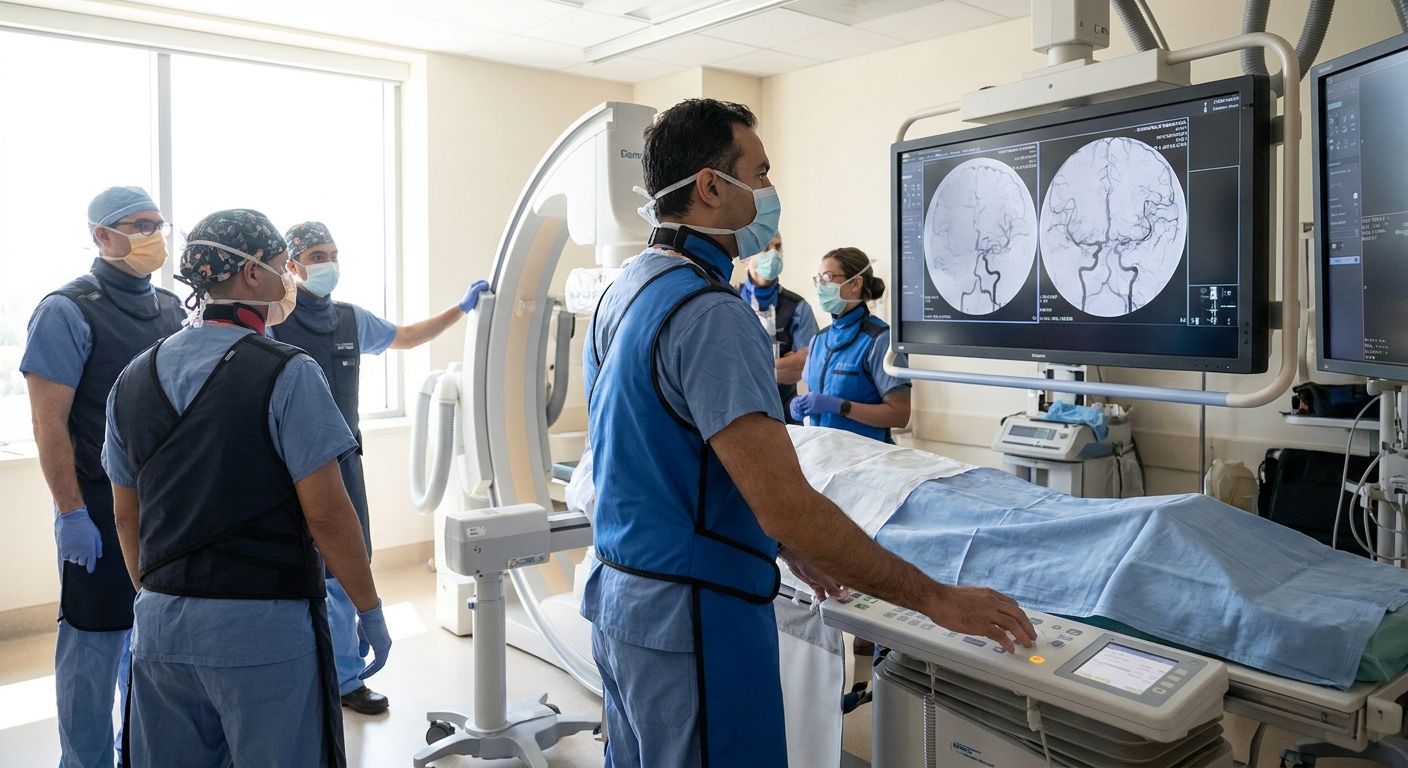
Stroke thrombectomy call is the single biggest quality-of-life variable in a neurointerventional radiology job, and most postings bury it three paragraphs deep. This guide breaks down what to look for, which career paths fit which physician, and what to skip if 3 a.m. wake-ups aren't sustainable for you long-term.
- Academic comprehensive stroke centers offer the highest thrombectomy volume but 1-in-4 to 1-in-6 call — Buy for early-career NIR physicians.
- Locum and per diem neurointerventional radiology jobs cover stroke gaps without long-term call obligation — Buy as a bridge.
- Private equity-backed multi-site groups vary wildly by contract terms — Consider only after a lawyer reviews the buyout clause.
- Skip any NIR role that can't show you door-to-puncture data or a dedicated stroke coordinator on staff.
Why this matters
The DAWN and DEFUSE 3 trials extended mechanical thrombectomy eligibility to 24 hours from last known well, and that single change pushed case volume up at comprehensive stroke centers nationwide. More eligible patients means more overnight call, more coordination with stroke coordinators, and more hospitals scrambling to staff code stroke coverage jobs around the clock.
That demand is why neurointerventional radiology jobs now show up across academic centers, community hospitals, and locum staffing pools in 2026 — not just at flagship university programs. The job title looks similar everywhere. The call burden, backup depth, and compensation structure do not.
Who this is for
This guide is for fellowship-trained neurointerventional radiologists, dual-trained IR/diagnostic physicians credentialed for mechanical thrombectomy, and neuroradiology graduates weighing an NIR fellowship against a straight diagnostic path. If you're evaluating whether a stroke thrombectomy role fits your training and lifestyle in 2026, the criteria below apply whether you're looking at your first attending job or a lateral move out of a punishing call schedule.
What to look for in neurointerventional radiology jobs
Stroke center certification level
Comprehensive Stroke Centers (CSC) run the highest thrombectomy volume and the deepest bench of support staff, but they also carry the heaviest call. Thrombectomy-Capable Stroke Centers (TSC) see less volume with a smaller team, and Primary Stroke Centers (PSC) typically transfer thrombectomy candidates out rather than treat on-site. Know which tier you're joining before you sign, because volume and call frequency move together.
Call frequency and backup depth
A program's call schedule tells you more about the job than the salary line does. Ask how many NIR-credentialed physicians share call, whether there's a true backup on nights the primary is unavailable, and whether call gets split with general IR when volume spikes.
Door-to-puncture performance
The American Heart Association's benchmark targets door-to-puncture under 90 minutes for eligible thrombectomy patients. A program that can't produce its own door-to-puncture numbers either isn't tracking outcomes closely or doesn't want you to see them — either way, that's a red flag for a stroke thrombectomy job in 2026.
Case mix beyond thrombectomy
Pure stroke coverage gets repetitive fast. Ask whether the role includes aneurysm coiling, AVM embolization, or carotid stenting alongside thrombectomy call — case variety keeps procedural skills sharp and makes the schedule feel less like a single-task rotation.
Credentialing pathway required
Some programs require ACGME-accredited neurointerventional fellowship training; others accept a Certificate of Added Qualification in neuroradiology plus endovascular case logs. Confirm which pathway the employer credentials against before you invest time in the application.
Compensation structure for call
Base salary plus RVU production is standard, but call stipends vary from a flat nightly rate to nothing at all if call is considered part of base duties. Get the call stipend structure in writing — verbal promises about "we'll make it worth your while" rarely survive contract review.
Compare live NIR openings now
RadBoard tracks 5,000+ radiology jobs from 20 sources, updated for 2026 hiring cycles.
Top picks by career path
Academic comprehensive stroke center — the high-volume standard-bearer. Call at CSC programs typically runs 1-in-4 to 1-in-6 among NIR-credentialed staff, with the highest thrombectomy case counts in the region. This is the strongest path for building a resume as a subspecialist, and it pairs well with fellowship-trained neuroradiology jobs if you're weighing academic tracks. Verdict: Buy for early-career NIR physicians chasing volume and teaching exposure.
Hospital-employed community TSC — the steady middle path. Case volume runs lower than a CSC, but so does the call frequency, and most TSCs still hold themselves to the same 90-minute door-to-puncture target. Verdict: Consider if you want thrombectomy volume without academic obligations.
Private equity-backed multi-site group — the compensation play. Production-based pay can outpace hospital-employed salaries, but buyout terms, non-compete radius, and equity vesting schedules vary enormously between groups. Review the private equity-backed radiology group job offer checklist before signing anything with an equity component. Verdict: Consider, but only after a contract attorney reviews the buyout clause.
Locum or per diem stroke coverage — the bridge assignment. Daily or hourly rates with no long-term call commitment make this the right move between permanent contracts or while you're finishing credentialing paperwork. Verdict: Buy as a bridge, not a career destination.
Dual IR/diagnostic generalist covering shared stroke call — the hedge. You get broader case variety, but thrombectomy volume gets diluted across general IR duties, which slows skill-building for physicians who want NIR to be their primary identity. Verdict: Skip if maximizing thrombectomy volume is the actual goal.
What to avoid
- Solo NIR coverage at a facility with no backup physician. It looks like autonomy on paper; in practice it means no vacation coverage and no relief when two strokes hit overnight.
- Any listing that omits stroke center certification tier. A job titled "neurointerventional radiology" at an uncertified facility likely means transfer-out cases only, not hands-on thrombectomy volume.
- Call stipends described as "competitive" without a number attached. Get the dollar figure before you interview, not after you've accepted.
Verdict comparison
| Path | Call burden | Credentialing needed | Compensation model | Verdict |
|---|---|---|---|---|
| Academic CSC | Heavy (1-in-4 to 1-in-6) | ACGME NIR fellowship or CAQ | Salary + RVU bonus | Buy |
| Hospital-employed TSC | Moderate | Dual IR/DR board cert | Base salary + call stipend | Consider |
| PE-backed multi-site group | Variable by site | Same as above | Salary + production/equity | Consider |
| Locum/per diem stroke coverage | Shift-based, no long-term call | Active state license + privileges | Daily or hourly rate | Buy (bridge) |
| Shared-call generalist role | Lighter, diluted volume | IR residency + NIR fellowship | Base + call stipend | Skip |
FAQ
What are neurointerventional radiology jobs?
Neurointerventional radiology jobs involve catheter-based treatment of brain and spine vascular conditions, most commonly stroke thrombectomy, aneurysm coiling, and AVM embolization. They require either ACGME-accredited NIR fellowship training or dual IR/diagnostic credentialing with endovascular case logs.
Is demand for neurointerventional radiology jobs high in 2026?
Demand is elevated in 2026 because the DAWN and DEFUSE 3 trials extended thrombectomy eligibility to 24 hours from last known well, increasing case volume at comprehensive and thrombectomy-capable stroke centers alike. Community hospitals are adding overnight NIR coverage to meet that volume.
How much do neurointerventional radiologists earn in 2026?
Compensation varies by call burden, site type, and production model, with academic CSC roles typically paying salary plus RVU bonus and PE-backed groups adding production or equity components. Review base salary, call stipend, and RVU thresholds separately rather than comparing total compensation figures alone.
What credentials do I need for stroke thrombectomy call?
Most programs require either ACGME-accredited neurointerventional fellowship training or a Certificate of Added Qualification in neuroradiology paired with documented endovascular case volume. Confirm the specific pathway with each employer since credentialing committees differ by hospital system.
Is locum tenens a good entry point into neurointerventional radiology?
Locum and per diem stroke coverage work well as a bridge between permanent contracts or while finishing state licensing, since it carries no long-term call obligation. It's not a substitute for the sustained case volume needed to build a long-term NIR career.
Should I take a comprehensive stroke center job or a community TSC job first?
Comprehensive stroke centers offer the highest thrombectomy volume for career-building but come with heavier call, typically 1-in-4 to 1-in-6 among NIR-credentialed staff. Community thrombectomy-capable stroke centers offer a lighter call schedule with lower case volume, which suits physicians prioritizing work-life balance over case count.
What's the difference between a CSC and a TSC for thrombectomy jobs?
A Comprehensive Stroke Center runs full-service stroke care with the highest procedural volume and deepest support staff, while a Thrombectomy-Capable Stroke Center performs the same procedure with lower volume and a smaller team. Primary Stroke Centers generally transfer thrombectomy candidates rather than treat them on-site.
How do I compare multiple stroke coverage job offers efficiently?
Line up call frequency, door-to-puncture data, credentialing requirements, and stipend amounts side by side rather than comparing total compensation figures alone. RadBoard aggregates 5,000+ radiology jobs from 20 sources, which makes side-by-side comparison faster than checking individual hospital career pages one at a time.
One last thing
Ask for the program's door-to-puncture data before you ask about salary. A hospital that can produce its own numbers against the 90-minute AHA benchmark is running a stroke program with real infrastructure behind it; one that can't is asking you to build that infrastructure yourself while covering call.