
Choose RadBoard if you want a radiology job search platform that brings positions from multiple sources into one search; choose AMN Healthcare if you want a healthcare staffing company as your recruiting contact. For your 2026 search, the distinction is independent discovery versus recruiter-led placement, not two versions of the same job board.
- RadBoard vs AMN Healthcare compares independent radiology job search with recruiter-led staffing.
- RadBoard aggregates 5,000+ radiology positions from 20 sources and offers AI-powered search and swipe-to-save features.
- Choose AMN Healthcare when your priority is discussing staffing opportunities with a recruiting contact.
- Neither discovery nor recruitment replaces checking the actual schedule, clinical duties, and contract.
Why this matters
A job search platform helps you find positions. A staffing company connects recruitment with an employer's hiring needs. Confusing those functions creates the wrong expectations: saving a listing is not arranging a placement, and speaking with a recruiter is not surveying every employer.
For a radiologist planning a move in 2026, start by naming the task. Are you exploring different practice settings, or trying to organize a particular assignment? That answer determines which service belongs at the center of your search.
RadBoard is best for radiologists who want to discover and save opportunities across multiple sources. AMN Healthcare is the better starting point when you specifically want a staffing relationship rather than another discovery tool.
At a glance
| Dimension | RadBoard | AMN Healthcare |
|---|---|---|
| Best for | Independent exploration of radiology positions | Recruiter-led healthcare staffing conversations |
| Discovery scope | Aggregates 5,000+ radiology positions from 20 sources | Staffing-company route to employer opportunities |
| Recruiting relationship | Search platform; do not assume placement representation | Healthcare staffing company |
| Standout feature | AI-powered search and swipe-to-save | Recruiting relationship rather than aggregation |
| Assignment coordination | Use for discovery; establish who handles the assignment | Better starting point for discussing staffing coordination |
| Subspecialty fit | Check the duties behind each listing | Check the duties behind each proposed position |
| Contract evaluation | Requires position-specific review | Requires position-specific review |
| Pricing model | Separate platform-access terms from employment terms | Separate candidate terms from staffing and employment agreements |
Independent discovery favors the aggregator
The platform's stated scope is 5,000+ radiology positions from 20 sources. Those figures describe aggregation, not a verified count of unique employers or a promise that every position matches your requirements. Use the breadth to build a shortlist, then investigate individual roles.
This approach fits an exploratory search. You can consider academic work, private practice, hospital employment, or remote reading without first committing your search to a particular recruiting conversation. The advantage is the ability to compare directions before choosing one.
The limitation is equally clear: a search result does not establish your eligibility or the employer's willingness to accommodate your schedule. You still need to confirm the actual clinical work and hiring process.
AMN Healthcare serves a different purpose. A staffing conversation is useful when you want to discuss a defined requirement, but it is not evidence of whole-market coverage. Choose aggregation for discovery; do not treat either route as a complete census of radiology employment.
A recruiting relationship favors AMN Healthcare
AMN Healthcare is the better fit when your immediate need is a staffing contact. That is a different requirement from finding more listings. You want someone to discuss an employer's needs, explain the recruiting process, and establish the next step for a particular opportunity.
Bring a clear brief. Specify your clinical scope, acceptable locations, preferred schedule, and employment objective before asking for recommendations. A recruiter cannot resolve a poorly defined search simply by presenting more positions.
The tradeoff is that a recruiting relationship still needs boundaries. Before authorizing a submission, establish which employer and position it covers, what information will be shared, and whether you have already approached that practice through another channel.
For a practical preparation guide, read how to work with a radiology recruiter. Use the conversation to clarify representation rather than assuming that an introduction includes every later step.
Saving a shortlist favors the search platform
RadBoard's radiology job search platform includes AI-powered search and swipe-to-save features. The practical distinction is between finding a possible match and retaining it for further comparison. Saving supports the second task; it does not complete the application.
Use that shortlist deliberately. For every saved position, record what attracted you and what remains unresolved. A role described as remote, for example, still needs a defined schedule, clinical scope, and location requirements before you can assess fit.
A useful shortlist separates these questions:
- Clinical fit: Does the work match the modalities and procedures you want to perform?
- Schedule fit: Do the actual hours and call expectations match your limits?
- Employment fit: Does the proposed relationship match your career objective?
AMN Healthcare is more relevant once your next action requires a recruiting conversation. Do not infer that a staffing company lacks search tools; the distinction here is the explicitly described search-and-save workflow versus a staffing relationship.
Choose the search platform when your bottleneck is organizing possibilities, not arranging a specific introduction.
Staffing coordination favors AMN Healthcare
For a 2026 locum tenens search, discovery and coordination are separate jobs. Finding an assignment does not settle the clinical scope, submission process, credentialing requirements, or contractual responsibilities. Those questions need named owners.
AMN Healthcare is the better starting point when you want to discuss that coordination through a staffing company. Ask which steps the recruiting team handles, which belong to the facility, and which remain your responsibility. Get the division of work in writing before relying on it.
Do not assume an agency relationship guarantees a start date, resolves licensing, or includes particular travel or insurance arrangements. Establish those terms for the specific assignment. A service category is not a contract.
The aggregator remains useful for discovering alternatives, but aggregation alone does not establish responsibility for placement. Choose the staffing route when your bottleneck is coordinating a defined assignment rather than finding possible assignments.
This is a genuine advantage for the recruiter-led model, with a clear limitation: the value rests on the actual engagement and agreed responsibilities, not the company name alone.
Subspecialty fit is a tie until you inspect the work
Neither a broad search nor a recruiter introduction proves clinical fit. A subspecialty label is only the beginning. You need to establish how much of the position involves your preferred work and what else you will be expected to cover.
For either route, assess 3 criteria before advancing:
- Clinical scope: Modalities, procedures, general coverage, and exclusions.
- Work schedule: Reading hours, call, weekends, and onsite expectations.
- Practice structure: Employment relationship, reporting line, and decision-making responsibilities.
These criteria matter more than which service introduced the position. A neuroradiology-trained physician seeking focused reading and a general radiologist seeking mixed coverage need different answers from the same employer.
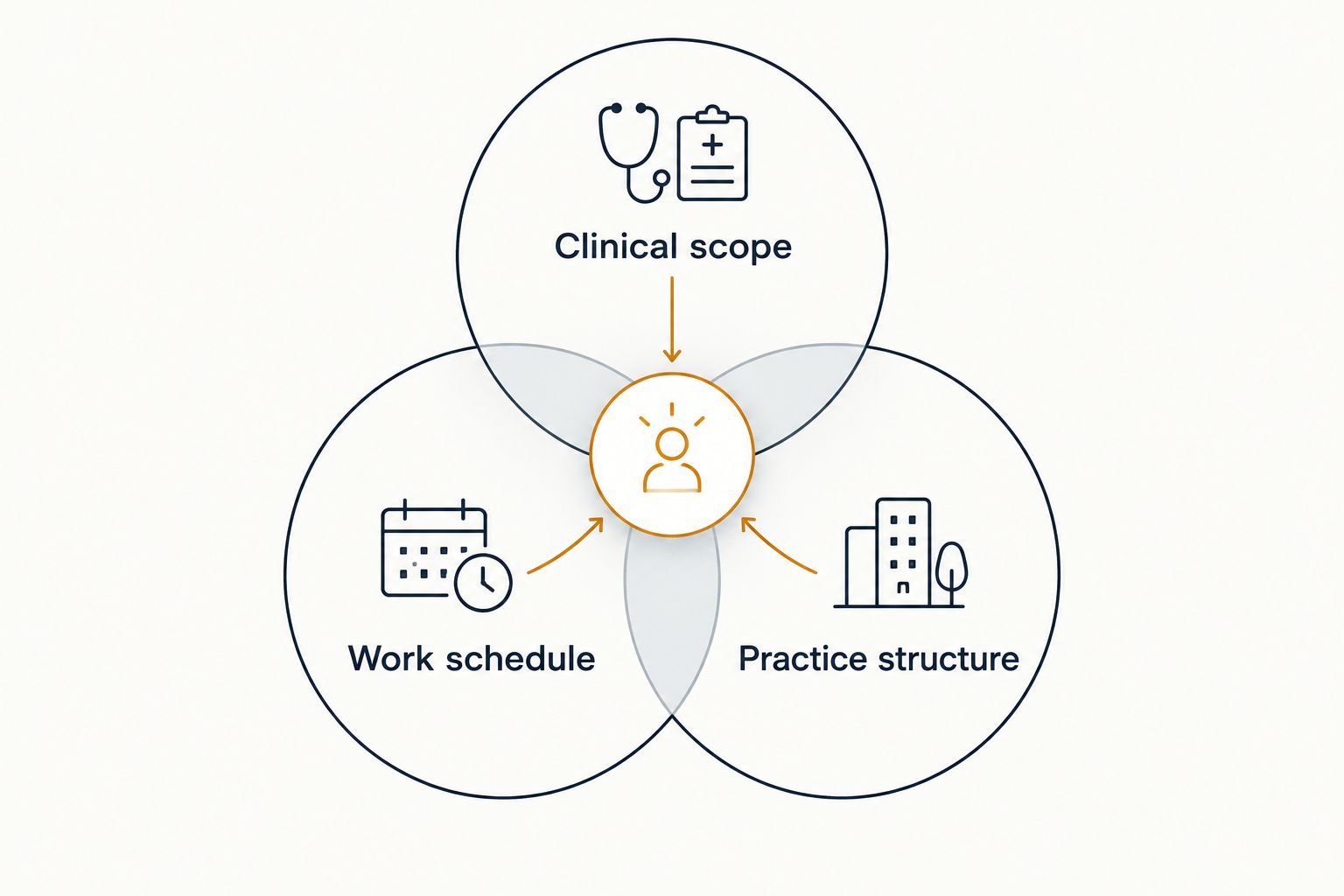
Treat any unanswered criterion as a question for the employer, not a reason to fill the gap with assumptions. Neither route wins on subspecialty fit without position-level evidence. The right introduction to the wrong clinical role is still the wrong role.
Contract evaluation is a tie: neither route replaces review
Your 2026 employment decision should rest on the written agreement and verified responsibilities. A detailed listing helps you prepare questions. A recruiter helps you pursue a conversation. Neither substitutes for reviewing what you would actually sign.
Build a comparison sheet using the same fields for every opportunity:
- Clinical duties and required coverage.
- Scheduled work, call, and changes to those obligations.
- Compensation structure and productivity definitions.
- Malpractice responsibilities and any tail obligations.
- Termination terms and post-employment restrictions.
- Ownership or partnership terms, when offered.
Keep promises separate from contract language. If an interview describes subspecialty-only work but the agreement requires broader coverage, resolve the difference before acceptance. Do not assume the more attractive description controls.
Neither service wins on contract protection simply by introducing the job. Obtain qualified legal advice for provisions you do not understand, and direct clinical questions to someone authorized to explain the practice's expectations. A clear answer should identify both the obligation and who can change it.
Pricing: separate access terms from employment terms
For this 2026 comparison, pricing should be evaluated at the correct layer. Platform access, recruitment, staffing agreements, and physician compensation describe different relationships. Treating them as one expense obscures who owes what to whom.
For RadBoard, establish the current terms of using the search platform. Keep that question separate from the compensation and obligations attached to a position you discover. A listing does not define your eventual employment agreement.
For AMN Healthcare, establish your candidate-facing terms and the structure of the proposed engagement. Ask which organization would contract with you and which documents govern the assignment or employment. Do not infer those answers from the staffing model alone.
The tradeoff is clarity versus assumptions, not a supported cheaper-versus-costlier ranking. Before choosing either route, ask:
- What terms apply to my use of this service?
- What separate agreement applies to the position?
- Who is responsible for each contractual obligation?
Predictability comes from explicit terms. Flexibility comes from understanding what you can accept, decline, or change—not from the discovery channel.
Final verdict: choose by the task you need completed
Choose RadBoard if you are an independent market explorer
You are a practicing radiologist or graduating trainee who wants to compare career directions before pursuing a specific position. You prefer to search across sources, save possibilities, and develop your own shortlist.
Winner: the aggregator. Its stated aggregation and search-and-save features match that task. The limitation is that you must still establish who handles the application, employer communication, and any placement responsibilities.
Start with your clinical and schedule requirements. Save positions that meet them, then investigate the unresolved details instead of equating a large shortlist with a finished search.
Choose AMN Healthcare if you want a staffing-led search
You are a radiologist seeking a recruiting contact for a defined placement or assignment objective. You already know the work you want and need a conversation about the employer's requirements and recruiting process.
Winner: AMN Healthcare. The staffing-company model fits that objective better than aggregation alone. The limitation is that you must confirm the exact scope of representation and support for your engagement.
Bring your requirements in writing. Before a submission, confirm the employer, position, clinical scope, and next step so the conversation advances a specific decision.
One-glance scorecard
| Dimension | Winner |
|---|---|
| Independent market exploration | Aggregator |
| Cross-source discovery | Aggregator |
| Recruiting relationship | AMN Healthcare |
| Explicit search-and-save workflow | Aggregator |
| Discussing staffing coordination | AMN Healthcare |
| Subspecialty fit | Tie; inspect the actual work |
| Contract evaluation | Tie; review the actual agreement |
| Pricing | No price-based winner |
FAQ
Is RadBoard better than AMN Healthcare for radiology jobs?
RadBoard is better suited to independent discovery across multiple sources; AMN Healthcare is better suited to a recruiter-led staffing conversation. Choose according to whether you need a shortlist or a staffing relationship.
Are a radiology job board and a staffing company the same thing?
No. A job search platform helps you discover opportunities, while a staffing company works within a recruitment and placement relationship. Confirm the responsibilities attached to any specific engagement.
Which option should I use for locum tenens radiology work?
Choose AMN Healthcare when your priority is discussing an assignment through a staffing company. Use an aggregator when your priority is discovering alternatives, and confirm who handles coordination before proceeding.
Does saving a radiology job submit an application?
Do not treat saving a position as submitting an application. Establish the actual application step and who receives your information before assuming the employer has considered you.
How should I compare the cost of a job platform and a recruiter?
Compare the applicable service terms separately from the employment or assignment agreement. Confirm your obligations directly rather than assuming either route has a particular candidate fee structure.
Can I use a search platform and a recruiter together?
Yes, you can use discovery and recruiting as separate parts of your search. Track employer contacts and confirm representation before authorizing a submission to avoid confusion about the same position.
What should I check before accepting a radiology position in 2026?
Check clinical duties, schedule, compensation structure, malpractice responsibilities, and termination provisions against the written agreement. Resolve differences between the listing, interview discussion, and contract before acceptance.
One last thing
Track positions by employer and role, not just by where you found them. Keep a record of the clinical description, contact person, application status, and any submission authorization. That gives you a clearer search history when you use discovery and recruiting together.
For your 2026 search, keep the decision simple: choose the discovery tool to find possibilities, and choose the staffing relationship to pursue a defined recruiting objective. Judge the eventual job on its own terms.