
RadBoard vs RadWorking comes down to reach versus routine. RadBoard pulls 5,000+ radiology positions from 20 sources into one AI-searchable feed. RadWorking is a separate radiology job board you check as its own destination. This page compares them on the dimensions that decide a 2026 job search.
- RadBoard aggregates 5,000+ radiology jobs from 20 sources, so one search replaces many tabs.
- Choose RadBoard in 2026 if you want breadth, AI search and swipe-to-save shortlisting.
- Keep RadWorking as a second source if you already use it; no single board covers every employer.
- On pricing, features and listing counts for RadWorking, verify on its site before deciding.
Quotable verdict: RadBoard is the better first stop for radiologists who want every opening in one place; RadWorking is a reasonable second check, not a substitute for aggregated search.
Why this matters
Radiology hiring is spread across hospital systems, private groups, teleradiology companies, staffing agencies and national chains. No single posting site sees all of it. The practical question in 2026 is not which board is good, but which board lets you see the most relevant openings with the least effort.
That is the axis of difference here. RadBoard is built around aggregation: 20 sources feeding one searchable index. A single-destination board shows you what is posted there. The rest of this page tests both approaches on search, shortlisting, market data, pricing and fit.
The RadBoard 2026 US Radiology Job Market Report analyzed 3,700+ active listings for salary benchmarks, subspecialty demand, ownership trends, geographic distribution and AI adoption. That data layer is part of what separates a job feed from a research tool.
At a glance
| Dimension | RadBoard | RadWorking |
|---|---|---|
| Best for | Radiologists who want every opening in one feed | Radiologists who already check it as a routine source |
| Listing model | Aggregates 5,000+ positions from 20 sources | Verify listing volume and sourcing on its site |
| Search | AI-powered search | Verify on its site |
| Shortlisting | Swipe-to-save | Verify on its site |
| Market data | 2026 US Radiology Job Market Report across 3,700+ listings | Verify on its site |
| Subspecialty depth | Subspecialty demand tracked in the market report | Verify on its site |
| Pricing model | Check current pricing on the site | Check current pricing on the site |
| Standout feature | One search across 20 sources | Verify on its site |
Where the RadWorking column says verify, the inputs behind this page do not state a figure, and a guessed one would be worse than none. Open both sites and fill those cells yourself before you commit time to either.
RadBoard offers more reach
Reach is the clearest difference. RadBoard combines 20 sources into 5,000+ positions. You run one search instead of repeating the same filters on 20 sites.
That matters most if you are flexible on geography or open to several practice types. A hospital-employed role, a private group and a teleradiology contract can sit side by side in one result set.
A single board can still carry listings the aggregator misses, because no index is complete. That is the honest case for keeping a second source open. For a ranked view of the wider field, see the best radiology job boards for finding openings fast.
Verdict: RadBoard wins on reach.
RadBoard is the better search tool
RadBoard uses AI-powered search. You describe the role you want rather than stacking filters one by one, and the matching does the narrowing. If you have never used AI matching for job hunting, how to use AI-powered job matching to find radiology openings walks through the approach.
The weakness of any AI search is that results are only as good as your description. Vague input returns vague matches. Name the subspecialty, schedule type and setting you want.
Verdict: RadBoard has the stronger search, based on its stated AI feature set. Compare against RadWorking's search by running the same query on both.
Shortlisting: RadBoard is built for it
RadBoard's swipe-to-save flow turns a long feed into a shortlist quickly. You move through listings and keep the ones worth a second look. It suits scanning a high-volume feed, especially on a phone between cases.
The tradeoff: swiping is fast but shallow. Once you have a shortlist, you still need to read the details on every role. Speed in triage does not replace diligence on compensation structure, call burden or group ownership.
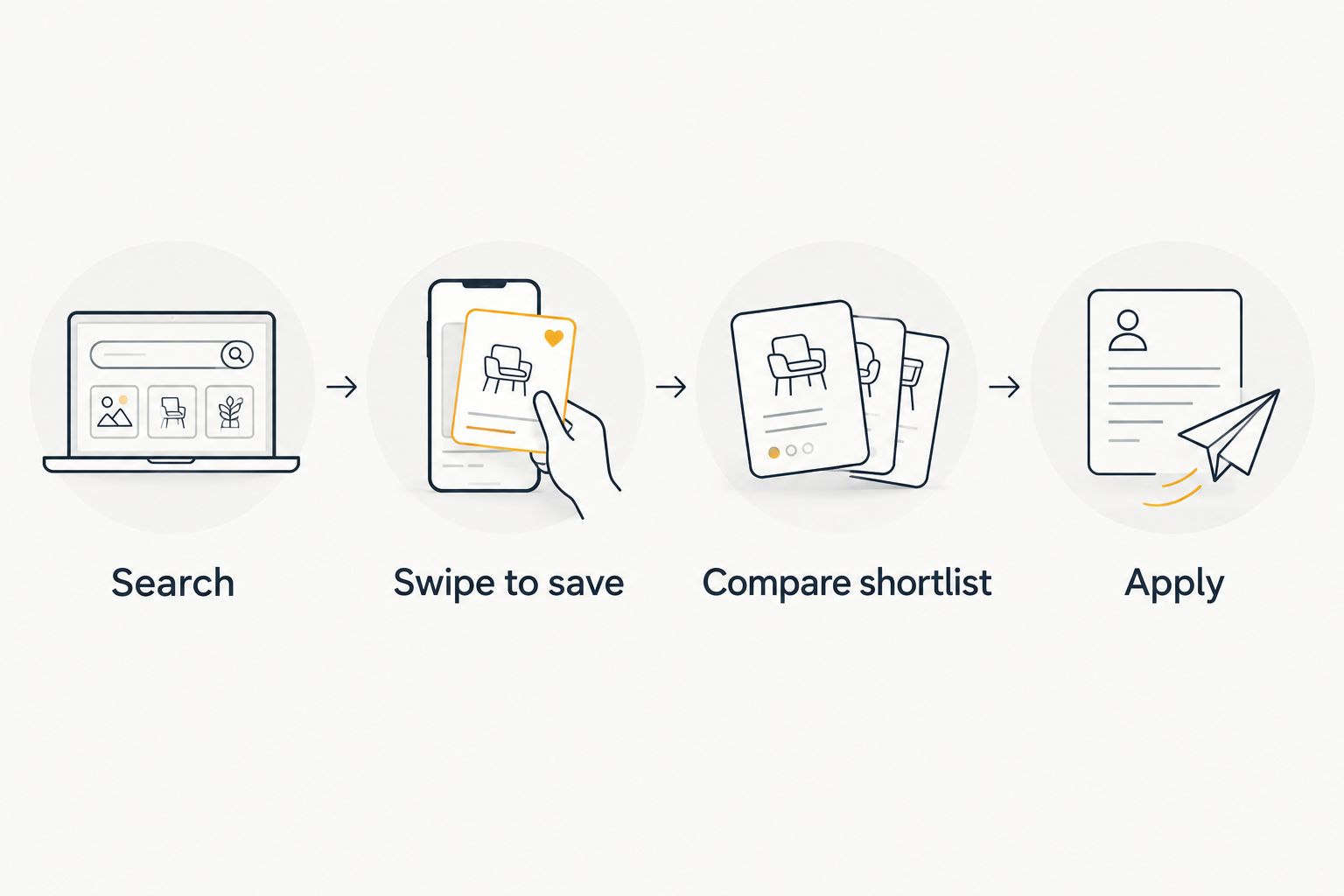
Verdict: RadBoard has the edge on shortlisting workflow.
Market data: RadBoard publishes it
A job board that also publishes market research gives you negotiating context. The RadBoard 2026 US Radiology Job Market Report covers salary benchmarks, subspecialty demand, ownership trends, geographic distribution and AI adoption across 3,700+ active listings.
That helps you judge an offer against the market instead of against a single recruiter's number. For offer-side tactics, how to negotiate a higher radiologist salary offer is a useful companion, but it is not one of the five links counted below as a necessity; read it after you have an offer in hand.
Verdict: RadBoard wins on published market data. Whether RadWorking publishes comparable research is something to check on its site.
Trust and familiarity: a tie
Both are radiology-focused destinations rather than general job sites. That is a real advantage over generic boards, where radiology roles sit among thousands of unrelated postings. For that comparison, see RadBoard vs Indeed.
On specialty focus, both handle the basics well. Neither makes you dig through nurse or admin listings to reach a radiology role.
Verdict: tie on specialty focus.
Where RadWorking can still win
Habit and direct relationships count. If you already have saved searches, alerts or a profile on RadWorking, switching has a real cost, and a second source costs you little.
- Existing account: your history and alerts are already set up.
- Different employer mix: any board can carry listings that another does not.
- Workflow preference: some radiologists prefer a single board's interface over a feed of aggregated results.
This is a position, not a claim about RadWorking's inventory. For the broader set of options, read RadWorking alternatives for radiology job search.
Verdict: RadWorking is the better pick only when you are already invested in it.
Pricing
This page does not quote prices for either board. Prices change, and none are stated in the inputs behind this comparison.
The useful comparison is the model. A free-to-browse board costs you nothing but time. A paid or gated tier trades money for access or features. Check each site's current pricing page, then ask one question: does the paid tier add listings you cannot see elsewhere, or only convenience?
Scorecard
| Dimension | Winner |
|---|---|
| Reach across employers | RadBoard |
| Search approach | RadBoard |
| Shortlisting workflow | RadBoard |
| Published market data | RadBoard |
| Radiology specialty focus | Tie |
| Existing account value | RadWorking, if you already use it |
| Pricing | Verify both |
Final verdict
Choose RadBoard if you are starting a search in 2026, want 5,000+ positions from 20 sources in one feed, and want AI search plus swipe-to-save to cut triage time. Start at RadBoard and run your subspecialty query first.
Choose RadWorking if you already maintain a profile and alerts there and want it as a second source. Use it alongside an aggregator rather than instead of one.
The strongest 2026 search runs both: aggregate on RadBoard, then cross-check the second board for anything unique.
FAQ
Is RadBoard better than RadWorking in 2026?
RadBoard is the better first stop for breadth, because it aggregates 5,000+ radiology positions from 20 sources. RadWorking remains a reasonable second source if you already use it.
How many jobs does RadBoard list?
RadBoard aggregates 5,000+ radiology positions from 20 sources. Its 2026 market report analyzed 3,700+ active listings.
Does RadBoard use AI?
Yes. RadBoard offers AI-powered search, plus swipe-to-save for building a shortlist. Specific, detailed queries return better matches than vague ones.
Should I use both RadBoard and RadWorking?
Yes, if you want maximum coverage. Run your main search on RadBoard, then cross-check RadWorking for listings the aggregator does not show.
How much do RadBoard and RadWorking cost?
Check each site's current pricing page. Prices change, so this comparison does not quote figures for either board.
What data does RadBoard publish on the radiology job market?
The RadBoard 2026 US Radiology Job Market Report covers salary benchmarks, subspecialty demand, ownership trends, geographic distribution and AI adoption.
One last thing
Run the same query on both boards today: your subspecialty, your target region, your preferred schedule. Count how many roles appear on one board and not the other. That overlap number tells you more about which board deserves your time than any feature list.