
Choose RadBoard if you want to find radiologist positions across multiple sources; choose Glassdoor if you already have employers in mind and need employee reviews and reported salary information. This 2026 comparison separates radiology job discovery from employer research so you can use the right platform for each decision.
- RadBoard vs Glassdoor is a choice between radiology job discovery and employer research.
- RadBoard aggregates 5,000+ radiology positions from 20 sources and supports search and swipe-to-save.
- Glassdoor is better for employee reviews and reported salary context, not radiology-specific contract verification.
- Use specialist search to build your shortlist; use employer research to prepare interview questions.
Why this matters
A radiology opening and an employer reputation answer different questions. An opening tells you what a practice is recruiting for. Employee feedback helps you investigate what working there involves, but it does not establish the terms of your prospective contract.
Your 2026 search needs both discovery and verification. Start with the clinical work you want, then investigate the employer, department, schedule, and compensation structure. Neither a large listing collection nor a favorable employer review replaces a discussion with the hiring practice.
At a glance
| Dimension | RadBoard | Glassdoor |
|---|---|---|
| Best for | Radiologists building a clinical job shortlist | Candidates researching named employers |
| Job discovery | Aggregates 5,000+ radiology positions from 20 sources | General employment search across occupations |
| Standout feature | Search and swipe-to-save for radiology opportunities | Employee reviews and reported salary information |
| Employer culture | Start with the listing, then investigate the practice | Read employee accounts to develop interview questions |
| Compensation research | Examine the terms described in individual openings | Use reported salaries as context, not an offer |
| Career breadth | Focused on radiology positions | Useful when exploring employers and occupations beyond radiology |
| Offer verification | Confirm clinical duties and contract terms directly | Confirm whether reviews and salary reports match the relevant role |
| Pricing model | Check current candidate-access terms before committing | Check current access and account requirements before committing |
Specialist search wins for a radiologist's initial shortlist
RadBoard is best for radiologists building a shortlist of clinical positions. Its stated scope is 5,000+ radiology positions aggregated from 20 sources. That gives you a radiology-focused starting point rather than a general employment search.
The advantage is relevance of purpose, not a proven difference in placement outcomes. Aggregation lets you explore openings collected from multiple sources. It does not establish that every listing is unique, still recruiting, or suitable for your credentials.
Use the collection to identify possibilities, then read each opening against your requirements. A fellowship-trained radiologist seeking subspecialty work needs to distinguish a dedicated reading role from a general position that includes occasional subspecialty cases.
Glassdoor is the better starting point when your question concerns a named employer rather than finding clinical openings. For example, researching a hospital system before an interview is different from locating practices recruiting for your preferred case mix.
Tradeoff: specialist discovery serves a defined clinical search; a general employment platform serves broader employer exploration. Choose the starting point that matches the question you need answered first.
Search and swipe-to-save suit opportunity collection
The specialist platform's search and swipe-to-save features support finding and retaining opportunities for further review. These functions address the collection stage of a job search. Saving a position preserves a lead; it does not validate the employer or establish eligibility.
Before searching, write your requirements as separate criteria:
- Clinical fit: subspecialty, modalities, procedures, and general coverage expectations.
- Schedule fit: onsite or remote work, shift timing, weekends, and call obligations.
- Practice fit: academic responsibilities, employment structure, and partnership expectations.
Those are 3 screening criteria, not evidence that a platform automatically verifies each one. Use them to decide which openings deserve an employer conversation. Keep an unanswered requirement visible rather than treating silence in a listing as agreement.
Glassdoor's standout value is different: employee accounts and reported salary information support employer research. It belongs beside your saved shortlist when you need questions about management, staffing, or compensation context.
Neither function substitutes for the other. Collect opportunities with search; investigate employers with evidence relevant to the role. That distinction keeps a convenient browsing feature from becoming an unsupported endorsement of a practice.
Glassdoor wins for employee-review research
Glassdoor is the better tool for reading employee accounts about an employer. Reviews give you material to investigate, including descriptions of management, workplace expectations, and employee experience. Treat them as individual accounts rather than findings about every department.
For a radiologist, relevance matters more than an employer-wide impression. A review from another occupation or facility does not describe your prospective reading room. Check the reviewer's role, location, and date before using the account to judge a clinical position.
Turn relevant observations into questions:
- Who decides staffing levels and schedule changes?
- How does the department handle unexpected absences?
- What happens when coverage demands exceed the planned schedule?
- Can you speak with a radiologist doing comparable work?
The limitation is scope. An employer page can contain useful accounts without describing the specific group, hospital contract, or section you would join. An old review also describes a different point in time from your 2026 hiring conversation.
For a deeper interview framework, use the guide to evaluating radiology practice culture before accepting. Use reviews to identify questions, then test the answers with the department and prospective colleagues.
Both require role-specific compensation checks
Glassdoor is useful for reported salary context. A radiology listing is useful for whatever compensation terms the employer states. Neither source, by itself, defines the complete economics of an offer.
This dimension is a tie on verification, not a claim that the platforms provide identical information. Reported salaries describe submissions associated with particular roles and circumstances. Listing language describes an advertised opportunity; your written offer establishes the terms being proposed to you.
For a 2026 offer comparison, separate the following components before making a judgment:
- Guaranteed compensation and the period it covers.
- Productivity calculations and the definition of credited work.
- Call, weekend, and additional-shift obligations.
- Benefits, leave, and professional-expense support.
- Malpractice arrangements and responsibilities when employment ends.
Do not treat a salary report as a promise from the hiring group. Likewise, do not treat an advertised compensation statement as a complete contract summary. Ask which components apply to your proposed schedule and employment structure.
Both platforms provide starting points; the employer must explain the actual offer. Keep salary research separate from contract verification so an attractive headline does not obscure duties or obligations that change the comparison.
Glassdoor wins when your search extends beyond radiology
Glassdoor's general employment scope is useful when you are exploring employers or roles beyond clinical radiology. A physician investigating industry, consulting, or another nonclinical direction has a different research task from a radiologist looking for a reading position.
A broad platform lets you investigate organizations across occupations. That breadth is its advantage here. It does not establish that a particular job accepts physicians, values your subspecialty training, or offers a workable transition from clinical practice.
Read the role requirements closely. Separate jobs that require medical expertise from jobs that merely sit within a healthcare organization. Ask how the employer evaluates clinical experience against the position's stated responsibilities.
The specialist platform's focused scope is a strength for radiology discovery and a boundary for broader career exploration. Do not expect a radiology collection to function as a complete map of nonclinical employment.
Choose Glassdoor for cross-industry employer research; choose a radiology-focused search for clinical radiologist openings. The better platform changes when the career question changes, not because one platform wins every category.
Both require direct verification before you apply or sign
Neither platform should be your final authority on a role's current requirements. An aggregated opening needs confirmation with its hiring contact. An employee review needs interpretation in the context of the relevant employer, department, and date.
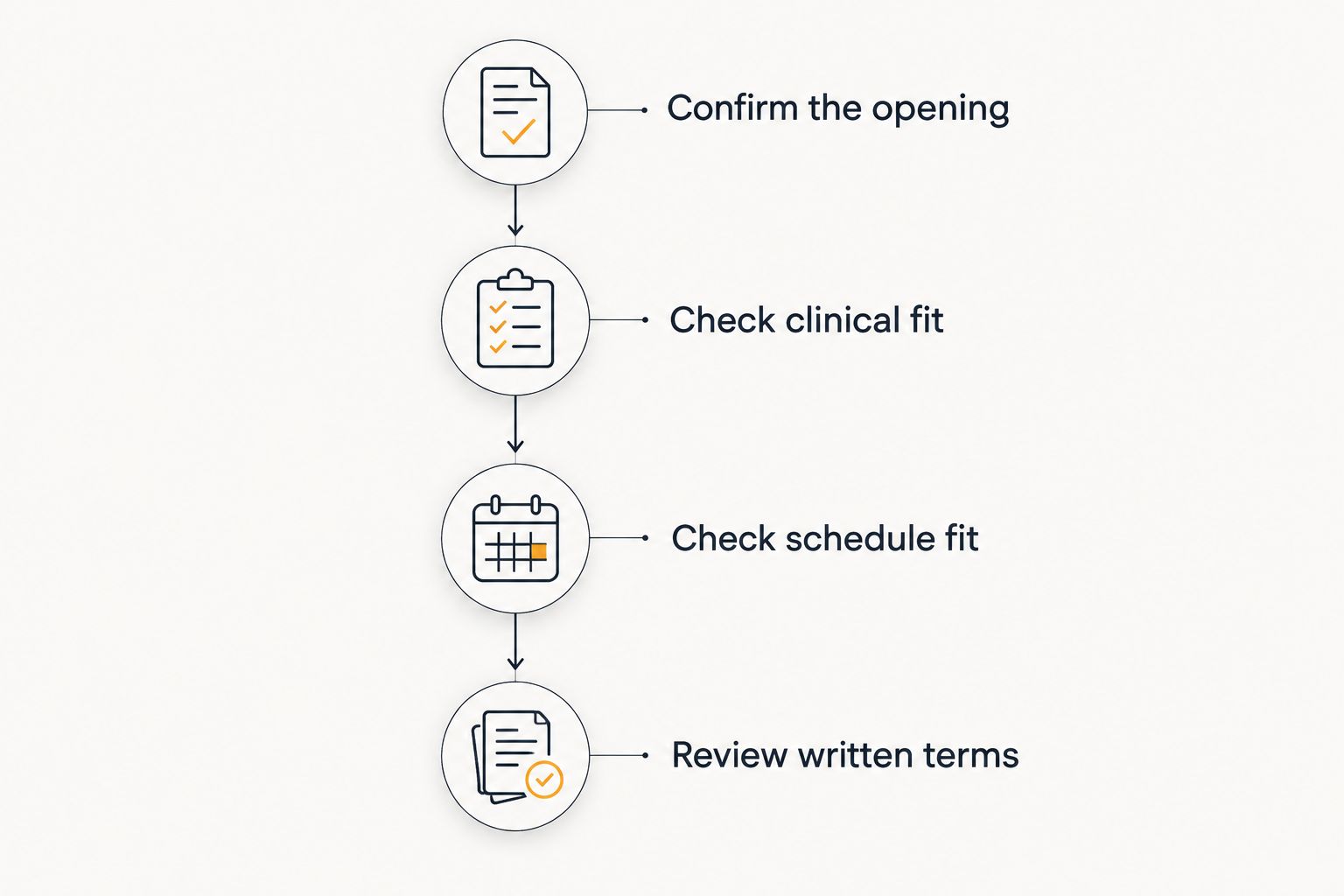
Use the same verification process regardless of where you found the lead:
- Confirm the opening: ask whether recruitment continues and which location or group is hiring.
- Check clinical fit: establish case mix, procedures, credentials, and coverage expectations.
- Check schedule fit: clarify shifts, call, weekends, and onsite responsibilities.
- Review written terms: compare the proposed agreement with the recruiting conversation.
This is a sequence for your due diligence, not a claim that either platform performs these checks. Keep notes against each opportunity so you can distinguish confirmed terms from unanswered questions.
A remote opportunity needs the same discipline as an onsite position. Confirm where you must hold credentials, what the schedule requires, and who provides operational support. A saved listing or favorable review does not answer those questions automatically.
Pricing: compare current access terms, not assumed models
For your 2026 search, check each platform's current candidate-access terms before creating an account or committing to a paid feature. Confirm what you can search, save, and read under the access terms presented to you.
Evaluate predictability and flexibility separately. Predictability means knowing the commitment and the functions it includes. Flexibility means being able to use the functions your search actually needs without committing to unrelated services.
Do not assume that candidate access follows the same model as employer recruiting services. Those are different purchasing decisions. Your relevant comparison is access to clinical opportunities on one side and access to employer research on the other.
There is no pricing winner without comparing the current terms applicable to you. Make that check after deciding which task the platform serves. Access to an irrelevant function is not a reason to change your search strategy.
Final verdict for 2026
Choose RadBoard if you are a clinical radiologist building a shortlist
Winner for this profile: RadBoard radiology job search. You know the clinical work you want and need to find opportunities across multiple sources. Use search and swipe-to-save to collect leads, then confirm the duties and recruiting status directly.
This recommendation fits a fellow approaching an attending search, an established radiologist considering a practice change, or a physician investigating a different schedule. The platform's stated scope supports discovery; it does not replace employer assessment or contract review.
Choose Glassdoor if you are investigating employers or broader careers
Winner for this profile: Glassdoor. You have an employer shortlist and want employee accounts and reported salary context, or you are researching organizations outside a strictly clinical radiology search.
Its limitation is specificity. Employer-level information needs a department-level check before you apply it to a radiologist position. Bring relevant observations into interviews rather than using them as a final judgment.
One-glance scorecard
| Dimension | Winner |
|---|---|
| Best for clinical radiology discovery | Radiology-focused platform |
| Finding openings across aggregated radiology sources | Radiology-focused platform |
| Search and swipe-to-save for radiology leads | Radiology-focused platform |
| Employee-review research | Glassdoor |
| Compensation verification | Tie: confirm the actual offer |
| Research beyond clinical radiology | Glassdoor |
| Opening and contract verification | Tie: direct checks required |
| Pricing model | Compare current access terms |
FAQ
Is RadBoard better than Glassdoor for radiology jobs?
RadBoard is the better starting point for radiology job discovery because it aggregates 5,000+ radiology positions from 20 sources. Glassdoor is better for researching employee accounts and reported salary context at named employers.
Which platform should I use before a radiology interview?
Use Glassdoor for employer-review research and the job listing for role-specific preparation. Turn relevant employee accounts into questions about the actual department, schedule, and management structure.
Does an employer's Glassdoor page describe its radiology department?
An employer's Glassdoor page does not establish conditions in its radiology department. Check each account's role, location, and date, then speak with radiologists doing comparable work.
Can I use Glassdoor salary information to judge a radiology offer?
Use Glassdoor salary information as context, not as confirmation of your offer's value. Compare the proposed compensation structure, duties, benefits, and malpractice responsibilities in the written terms.
Does saving a radiology job confirm that it is still recruiting?
Saving a radiology job does not confirm that recruitment continues. Contact the hiring group to verify the opening, location, and current requirements.
Which platform is better if I want to leave clinical radiology?
Glassdoor is the better fit for researching employers across occupations. Check each role's requirements to establish whether clinical experience matches the responsibilities.
What should I check about platform access in 2026?
Check the current candidate-access terms and which search, saving, or research functions they include. Distinguish candidate access from services sold to employers.
One last thing
Before weighing an employer review, confirm who would actually employ you. A hospital name, the radiology group providing coverage, and the entity issuing your contract are different things to establish in the recruiting conversation.
Research the organization named in the proposed agreement, not just the facility named in the opening. That simple check keeps employer feedback attached to the right employment decision.