
Choose RadBoard if you want a radiology-focused job search across 5,000+ positions from 20 sources; choose Indeed if you want to compare radiology openings with opportunities across other occupations. For 2026, the deciding factor is specialty focus versus career breadth—not which platform displays the longest results page.
- RadBoard vs Indeed: choose specialty-focused radiology job search versus broader career discovery.
- RadBoard aggregates 5,000+ radiology positions from 20 sources and offers AI-powered search and swipe-to-save.
- Indeed is the better starting point when your search extends beyond radiology into other occupations.
- Neither platform replaces employer confirmation of duties, schedules, credentialing requirements, or contract terms.
Why this matters
A radiologist choosing a job board needs more than a matching job title. You need to distinguish attending physician work from other imaging roles, then examine subspecialty coverage, call expectations, location, and employment structure.
A broad employment platform and a specialty platform solve different discovery problems. The first lets you explore several career directions; the second keeps your starting point inside a defined field. Choose your search environment before spending time refining individual queries.
For your 2026 search, separate discovery from due diligence. Finding an attractive listing is the beginning; confirming the actual position is the next task. Neither a specialty label nor a recognizable job-board name establishes that an opening meets your requirements.
At a glance
| Dimension | RadBoard | Indeed |
|---|---|---|
| Best for | Radiologists looking for career opportunities within radiology | Job seekers comparing occupations, employers, and career directions |
| Clinical search scope | Aggregates 5,000+ radiology positions from 20 sources | General employment search that includes radiology roles |
| Cross-sector scope | Radiology-focused platform | Broad occupational coverage |
| Standout feature | AI-powered search within a radiology-focused platform | General job search by terms and location |
| Shortlist workflow | Swipe-to-save | Saved-job workflow |
| Career-change exploration | Starting point when radiology remains your target field | Better starting point when your target extends beyond radiology |
| Listing verification | Confirm details with the hiring employer | Confirm details with the hiring employer |
| Pricing model | Check current candidate terms before choosing a paid service | Employer advertising includes sponsored listings; distinguish these from candidate services |
The table compares the platforms' purposes and established functions. It does not treat listing totals as evidence of unique openings, successful placements, or stronger employment terms.
RadBoard is the better starting point for radiology-focused search
RadBoard is best for radiologists who want a specialty-focused job search rather than a general employment search. Its stated scope is 5,000+ radiology positions aggregated from 20 sources. Those figures describe the platform's collection, not the number of positions matching your individual requirements.
That distinction matters when you have a narrow brief. A breast imager seeking a particular practice setting needs to evaluate different requirements from a diagnostic radiologist seeking a general reading position. The shared specialty is a useful starting point, but it does not make the jobs interchangeable.
Use a specialty-focused platform when you already know that your next role belongs in radiology. Begin with the clinical work you want, then check the schedule and practice structure in each result. Do not reverse that order simply because a listing has an appealing headline.
The limitation is the same specialization that creates the fit. A radiology-focused platform is not the right primary research environment for comparing unrelated professions. Its aggregate listing count also does not establish complete coverage of every employer or source.
Indeed remains useful for searching named employers and specific physician job titles. Its broader scope, however, makes precise wording important: imaging-related terminology alone does not identify the physician role you want.
Indeed wins when you need opportunities beyond radiology
Indeed is the better starting point for a search spanning multiple occupations. Its general employment scope fits someone comparing clinical work with a different career direction, rather than someone committed to another radiology position.
For example, if you are exploring an industry role, begin with the role's actual title and responsibilities. Searching only for radiologist positions keeps the research centered on your current professional identity, even when the work you want has a different name.
Broad coverage is useful for a household relocation search, too. A radiologist and a partner working in another occupation can investigate the same geographic area without expecting both professions to appear on a specialty platform.
The tradeoff is relevance work. A general job board serves many occupations, so you must read results closely enough to separate physician opportunities from technical, administrative, and other healthcare roles. Broad discovery does not eliminate that task.
For 2026, use Indeed to answer a broad question: what kinds of work exist in my target location or career category? Use a radiology-focused search to answer the narrower question: which radiology positions deserve employer follow-up? Those are different research tasks, and each deserves its own search brief.
RadBoard offers a specialty-specific search-and-save combination
The platform combines AI-powered search with swipe-to-save for radiology opportunities. Choose that combination when you want to explore your radiology brief and retain positions for later review. The supported distinction is the workflow, not a measured advantage in search accuracy or hiring outcomes.
Write your requirements before you search. Describe the clinical work, location, and schedule you want, then inspect whether each result actually supports those requirements. A search tool helps you find candidates for review; it does not establish that every condition is satisfied.
A useful brief separates requirements from preferences:
- Required: the physician role and clinical responsibilities you are qualified to perform.
- Required: geographic or work-location constraints you cannot change.
- Preferred: a subspecialty emphasis, practice setting, or schedule arrangement.
- To confirm: call duties, credentialing expectations, and employment terms.
Indeed's general term-and-location search supports a different starting method. Use explicit role names, then adjust the wording as you learn how employers describe the work. That approach suits a search where you are still discovering the right occupational category.
Neither method removes the need to open the description. Do not interpret a result's presence as proof of subspecialty fit, eligibility, or employer willingness to accommodate your schedule.
Both support shortlisting; the saved job is not the final decision
Both platforms support keeping jobs for later review. Swipe-to-save is the stated specialty-platform workflow; Indeed also provides saved jobs. The meaningful question is how you turn that saved collection into a useful shortlist.
Saving a listing records interest. It does not mean the position has passed a clinical, scheduling, or contractual review. Keep that distinction visible so an attractive title does not become an assumed fit.
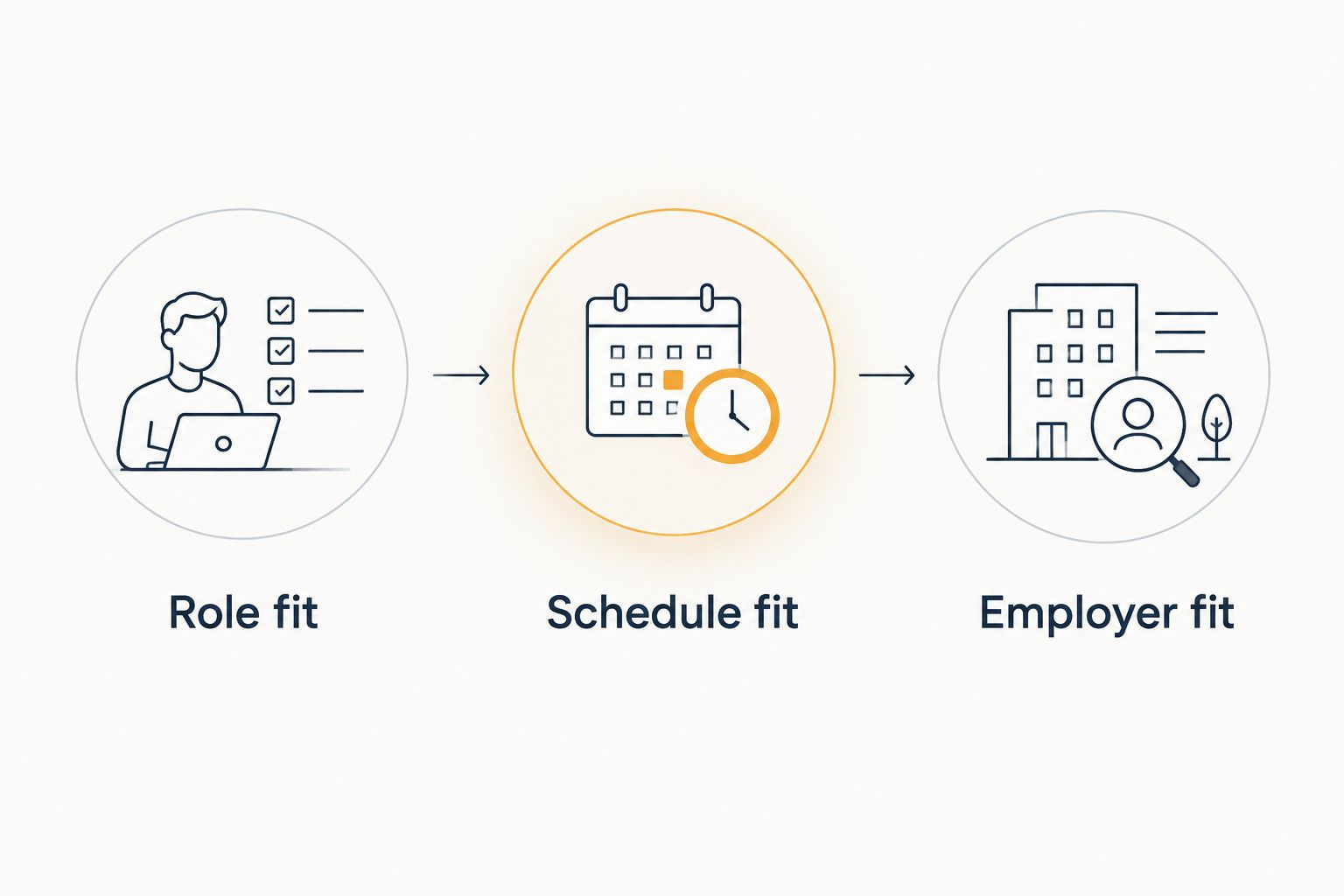
Use 3 checks before moving a saved position into your employer-contact list:
- Role fit: Confirm that the opening is for a radiologist and identify the expected clinical work.
- Schedule fit: Read the work-location, shift, and call language; mark unanswered questions.
- Employer fit: Identify the hiring practice or organization and the person responsible for explaining the position.
Apply these checks in order. There is no reason to spend time investigating an employer's partnership structure if the position requires clinical work outside your target role.
The limitation of both saved-job workflows is that saving does not resolve unanswered questions. Maintain your own notes about what the description states, what it leaves unclear, and what you need to ask. That makes your shortlist a decision aid rather than a collection of appealing headlines.
Indeed is better for researching a career change beyond clinical work
Cross-sector discovery and career-change research are related, but they are not identical. Broad discovery shows you categories of work; career-change research asks whether your experience meets a particular role's requirements.
Choose Indeed when you need to investigate occupational titles outside your current radiology role. Search the work you want to perform, not only the credential you already hold. Read the responsibilities before deciding whether a title represents a realistic transition.
For a physician considering industry, consulting, or another nonclinical direction, record the requirements that recur in the descriptions you review. Distinguish required experience from preferred experience. Do not assume that medical training automatically satisfies a position's commercial, operational, or technical requirements.
The drawback is that breadth does not establish suitability. A result connected to healthcare is not necessarily a physician-level role, and a familiar employer name does not explain the job's decision-making authority.
A radiology-focused platform remains the more direct starting point when you want a different practice arrangement within the specialty. Changing from hospital work to remote reading is a different search problem from leaving clinical work entirely. Define which change you are making before selecting your primary board.
Both require employer verification before an application becomes a decision
Neither platform replaces direct verification with the hiring employer. Apply the same standard whether a listing appears on a specialty platform or a general job board.
Ask whether the position is still being recruited, who employs the physician, and which responsibilities belong to the advertised role. Then resolve the details that determine whether you would accept it. A listing is a summary, not an employment agreement.
For your 2026 shortlist, organize employer questions into clear categories:
- Clinical work: modalities, subspecialty responsibilities, procedures, and coverage expectations.
- Schedule: onsite requirements, remote arrangements, shifts, weekends, and call.
- Practice structure: employer identity, ownership, supervision, and any partnership path.
- Employment terms: compensation structure, benefits, malpractice arrangements, and contract restrictions.
- Eligibility: required credentials, licensure, and the employer's credentialing process.
Treat unanswered questions as tasks, not favorable assumptions. If a description says remote, ask what remote means for that position. If it mentions partnership, ask for the actual pathway and written terms.
There is no platform winner on this dimension. The employer supplies the answers, and you remain responsible for comparing them with your requirements. Keep the same verification standard across every source.
Pricing: separate platform terms from the value of an offer
Compare candidate-service terms separately from employer advertising. Indeed's employer advertising model includes sponsored listings; an employer's decision to promote a listing does not establish that the job fits you.
Before selecting a paid candidate service on either platform, check its current terms, billing structure, cancellation conditions, and included functions. Use the terms attached to that service rather than assuming every job-search feature follows the same model.
The practical tradeoff is predictability versus flexibility. A subscription commitment belongs in a different decision from an optional service used for a specific task. Evaluate the commitment and the function you need without confusing either with the employment package offered by a hiring practice.
For your 2026 decision, start with discovery fit. A platform expense and a radiology employment offer answer different questions: one concerns your search workflow; the other concerns the work you would perform and the agreement you would sign.
Final verdict: choose by the search you are actually running
Choose RadBoard if you are a radiologist staying within the specialty
RadBoard wins for a radiologist seeking a radiology-focused starting point. Choose it when your next step is another radiology position and you want its stated aggregation, AI-powered search, and swipe-to-save workflow.
Its scope is the advantage and the boundary. Use it to discover positions, then verify the clinical brief and employment terms with the employer. Do not treat the aggregate collection as a guarantee that your exact position is represented.
Choose Indeed if you are comparing occupations or changing career direction
Indeed wins for a job seeker whose research extends beyond radiology. Choose it when you need general occupational coverage, want to investigate unfamiliar role titles, or are coordinating a location search across different professions.
Its breadth is useful, but you must enforce relevance yourself. Use explicit role terms and read responsibilities closely. When your research narrows back to radiology, add a specialty-focused search rather than assuming a broad board covers every source.
| Dimension | Winner |
|---|---|
| Radiology-focused starting point | RadBoard |
| Cross-sector discovery | Indeed |
| Specialty-specific search-and-save combination | RadBoard |
| Keeping a shortlist for review | Tie |
| Career-change research beyond radiology | Indeed |
| Employer and contract verification | Tie—required for both |
| Candidate-service purchasing decision | No general winner—compare current terms |
FAQ
Is RadBoard better than Indeed for radiologists?
RadBoard is the better starting point for radiologists who want a specialty-focused job search. It aggregates 5,000+ radiology positions from 20 sources and offers AI-powered search and swipe-to-save; Indeed is better suited to broader occupational exploration.
When should a radiologist use Indeed instead?
Use Indeed when your search extends beyond radiology or you need to compare different occupations in a location. Search the actual role title and review responsibilities rather than relying only on healthcare-related keywords.
Does a larger listing collection mean more suitable jobs?
A larger listing collection does not establish more suitable jobs for your requirements. Evaluate physician role, clinical responsibilities, schedule, location, and employer details before shortlisting a position.
Can I save jobs on both platforms?
Both platforms support saving jobs for later review. RadBoard states that it offers swipe-to-save, while Indeed provides saved jobs; saving does not confirm that an opening meets your requirements.
How should I compare the cost of job-search services?
Compare the current terms of the specific candidate service you are considering. Separate candidate billing and commitments from employer advertising, and check cancellation conditions before agreeing to a paid service.
Can either platform verify my radiology employment contract?
Neither job-search platform replaces employer confirmation or independent review of your employment agreement. Confirm duties, schedule, compensation structure, malpractice arrangements, and restrictions before accepting a position.
Should I use both platforms for my 2026 radiology job search?
Use both when they serve distinct tasks in your 2026 search. Start with specialty-focused discovery for radiology positions and add Indeed for broader career research or a targeted employer search, keeping one consistent verification checklist.
One last thing
A second listing for the same position is not a second employment option. When you research across sources, match the employer, location, clinical duties, and contact details before treating similar advertisements as separate opportunities.
Keep one decision record per position. That record should contain the questions you have resolved and the terms you still need to confirm—not just the places where you found the advertisement.