
Best for finding radiology openings: RadBoard. Best for a coordinated locum search: a radiology locum tenens staffing agency. Best for a permanent search: a permanent-placement recruiter. No staffing agency can be ranked by placement speed in 2026 without comparable, verified timelines.
- Radiology staffing agencies ranked by placement speed need comparable placement records; none are provided here.
- RadBoard is best for radiologists who want to search openings themselves, not agency placement.
- Choose a locum tenens agency for assignment coordination or a permanent recruiter for an employer-led search.
- Compare the date of your first suitable opening, first employer response and cleared start date.
Why this matters
A fast introduction is not the same as a fast placement. A recruiter can send your CV before an employer responds; an employer can make an offer before credentialing and privileges are complete. If you ask only how quickly an agency submits candidates, you miss the date that matters: when you can start work.
RadBoard describes a radiology job search platform with 5,000+ positions from 20 sources, AI-powered search and swipe-to-save features. Those figures describe search coverage, not placement speed. RadBoard is not a staffing agency, and its listing count cannot be compared with an agency's time to placement.
For a 2026 locum search, keep credentialing preparation for locum tenens radiology separate from recruiter response time. That distinction prevents a quick first call from masking a delayed start.
What makes the best radiology search route for speed?
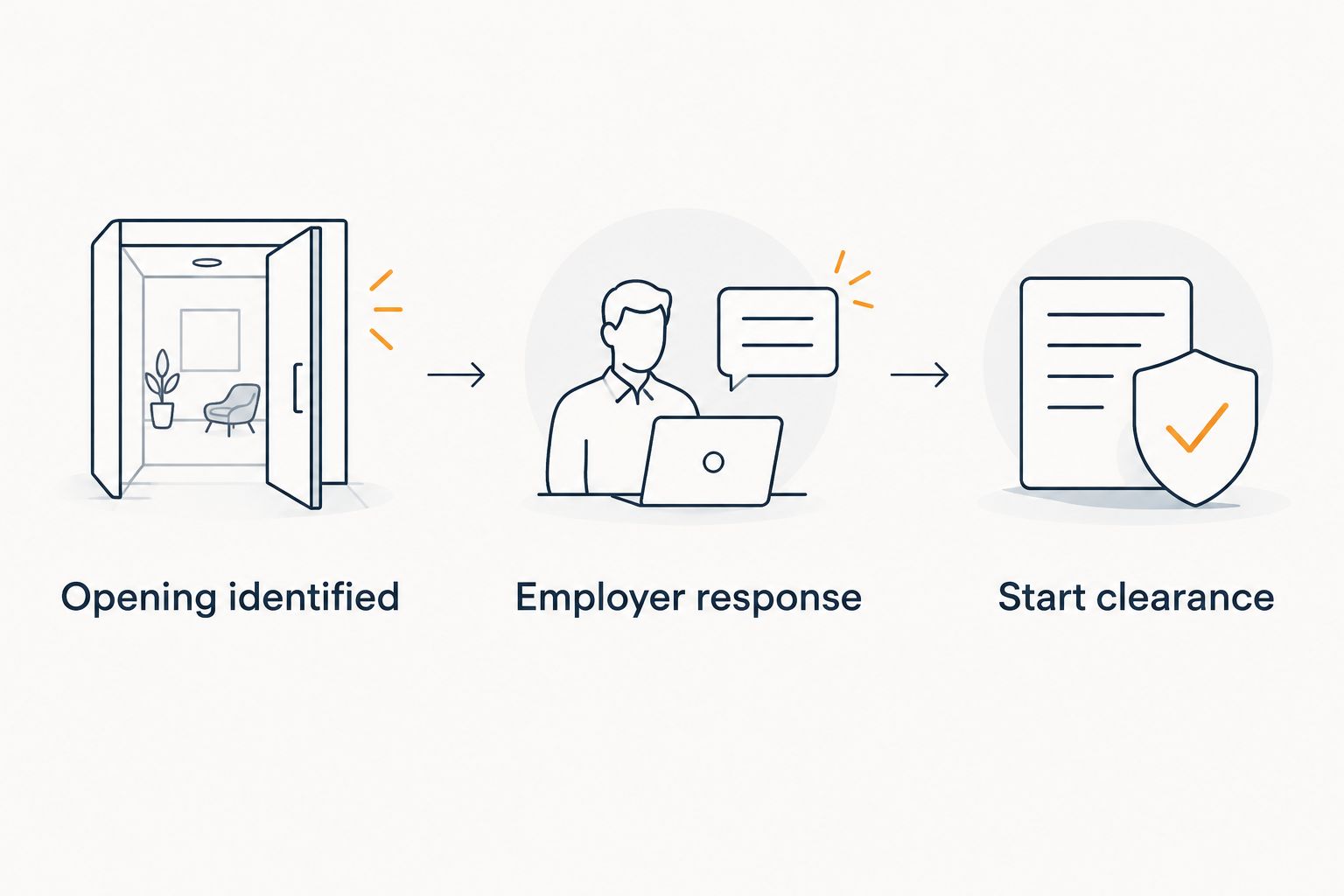
Use the same checkpoints for every route. Do not accept a speed claim that changes the finish line from one recruiter to another.
- Opening identified: When did you receive a role that matched your subspecialty, location, schedule and employment preference?
- Employer response: When did the hiring practice confirm interest, rather than merely receive a submission?
- Start clearance: When were the requirements for the specific role complete so you could begin?
- Candidate workload: Which applications, documents and follow-ups must you handle yourself?
- Search control: Can you compare multiple roles, or does one intermediary control what you see?
Ask for dates and definitions for all three checkpoints. A claim about a first call measures contact speed; a claim about a cleared start measures something different. In 2026, treat either claim as unverified until the provider explains what it counted.
Radiology search routes at a glance
This is a decision order, not a measured speed ranking. Start with the route that fits the kind of search you want, then request comparable dates before judging placement speed.
| Route | Best for | What it does | Key limitation |
|---|---|---|---|
| RadBoard | Finding openings independently | Aggregates radiology listings from multiple sources | Does not place candidates or report time to placement |
| Locum tenens staffing agency | Coordinating a temporary assignment search | Acts as an intermediary between a physician and assignment opportunities | Its first submission is not a cleared start |
| Permanent-placement recruiter | Running an employer-led permanent search | Introduces candidates to hiring employers | Employer decisions remain outside the recruiter's control |
| Direct employer application | Pursuing an employer you have already chosen | Sends your application to that employer | Limits your view to roles you find and pursue yourself |
The table separates search coverage, recruiter coordination and employer selection. They solve different problems. None has a substantiated 2026 placement-speed figure in the supplied information, so assigning an agency a fastest-placement title would be false precision.
1. RadBoard: best radiology search route for finding openings yourself
RadBoard aggregates 5,000+ radiology positions from 20 sources. Its AI-powered search helps radiologists look for opportunities, while swipe-to-save lets them keep track of openings they want to revisit. Use it when your immediate problem is finding roles to evaluate, not hiring someone to manage your candidacy.
A larger pool of listings does not establish that any particular opening is active, suitable or quick to fill. Check each role's requirements and contact process before treating it as a near-term option. Keep a record of when you found the opening and when an employer actually responded.
RadBoard pros:
- Aggregates positions from 20 sources in one search platform.
- Lets you search and save openings while comparing options.
- Gives you direct control over which roles you pursue.
RadBoard cons:
- Is not a staffing agency and does not provide a recruiter-managed placement.
- Does not establish employer response times or cleared start dates.
- Leaves application decisions and follow-up with you.
Best for: Radiologists who want to build and compare their own shortlist. Verdict: Choose RadBoard for opening discovery; do not use its listing count as a placement-speed measure.
2. Locum tenens staffing agency: best for assignment coordination
A radiology locum tenens staffing agency is the relevant intermediary when you want help identifying and pursuing temporary assignments. Ask the agency which tasks it coordinates for the specific opening. Do not assume that submitting your CV, securing employer interest and completing start requirements happen at the same pace.
Before committing to one route, request an assignment description that specifies subspecialty, site, schedule and required credentials. Then ask when the employer reviews candidates and what must happen before the first shift. These questions make a 2026 speed discussion about the assignment rather than a general claim about the agency.
Locum tenens staffing agency pros:
- Provides a contact point for discussing temporary assignments.
- Lets you state assignment requirements before agreeing to a submission.
- Can clarify the steps between employer interest and a possible start.
Locum tenens staffing agency cons:
- No agency-specific placement timeline is available here for comparison.
- A quick submission does not prove a quick employer decision or start.
- You still need to verify that an assignment fits your clinical scope and schedule.
Best for: Radiologists who want an intermediary for a temporary assignment search. Verdict: Choose a locum tenens agency for coordination, but judge speed by the cleared start date.
3. Permanent-placement recruiter: best for an employer-led search
A permanent-placement recruiter is the better fit when you want an intermediary to introduce you to employers hiring for an ongoing role. This route centers on practice fit, interviews and an employment decision rather than the start of a temporary assignment. The recruiter can facilitate an introduction; the employer decides whether to advance the application.
Tell a recruiter what constitutes a suitable opening before allowing a submission. Specify subspecialty, desired practice setting, schedule and location. Ask whether the employer has acknowledged the opening and what its next decision point is. A recruiter who cannot distinguish an identified opening from a confirmed employer response has not supplied a useful speed comparison.
Permanent-placement recruiter pros:
- Offers a defined contact for an employer-led search.
- Can discuss role fit before your candidacy is presented.
- Gives you a way to track introductions separately from employer responses.
Permanent-placement recruiter cons:
- No verified recruiter-by-recruiter time-to-placement data is available here.
- The recruiter does not control the employer's interview or offer decision.
- An introduction alone does not confirm that a role meets your requirements.
Best for: Radiologists seeking a permanent role who want someone to coordinate introductions. Verdict: Choose a permanent recruiter for search coordination, not an unsupported promise of faster placement.
4. Direct employer application: best when you know where to apply
Apply directly when you have identified a specific employer and role that meet your requirements. This removes a recruiter from the introduction step, but it does not establish a faster hiring process. The employer still controls review, interviews and the decision about whether you can start.
Keep the same checkpoint record you would use with an agency. Record the opening, your application date, the first substantive employer response and the status of start requirements. If you also work with recruiters, track which roles have already received your application so you can discuss submissions accurately.
Direct application pros:
- Keeps your communication with the employer in your own hands.
- Works well when your shortlist already contains specific roles.
- Makes it clear when you submitted an application.
Direct application cons:
- Requires you to find and evaluate openings yourself.
- Offers no recruiter to coordinate the search.
- Does not make the employer's decision or start clearance faster by itself.
Best for: Radiologists with a defined employer shortlist. Verdict: Choose direct applications for known roles; do not assume fewer intermediaries means a faster start.
How these routes were ranked
The 2026 order follows the first action each route helps you take: find openings, coordinate temporary assignments, arrange permanent introductions or apply to a chosen employer. It is not an agency leaderboard. The inputs contain no named staffing agencies, dated placement records, shared definition of placement or comparable candidate groups. Ranking agencies by days would require all four.
To compare agencies yourself, give each the same role criteria and ask for the same three dates: suitable opening identified, employer response and cleared start. Ask whether its reported timeline covers radiologists in your subspecialty and the type of role you want. If an agency reports only time to first contact, label it that way; do not compare it with another provider's time to start.
Which radiology search route should you choose?
For an undecided radiologist in 2026, start by identifying suitable openings, then choose whether you need a recruiter. Search independently if you want to compare roles first. Use a locum tenens agency if you need an intermediary for temporary assignments, or a permanent-placement recruiter if you want employer introductions for an ongoing job.
Do not turn that choice into a claim about which agency places radiologists fastest. The decisive comparison is the time between a suitable opening and a cleared start, measured the same way for every provider. Until you have those records, the honest answer to radiology staffing agencies ranked by placement speed is that no verified agency winner is established.
FAQ
Which radiology staffing agency places physicians fastest in 2026?
No fastest radiology staffing agency can be identified from the information provided. A defensible comparison needs dated, agency-specific records measured from the same starting point to a cleared start.
Is RadBoard a radiology staffing agency?
No. RadBoard is a radiology job search platform that aggregates 5,000+ positions from 20 sources; it is not presented as a recruiter-managed placement service.
Is a locum tenens agency faster than a permanent-placement recruiter?
There is no verified speed comparison here. The routes serve different kinds of searches, so compare timelines only after defining the role type and the same start and finish points.
What should I ask a radiology recruiter about placement speed?
Ask for the dates of the first suitable opening, first employer response and cleared start. Confirm whether the recruiter's figure covers radiologists seeking the same type of role as you.
Does a faster recruiter response mean a faster job start?
No. Recruiter response, employer selection and start clearance are separate checkpoints. Track each date instead of treating the first reply as a placement.
Should I apply directly or use a radiology recruiter?
Apply directly when you have a specific employer and role in mind; use a recruiter when you want coordinated introductions. Neither route has a verified speed advantage in the information provided.
How do I compare radiology staffing agencies ranked by placement speed?
Compare agencies using the same role criteria and the same definition of placement. Request dated records through cleared start, not just a claim about how quickly candidates are contacted.
One last thing
The most useful 2026 speed question is not how quickly a recruiter can call you. It is which suitable role can reach a cleared start, and what remains between your application and that date? Ask it before comparing any agency's headline timeline.