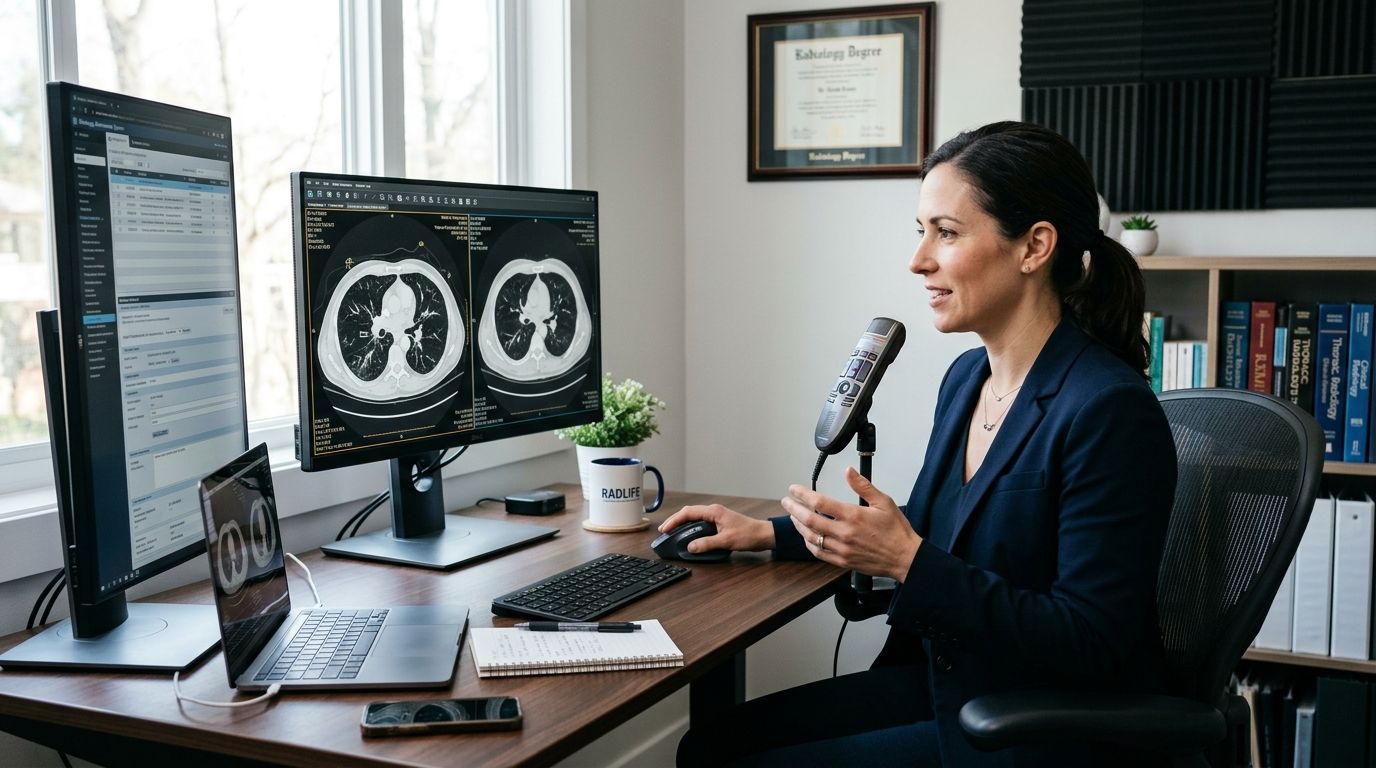
Remote radiology jobs let you read studies from a home workstation instead of a hospital reading room, and in 2026 the arrangements range from full teleradiology contracts to hybrid in-office/remote splits. This guide breaks down what actually matters when you're evaluating remote radiology jobs, not just what the job posting promises.
- Full-time teleradiology contracts with 8-12 hour shift blocks are the steadiest remote radiology jobs in 2026 — Buy.
- Nighthawk and overnight remote coverage pays a premium but disrupts sleep cycles long-term — Consider, not a default choice.
- Multi-state licensing is the real gatekeeper for remote radiology jobs, not the technology.
- RadBoard tracks remote listings across 5,000+ radiology positions pulled from 20 sources, updated for the 2026 market.
Why this matters
Radiology is one of the few clinical specialties where the physical exam is unnecessary for the read itself, which is why remote radiology jobs expanded faster than almost any other physician remote-work category. But "remote" covers wildly different setups — a fully asynchronous teleradiology contract is not the same commitment as a hybrid role where you're on PACS from home two days a week. Picking the wrong structure costs you either income stability or the schedule flexibility you took the job for in the first place.
Compensation models, licensing requirements, and call obligations differ by arrangement, and none of that shows up in a job title. You have to read past the headline.
Who this is for
This guide is for practicing radiologists and radiology residents finishing training in 2026 who want a schedule they control — parents managing childcare, physicians relocating without wanting to restart a job search, or subspecialists who've concluded their read volume doesn't require a physical seat in a reading room. It's not for radiologists who need in-person procedural volume (IR, breast biopsy) as their primary case mix — those roles stay hybrid or in-person by necessity.
What to look for in remote radiology jobs
Licensing footprint required
Most remote radiology jobs require an active medical license in every state where the patient sits at the time of the study, not just where you live. A group covering a dozen states means you're either already licensed in most of them or the employer is funding and processing new applications — ask which, before you sign anything, because licensing lag can delay your start date by months.
Shift structure and read volume expectations
Remote roles are typically built around defined shift blocks — commonly 8 to 12 hours — with a set read-volume target per shift rather than an open-ended workload. A vague "as needed" volume clause is a red flag; you want a number in the contract, not an estimate in the interview.
Call and overnight obligations
Some remote radiology jobs are structured entirely around overnight or weekend coverage (often called nighthawk work), while others are business-hours only with occasional call. Know which one you're evaluating before you compare pay, since overnight-heavy contracts pay more per shift precisely because they cost you more in sleep disruption.
Technology and workstation requirements
A legitimate remote radiology job specifies PACS access, dictation software, and monitor/workstation standards in writing — diagnostic-grade monitors, redundant internet, and VPN access aren't optional extras, they're the baseline for reading studies remotely in 2026. If the employer is vague on this, expect friction in your first month.
Malpractice coverage across state lines
Coverage needs to extend to every state where you're reading studies, not just your home state. Confirm tail coverage terms too — this matters more in remote arrangements where you may hold contracts with multiple entities simultaneously.
Subspecialty match
Remote demand skews toward high-volume, protocol-driven reads — general diagnostic, MSK, neuro — more than it does toward subspecialties that lean on multidisciplinary tumor boards or same-day consults. If your subspecialty depends on in-person collaboration, a fully remote contract may not fit the way you practice.
Top picks for remote radiology jobs in 2026
Full-time teleradiology group contract — the steady paycheck pick
These contracts run on fixed 8-12 hour shift blocks with a defined read-volume target and salaried or per-shift compensation. The steadiness is the point: you know your schedule weeks out, and the employer typically handles multi-state licensing costs as part of onboarding. Verdict: Buy for radiologists who want predictable income without a hospital commute.
Academic hybrid remote/in-office split — the balance play
Some academic and health-system employers now let radiologists read remotely two or three days a week while keeping in-person days for tumor boards, teaching, or procedural coverage. You keep institutional benefits and career trajectory while trimming commute days. Verdict: Consider if you value academic affiliation over maximum schedule flexibility.
Nighthawk and overnight remote coverage — the high-pay night shift
Overnight remote coverage compensates at a premium specifically because it's overnight, and it's genuinely flexible in the sense that your daytime hours are entirely your own. The tradeoff is chronic circadian disruption if you stay on it past a year or two. Verdict: Consider as a short-term or supplemental arrangement, not a decade-long plan.
Locums remote short-term contracts — the flexible testing ground
Short-term remote locums let you sample a group's volume, technology stack, and culture before committing to anything permanent, typically over a matter of weeks rather than years. Rates are often set per study or per shift rather than salaried. Verdict: Buy if you're relocating, between permanent roles, or testing whether remote work fits your life before signing longer.
Independent multi-platform contractor reads — the DIY route
Reading for several platforms as an independent contractor maximizes control over your calendar, but you absorb your own licensing costs, malpractice tail coverage, and the administrative overhead of juggling multiple credentialing files. Verdict: Skip unless you specifically want the administrative complexity in exchange for full schedule control — most radiologists underestimate the overhead here.
Before signing anything, run the compensation structure past a second set of eyes — negotiating a higher offer matters as much in remote contracts as in-person ones, since remote pay models (per-shift, per-study, salaried) aren't directly comparable without doing the math yourself.
What to avoid
- Open-ended "remote-friendly" postings with no shift structure. If the listing can't tell you shift length or read-volume targets, the employer hasn't defined the role yet — you will.
- Contracts that push licensing costs entirely onto you without disclosing it up front. Multi-state licensing runs into the thousands of dollars in fees and months in processing time; know who's paying before you accept.
- Overnight-heavy roles marketed as "flexible" without disclosing the overnight requirement. Flexible daytime hours built on a mandatory overnight shift is not the same flexibility a parent or caregiver is usually looking for.
Verdict comparison
| Arrangement | Schedule flexibility | Licensing burden | Income stability | Verdict |
|---|---|---|---|---|
| Full-time teleradiology contract | Moderate | Employer-handled | High | Buy |
| Academic hybrid split | Low-moderate | Employer-handled | High | Consider |
| Nighthawk/overnight coverage | High (daytime) | Employer-handled | Moderate | Consider |
| Locums remote short-term | High | Mixed | Low-moderate | Buy |
| Independent contractor reads | Highest | Self-funded | Low | Skip |
RadBoard's 2026 US Radiology Job Market Report tracks these arrangement types across 3,700+ active listings pulled from a pool of 5,000+ radiology positions aggregated from 20 sources — the platform's search and swipe-to-save tools let you filter for remote-specific postings without scanning every listing manually.
FAQ
Are remote radiology jobs harder to find than in-person roles in 2026?
No, but they're structured differently, so filtering matters more than volume. RadBoard aggregates 5,000+ radiology positions from 20 sources, and remote-specific postings can be filtered rather than searched manually one job board at a time.
Do remote radiology jobs pay less than in-person roles?
Pay structure varies by arrangement rather than by remote status alone — overnight and nighthawk remote roles often pay a premium, while some hybrid academic roles trade pay for institutional benefits. Compare per-shift or per-study rates directly rather than assuming remote means lower pay.
How many state medical licenses do I need for a remote radiology job?
You need an active license in every state where the patient is physically located at the time of the study, which for a multi-state teleradiology group can mean a dozen or more licenses. Ask upfront whether the employer funds and processes these applications.
Can radiology residents apply for remote radiology jobs right after training?
Most remote teleradiology groups prefer board-certified radiologists, though some hybrid academic and locums arrangements accept newly certified physicians. Licensing timelines matter more here than for in-person roles, so start the credentialing process early.
What technology do I need for a remote radiology job?
Diagnostic-grade monitors, PACS and dictation software access, redundant high-speed internet, and VPN credentials are the standard baseline for remote radiology jobs in 2026. A legitimate employer specifies these requirements in writing before you start.
Is nighthawk radiology a good long-term remote career?
Nighthawk coverage pays a premium and offers genuine daytime flexibility, but the circadian disruption makes it a better short-term or supplemental arrangement than a permanent career plan for most radiologists.
How do I compare pay across different remote radiology job structures?
Convert every offer to a per-shift or per-study equivalent before comparing, since salaried, per-shift, and per-study models aren't directly comparable on a headline number alone. Negotiating tactics for remote contracts follow the same principles as in-person offers.
Do remote radiology jobs require malpractice coverage in every state I read from?
Yes, malpractice coverage needs to extend to every state where the patient is located during the read, not just your home state. Confirm tail coverage terms separately, especially if you hold contracts with more than one employer.
One last thing
The detail radiologists underestimate most in remote radiology jobs isn't the technology or the pay — it's the licensing timeline. A dozen state medical licenses can take months to clear even with an employer funding the process, so the radiologists who land remote roles fastest in 2026 are the ones who start credentialing before they've signed anything.
RadBoard indexes remote-eligible listings across its 5,000+ job database so you can filter for arrangement type before you start the licensing clock.