
Yes, you can do locum tenens radiology right out of fellowship if you meet the assignment’s licensing, credentialing, privileging, and clinical requirements. Fellowship completion does not automatically qualify you for every opening: confirm that the facility accepts your board status and experience, and that the actual reading or procedural scope matches your training before committing to a start date.
- Can new radiology graduates do locum tenens? Yes, when facility requirements and clinical scope match their qualifications.
- Choose a first assignment with defined duties, orientation, and an identified radiologist for consultation.
- Board eligibility, medical licensure, and hospital privileges are separate checks; fellowship completion does not replace them.
- RadBoard aggregates 5,000+ radiology positions from 20 sources; confirm new-graduate eligibility directly with each hiring organization.
Can you do locum tenens radiology right out of fellowship?
Yes—but acceptance is assignment-specific, not automatic. A hospital or practice evaluates your credentials against the work it needs covered. Your fellowship establishes relevant training; it does not establish that you can cover every modality, procedure, patient population, or call responsibility on a particular service.
For your 2026 search, separate finding an opening from receiving authorization to work. RadBoard aggregates radiology positions, but the hiring organization and facility determine whether your qualifications meet an assignment’s requirements.
Use this sequence before accepting:
- Confirm eligibility. Ask whether the facility accepts physicians immediately after fellowship and whether your current board status qualifies.
- Define clinical scope. Obtain the modalities, patient populations, procedures, and call responsibilities in writing.
- Verify approvals. Confirm the required medical license, credentialing approval, and clinical privileges for each covered site.
- Confirm readiness. Resolve orientation, system access, consultation arrangements, and malpractice coverage before your first shift.
Why this matters
Your first attending assignment combines independent clinical responsibility with unfamiliar local systems. A temporary contract does not reduce the need to understand critical-result communication, contrast-response procedures, procedural support, or escalation pathways.
Choose the work you can perform independently, not simply the assignment that accepts your application. A narrow, familiar clinical scope with clear support is a better starting criterion than a broad job title. Ask what reaches your worklist when the scheduled subspecialist is unavailable.
For a 2026 fellowship graduate, the decision is not just whether locums is permitted. It is whether the specific assignment gives you a workable transition from supervised training to independent practice.
Which first locum assignment fits your training?
Compare assignments by duties and support rather than by the words “locum,” “remote,” or “fellowship-trained.” None of those labels tells you how broad the worklist is or who handles cases outside your competence.
| Assignment | Best for | Advantage | Limitation to check |
|---|---|---|---|
| Subspecialty-focused locums | Graduates seeking work closely aligned with fellowship | Concentrates work within a familiar clinical area | The contract can still include general coverage or call |
| General diagnostic locums | Graduates comfortable with the stated cross-modality case mix | Uses broader diagnostic training | Requires independent readiness beyond the fellowship worklist |
| Remote locums | Graduates ready for independent reading with defined remote support | Removes the need to work physically at the reading site | Consultation, technical support, and communication need explicit arrangements |
| Permanent attending role | Graduates prioritizing continuity and an established team | Offers an ongoing setting for professional relationships | Mentorship and protected onboarding still require verification |
Subspecialty-focused locums
Best for graduates whose recent experience matches the assignment’s actual case mix. Request a representative worklist and a list of excluded studies. “MSK coverage,” for example, is not enough information to determine whether the role also includes unrelated emergency examinations or procedures.
The advantage is clinical alignment. The limitation is that a subspecialty title does not define the entire shift. Ask whether general studies enter the queue and who takes responsibility when something falls outside the agreed scope.
General diagnostic locums
Best for graduates who can independently cover the specified modalities and patient populations. Review your readiness against the proposed work, including areas you used less frequently during fellowship. Do not treat residency exposure as proof of current comfort with every examination.
General coverage gives you a broader clinical role, but it also demands a broader skills assessment. Ask about emergency imaging, pediatric studies, fluoroscopy, contrast supervision, and any procedures included in the assignment. Decline duties you cannot perform safely and independently.
Remote locums
Best for graduates with a defined reading scope and dependable remote consultation arrangements. Working remotely changes where you interpret studies; it does not remove licensing, credentialing, or clinical responsibility.
Confirm which facilities you will cover and which state licenses the arrangement requires. Ask how you reach technologists, obtain prior examinations, communicate urgent findings, and manage a system outage. Remote work is not a substitute for an organized clinical support structure.
Why eligibility varies between assignments
Facilities assess the physician against the service being covered. These factors explain why acceptance for one assignment does not establish eligibility for another:
- Board status: Ask whether the facility accepts your current certification or eligibility status and whether it imposes a certification deadline.
- Medical licensure: Confirm the license requirements for the states and practice arrangement involved; do not assume one license covers every site.
- Clinical privileges: The facility must authorize the clinical activities you will perform, including procedures when applicable.
- Recent training and competence: Supply documentation that supports the specific work requested, not just a fellowship completion date.
- Assignment scope: General call, specialized interpretation, and procedural coverage require different assessments of readiness.
- Work authorization: If your immigration status restricts employment, obtain qualified advice before accepting temporary or independent-contractor work.
For a 2026 start, ask the credentialing office about current requirements rather than relying on another physician’s experience. An agency’s willingness to submit your application is not the same as facility approval.
How do you prepare before fellowship ends?
Begin with a complete, consistent credentialing file. Collect your training history, license information, board-status documentation, references, and any requested procedure or case records. Use accurate dates and explain gaps directly.
Ask your program which documentation it can provide and how verification requests are handled after graduation. Then ask the receiving facility for its own checklist. A recruiter’s checklist does not replace the facility’s requirements.
Establish a realistic start condition
For a 2026 assignment, make the start date contingent on required approvals and completed onboarding. Do not assume an advertised date accounts for your individual licensing or credentialing situation.
Get written confirmation of what remains outstanding and who owns each task. If approval is delayed, resolve the schedule and contract consequences before making travel commitments. Do not begin clinical work while required authorization remains incomplete.
Separate documents from clinical preparation
A complete file establishes that your application can be reviewed. It does not teach you the local workflow. Request orientation to the reporting system, worklist routing, critical-result process, and after-hours contacts.
If procedures are included, confirm equipment familiarity, staffing, patient selection, recovery arrangements, and emergency support. Treat an unfamiliar procedural environment as a separate readiness question, even when the procedure itself is familiar.
What should you ask before signing?
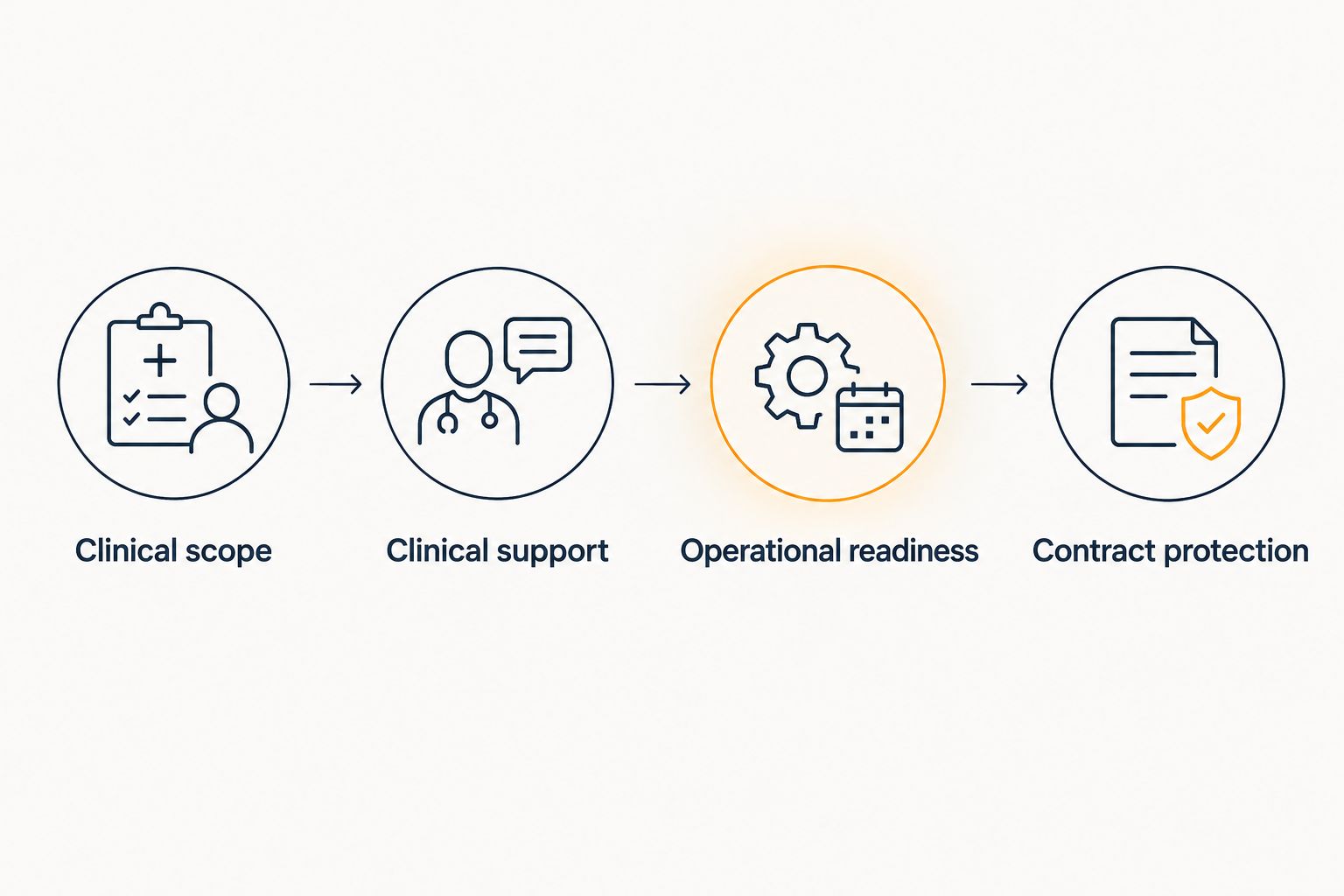
Use these 4 checks to turn a general offer into a defined assignment. Request answers from the clinical lead or credentialing team when the recruiter cannot resolve a clinical or approval question.
- Clinical scope: Which examinations and procedures are included, which are excluded, and who covers exceptions?
- Clinical support: Who provides consultation, how do you reach that person, and what happens when that person is unavailable?
- Operational readiness: How are orientation, system access, worklist routing, and urgent-result communication handled?
- Contract protection: Who arranges malpractice coverage, what does it cover, and what obligations continue after the assignment ends?
These checks connect directly: a written scope is incomplete without a process for handling exceptions. A named consultant is not sufficient without a way to reach that person during your actual shift.
Read the cancellation and termination provisions as carefully as the schedule. Have a qualified attorney review terms you do not understand, and have an insurance professional explain coverage questions. Temporary work still creates obligations after your final shift.
How should you evaluate workload and backup?
Ask for the expected case mix and workload by shift, including how urgent studies interrupt routine reading. Obtain the actual productivity expectations and ask how the practice handles unusually complex cases. Do not invent a personal target from another physician’s reported volume.
A first assignment needs an escalation process, not a promise that someone is usually available. Request the contact pathway for difficult interpretations, clinical disagreements, contrast events, and technical failures. Clarify whether consultation is informal or part of an assigned coverage responsibility.
Orientation should also cover how discrepancies are reviewed and how you receive feedback. Independent practice does not mean practicing without quality review. Ask who discusses concerns with you and how unresolved issues reach the clinical lead.
Do you need attending experience before doing locums?
Prior attending experience is an assignment-specific requirement, not something to infer from the word “locums.” Ask the facility directly whether it accepts a physician immediately after fellowship and what evidence of competence it requires.
If the organization requires prior independent practice, a fellowship does not override that requirement. Consider a different assignment or an employed role with suitable onboarding rather than trying to negotiate around a clinical eligibility standard.
Can you do locums while waiting for board certification?
Your current board status must satisfy the facility’s requirements. Board eligibility and board certification are not interchangeable, and neither replaces medical licensure or clinical privileges.
State your status accurately on applications and ask about any certification deadline. For a 2026 assignment, confirm how an upcoming examination or status change affects scheduling and continued eligibility. Do not describe yourself as certified before certification is awarded.
Is locums better than a permanent first job?
Locums is a reasonable first-job option when the scope, approvals, and support fit your needs; it is not automatically the better choice. Temporary work lets you accept a defined assignment, but you must evaluate each setting’s onboarding and clinical arrangements.
A permanent position offers an ongoing team structure, but the job title alone does not guarantee mentorship. Compare who reviews cases with you, how duties expand, and whether consultation is available during your shifts. Choose the arrangement with clear answers rather than assuming employment type determines support.
Where should you begin your search?
RadBoard is best for radiologists who want to search positions aggregated from multiple sources. The radiology job search platform brings together 5,000+ positions from 20 sources and includes swipe-to-save features for building a shortlist.
That breadth helps with discovery, not clinical approval. RadBoard’s overall position count is not a count of locum assignments accepting new fellowship graduates. Confirm the opening’s scope, board requirements, and new-graduate eligibility directly with the hiring organization before treating it as a fit.
For your 2026 shortlist, record the clinical scope, location, board requirement, support contact, and approval status for each assignment. An unanswered eligibility question should remain visible rather than becoming an assumption.
FAQ
Can new radiology graduates do locum tenens immediately after fellowship?
Yes, new radiology graduates can do locum tenens when they meet the assignment’s licensing, credentialing, privileging, and clinical requirements. Confirm that the facility accepts physicians without prior attending experience before committing.
Do I have to be board certified to accept a radiology locum assignment?
The facility determines whether your board status meets its requirements. Ask whether board-eligible physicians qualify and whether certification is required by a specified deadline.
Can I start a locum assignment before hospital privileges are approved?
Do not start work requiring hospital privileges until those privileges and other required approvals are in place. A signed contract or recruiter confirmation does not replace authorization from the facility.
Is remote locum radiology a good first job after fellowship?
Remote locum radiology is a reasonable first-job option only when the clinical scope and remote support arrangements fit your readiness. Confirm consultation access, urgent-result communication, technical support, and the licenses required for the arrangement.
What should I ask about malpractice coverage for locums?
Ask who arranges malpractice coverage, which activities and locations it covers, and what protection applies after the assignment ends. Have an insurance professional explain the policy and any reporting or tail-coverage obligations.
Should I choose subspecialty locums or general diagnostic coverage?
Choose the assignment whose actual duties match your independent competence. A subspecialty title does not exclude general coverage, and a general diagnostic role requires a separate review of modalities, procedures, and call duties.
Does RadBoard approve radiologists for locum assignments?
RadBoard is a radiology job search platform, not the facility granting clinical privileges. The hiring organization and facility determine assignment eligibility and required approvals.
One last thing
Before accepting, ask the clinical lead: What happens when a case outside my agreed scope reaches my worklist? The answer should identify who takes the case, how you contact that person, and how responsibility is transferred. An exception pathway tells you more about readiness than a broad assurance that the job is straightforward.