
Yes. A radiologist can work part time and keep board certification; reducing your employment hours does not, by itself, cancel certification. You still need to satisfy your certifying board’s requirements, and your medical license, hospital privileges, and modality-specific qualifications remain separate obligations.
- Can a radiologist work part time and keep board certification? Yes—continued compliance, not employment fraction, determines certification status.
- American Board of Radiology requirements remain separate from hospital privileges, state licensing, and mammography qualifications.
- Document your clinical scope and recent experience before reducing shifts or dropping procedures.
- RadBoard aggregates radiology positions; confirm certification and credentialing requirements directly with the responsible organizations.
Can a radiologist work part time and keep board certification?
Yes—part-time employment and continued board certification are compatible. For an American Board of Radiology-certified physician, the relevant question is whether you meet the requirements applicable to your certificate and Continuing Certification participation, not whether your contract describes you as full time.
Before comparing radiology jobs with flexible FTE, separate the requirements below. A suitable schedule must accommodate every obligation relevant to your actual work.
| Requirement | Who sets it | What to verify before reducing hours |
|---|---|---|
| Board certification | Your certifying board | Certificate status and applicable Continuing Certification obligations |
| Medical licensure | Each relevant state medical board | License status, renewal requirements, and required education |
| Hospital privileges | Each hospital or credentialing organization | Recent experience, competency evidence, and requested clinical scope |
| Mammography qualifications | Federal MQSA requirements and facility review | Continuing experience, education, and qualification records |
| Employment terms | Your employer or contracting group | Schedule, call, workload, and responsibility for credentialing documentation |
These requirements are not interchangeable. An active board certificate does not automatically establish eligibility for every hospital privilege or imaging service.
Why this matters
The practical risk is confusing fewer shifts with fewer professional obligations. A part-time contract changes your employment arrangement; it does not automatically reduce the education, assessment, or documentation required by another organization.
For a 2026 schedule change, start with the work you intend to retain. A diagnostic radiologist continuing a familiar reading practice faces different credentialing questions from an interventional radiologist dropping procedures or a breast imager sharply reducing mammography sessions.
Design the schedule around the qualifications you need to preserve. Do not accept a reduced-hours arrangement first and investigate clinical eligibility afterward.
How do you confirm that your part-time plan preserves certification?
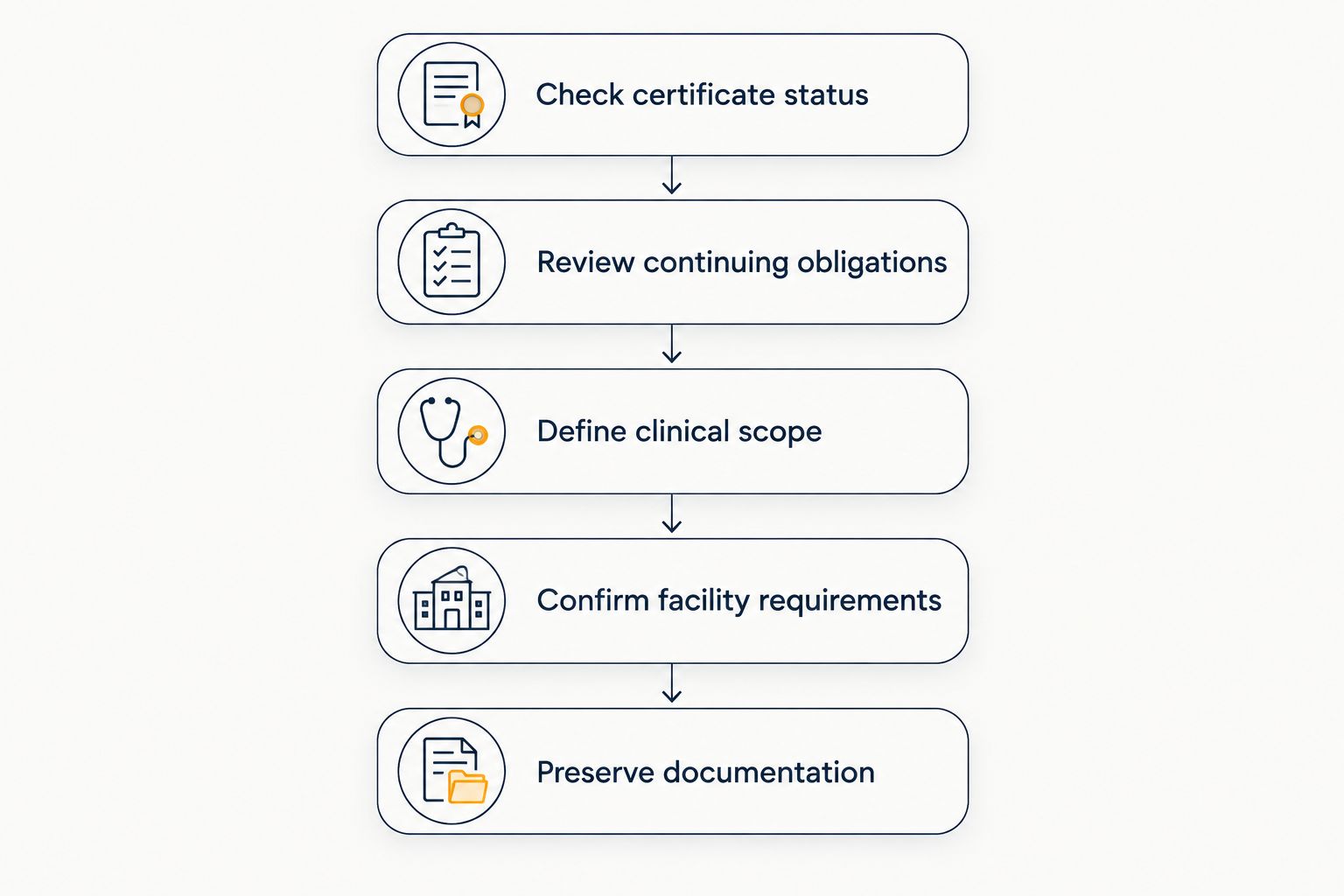
Use this sequence before signing a contract amendment. Keep board requirements and facility requirements in separate records so that an approval from one organization does not get mistaken for approval from another.
1. Check certificate status
Review your certifying board’s record of your current certification. Identify the specialty certificate, any subspecialty certificates, and the Continuing Certification requirements that apply to you.
For American Board of Radiology diplomates, consult the board’s Continuing Certification guidance and your individual account. Do not substitute a colleague’s renewal experience for your own requirements: certificate type and participation status matter.
2. Review continuing obligations
List the education, assessment, professional standing, and improvement activities applicable to your certification. Check your personal deadlines and outstanding tasks before changing your schedule.
A reduced clinical schedule is not permission to stop required participation. If your planned arrangement includes an extended absence or a substantial change in professional activity, ask the board how its rules apply to that specific arrangement.
3. Define clinical scope
Write down the modalities, procedures, and patient-care responsibilities you will retain. Be precise about work you intend to stop performing.
“Part-time radiology” is not a clinical scope. Diagnostic interpretation, mammography, image-guided procedures, and interventional coverage bring different qualification and competency questions.
4. Confirm facility requirements
Send the proposed scope and schedule to each relevant medical staff office. Ask which recent-experience records, competency assessments, references, and renewal documents it requires for the privileges you want to retain.
Get the response in writing. A department’s willingness to schedule you does not replace the facility’s credentialing decision.
5. Preserve documentation
Arrange access to your case records, continuing education certificates, assessment records, and credentialing correspondence. Establish who will provide documentation after your employment terms change.
If you work at multiple facilities, maintain a consolidated record while preserving the supporting records from each site. Confirm what each reviewing organization accepts rather than assuming a personal spreadsheet is sufficient.
Which part-time arrangement fits your clinical responsibilities?
No employment model automatically preserves certification or privileges. Compare arrangements by how well they support the clinical work and documentation you need, not by the number of free weekdays they appear to offer.
| Arrangement | Best for | Main advantage | Main limitation to resolve |
|---|---|---|---|
| Reduced schedule with your existing group | Physicians seeking continuity | Keeps the transition within a familiar clinical setting | Confirm revised workload, call, and privilege expectations |
| Part-time work with a new employer | Physicians changing practice settings | Lets you negotiate a new clinical scope explicitly | Requires review of the new employer’s credentialing standards |
| Per-diem or locum assignments | Physicians seeking assignment-level flexibility | Allows you to evaluate individual coverage commitments | Requires coordination of records and credentials across assignments |
| Part-time teleradiology | Physicians seeking remote interpretation work | Changes the work location without requiring an onsite reading schedule | Does not remove licensing, credentialing, or scope requirements |
Choose the arrangement that preserves the work you actually intend to perform. A flexible schedule is not useful if its case mix leaves you unable to document the experience required for a service you want to retain.
For each offer, request the expected modalities, procedures, shift responsibilities, and credentialing criteria. “Flexible” and “part time” are scheduling descriptions, not evidence that the position fits your professional requirements.
Why part-time eligibility varies
The answer to the certification question is straightforward; the details of continued clinical practice require individual review. For 2026 planning, focus on these factors:
- Certifying board and certificate: Follow the requirements of the organization that issued your certificate. Do not treat American Board of Radiology guidance as a substitute for another board’s rules.
- Continuing Certification status: Check your own participation record, deadlines, and outstanding requirements before assuming everything is current.
- Clinical scope: Removing a modality or procedure changes the experience you accumulate and the privileges you need.
- Facility standards: Each credentialing organization evaluates the privileges it grants. Ask about the specific services you intend to provide.
- Modality-specific requirements: Mammography has federal continuing-qualification standards separate from board certification.
- Practice interruptions: A continuous reduced schedule and a prolonged absence are different situations. Ask about return-to-practice requirements before taking an extended break.
These are separate checks, not reasons to reject part-time practice. Resolve them before committing to a schedule that is difficult to reverse.
Does mammography require a minimum reading volume?
960 mammographic examinations over the preceding 24 months is the federal continuing-experience standard for interpreting physicians under MQSA. FDA regulations address interpretation or multireading, and facilities review the documentation supporting qualification.
For your 2026 planning, the relevant authority is the FDA’s Mammography Quality Standards Act framework, including the personnel requirements in 21 CFR 900.12. This is a mammography qualification requirement—not a universal minimum case volume for maintaining radiology board certification.
The mammography continuing-education requirement includes at least 15 category I credits in mammography during the preceding 36 months. Other qualification provisions also apply; satisfying these continuing-experience and education figures alone does not establish eligibility to perform every breast imaging service.
If you plan to retain mammography interpretation, ask the facility’s responsible personnel to review your records and proposed schedule. Do not estimate continued qualification from shift count alone. The work performed during those shifts and the applicable review period matter.
Does the ABR require full-time employment?
The American Board of Radiology’s Continuing Certification framework is not a full-time employment requirement. Its framework addresses professional standing, lifelong learning and self-assessment, knowledge assessment, and improvement in medical practice.
For a 2026 employment change, use the ABR’s official guidance and your individual account to identify applicable requirements. If your proposed role removes clinical work or substantially changes your activity, obtain an answer specific to that plan rather than assuming that general part-time guidance resolves it.
Can I stop clinical work and remain board-certified?
Stopping clinical work is a different question from reducing clinical hours. Ask your certifying board how its requirements apply to your proposed nonclinical role, and separately ask facilities what would be required if you later sought to resume patient care.
Do not describe yourself as retired, inactive, or clinically active without checking how the relevant organization defines that status. Keep a written record of the response and the circumstances you described.
What should your part-time contract address?
Put the clinical scope and administrative responsibilities in writing. A contract that reduces scheduled shifts but leaves call, coverage, and documentation duties unclear does not define the full commitment.
Before signing, request written answers to these questions:
- Which modalities and procedures will you perform, and which will you stop performing?
- Who supplies case records and competency documentation for credentialing reviews?
- Who tracks license renewals and facility reappointments?
- Which education or assessment responsibilities remain yours?
- What happens if your case mix no longer supports a requested privilege?
- How are call, extra coverage, and work outside scheduled shifts handled?
For a 2026 transition, review the proposed amendment alongside your current agreement. Confirm which existing provisions remain in force rather than treating the new schedule as a replacement for the entire contract.
Where should you look for part-time radiology positions?
RadBoard is best for radiologists seeking one radiology job search across multiple sources. The radiology job search platform aggregates 5,000+ positions from 20 sources and includes swipe-to-save features for organizing opportunities.
Use RadBoard to identify positions, then ask employers about the actual schedule, clinical scope, and credentialing requirements. A job-search platform helps you find opportunities; the certifying board and credentialing organizations determine whether your proposed work meets their requirements.
Save positions that describe the work you want to retain. Before applying, prepare a short statement of your available schedule, modalities, procedures, and current credentials so the employer can assess the proposed arrangement directly.
Find your next radiology position
Compare radiology opportunities aggregated from 20 sources, then confirm schedule and credentialing requirements.
FAQ
Can a radiologist work part time and keep board certification?
Yes, a radiologist can work part time and keep board certification by continuing to meet the requirements applicable to their certificate. Medical licensing, hospital privileges, and modality-specific qualifications require separate review.
Does reducing my hours reduce my Continuing Certification requirements?
Reducing your employment hours does not automatically reduce your Continuing Certification requirements. Check your certifying board’s guidance and your individual participation record before changing your schedule.
Is there a minimum number of weekly hours for ABR certification?
ABR Continuing Certification is not based on a universal full-time weekly work schedule. Review the requirements applicable to your certificate and ask the ABR about substantial changes in professional activity.
Can I keep reading mammograms if I only work part time?
Yes, part-time mammography interpretation is compatible with continued qualification if you meet all applicable requirements. The federal continuing-experience standard includes 960 mammographic examinations over the preceding 24 months, separate from board certification.
Will keeping my board certification guarantee hospital privileges?
No, board certification does not guarantee hospital privileges. Each facility reviews the qualifications and competency evidence required for the clinical privileges you request.
Is remote radiology work treated differently for board certification?
Working remotely does not replace your certifying board’s requirements. Teleradiology also requires attention to applicable state licensing, facility credentialing, and the scope of services you provide.
Can RadBoard confirm that a part-time job meets my certification requirements?
RadBoard is a radiology job search platform, not a certifying board or credentialing authority. Confirm certification requirements with your board and clinical eligibility with the relevant facilities before accepting a position.
One last thing
Count the work you need to retain, not just the shifts you want to remove. Before committing to part-time practice, compare your proposed case mix with the qualifications and privileges you intend to keep.
A reduced schedule and a reduced clinical scope are different decisions. Make both explicit, and keep the written responses from your board and credentialing offices with your contract records.