
Yes—an IMG radiologist can get a J-1 waiver job without completing a fellowship if the physician meets the applicable waiver, licensing, immigration, and employer requirements. Fellowship is not a universal federal requirement for a clinical-service waiver, but a state program or hiring practice can impose additional conditions. Completing residency and qualifying for independent practice remain separate questions from obtaining the waiver.
- An IMG radiologist can get a J1 waiver without fellowship; the employer and waiver program must accept the arrangement.
- USCIS waiver requirements do not replace state medical licensing, board eligibility, or hospital credentialing.
- Conrad 30 specialist participation depends on the state program; radiology eligibility is not automatic.
- RadBoard supports radiology job discovery, not a determination of immigration eligibility.
Can an IMG get a J-1 waiver radiology job without a fellowship?
Yes, but distinguish a fellowship requirement from a qualification requirement. A physician who completed qualifying diagnostic radiology residency has a different application profile from a physician whose radiology training occurred entirely outside the United States. Neither profile receives automatic waiver eligibility simply because an employer wants to hire the physician.
For a 2026 application, use USCIS guidance on foreign medical graduates and the chosen waiver program’s current requirements as the immigration starting point. Use the state medical board, American Board of Radiology, and hospital credentialing office for their respective qualification requirements. These authorities answer different questions.
The guide to finding your first radiology job without a fellowship addresses the employment side; the waiver requires an additional review.
| Applicant or job situation | What supports the application | What still needs confirmation | Best for |
|---|---|---|---|
| Qualifying residency completed; no fellowship | Residency training supports consideration for general diagnostic work | License eligibility, board status, privileges, and waiver-program acceptance | Physicians seeking general diagnostic practice |
| Radiology training completed abroad | Prior training documents the physician’s experience | Recognition of training for licensing, certification, immigration, and privileges | Physicians establishing their US qualification pathway |
| Fellowship listed as preferred | The employer has not described fellowship as mandatory | Whether the department will accept residency training and demonstrated competence | Applicants seeking clarification before applying |
| Fellowship listed as required | The position has an explicit training condition | Whether the requirement is mandatory for the actual duties and privileges | Fellowship-trained applicants matching that requirement |
Why this matters
A fellowship decision affects training plans, but a waiver decision affects your ability to remain and work under the proposed arrangement. Do not enroll in a fellowship solely because someone treats it as a universal waiver requirement. Ask which written rule or credentialing condition requires it.
Conversely, a recruiter’s willingness to consider a physician without fellowship does not establish immigration eligibility. You need agreement between the waiver program, employer, immigration counsel, licensing authority, and credentialing office—not just a positive interview.
What does a clinical-service J-1 waiver actually require?
A clinical-service waiver addresses the applicable 2-year home-country physical presence requirement attached to J-1 physician training. It does not itself issue a medical license, grant hospital privileges, or authorize employment independently of the required immigration approvals.
USCIS describes a 3-year full-time service commitment for the Conrad 30 route, generally in H-1B status. Its physician-waiver guidance describes full-time employment as 40 hours per week. Confirm the applicable route and contract requirements with immigration counsel rather than assuming every physician waiver follows identical rules.
Under Conrad 30, a state health department can request waivers for up to 30 physicians per federal fiscal year. That is a statewide limit, not a radiology allocation or an assurance that a particular state accepts radiology applications.
For your 2026 search, check the state health department’s current physician-waiver materials for specialty policies, application procedures, and service-site requirements. Other interested government agency routes have their own criteria; an employer’s eligibility under one route does not establish eligibility under another.
The practical test is not whether you have a fellowship certificate. It is whether your qualifications and the proposed employment satisfy the specific route.
How do you check eligibility before accepting interviews?
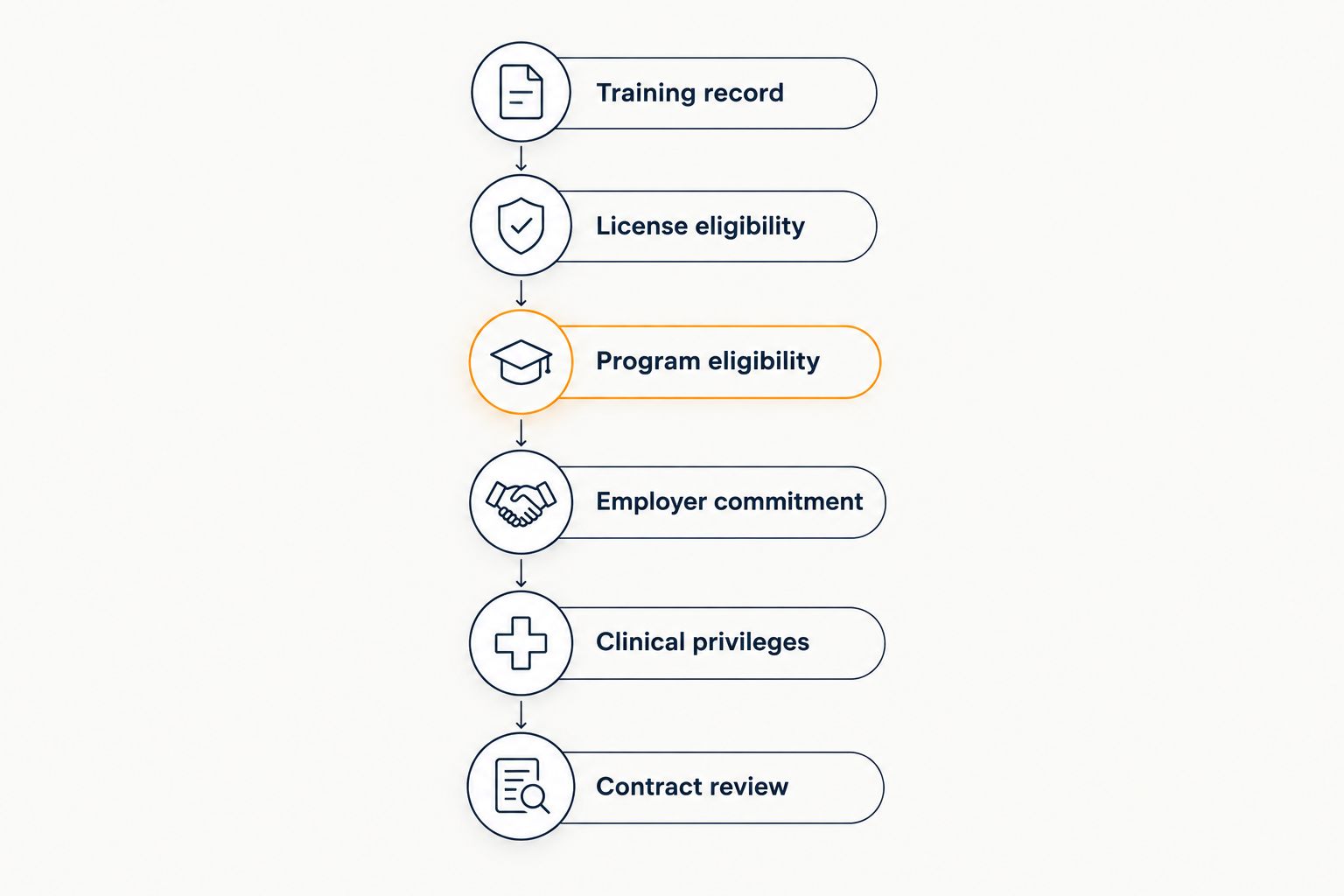
Work through the following sequence before treating a position as a viable waiver opportunity. Keep written answers with the job description so that changes in duties, locations, or employer do not escape review.
- Training record. Identify where you completed medical school, internship, residency, and any additional training. Separate completed training from planned training, and document your actual certification status.
- License eligibility. Ask the relevant state medical board which licensing requirements apply to your training history. Do not assume that eligibility in one state establishes eligibility elsewhere.
- Program eligibility. Identify the waiver route and sponsoring agency. For Conrad 30, confirm whether the state accepts radiologists and whether the proposed position meets its current criteria.
- Employer commitment. Ask the employer to confirm support for the physician-waiver process and the required employment petition. General willingness to sponsor a visa is not a complete answer.
- Clinical privileges. Have the department and credentialing office review the actual work you would perform. Obtain a clear answer about fellowship requirements before negotiating a final contract.
- Contract review. Have physician immigration counsel review the employer, work locations, duties, service commitment, and proposed start date. Coordinate that review with an attorney reviewing employment terms.
This order prevents a common application problem: discussing an attractive position before establishing that the employer can use the proposed immigration route. It also separates correctable documentation gaps from a fundamental mismatch.
What changes if you completed radiology residency outside the US?
No fellowship does not mean no additional US training is necessary. If you completed radiology residency abroad, your first task is to establish which licensing and certification pathways accept your training. A waiver removes an immigration requirement; it does not convert foreign specialty training into US board eligibility.
The American Board of Radiology publishes an alternate pathway for eligible internationally trained diagnostic radiologists. That pathway has its own institutional and training requirements. Do not assume that an ordinary attending offer, an isolated fellowship, or a waiver-sponsored position satisfies them.
For a 2026 application, ask the prospective institution to explain exactly how the appointment fits your intended certification pathway. Then confirm the arrangement with the relevant authorities rather than relying on the position title.
Prepare a concise qualification summary that distinguishes:
- Your medical degree and country of graduation.
- Your completed radiology training and training institutions.
- Your current medical licenses and restrictions.
- Your actual board certification or eligibility status.
- Your present immigration status and training end date.
- The work you seek and the qualifications still under review.
This gives the employer a usable starting point without overstating eligibility. Describe the pathway you have confirmed, not the credential you expect to obtain.
Why does eligibility vary between radiology employers?
The answer changes because several independent requirements must align. For your 2026 shortlist, record the following factors separately rather than combining them into a single sponsorship checkbox.
- State program policy. Conrad 30 specialty participation and application requirements vary by state. Confirm radiology acceptance directly in the current program materials.
- Training recognition. The state medical board and certification body evaluate qualifications under their own rules. An employer’s interest does not replace those decisions.
- Clinical scope. General diagnostic interpretation, subspecialty interpretation, and procedures require different assessments of competence and privileges. Confirm the actual duties rather than relying on the job title.
- Service locations. The waiver application concerns an identified employment arrangement. Ask counsel to review every proposed worksite and any remote-reading component.
- Employer participation. The organization must agree to support the applicable immigration process and employment commitment. A recruiter cannot establish that commitment alone.
- Timing. Training completion, program application procedures, licensing, credentialing, and immigration approvals must fit together. Do not promise a start date before those dependencies receive review.
Fellowship can strengthen a subspecialty application or satisfy an employer’s stated requirement. Its limitation is equally clear: additional training does not cure an ineligible employer, an unsuitable service arrangement, or an unresolved licensing pathway.
How should you search for positions without a fellowship?
Start with general diagnostic radiology positions whose stated requirements match your completed training. Treat “fellowship preferred” as a reason to ask for clarification, not as either an automatic rejection or permission to ignore the preference.
RadBoard is best for radiologists who want to search positions aggregated from multiple sources. The RadBoard radiology job search platform draws from 20 sources and includes swipe-to-save features. Its role is discovery: finding a listing does not establish that the employer accepts waiver applicants or physicians without fellowship.
Use RadBoard to identify potential employers, then verify the original requirements directly. Keep an employer on your actionable shortlist only after someone responsible for hiring confirms the training requirement and someone responsible for immigration confirms the proposed sponsorship route.
Ask these questions in your initial contact:
- Does this position require fellowship, or is fellowship preferred?
- Will the department consider my specific residency and board status?
- Which physician-waiver route would the employer support?
- Has immigration counsel reviewed this position’s locations and duties?
- Who coordinates licensing and hospital credentialing?
- What must be approved before the employer confirms a start date?
Request answers in writing. If an answer remains unresolved, mark the position as unconfirmed rather than treating it as a waiver opportunity.
Does Conrad 30 require a radiology fellowship?
A 3-year service commitment is a central Conrad 30 requirement; a radiology fellowship is not a universal federal condition. A state program, employer, or credentialing body can still impose requirements that determine whether your particular application succeeds.
Can a remote radiology job qualify for a waiver?
The 40 hours per week associated with full-time clinical-service waiver employment do not make a remote position automatically eligible. Have the sponsoring agency and immigration counsel review the physician’s location, covered facilities, patient population, and proposed duties before treating teleradiology as a qualifying arrangement.
Does a waiver replace the home-country requirement permanently?
The 2-year home-country physical presence requirement is the obligation addressed by the waiver, but a clinical-service waiver carries its own conditions. Approval does not eliminate the required service commitment or permit you to change employers and locations without reviewing the immigration consequences.
FAQ
Can an IMG radiologist get a J1 waiver without fellowship?
Yes, an IMG radiologist can obtain a J-1 waiver job without fellowship when the applicable waiver program, licensing authority, and employer accept the physician’s qualifications and employment arrangement. Fellowship is not a universal federal clinical-service waiver requirement.
Do I need US radiology residency before applying for a waiver job?
Your required training depends on the licensing, certification, immigration, and credentialing pathways applicable to you. Physicians trained abroad should establish those pathways before assuming that a waiver-sponsored attending position is available to them.
Does every state accept radiologists under Conrad 30?
Do not assume that every state accepts radiologists under Conrad 30. Check the current state health department requirements for specialty participation and the proposed position.
Is fellowship preferred the same as fellowship required?
No, preferred and required describe different hiring conditions. Ask the department and credentialing office whether your completed training qualifies you for the actual duties and privileges.
Can I use a no-objection statement for a J-1 physician training waiver?
A no-objection statement is not an available waiver basis for physicians who acquired J-1 status for graduate medical education or training. Physician immigration counsel should identify the waiver grounds applicable to your circumstances.
Can I change employers during my waiver service?
Changing employers during clinical-service waiver employment requires immigration review. Do not resign or start a replacement job before counsel confirms the applicable requirements and approvals.
Does a job listing that mentions visa sponsorship guarantee a J-1 waiver?
No, visa sponsorship language does not guarantee support for a J-1 physician waiver. Confirm the specific waiver route, employer participation, work locations, and physician qualification requirements.
One last thing
Ask who requires the fellowship. An answer naming the state program, medical board, certification pathway, or hospital credentialing rule gives you something specific to verify. An unsupported statement that all IMG waiver applicants need fellowship does not.
For a 2026 decision, have qualified physician immigration counsel review your circumstances before you decline a job, extend training, or sign a service commitment. This article provides general information, not individual legal advice.