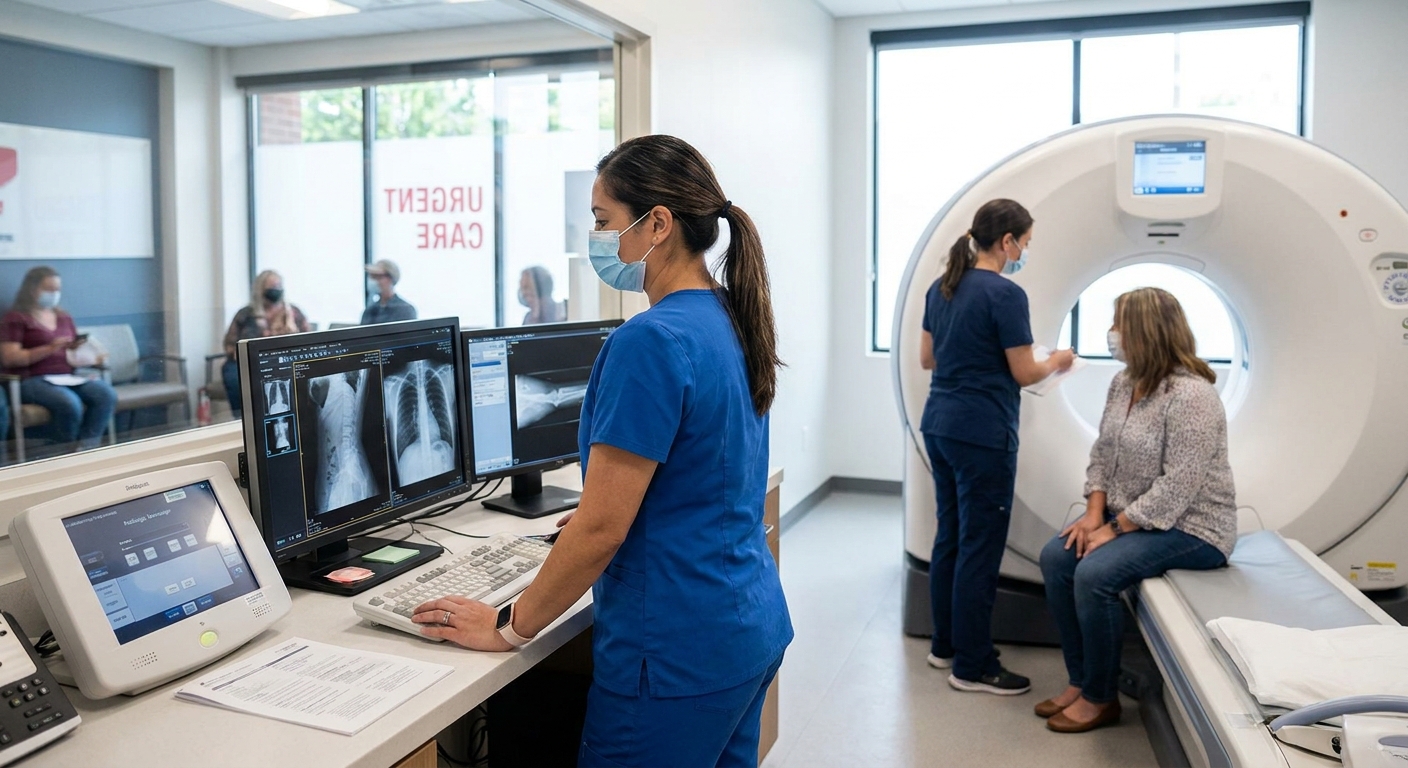
Walk-in imaging chains run radiology differently than a hospital department — higher patient volume, faster turnaround windows, and a modality mix built around X-ray, CT, and ultrasound rather than deep subspecialty reads. This guide breaks down what to check before taking an urgent care radiology job at one of these chains and which job models actually deliver on the promise of predictable, no-call work in 2026.
- Urgent care radiology jobs at national imaging chains reward speed over subspecialty depth — verdict: Buy for high-volume generalist readers.
- No-call outpatient center roles fit walk-in imaging chains skipping overnight coverage — verdict: Buy for burnout-sensitive candidates.
- Emergency-style fast-paced reads inside urgent care settings suit radiologists who want acuity variety — verdict: Consider, not a fit for everyone.
- Multi-site walk-in imaging chain coverage pays more per RVU but adds drive time between locations — verdict: Hold until mileage or travel pay is confirmed in writing.
- RadBoard tracks 5,000+ radiology positions from 20 sources, including walk-in imaging chain openings, current for 2026.
Why this matters
Urgent care and walk-in imaging chains have expanded faster than hospital radiology headcount over the last several years, and the job model looks nothing like a traditional department read. Shifts are shorter, studies are simpler on average, and turnaround expectations are measured in minutes, not hours.
That combination attracts radiologists chasing schedule control — but it also attracts practices that pad job postings with vague titles to fill high-volume slots fast. Knowing what separates a well-run walk-in imaging chain job from a churn mill matters more here than in almost any other radiology setting, because volume-based comp models punish slow decision-making on the front end.
Who this is for
This guide is for board-certified or board-eligible general radiologists who want high-volume outpatient work — X-ray, CT, ultrasound, and occasional MRI — without hospital call, and who are evaluating urgent care or freestanding walk-in imaging chain openings for 2026. It's also useful for radiologists coming off a fellowship who want generalist volume before narrowing into a subspecialty niche later.
What to look for in urgent care radiology jobs for walk-in imaging chains
Read volume and turnaround SLA
Walk-in imaging chains sell speed to patients, and that pressure lands on radiologists as a turnaround service-level agreement. Ask for the actual SLA in writing — same-day, two-hour, or 30-minute reads mean very different workdays, and a vague answer here is a red flag.
Modality mix
Most urgent care radiology jobs skew heavily toward X-ray and CT, with ultrasound as the third leg and MRI as a smaller slice. If a listing promises "varied caseload" but can't quantify the modality split, you're likely walking into a plain-film-heavy shift disguised as general radiology.
Call and after-hours coverage
One of the biggest draws of walk-in imaging chains is no-call scheduling, but not every chain delivers on it. Some multi-site operators rotate radiologists through a shared overnight or weekend queue across locations — confirm whether "no call" means zero after-hours reads or just reduced frequency.
Compensation model
RVU-based pay dominates high-volume outpatient settings because it aligns radiologist output with chain revenue. A flat hourly or salaried model can look safer on paper but often caps upside in a setting built for volume — know which model you're signing before you compare offers.
Ownership structure
Many national walk-in imaging chains are private equity-backed, which shapes everything from staffing ratios to how fast a practice culture can shift after a new ownership round. Ask directly who owns the group and how recently it changed hands.
Search urgent care radiology jobs now
Filter 5,000+ radiology positions from 20 sources by setting, call schedule, and comp model.
Top picks: job models at walk-in imaging chains
The volume play — national imaging chain outpatient roles. These positions run the highest study counts per shift across X-ray, CT, and ultrasound, and they're the most common entry point into urgent care radiology jobs in 2026. The tradeoff is repetition — you'll read a lot of straightforward studies fast, with limited subspecialty variety. See open roles in radiology jobs at national imaging center chains. Verdict: Buy if you want high throughput and don't mind a narrower modality mix.
The burnout-proof pick — outpatient centers with genuine no-call. These roles strip out after-hours and weekend coverage entirely, which is the single biggest quality-of-life lever in outpatient radiology. Confirm the no-call claim against the actual schedule before signing — some postings blur "no call" with "reduced call." Details are in outpatient imaging center radiology jobs with no call. Verdict: Buy for anyone prioritizing schedule predictability over pay ceiling.
The wildcard — fast-paced, urgent-acuity reads. Some walk-in imaging chains run closer to an emergency model, with unpredictable acuity mixed into the same shift as routine outpatient studies. It suits radiologists who get restless on repetitive plain-film volume and want variety inside a still-outpatient setting. Compare it against emergency radiology jobs for fast-paced trauma reads. Verdict: Consider if you want acuity variety without a full ER contract.
The trade-off pick — no-weekend-call schedules. These jobs keep weekday reads at a normal outpatient pace but still ask for occasional weekend coverage across a chain's sites, usually at a comp premium. It's a middle ground between full no-call and a traditional rotation, and it works well for radiologists who want most weekends free without giving up the extra RVU pay entirely. Verdict: Consider — weigh the weekend premium against how many weekends you'd actually lose.
What to avoid
- "General radiology" postings with no modality breakdown. If the listing can't say what percentage is X-ray versus CT versus ultrasound, assume it's plain-film heavy.
- "Flexible schedule" language with no stated shift length. Walk-in imaging chains often use this phrase to mean rotating shift lengths that change week to week — get the actual shift pattern before you accept.
- Newly acquired locations under a fresh PE rollup. Staffing ratios and turnaround SLAs frequently tighten in the first 12 months after a private equity acquisition, before culture and workflow stabilize.
Verdict comparison
| Job model | Read volume | Call schedule | Modality mix | Verdict |
|---|---|---|---|---|
| National imaging chain outpatient | High | Varies by site | X-ray/CT-heavy, some ultrasound | Buy |
| Outpatient no-call center | Moderate-high | None | Balanced outpatient mix | Buy |
| Fast-paced urgent-acuity reads | High | Occasional after-hours | Mixed acuity, outpatient setting | Consider |
| No-weekend-call schedule | Moderate | Occasional weekend | Standard outpatient | Consider |
FAQ
What is an urgent care radiology job at a walk-in imaging chain?
It's a radiology position reading X-ray, CT, and ultrasound studies for a freestanding, high-volume outpatient center rather than a hospital department. Most walk-in imaging chains prioritize fast turnaround and standardized reads over subspecialty depth.
Is urgent care radiology different from emergency radiology?
Yes — urgent care radiology covers routine and semi-urgent outpatient studies at a walk-in center, while emergency radiology handles trauma and acute hospital-based cases. Some walk-in imaging chains blend the two with unpredictable acuity, which is closer to an emergency model.
Do walk-in imaging chain jobs require call?
Many are structured as true no-call roles, but some multi-site chains rotate radiologists through shared weekend or overnight coverage. Always confirm the actual call frequency in writing rather than relying on the job title.
How many urgent care radiology jobs are open in 2026?
RadBoard tracks 5,000+ radiology positions from 20 sources in 2026, with a meaningful share concentrated in outpatient and walk-in imaging chain settings. Openings shift week to week as chains expand or backfill sites.
Are walk-in imaging chain jobs good for new radiology graduates?
They're a common entry point because the volume builds speed and confidence on routine studies quickly. New graduates should still confirm supervision and quality-review support before starting, since some chains run lean on senior oversight.
What subspecialty background helps most in urgent care radiology jobs?
General diagnostic training covers most of the workload, with musculoskeletal and body imaging experience giving an edge given how much sports- and abdomen-related imaging flows through walk-in centers. Deep subspecialty training in areas like neuroradiology adds less value in this setting.
How is pay structured at walk-in imaging chains?
Most urgent care radiology jobs use an RVU-based model tied to study volume, though some chains offer flat hourly or salaried pay for predictability. RVU models generally offer higher upside for radiologists comfortable with high throughput.
Are walk-in imaging chain jobs stable long-term careers?
Stability depends heavily on ownership — independently run centers tend to have steadier staffing than recently acquired, private equity-backed locations. Ask about ownership history before treating any single site as a long-term home.
One last thing
The fastest-growing complaint in walk-in imaging chain roles isn't pay — it's turnaround SLA creep after a site gets acquired or added to a larger network. Get the SLA in writing before you sign, and revisit it at your first performance review, because a 30-minute standard quietly tightened to 15 minutes changes the job without changing the title.