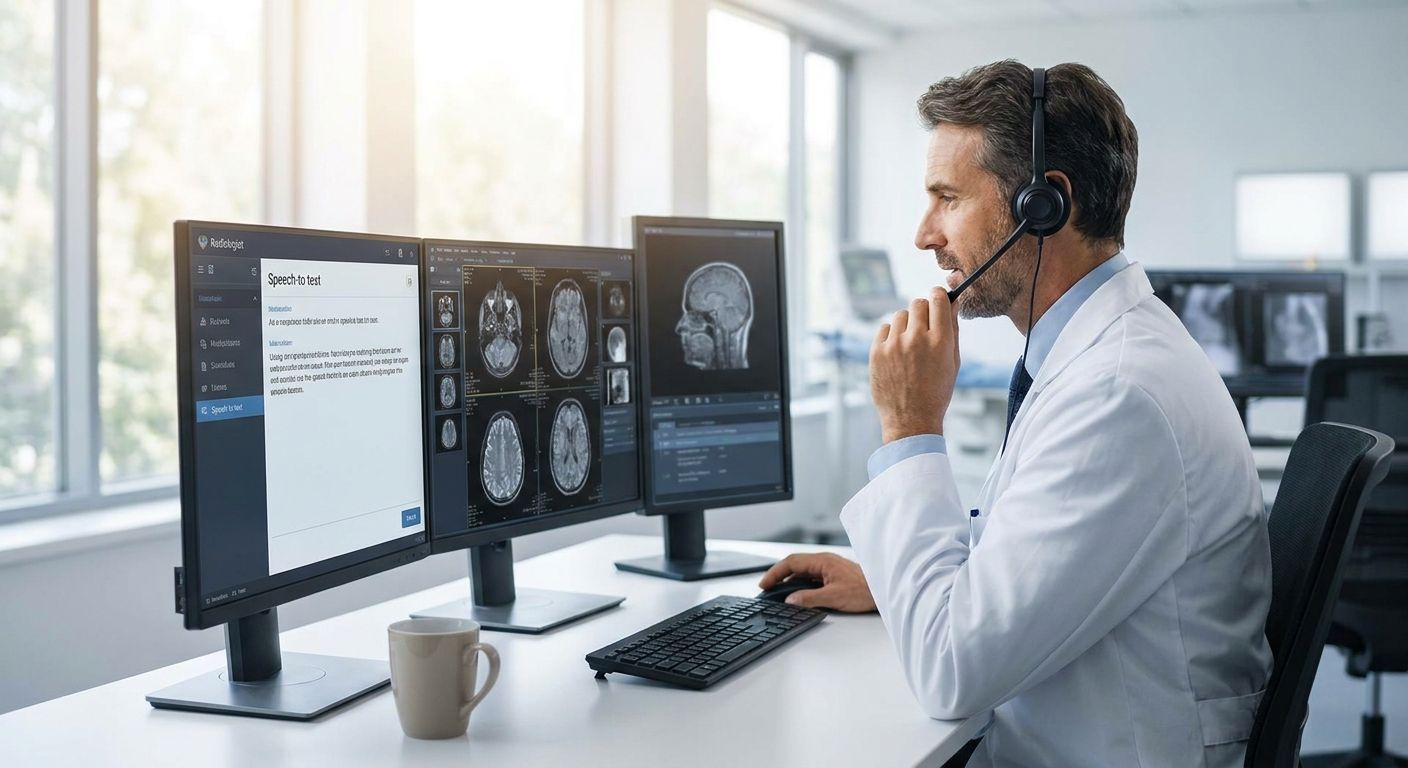
AI dictation radiology jobs are positions where radiologists use AI-assisted speech recognition and structured reporting tools to shorten the gap between image acquisition and a finalized report. The segment differs from a generic diagnostic radiology opening because turnaround time becomes a measurable, negotiated part of the job — tied to RVU thresholds, same-day read requirements, or a backlog cap written into the contract, not just a vague expectation to "read faster."
- AI dictation radiology jobs pair radiologists with AI-assisted speech recognition and structured reporting, not just faster typing.
- Turnaround-time clauses tied to RVU pay or same-day read requirements matter more than the dictation vendor's brand name.
- RadBoard aggregates 5,000+ radiology positions from 20 sources, and lets you filter by tech stack instead of scanning hospital career pages one by one.
- Documentation burden outside the dictation software often erases the time AI-assisted reporting saves — screen for it separately from dictation speed.
Why AI dictation matters for radiologists chasing turnaround
Turnaround time (TAT) is one of the few productivity metrics that shows up in both quality reviews and compensation formulas at the same time. A radiologist reading 60 studies a shift with an AI-assisted draft-report tool clears backlog differently than one dictating every finding line by line, and employers increasingly write that difference into the job posting itself — same-day read guarantees, no-backlog language, or RVU bonuses scaled to AI-assisted volume.
That means the job search itself has to change. Searching "radiology jobs" and filtering by state misses the variable that actually determines your daily workload: what dictation and reporting stack the site runs, and how the contract treats speed. RadBoard aggregates 5,000+ radiology positions from 20 sources specifically so you can filter on that variable instead of reading every posting in full.
How to find and land an AI dictation radiology job
Define what "faster turnaround round" means at each employer
Employers use "AI-assisted dictation" as a recruiting phrase without agreeing on what it delivers. Before you apply, pin down:
- Target TAT for STAT versus routine studies at that specific site
- Average report volume expected per shift with the AI tool active
- Backlog carryover policy — does unread volume roll to the next shift or the next radiologist
- Whether TAT is measured per study, per shift, or per week
- Any quality-versus-speed tradeoff metrics tied to peer review
Identify the dictation and reporting technology stack
Not all "AI dictation" is the same product doing the same job. Some tools transcribe speech; others draft a preliminary structured report you edit rather than dictate from scratch. Ask about:
- Front-end speech recognition versus AI-generated draft reports
- Structured reporting templates built into the platform
- Critical-results flagging and how it routes to referring physicians
- Macro and template customization support during onboarding
- Depth of PACS/RIS integration — does the tool pull prior reports automatically
Search hospital and vendor job boards manually first
The free, manual route still works if you have time: hospital career pages, radiology group websites, PACS-vendor partner job listings, and society classifieds through the ACR or RSNA all post AI-dictation-specific openings. It just takes hours per week to cross-reference tech stack against location and subspecialty.
The faster path is filtering by tech stack and turnaround language directly. AI-powered job matching surfaces postings that mention AI-assisted dictation, structured reporting, or same-day reads without you reading every listing word for word, and swipe-to-save lets you shortlist candidates from RadBoard's 5,000+ aggregated positions in one sitting instead of ten browser tabs.
Negotiate turnaround-time and productivity terms before signing
A fast dictation tool with no contract protection just means your employer raises expected volume to match it. Negotiate:
- Whether RVU thresholds assume AI-assisted speed or pre-AI baseline productivity
- Language guaranteeing same-day reads with no case backlog rather than an aspirational goal
- A defined backlog cap with overtime or holdover pay if TAT targets are missed
- Who is responsible for reads when the AI tool is down or under maintenance
Evaluate documentation burden separate from dictation speed
A radiologist can dictate a report in half the time and still lose the gain to EHR clicks, compliance add-ons, or copy-paste note bloat layered on top of the actual read. Screen for:
- Total click count required to close a study in the EHR, not just the PACS
- Whether structured templates auto-populate compliance language or require manual entry
- Protocol-only versus full-read responsibilities bundled into the same shift
- Coding and billing documentation requirements added after the AI draft is finalized
Verify onboarding and training time for the AI tool
Every AI dictation system needs a voice profile and macro library built for your speech pattern and subspecialty vocabulary. Ask about:
- How long voice-profile training takes before accuracy stabilizes
- Whether the site supports custom macros for your subspecialty terms
- Typical error-correction rate reported by radiologists during the first weeks
- IT support responsiveness when the tool misfires mid-shift
Comparing employer types for AI dictation work
| Setting | Best for | AI dictation maturity | Key limitation |
|---|---|---|---|
| Academic health system | Radiologists who want protected research or teaching time | High — front-end speech recognition plus structured templates | Slower to adopt newest AI drafting tools due to procurement cycles |
| Private practice group | RVU-driven radiologists wanting productivity-linked bonuses | Varies widely site to site | No standardized dictation stack across locations |
| Teleradiology company | Remote radiologists prioritizing volume and flexible shifts | Usually high — cloud-based AI-assisted reporting | Turnaround SLAs can be aggressive with low tolerance for backlog |
| Hospital-employed | Radiologists wanting stability and enterprise IT support | Moderate to high, depends on the health system's IT budget | Documentation requirements can offset dictation speed gains |
| National imaging center chain | Radiologists wanting a standardized workflow across sites | High — chain-wide platform consistency | Less room to customize macros or templates per location |
The verdict: teleradiology and national imaging chains generally deliver the most mature AI dictation stacks in 2026, but academic and hospital-employed roles trade some speed for stability and IT support — match the setting to what you actually want traded off, not to the AI label on the posting.
Filter radiology jobs by AI dictation stack
Search and swipe through 5,000+ listings from 20 sources on RadBoard.
Common mistakes radiologists make chasing AI dictation jobs
- Assuming every "AI-assisted dictation" posting runs the same stack. Moving from a residency-trained voice profile and macro library to a new employer's system, even a familiar vendor, costs real ramp-up time if templates weren't rebuilt for your subspecialty.
- Negotiating salary without asking about backlog and carryover policy. A faster dictation tool doesn't help if daily volume expectations rise to absorb the time saved.
- Ignoring documentation burden outside the dictation software. EHR clicks, compliance narrative requirements, and coding add-ons can erase gains from AI-assisted drafting entirely.
- Skipping a test of voice recognition accuracy for their own accent or subspecialty vocabulary before signing, then discovering a high correction rate in week one.
- Not asking who owns and maintains the AI tool — site, vendor, or employer — which affects update cadence and who you call when it breaks mid-shift.
FAQ
What is the best radiology job for AI-assisted dictation in 2026?
The best AI dictation radiology jobs in 2026 pair a modern front-end speech recognition or draft-reporting system with contract language that caps daily backlog, since a fast dictation tool means little if volume expectations rise to match it. Teleradiology companies and national imaging chains tend to run the most standardized stacks, but ask each employer directly rather than relying on the posting's language alone.
Is AI-assisted dictation faster than traditional voice recognition?
AI-assisted dictation, which drafts a structured preliminary report the radiologist edits, is generally faster for narrative reporting than traditional trained voice-recognition transcription alone. The actual time saved depends on template quality, subspecialty vocabulary support, and how deeply the tool integrates with PACS and RIS at that site.
How much does AI dictation reduce radiology report turnaround time?
Turnaround-time reduction from AI-assisted dictation varies by subspecialty, template complexity, and PACS/RIS integration depth at each site, so there is no single reliable industry-wide figure. Ask each employer for their own measured turnaround metrics rather than relying on a vendor's published averages.
Do AI dictation radiology jobs pay more than other radiology jobs?
AI dictation jobs are not paid a fixed premium for the technology itself; compensation is typically tied to RVU-based models where AI-assisted speed raises the volume a radiologist can attain in a shift. The pay difference comes from higher achievable RVU output, not the dictation label on the job posting.
What AI dictation software do radiology employers use most?
Front-end speech recognition and AI-assisted structured reporting platforms from established radiology IT vendors are the most common systems referenced in postings, though the exact stack varies by health system and PACS vendor relationship. Confirm the specific system during the interview rather than assuming from the job title.
How do I find AI dictation radiology jobs near me?
Filter radiology job listings for language mentioning AI-assisted reporting, structured templates, or same-day read requirements instead of searching generic radiology job titles. AI-powered job matching tools that aggregate multiple sources into one searchable list cut the manual cross-referencing time significantly.
Is teleradiology or hospital-employed better for AI dictation work?
Teleradiology companies generally run more standardized, cloud-based AI dictation stacks with aggressive turnaround SLAs, while hospital-employed roles trade some dictation speed for enterprise IT support and job stability. The right choice depends on whether you prioritize workflow consistency or institutional backing.
One last thing
The fastest way to cut your own turnaround time in 2026 usually isn't switching dictation vendors — it's switching sites that already run the same vendor stack you trained on. Speech recognition engines can be identical across two employers while their macro libraries and template depth are built entirely differently, and that difference in local customization, not the underlying AI model, is what actually changes how fast you clear a shift.