Best overall in 2026: a neuroendovascular fellowship that documents hands-on thrombectomy training and graduated operator responsibility. Best for a diagnostic radiologist: a program that explicitly accepts the applicant’s training pathway. Best for an academic career: a program with documented research time and mentorship. No named fellowship earns a defensible top ranking without current eligibility rules, case logs and fellow outcomes.
- The best interventional neuroradiology fellowship programs in 2026 document procedural responsibility, case mix and graduate outcomes.
- Prioritize eligibility first: a strong program is not an option if it does not accept your training pathway.
- Compare fellow-performed cases and operator roles, not a hospital’s total procedure count.
- RadBoard is best for radiologists comparing career opportunities after training, not for finding fellowship places.
Why this matters
Interventional neuroradiology training is a career decision and a procedural training decision. A hospital’s reputation does not tell you whether its fellows perform thrombectomies, how responsibility changes during training, or whether graduates enter the jobs you want. In 2026, ask programs for evidence you can compare before you commit to interviews.
Your eventual job search is a separate step. RadBoard aggregates 5,000+ radiology positions from 20 sources and offers search and swipe-to-save features. Its job listings can help you examine the kinds of roles employers advertise; they do not establish which fellowship provides the best training.
What makes the best interventional neuroradiology fellowship program?
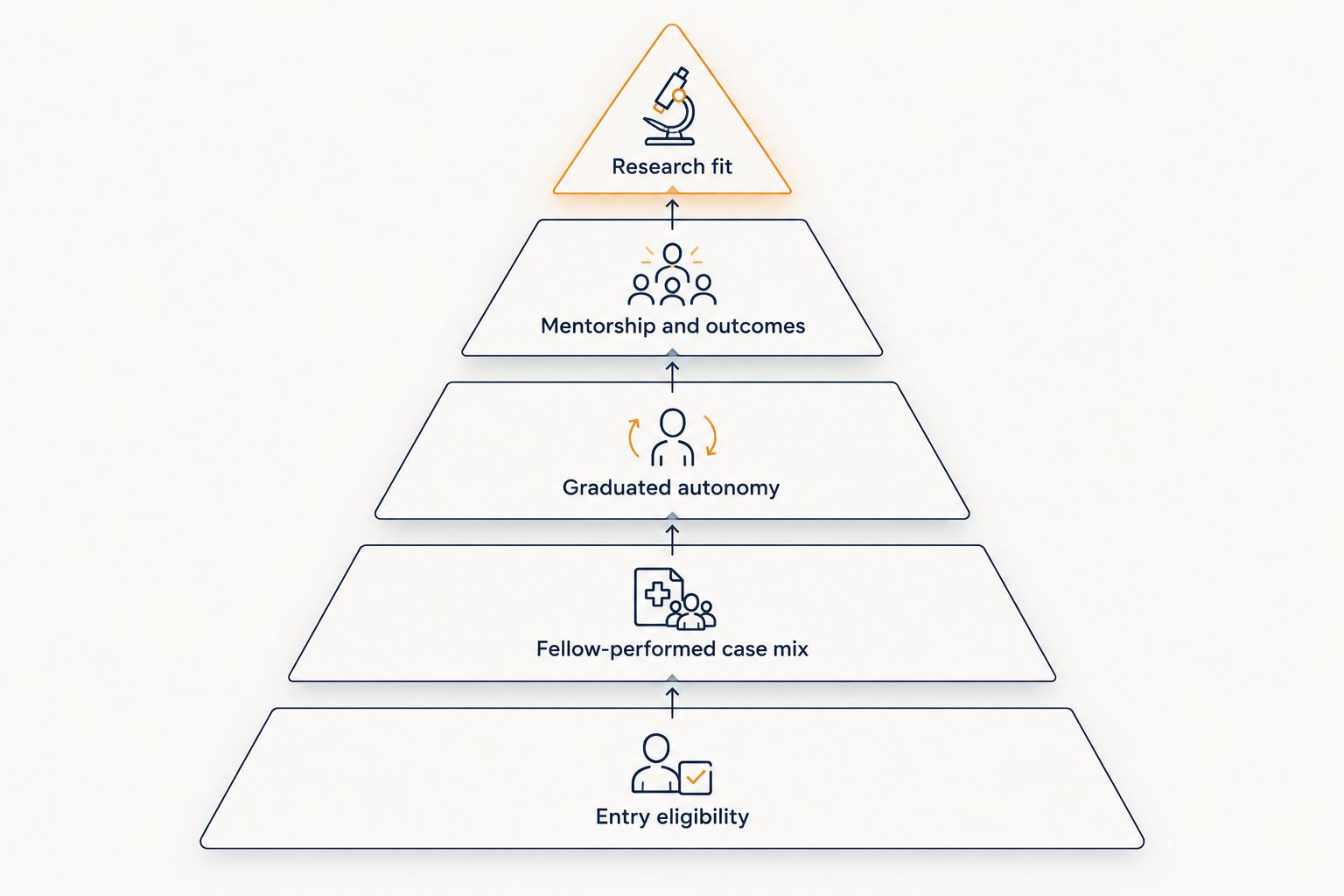
Use these criteria before treating any institution as a top pick:
- Entry eligibility: Confirm that the program accepts your completed residency, required prior fellowship training and certification status. Get the requirements for your specific pathway in writing.
- Fellow-performed case mix: Request a breakdown of cases fellows actually perform, including acute stroke work, aneurysm treatment and other neurovascular procedures relevant to your goals. A department-wide total is not a fellow case log.
- Graduated autonomy: Ask when fellows become primary operators, who supervises them and how decisions about independence are made. Observation and participation are different forms of training.
- Call and acute workflow: Establish what fellows do during a stroke alert, including imaging review, treatment decisions, procedures and follow-up. Ask who takes call alongside them.
- Mentorship and outcomes: Identify the physicians who supervise fellows and the roles recent graduates took. A program’s stated focus is less useful than a documented training path.
- Research fit: If you want an academic job, ask whether research time, project support and mentorship appear in the actual fellowship schedule.
The best program is the one that can show what its fellows do, not just what its hospital does. Apply that rule to every program on your 2026 shortlist.
The diagram separates the questions you must answer before comparing prestige or location.
Best fellowship options at a glance
These are program profiles, not a ranking of named institutions. Use them to identify the strongest fit among programs that confirm they are accepting applicants in 2026. No institution-specific procedure counts, entry rules or graduate outcomes are established here, so assigning a named program a top position would make the comparison unreliable.
| Rank | Fellowship profile | Best for | Evidence to request | Key limitation |
|---|---|---|---|---|
| 1 | High-autonomy neuroendovascular program | Applicants pursuing procedure-heavy practice | Fellow case logs and primary-operator progression | High department volume does not prove fellow autonomy |
| 2 | Explicit radiology-entry program | Diagnostic radiologists checking eligibility | Written pathway requirements and prior trainee backgrounds | Eligibility alone does not establish case quality |
| 3 | Research-integrated program | Applicants targeting academic roles | Scheduled research time and graduate roles | Research time can reduce clinical exposure |
| 4 | Broad neurovascular-care program | Applicants seeking multidisciplinary work | Fellow roles across stroke and neurovascular care | Broad exposure can leave procedural responsibility unclear |
A program can fit more than one profile. Rank it under the use case that matters most to you, then apply the same questions to every other program. A 2026 interview invitation is not evidence that its clinical experience matches your career plan.
1. High-autonomy program: best for procedure-heavy practice
A high-autonomy program gives you a documented progression from supervised participation to greater responsibility as a neuroendovascular operator. Best for: applicants who intend to perform procedures in their attending role. This is the default profile because procedural responsibility is the central question a fellowship must answer.
High-autonomy program pros:
- A fellow-specific case log makes exposure easier to assess.
- Defined operator roles let you distinguish performing a procedure from observing it.
- A stated progression gives you concrete expectations to discuss with faculty.
High-autonomy program cons:
- A busy service does not guarantee that fellows are primary operators.
- Case counts alone cannot show how much decision-making a fellow performs.
- Your desired procedures still need to appear in the fellow-level breakdown.
Ask for anonymized recent fellow logs and a description of operator roles by stage of training. Then ask fellows whether the written progression matches what happens on call. Verdict: Choose this profile first when the evidence confirms both relevant case mix and increasing responsibility; hold off if the program supplies only department totals.
2. Explicit radiology-entry program: best for diagnostic radiologists
An explicit radiology-entry program publishes or directly confirms how diagnostic radiology applicants qualify for consideration. Best for: radiologists who need to establish pathway eligibility before comparing clinical training. In 2026, do not infer eligibility from a program’s name or from the specialty backgrounds of its faculty.
Explicit radiology-entry program pros:
- Written requirements let you rule out an unsuitable pathway early.
- A clear entry route makes prerequisite planning more concrete.
- The program can explain how prior neuroradiology training fits its expectations.
Explicit radiology-entry program cons:
- Acceptance of radiology applicants says nothing about fellow-performed cases.
- Prerequisites can make an otherwise appealing program unsuitable for your timeline.
- Published general requirements might not answer questions about your individual training history.
Send the program your training history and ask for its current written eligibility criteria. If you qualify, apply the same case-log and autonomy tests used for the top profile. Verdict: Choose this profile when eligibility is confirmed and the procedural evidence holds up; skip a program that cannot establish a viable entry route for you.
3. Research-integrated program: best for an academic career
A research-integrated program gives an applicant a defined way to pursue scholarly work alongside clinical training. Best for: physicians whose target attending role includes research or teaching. A list of faculty publications does not establish that fellows receive project time or mentorship.
Research-integrated program pros:
- Scheduled research time makes the academic component assessable.
- A named mentor and defined project role clarify who supports the work.
- Graduate career paths help you test whether the program fits your goal.
Research-integrated program cons:
- Time assigned to research leaves less time for clinical work.
- Department publications do not prove fellow participation.
- A promising project does not replace adequate procedural training.
Ask to see the actual schedule, not a general statement that research is encouraged. Speak with recent fellows about how projects and clinical responsibilities competed for time. Verdict: Choose this profile when protected research fits your intended job and the fellow case log still meets your procedural needs; hold if either part is unclear.
4. Broad neurovascular-care program: best for multidisciplinary work
A broad neurovascular-care program lets you assess how procedural training connects with imaging review, acute treatment decisions and follow-up. Best for: applicants who want a role spanning the neurovascular care pathway rather than a narrowly defined procedural assignment. The useful measure is the fellow’s role in that pathway, not the number of specialties represented in a hospital.
Broad neurovascular-care program pros:
- A clear acute-care workflow shows where fellows participate in decisions.
- Defined supervision helps you understand how teams work together.
- Follow-up responsibilities can clarify the scope of the eventual attending role.
Broad neurovascular-care program cons:
- Multidisciplinary exposure can sound stronger than the fellow’s actual procedural role.
- A complex call structure can make individual responsibilities hard to assess.
- Breadth is a poor trade if it displaces the procedures you need to perform.
Ask a current fellow to walk through a recent call shift, from first imaging review through follow-up. Compare that account with the written rotation and supervision plan. Verdict: Choose this profile when the broad workflow supports, rather than substitutes for, meaningful operator experience; hold if fellow duties remain vague.
How to compare named programs in 2026
Build a shortlist of named institutions only after checking their current fellowship information. For each one, record the exact program title, its application route, accepted training backgrounds and the person who can confirm requirements. Program labels such as interventional neuroradiology and neuroendovascular training are not substitutes for those details.
Use the same interview questions at every program:
- Which procedures did recent fellows perform as primary operators, and which did they assist or observe?
- How does operator responsibility change during the fellowship?
- What does a fellow do during an acute stroke call?
- Which prior training routes are eligible for this specific program?
- Where did recent graduates work, and what procedures are part of their roles?
- If research matters to you, where does protected time appear in the schedule?
Keep answers tied to the individual program. A health system with multiple sites can have different rotations and fellow responsibilities at each one. Likewise, a faculty member’s clinical interests do not establish that a fellow rotates through those cases.
Do not rank institutions by reputation alone. In 2026, the stronger application list is the one built from confirmed eligibility, fellow-level clinical evidence and the work you want to do after graduation. If a program cannot answer a priority question, mark that answer unresolved rather than filling the gap with its hospital’s name.
Compare radiology career paths
Search 5,000+ radiology positions from 20 sources as you plan your next role.
How we ranked
The profiles are ordered by the decisions an applicant needs to make: first, whether the training develops the procedural role they want; next, whether their background qualifies; then, whether the program supports an academic or broad clinical goal. The table does not score hospitals, verify 2026 openings or claim that any institution has a particular case volume. Each verdict depends on evidence from the individual program.
This distinction matters when you compare two attractive offers. A program that confirms your eligibility but cannot show fellow-performed cases has answered only the entry question. A program with relevant cases but no clear progression has answered only the exposure question. Press for both before putting either at the top of your list.
Which interventional neuroradiology fellowship should you choose?
Choose a high-autonomy program with verified fellow-performed neuroendovascular cases as your default. If you are entering from diagnostic radiology, confirm written eligibility before weighing that clinical evidence. If your goal is academic practice, add research time and graduate roles to the comparison; do not let them replace the procedural checks.
Keep the 2026 decision tied to your intended attending work. An applicant planning a procedure-heavy role and an applicant planning a research-led role need different answers from the same interview. Neither should treat a hospital-wide case total as proof of what a fellow will do.
FAQ
What are the best interventional neuroradiology fellowship programs in 2026?
The best fit is a program that confirms your eligibility and documents fellow-performed cases, increasing operator responsibility and relevant graduate outcomes. A named institution cannot be ranked reliably from its reputation alone.
How should I compare neuroendovascular fellowship programs?
Compare written entry requirements, fellow-level case logs, operator roles, call duties and recent graduate paths. Ask the same questions at each program so department-wide figures do not distort the comparison.
Can a diagnostic radiologist apply to an interventional neuroradiology fellowship?
A diagnostic radiologist should check the entry requirements of each specific program. Ask the program to confirm how your completed training meets its current eligibility rules before evaluating its clinical fit.
Does a hospital’s procedure volume show what a fellow will do?
No. A hospital-wide procedure total does not identify which cases fellows perform, assist or observe; request fellow-specific logs and an explanation of operator roles.
What should I ask current interventional neuroradiology fellows?
Ask what they actually do during procedures and acute stroke calls, how supervision changes, and whether the schedule matches the program’s description. Ask about research time if an academic career is your goal.
Is research time more important than procedural volume?
Research time matters most when it supports the academic role you want. It does not replace evidence that fellows gain the procedural experience required for their intended clinical work.
When should I assess jobs after fellowship?
Assess potential attending roles while defining your training goals, then compare programs against those roles. RadBoard lists 5,000+ radiology positions from 20 sources for career exploration, not fellowship placement.
One last thing
Ask each program to separate cases performed, cases assisted and cases observed. That distinction is more useful than a single volume figure when you are choosing procedural training in 2026. RadBoard can help you examine radiology jobs after fellowship, but the program itself must substantiate the training it promises.