
Best overall: predictable scheduling with usable paid caregiver leave. Best for recurring appointments: reduced-FTE employment with retained benefits. Best for disrupted childcare: backup dependent care. This 2026 guide ranks benefit packages for radiologists caring for children, aging parents, or other dependents—not employers by reputation.
- Best radiology jobs for caregivers benefits: choose predictable scheduling and usable paid leave first.
- Reduced-FTE employment fits recurring caregiving only when benefit eligibility remains intact.
- Backup dependent care needs eligibility rules that match your family and working hours.
- RadBoard helps radiologists compare career opportunities; verify caregiver benefits directly with each employer.
Why this matters
A caregiver benefit has value only when you can use it during your actual working schedule. A leave policy does not solve daily pickup conflicts, and a remote reading assignment does not provide someone to supervise a dependent while you interpret studies.
RadBoard aggregates 5,000+ radiology positions from 20 sources. Use that breadth to compare roles, then narrow your shortlist around the caregiving constraint an employer must accommodate.
RadBoard is a radiology job search platform for caregivers who want to compare career opportunities across sources. Employer policies, eligibility documents, and contract terms—not the platform—determine whether a position meets your needs.
For a 2026 offer, separate three questions: when you must work, what happens when care arrangements fail, and which benefits continue when you reduce hours. Treat an unanswered question as an unresolved offer term, not as flexibility.
What makes the best radiology employer benefits for caregivers
Evaluate each package against these six criteria before comparing employers:
- Schedule certainty: Written working hours, call obligations, weekend assignments, and rules for schedule changes.
- Leave usability: Covered caregiving situations, approval requirements, intermittent use, and arrangements for clinical coverage.
- Dependent eligibility: Whether support includes children, aging parents, spouses, or other relatives relevant to your situation.
- Benefits continuity: Health coverage and other benefits at the employment fraction you intend to work.
- Workload alignment: Reading expectations, meetings, and administrative duties that match your contracted time.
- Policy authority: Documents that identify who approves requests and which terms apply to employed physicians.
Start with your nonnegotiable constraint. If you cannot cover evenings, reject an evening obligation before weighing leave or dependent-care support. Benefits should solve your actual problem rather than decorate an otherwise incompatible schedule.
Caregiver benefit packages at a glance
These rankings compare benefit designs, not verified offers from named employers. Each package earns a distinct use-case slot; none guarantees that a particular practice provides it.
| Rank | Benefit package | Best for | Standout feature to verify | Key limitation |
|---|---|---|---|---|
| 1 | Predictable schedule plus paid caregiver leave | Daily routines and occasional care emergencies | Defined hours and accessible leave | Coverage rules can restrict use |
| 2 | Reduced FTE with retained benefits | Recurring appointments and sustained care duties | Protected time away from work | Eligibility and workload must match reduced hours |
| 3 | Backup dependent care | Unexpected childcare or eldercare disruptions | Support when usual care fails | Eligible dependents and service hours vary |
| 4 | Fixed-shift remote or hybrid work | Eliminating travel between work and caregiving | Defined reading location and working hours | Remote work is not simultaneous caregiving |
| 5 | Extended leave with a documented return plan | A temporary period of intensive care | Continuity from leave through return | Pay and benefit continuation need separate confirmation |
| 6 | Shift swaps and caregiver-aware call rules | Occasional conflicts in an otherwise workable role | A defined process for changing coverage | A swap still requires qualified coverage |
1. Predictable scheduling: best caregiver benefit for daily routines
Predictable scheduling establishes when you are responsible for clinical work. Pair it with paid caregiver leave so routine commitments and unexpected interruptions have separate solutions. For a radiologist with daily caregiving duties, this is the default package to prioritize.
Ask the practice to define start times, finishing expectations, meetings, call, and weekend coverage. Then ask how leave affects reading assignments and compensation calculations. A stated finishing time is incomplete if the employer also expects you to remain until an undefined queue clears.
Predictable scheduling pros:
- Gives you a defined window for arranging dependent care.
- Separates ordinary scheduling from emergency leave requests.
- Makes recurring conflicts visible before you accept.
Predictable scheduling cons:
- A fixed schedule does not resolve a care emergency by itself.
- Leave approval and coverage requirements can limit practical use.
Best for: Caregivers whose primary need is a dependable daily routine.
For your 2026 contract review, request the schedule and leave policy together. Confirm whether meetings, tumor boards, and late consultations fall inside your working window. Also ask whether leave creates later make-up shifts.
Verdict: Buy—prioritize predictable scheduling when daily care arrangements depend on your working hours.
2. Reduced FTE: best caregiver benefit for recurring appointments
Reduced full-time-equivalent employment creates recurring time away from work. It suits ongoing appointments, rehabilitation visits, or sustained family responsibilities better than repeatedly requesting exceptions to a full-time schedule.
The benefit package matters as much as the employment fraction. Confirm your eligibility for health coverage, leave, retirement benefits, and professional support at the proposed FTE. Review going part-time without losing benefits as a radiologist before comparing reduced-hours offers.
Reduced-FTE employment pros:
- Establishes recurring nonworking time rather than ad hoc absences.
- Lets you negotiate caregiving commitments into the role itself.
- Makes workload and benefit eligibility explicit offer terms.
Reduced-FTE employment cons:
- Reduced hours do not automatically preserve every benefit.
- Meetings and administrative duties can erode protected time.
Best for: Radiologists with predictable, continuing caregiving commitments.
Ask which obligations shrink with FTE and which remain unchanged. A reduced reading schedule with unchanged call, committee work, and meetings is not the same as a proportionately reduced role. Get the return-to-full-time process documented if your care responsibilities are temporary.
Verdict: Buy—choose reduced FTE when benefits eligibility and total duties match the agreed hours.
3. Backup dependent care: best caregiver benefit for disruptions
Backup dependent care addresses failures in your usual arrangements. Evaluate childcare and eldercare separately; a program covering one does not establish coverage for the other.
Request the benefit's eligibility rules and operating details. Ask whether it supports care at home or at a facility, whether advance registration is required, and what happens when no provider accepts a request. Check whether the service covers the hours you actually work.
Backup dependent care pros:
- Provides a separate response to disruptions in usual care.
- Gives you a concrete program to evaluate before joining.
- Addresses a different need from scheduled leave.
Backup dependent care cons:
- Dependent age, relationship, or care needs can restrict eligibility.
- A benefit description does not guarantee a successful placement.
Best for: Caregivers whose regular arrangements work but occasionally fail.
In a 2026 benefits review, ask specifically about illness exclusions, overnight support, school closures, and adult care needs. These questions establish whether the program fits your circumstances; they do not imply that an employer offers those services.
Keep an alternative plan. Backup care and emergency leave should complement each other, because arranging a provider and obtaining clinical coverage are different tasks.
Verdict: Buy—prioritize backup dependent care when its written rules match your dependents and shifts.
4. Fixed-shift remote work: best caregiver benefit for avoiding travel
Remote or hybrid radiology work changes where you read. A fixed shift defines when you read. For caregivers, evaluate those terms separately: location flexibility does not establish scheduling flexibility.
Confirm required onsite days, meeting attendance, shift boundaries, and responsibilities after the reading session ends. Before treating remote work as a solution, arrange uninterrupted clinical working time and appropriate dependent care.
Fixed-shift remote work pros:
- Removes travel to the workplace during remote assignments.
- Separates work-location decisions from shift commitments.
- Lets you compare onsite and remote obligations explicitly.
Fixed-shift remote work cons:
- Active caregiving conflicts with uninterrupted clinical reading.
- Remote assignments can still include evenings, weekends, or call.
Best for: Radiologists whose main caregiving obstacle is travel rather than clinical working time.
Ask who supplies and supports the reading setup, how interruptions are handled, and whether remote status is a documented term or a discretionary arrangement. Do not assume you can relocate freely; licensure, credentialing, and employer requirements still need review.
Verdict: Buy—choose fixed-shift remote work to remove travel, not to replace dependent care during clinical duties.
5. Extended leave: best caregiver benefit for intensive temporary care
Extended leave provides time away for a sustained caregiving episode. A documented return plan addresses what happens afterward: employment status, schedule, duties, and any phased return arrangements.
Separate employer-paid leave from statutory protections. Under the U.S. Department of Labor's federal FMLA guidance, eligible employees of covered employers can receive up to 12 workweeks of unpaid, job-protected leave for qualifying reasons, including care for a spouse, child, or parent with a serious health condition.
The standard employee eligibility tests include at least 12 months of employment and 1,250 hours of service during the preceding 12 months, along with applicable worksite requirements. FMLA is not a general entitlement to leave for every caregiving situation. Confirm current federal, state, and employer rules for your circumstances in 2026.
Extended leave pros:
- Addresses care needs that exceed occasional absences.
- Makes benefit continuation a defined review point.
- Connects leave approval with a plan for returning.
Extended leave cons:
- Job protection and paid leave are different provisions.
- Eligibility depends on the applicable policy and law.
Best for: A temporary period of intensive family care.
Ask HR to explain paid leave, unpaid leave, health coverage continuation, and return conditions separately. Have qualified counsel review disputed eligibility or contract terms.
Verdict: Buy—prioritize extended leave when a sustained absence is necessary and the return terms are documented.
6. Shift swaps: best caregiver benefit for occasional conflicts
A defined shift-swap process helps resolve isolated conflicts without changing your baseline employment arrangement. Caregiver-aware call rules specify how requests are handled, who approves them, and whether replacement duties follow.
Ask how a swap works for your subspecialty and credentialed sites. A colleague's willingness to help does not establish that the practice permits the change or that the colleague can cover the assignment.
Shift-swap flexibility pros:
- Addresses occasional conflicts within an otherwise suitable schedule.
- Provides a named approval route.
- Clarifies replacement duties before a conflict occurs.
Shift-swap flexibility cons:
- Qualified coverage remains necessary.
- Reciprocal shifts can create another caregiving conflict later.
Best for: Caregivers with infrequent scheduling exceptions.
Ask whether there is a formal escalation route when no swap is possible. Compare the policy with emergency leave rules, rather than accepting informal assurances that colleagues always help.
Verdict: Buy—use documented shift swaps for occasional exceptions; skip them as the sole solution to recurring conflicts.
How to rank your own offers
Rank benefit packages by schedule certainty, leave usability, dependent eligibility, benefits continuity, workload alignment, and written policy authority. This ranking favors arrangements that address daily constraints before benefits that solve narrower situations.
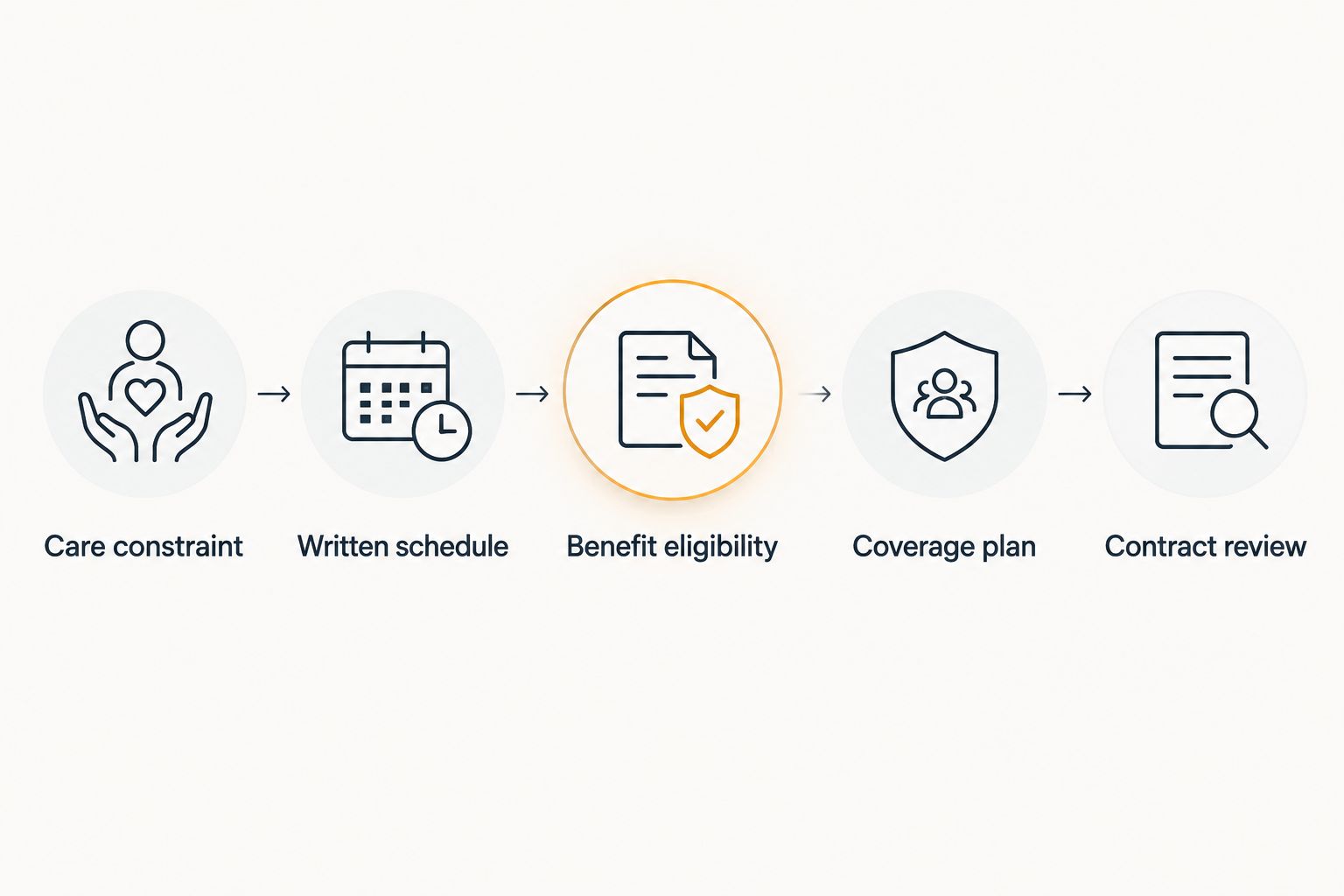
Build your shortlist in this order:
- Care constraint: Identify the caregiving commitment the role must accommodate.
- Written schedule: Compare clinical hours, call, meetings, and travel against that commitment.
- Benefit eligibility: Confirm which policies apply to your employment arrangement.
- Coverage plan: Establish how the practice handles planned leave and emergencies.
- Contract review: Resolve differences between recruiting statements and written terms.
Use the same questions for every offer. That keeps a familiar employer name or an attractive headline benefit from outweighing an incompatible schedule.
Which caregiver benefit package should you choose?
Choose predictable scheduling with usable paid caregiver leave as your default. Move reduced-FTE employment to the top when you need recurring time away; move extended leave to the top when care requires a sustained absence.
Use RadBoard to find radiology opportunities, then ask employers for evidence of the benefits that matter to you. Request the applicable physician policy, your eligibility terms, and a written explanation of clinical coverage. A recruiter summary is a starting point, not the final document.
Compare radiology career opportunities
Search opportunities aggregated from 20 sources, then verify caregiver policies with employers.
FAQ
What's the best radiology benefit for a working caregiver?
Predictable scheduling paired with usable paid caregiver leave is the default priority. It addresses daily care arrangements and unexpected absences separately; verify both in writing.
Is remote radiology work better than onsite work for caregivers?
Remote work is the better fit when travel is your main constraint and the shift matches your care arrangements. It does not replace dependent care during uninterrupted clinical reading.
Can I work part-time and keep employer benefits?
Benefit retention depends on the employer's eligibility rules for your employment fraction. Confirm health coverage, leave, retirement benefits, and professional support before accepting reduced hours.
Does backup childcare also cover an aging parent?
Backup childcare does not establish eldercare coverage. Request separate eligibility details for adult dependents, covered care needs, and service hours.
Does FMLA provide paid caregiver leave?
Federal FMLA provides unpaid, job-protected leave for eligible employees of covered employers with qualifying circumstances. Employer-paid leave and state programs require separate review.
What should I ask about caregiver leave during a radiology interview?
Ask which caregiving situations qualify, who approves leave, and how clinical coverage works. Then confirm whether leave affects compensation calculations, benefits, or later make-up duties.
How should I use RadBoard to find caregiver-compatible radiology jobs?
Use RadBoard to compare radiology career opportunities across sources and save roles for further review. Verify schedules, dependent-care benefits, and leave eligibility directly with each employer before accepting.
One last thing
Ask what happens to your duties when you take leave—not just whether leave exists. Confirm whether call, reading expectations, meetings, and administrative work are reassigned, reduced, or deferred. A deferred obligation can turn time away into a return-to-work burden.
For every 2026 offer you seriously consider, request the coverage plan alongside the benefit policy. That is the difference between a listed benefit and an arrangement you can actually use.