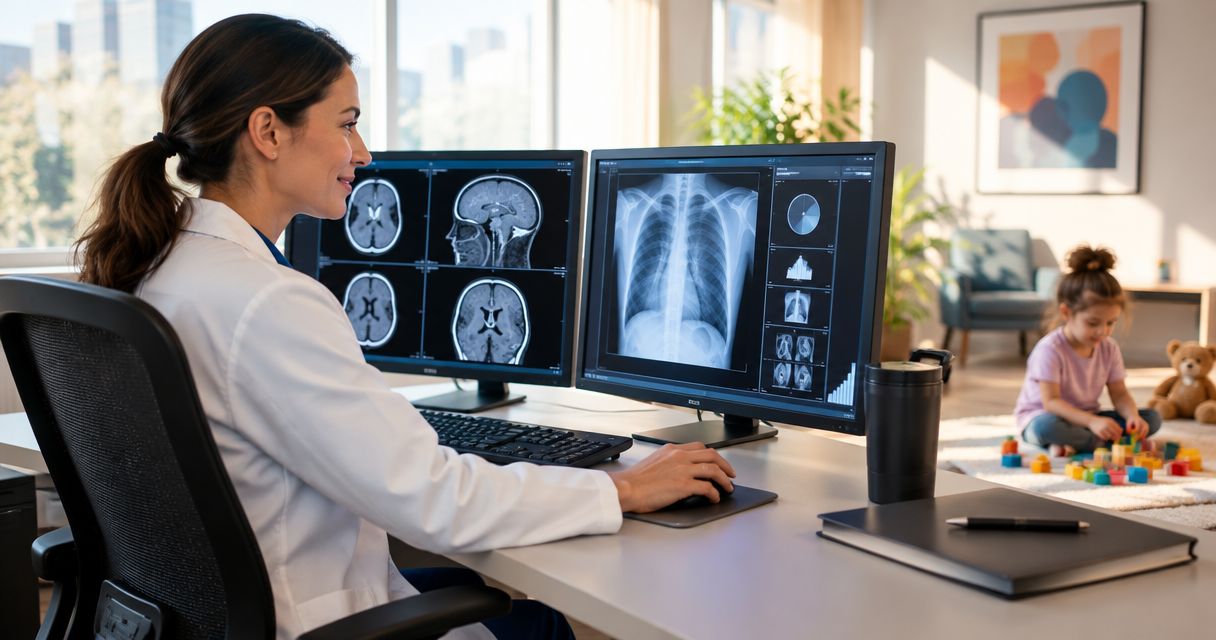
Radiology jobs with real childcare support — on-site daycare, backup care networks, or subsidized care — cluster inside large hospital systems and academic medical centers in 2026, not solo private practice. This guide ranks the employer categories most likely to offer it, plus where the benefit disappears entirely once you sign.
- The best radiology jobs with childcare benefits sit inside hospital-employed positions at large health systems, not private practice groups.
- Academic medical center radiology jobs pair backup care networks with structured parental leave, often through university HR.
- Teleradiology and remote radiology jobs replace on-site daycare with full schedule control instead.
- Locum tenens and PRN radiology jobs carry the least reliable family benefits — check the offer letter, not the job title.
Why this matters
Childcare is rarely a line item in a radiology job posting. It shows up buried in a benefits summary, or not at all, which is why most physicians only learn an employer offers backup care after they've already signed. Radiology's schedule shape — early call coverage, weekend blocks, on-call trauma reads — makes a childcare gap more disruptive than it would be in a typical 9-to-5 role, and a working parent without backup care loses income every time a nanny cancels or a daycare closes for a snow day.
The parental leave and family benefits landscape across radiology employers varies enormously by employer type in 2026, and childcare access tracks closely with employer size: the bigger the HR department, the more likely a backup care vendor is already under contract. RadBoard aggregates radiology jobs from 20 sources, which makes it easier to spot which employer type you're actually looking at before you dig into the benefits page.
What makes the best radiology jobs with childcare benefits
- Backup care network membership — the employer already contracts with a national backup care vendor, not a stipend you have to source yourself.
- On-site or near-site facility — a daycare physically located at or near the primary work site, not a directory of local providers.
- Extended parental leave with a phased return — paid leave that includes a ramp-up schedule instead of a hard return-to-full-call date.
- FTE flexibility — part-time or reduced-call options that cut the number of days full-day care is even needed.
- HR infrastructure size — an employer large enough to fund benefits beyond salary and malpractice coverage.
- Written into the contract — the offer letter states the benefit by name instead of a verbal promise from a recruiter.
Radiology jobs with childcare benefits: at a glance
| Employer Type | Best For | Standout Feature | Key Limitation |
|---|---|---|---|
| Hospital-employed radiology jobs | Full-time attendings wanting on-site or backup care | Backup care access bundled into system-wide HR benefits | Less schedule autonomy; RVU and call targets set by the system |
| Academic medical center radiology jobs | Physicians wanting structured leave plus a teaching track | University HR benefits often include subsidized backup care | Base compensation typically trails private practice |
| Multi-specialty group practice jobs | Physicians who want to negotiate a custom package | Partners can negotiate individualized family benefits | Childcare support isn't standardized across the group |
| Teleradiology and remote radiology jobs | Parents who want schedule control instead of a facility | Self-scheduling removes commute and fixed shift blocks | No on-site or backup childcare facility access at all |
| Locum tenens and PRN radiology jobs | Short assignments without long-term benefit dependence | Daily rate flexibility lets you choose weeks around care gaps | No employer-sponsored childcare benefit exists |
1. Hospital-employed radiology jobs: best for full-time attendings wanting on-site or backup care
Hospital-employed radiology jobs put you on the payroll of a health system large enough to run its own HR department, and that scale is exactly what makes backup childcare possible. A system covering thousands of employees can negotiate a contract with a national backup care vendor in a way a ten-radiologist private group cannot. You trade some autonomy over your schedule and RVU targets for access to the same family benefits offered to every other employed physician at the system, and in 2026 this is the category where a backup care benefit most often appears as a named line item rather than a verbal promise from a recruiter.
Hospital-employed radiology jobs pros:
- Backup care access typically extends to sick-child and school-break coverage, not just full-time daycare
- Benefits are standardized across the system, so the offer letter reflects what's actually available
- Larger systems tend to pair childcare access with more predictable call schedules
- Malpractice and CME benefits are bundled in alongside family benefits
Hospital-employed radiology jobs cons:
- RVU and call targets are set centrally, with limited room to negotiate
- Backup care usage caps (days per year) are common and rarely advertised upfront
- Compensation growth is slower than partnership-track private practice
Hospital-employed radiology jobs verdict: Buy — the strongest default for the childcare-benefit search in 2026.

2. Academic medical center radiology jobs: best for structured parental leave and backup care
Academic medical centers layer a university HR system on top of a hospital, which usually means a longer list of family benefits than a standalone community hospital carries. Parental leave at these institutions tends to include a phased return schedule — reduced call volume for the first weeks back — rather than a single hard return date. Teaching and research obligations add a second axis of schedule flexibility that a pure clinical role doesn't offer.
Academic medical center radiology jobs pros:
- University HR benefits often include subsidized backup care through the broader institution
- Phased return-to-work policies are more common than in private practice
- Sabbatical and extended leave options exist at some institutions alongside parental leave
Academic medical center radiology jobs cons:
- Base salary typically trails private practice and PE-backed group compensation
- Research and teaching time commitments can offset the schedule flexibility on paper
- Not every academic department funds backup care at the same level
Academic medical center radiology jobs verdict: Buy — best pick when family benefits and an academic track matter equally.
3. Multi-specialty group practice radiology jobs: best for negotiating custom family benefits
Multi-specialty groups sit between hospital employment and solo private practice: large enough to offer real benefits, small enough that individual partners can push for terms a hospital system won't customize. Childcare support here isn't standardized — one group might offer a stipend, another nothing — so the benefit depends entirely on what you negotiate before signing, not what's advertised in the posting.
Multi-specialty group practice jobs pros:
- Partnership track can include negotiated family benefits unavailable to employed physicians
- Smaller group size means faster decision-making on custom requests
- Compensation upside through partnership often outpaces hospital employment long-term
Multi-specialty group practice jobs cons:
- Childcare support isn't standardized; one group's package tells you nothing about the next
- Verbal promises from a recruiter don't always make it into the contract
- Group size may be too small to have negotiated a backup care vendor contract at all
Multi-specialty group practice jobs verdict: Hold — worth pursuing only if you get the family benefit in writing.
4. Teleradiology and remote radiology jobs: best for schedule control instead of on-site care
Teleradiology jobs solve the childcare problem differently: instead of providing a facility, they remove the commute and the fixed shift block that make childcare logistics hard in the first place. A radiologist reading from a home workstation on a self-scheduled shift doesn't need drop-off and pickup coverage the same way an on-site attending does. This is a substitute for childcare benefits in 2026, not a version of them.
Teleradiology and remote radiology jobs pros:
- Self-scheduling lets you build shifts around school hours and childcare availability
- No commute time reclaims time that would otherwise go to drive time
- Home workstation stipends are sometimes negotiable, which offsets setup costs
Teleradiology and remote radiology jobs cons:
- No on-site or backup childcare facility access exists in this category
- Full attention during a read still requires uninterrupted coverage at home
- Coordinating sick-day coverage is harder without a physical team nearby
Teleradiology and remote radiology jobs verdict: Hold — strong if flexibility matters more than an actual childcare facility.
5. Locum tenens and PRN radiology jobs: best for short-term flexibility without benefit dependence
Locum tenens and PRN radiology work trade nearly all standard benefits, including childcare, for a higher daily rate and full control over which weeks you work. That control can substitute for childcare planning — you pick assignments around school breaks — but there's no employer-sponsored backup care to fall back on when a gap opens mid-contract.
Locum tenens and PRN radiology jobs pros:
- Full control over which weeks and assignments you accept
- Daily rate flexibility can fund private childcare arrangements directly
- No long-term commitment if a family situation changes
Locum tenens and PRN radiology jobs cons:
- No employer-sponsored childcare benefit exists in this category
- Income stops the moment you stop taking assignments
- Credentialing overhead at each new site adds administrative time
Locum tenens and PRN radiology jobs verdict: Skip — for childcare benefits specifically; fine for other priorities.
How we ranked
Every category above is scored against the same six criteria: backup care network membership, on-site or near-site facility access, extended parental leave with a phased return, FTE flexibility, HR infrastructure size, and whether the benefit is written into the contract. Employer size correlates directly with the first three criteria — a health system employing thousands of workers has already negotiated backup care contracts that a five-physician group never will.
“If backup childcare matters more than salary, hospital employment beats private practice every time in 2026.”
Which radiology job type should you choose?
Default to hospital-employed radiology jobs at large health systems if childcare access is a top priority — the benefit shows up as a named line item more consistently than anywhere else on this list in 2026. Choose an academic medical center if you want the same backup care infrastructure plus a teaching or research track. Pick teleradiology if you'd rather control your own schedule than rely on a facility, and treat multi-specialty group practice and locum tenens work as negotiation-dependent — read the contract before you assume the benefit exists.
Filter radiology jobs by employer type
Search 5,000+ radiology openings on RadBoard and swipe to save the ones with family benefits listed.
FAQ
What's the best radiology job for on-site childcare in 2026?
Hospital-employed radiology jobs at large health systems offer the most consistent access to on-site or backup childcare in 2026, because system-wide HR departments have already contracted with backup care vendors. Academic medical centers rank a close second, often through the university's broader family benefits program.
Do hospital-employed radiologists get backup childcare benefits?
Many do, though the benefit is usually tied to the health system's overall employee benefits package rather than something specific to radiology. Confirm the details in the offer letter — usage caps and eligible dependent ages vary by system.
Are academic radiology jobs better than private practice for family benefits?
Academic medical centers generally offer more structured parental leave and backup care access than standalone private practice, because they inherit university HR infrastructure. Private practice groups can still offer competitive benefits, but they vary group to group instead of following a standard policy.
Does teleradiology help with childcare, or does it just avoid the issue?
Teleradiology jobs don't provide childcare benefits directly; they remove the commute and fixed shift structure that make childcare logistics hard. Self-scheduling gives parents more control over when they work, which functions as a substitute rather than an actual benefit.
How do I find radiology jobs that list childcare benefits?
Read the full benefits summary in the posting, not just the job title, since childcare access is rarely called out in headlines. RadBoard's AI-powered search lets you filter listings and swipe to save the ones worth a closer read before you apply.
Do locum tenens radiology jobs include family benefits?
No — locum tenens and PRN radiology work generally exclude employer-sponsored childcare and most other standard benefits in exchange for a higher daily rate and schedule control. Physicians in this category typically fund childcare directly rather than relying on an employer program.
Is on-site childcare common in radiology practice overall?
On-site childcare facilities are still uncommon across radiology employers as a whole in 2026; backup care network membership through a contracted vendor is far more common than a physical on-site daycare. Large health systems and academic medical centers are the employer types most likely to offer either.
One last thing
Childcare access almost never appears in the job title or the first paragraph of a posting — it's buried three pages into a benefits PDF, if it's written down at all. Before you sign, ask HR directly which backup care vendor is under contract and how many days per year it covers; a verbal "yes, we have that" from a recruiter is not the same as a named vendor and a usage cap in writing. Cross-reference whatever you're told against the actual offer letter, the same way you'd check any other family benefit, before treating it as real rather than a talking point.