
Best overall starting point: hospital-employed radiology jobs. Best for a teaching career: academic medical centers. Best for evaluating partnership alongside retirement benefits: independent private-practice groups. No named employer can be called the best radiology employer for 401(k) matching without its current plan terms. Use RadBoard to find radiology openings, then request the retirement plan details before you compare offers.
- The best radiology employers for 401k matching in 2026 cannot be verified from job titles or employer names alone.
- Start with hospital-employed roles, then compare academic, private-practice, outpatient and employed teleradiology offers.
- Ask for the match formula, eligible pay, eligibility date and vesting schedule in writing.
- RadBoard helps radiologists search 5,000+ positions from 20 sources; confirm benefits with each employer.
Why this matters
A retirement benefit can change the value of a radiology offer, but the word match does not tell you how much an employer contributes. A plan can base contributions on a defined portion of pay, delay participation or require service before employer contributions vest. You need the plan documents and the proposed employment terms to know what the benefit means for you.
The distinction matters most when you compare different practice models. An academic appointment, a hospital-employed role and a private-practice offer can use different retirement arrangements. A contractor assignment requires a different comparison from an employed position. In 2026, compare the written benefit attached to the specific job—not the reputation of the organization offering it.
RadBoard is a radiology job search platform, not a radiology employer. Its search covers 5,000+ positions from 20 sources; those figures describe the search catalog, not the number of jobs with a verified 401(k) match.
What makes the best radiology employer for 401(k) matching?
Use these criteria before ranking any 2026 offer. Request the summary plan description and ask the benefits administrator to explain any provision that affects your proposed role.
- Match formula: How does the employer calculate its contribution, and what must you contribute to receive it?
- Eligible pay: Does the calculation include only base salary, or does the plan define other compensation as eligible? Check the document rather than assuming a bonus counts.
- Eligibility date: When can you participate, and when do employer contributions begin?
- Vesting schedule: When do employer contributions become yours if you leave the job?
- Employment status: Are you joining as an employee, a partner or an independent contractor? Do not treat those arrangements as interchangeable.
- Plan document: Is the benefit a 401(k), a different employer-sponsored retirement plan or another form of contribution? Compare the actual plan, not shorthand in a job ad.
A verbal description is useful for screening, but it is not a substitute for written terms. If you receive several offers, put the answers in the same comparison sheet alongside compensation, call obligations and partnership terms. The question is not which employer has the most attractive-sounding benefit. It is which offer gives you the strongest documented retirement contribution under terms you can meet.
Search radiology openings
Explore 5,000+ positions from 20 sources, then confirm retirement benefits with employers.
Radiology employer types at a glance
These are search priorities, not verified rankings of matching rates. No employer-specific match formula, vesting schedule or plan document is available here. Every row requires confirmation for the individual position.
| Search priority | Best for | What to check first | Key limitation |
|---|---|---|---|
| Hospital-employed radiology | Comparing a defined employed role | Plan type and match formula | The hospital name does not establish your plan terms |
| Academic medical center | Radiologists seeking teaching or research duties | Whether the offered plan is a 401(k) or another retirement plan | Faculty and clinical appointments require role-specific review |
| Independent private-practice group | Radiologists considering a partnership path | Employee benefits versus future ownership terms | A partnership prospect is not a guaranteed retirement contribution |
| Outpatient imaging center | Radiologists seeking outpatient work | Eligibility and definition of eligible pay | Site type alone says nothing about matching |
| Employed teleradiology company | Radiologists prioritizing remote work | Employee classification and plan eligibility | Remote and contractor roles cannot be assumed to share benefits |
1. Hospital-employed radiology: best overall starting point
A hospital-employed position gives you a direct question to put to the employer: what retirement plan applies to this appointment? Start here if you want to compare an employed radiology offer against other employed roles. Best for: radiologists who want a clear starting point for a written benefits comparison.
Do not assume that every radiologist working at a hospital receives the hospital's employee benefits. The hiring entity and your employment classification matter. Ask who employs you, which plan covers that position and whether any proposed pay components count toward the contribution formula.
Hospital-employed radiology pros:
- An identified employing organization gives you a specific benefits administrator to contact.
- A written employment offer can be reviewed beside the plan documents.
- The format supports a direct comparison with another employed offer.
Hospital-employed radiology cons:
- A hospital-affiliated job can have a different hiring entity from the hospital itself.
- A posted role does not verify a match formula, eligibility date or vesting schedule.
Verdict: Hold. Put hospital-employed roles first on your research list, but do not rank a hospital's match until you have the terms for the actual position. RadBoard radiology job search can help you identify openings; the employer must confirm the benefit.
2. Academic medical center: best for teaching or research careers
Academic radiology roles belong on the list when teaching, research or an academic appointment is part of your job decision. Compare the retirement arrangement offered with the exact appointment. Best for: radiologists who want to weigh academic duties and documented retirement benefits together.
The first question is whether the advertised benefit is actually a 401(k). Some employment offers use another type of retirement plan, so calling every employer contribution a 401(k) match can make your comparison inaccurate. Ask for the applicable plan name and contribution rules before you place an academic offer beside a hospital or private-practice offer.
Academic medical center pros:
- The offer lets you evaluate retirement terms alongside the academic duties you want.
- A plan document gives you a basis for comparing employer contributions.
- You can ask how the proposed appointment affects eligibility.
Academic medical center cons:
- The relevant retirement plan is not established by the employer's academic status.
- Comparing unlike plan types takes more than reading a match percentage.
Verdict: Hold. Choose the academic role for its work and its verified total offer, not for an assumed 401(k) match. In 2026, request the plan that applies to your appointment.
3. Independent private-practice group: best for partnership comparisons
An independent radiology group is a distinct option if your decision includes a potential ownership path. Separate the retirement benefit available while employed from any future partnership arrangement. Best for: radiologists comparing current employee benefits with proposed partnership terms.
Ask whether the group offers an employer contribution to the position you are being hired into. Then ask what changes if your status changes. A future opportunity to become a partner is not the same thing as a current, documented match. Treat each as its own line in the offer comparison.
Independent private-practice group pros:
- You can examine current retirement benefits alongside a proposed career path.
- Separate questions for employee and partner status expose assumptions in an offer.
- Written terms make competing group offers easier to compare.
Independent private-practice group cons:
- Partnership language does not establish what you receive as a new hire.
- A change in status can make an employee-benefit comparison incomplete.
Verdict: Hold. Do not assign value to an unconfirmed match or an unwritten partnership outcome. For the other terms that affect this decision, compare the retirement documents with the employment agreement and private-practice radiology job interview questions.
4. Outpatient imaging center: best for an outpatient-focused search
An outpatient imaging center belongs on your list when outpatient work is a priority. Its setting describes the job, not its retirement plan. Best for: radiologists comparing outpatient duties and the benefits of a specific employed offer.
Ask who employs the radiologist at the site and which plan that employee can join. Then check when employer contributions begin and which compensation counts. These questions prevent you from treating two outpatient positions as equivalent simply because the clinical setting looks similar.
Outpatient imaging center pros:
- It keeps your preferred practice setting in the comparison.
- The employing entity and plan can be checked for each opening.
- You can assess the benefit alongside the proposed duties and schedule.
Outpatient imaging center cons:
- An outpatient job description does not confirm a 401(k) match.
- Similar clinical settings can involve different employment arrangements.
Verdict: Hold. Shortlist outpatient roles that fit your clinical goals, then compare only documented retirement terms. The outpatient label is not evidence of a stronger match in 2026.
5. Employed teleradiology company: best for remote-work comparisons
Teleradiology is a useful search lane if remote work is central to your decision. For this ranking, focus on employed offers and verify that the proposed position qualifies for the stated retirement plan. Best for: radiologists comparing remote employment with other employed radiology roles.
Do not mix a contractor opportunity into a table of employer 401(k) matches as though the benefits were equivalent. Confirm classification first. After that, request the match formula, eligibility date, eligible-pay definition and vesting terms for the employed role.
Employed teleradiology company pros:
- You can assess remote work and employer benefits in the same offer.
- Confirmed employee status creates a clearer basis for comparing plan documents.
- Written eligibility terms show whether the advertised benefit applies to you.
Employed teleradiology company cons:
- A remote listing does not establish employee status.
- An employed offer does not, by itself, confirm a 401(k) match.
Verdict: Hold. Advance a teleradiology role only when its work arrangement fits and the employer confirms its benefit terms. For a broader employment comparison, see the W-2 versus 1099 radiology job offer guide.
How to compare two offers in 2026
Use the same sequence for every finalist. The comparison starts with employment status because an employer-match question does not mean the same thing for an employee and an independent contractor. The diagram keeps the checks in that order: identify the plan, then inspect the provisions that determine what you receive.
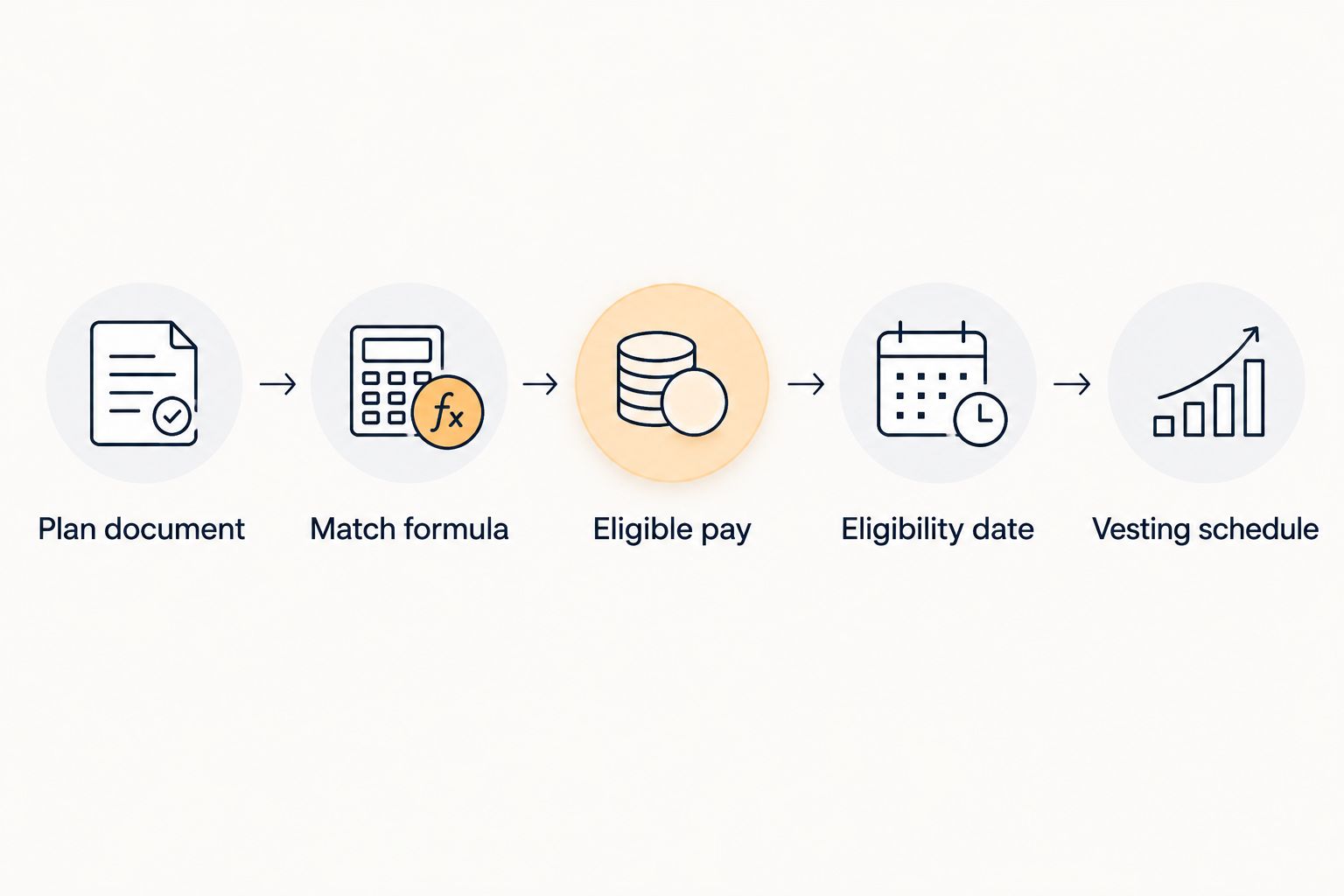
- Confirm your status. Identify the legal employer and whether the offered job makes you an employee, partner or contractor.
- Get the plan document. Record the plan type instead of assuming that every retirement contribution is a 401(k) match.
- Write down the formula. Note exactly what you must contribute and how the employer calculates its contribution.
- Check eligible pay and timing. Determine which compensation the formula uses and when participation and employer contributions start.
- Check vesting. Record when employer contributions become yours under the plan's rules.
Use those answers to compare offers side by side. If one employer cannot provide a relevant document or clarify how it applies to your position, leave its retirement-benefit value unverified. Do not fill the gap with the terms of another role at the same organization.
How we ranked these search priorities
The order favors a straightforward comparison of employed radiology offers, then adds paths where academic duties, partnership, outpatient practice or remote work affect the decision. It does not claim that hospitals contribute more than academic centers, private groups, imaging centers or teleradiology companies. No employer-level contribution figures were supplied for a defensible 2026 ranking.
That limitation changes the right next move: search by the kind of radiology work you want, collect the applicable plan documents from employers you are considering and rank offers, not employer categories. If total compensation is close, the written retirement terms can help break the tie; if they are missing, keep the comparison open.
Which radiology employer should you choose?
Start with hospital-employed openings if you have no preferred practice model, but choose no employer on 401(k) matching until you verify its plan. Choose an academic search if teaching or research is essential; investigate independent groups if partnership is part of your decision. Outpatient and employed teleradiology roles deserve the same document-based review when their work arrangements fit.
RadBoard radiology job search helps you build that shortlist across 5,000+ positions from 20 sources. Its search and swipe-to-save features organize opportunities; they do not establish an employer's retirement contribution. In 2026, the best match is the one attached to a job you want and confirmed in writing.
FAQ
What are the best radiology employers for 401k matching in 2026?
No named radiology employer can be ranked for its 2026 401(k) match without current plan terms for the specific job. Start with roles that fit your practice goals, then compare written match formulas, eligibility and vesting.
Does a hospital-employed radiology job include a 401(k) match?
A hospital-employed job title does not confirm a 401(k) match. Ask the hiring entity which retirement plan covers the offered position and request its contribution terms.
Do academic radiology jobs offer a 401(k)?
The academic label does not identify the retirement plan attached to a particular offer. Ask for the plan name and documents applicable to your appointment before comparing contributions.
Is private-practice partnership better than a 401(k) match?
Neither is automatically better for a particular radiologist. Compare the documented employee benefit with the separate written partnership terms rather than treating a potential future role as a current contribution.
Do teleradiology jobs offer employer retirement matching?
A teleradiology job's remote setting does not establish its retirement benefits. Confirm whether the position is employed or contracted, then request the applicable plan terms.
What should I ask about a radiology employer's 401(k) match?
Ask for the match formula, eligible-pay definition, eligibility date and vesting schedule. Request the plan document that applies to the specific position you have been offered.
Can RadBoard verify an employer's 401(k) match?
RadBoard is a radiology job search platform, not the source of an employer's plan terms. Use it to find openings, then ask each employer to confirm benefits in writing.
One last thing
A larger-sounding match can be less useful to you if you cannot qualify for it when you expect or if you leave before employer contributions vest. Ask for eligibility and vesting at the same time as the formula. That single request makes your 2026 offer comparison more useful than a list of employer names.