
Best default: a hospital-employed role with written pay and call terms. Best for avoiding call: a daytime outpatient role with explicit coverage exclusions. Best for ownership: an independent group with a documented partnership path. This 2026 guide ranks Midwest radiology employer models by those priorities—not by an employer name or an advertised compensation headline.
- For best radiology employers midwest pay and call searches, compare written compensation terms against actual coverage obligations.
- RadBoard aggregates 5,000+ radiology positions from 20 sources for physicians comparing career opportunities.
- Choose outpatient radiology for a no-call search; verify exclusions before accepting.
- Choose independent groups for ownership goals; require written partnership and call-allocation terms.
Why this matters
A Midwest radiology offer needs to answer two questions together: what work earns your compensation, and when are you responsible for coverage? A salary headline answers neither. Weekend shifts, backup obligations, productivity thresholds, and post-call duties belong in the same comparison.
RadBoard aggregates 5,000+ radiology positions from 20 sources and includes search and swipe-to-save features. Use that breadth to build a shortlist, then evaluate the actual employer, practice site, and contract behind each opportunity.
For your 2026 search, separate the location where you read from the hospitals you cover. A position advertised in one Midwest city can involve a broader service footprint. Ask for the complete coverage list rather than treating the recruiting location as the job description.
What makes the best Midwest radiology employer?
The strongest offer is the one you can evaluate without filling gaps with assumptions. Apply these criteria before comparing employer models:
- Compensation certainty: Identify guaranteed compensation, its duration, and the conditions that change it. Separate guaranteed earnings from contingent incentives.
- Call definition: Require explicit treatment of nights, weekends, holidays, backup coverage, and emergency procedures. Scheduled evening work and unscheduled call are different obligations.
- Workload transparency: Request case mix, productivity expectations, turnaround requirements, and non-reading duties. Study counts alone do not describe workload.
- Coverage support: Establish who handles overflow, simultaneous emergencies, technical failures, and absences. Get escalation responsibilities in writing.
- Schedule control: Confirm shift assignment, swaps, leave approval, and recovery after overnight coverage. A nominal day off is not useful if coverage responsibilities continue.
- Long-term terms: Examine partnership eligibility, compensation changes, termination provisions, and malpractice responsibilities with qualified advisers.
Reject comparisons that pair guaranteed compensation at one employer with hypothetical maximum earnings at another. Use the same employment fraction, schedule assumptions, and compensation period throughout your shortlist.
Midwest radiology employer models at a glance
These rankings identify the best starting point for each career priority. They do not assign unverified pay or call advantages to named institutions.
| Rank and employer model | Best for | Standout feature to seek | Key limitation |
|---|---|---|---|
| 1. Hospital-employed practice | A directly specified employment package | Written compensation and coverage obligations in one agreement | Hospital employment does not establish low call |
| 2. Daytime outpatient practice | Excluding nights and weekend call | Explicit outpatient-only duties and coverage exclusions | No-call wording does not establish a manageable daytime workload |
| 3. Independent radiology group | Pursuing ownership | Documented partnership eligibility and distribution rules | Future ownership is not guaranteed by a recruiting label |
| 4. Academic radiology department | Combining clinical work with teaching or research | Defined clinical effort and protected nonclinical time | Teaching and research duties must be included in workload comparisons |
| 5. Shift-based teleradiology employer | Working defined reading blocks | Clear shift boundaries and queue handoff rules | Remote work does not mean flexible or daytime work |
1. Hospital-employed practice: best for a defined employment package
Hospital-employed radiology puts the employment relationship with the hospital or health system. For your 2026 Midwest shortlist, prioritize roles that describe compensation, clinical duties, and call assignment together. Verify that the entity recruiting you is also the entity employing you.
Hospital-employed practice pros:
- You can request a single written description of employment and coverage responsibilities.
- A defined role gives you a clear basis for comparing clinical duties with compensation.
- Department leadership provides an identifiable contact for schedule and staffing questions.
Hospital-employed practice cons:
- The employment model does not prove that nights, weekends, or backup call are limited.
- Duties across several facilities require separate scrutiny of travel and coverage expectations.
- A compensation guarantee needs an explicit duration and explanation of what follows it.
Best for: Radiologists who want a specified employee role rather than an ownership arrangement.
Ask the department to explain how an ordinary schedule changes during vacancies and leave. Then ask whether those additional duties are mandatory, separately compensated, or absorbed into the existing agreement. Do not substitute the current staffing plan for a contractual coverage limit.
Verdict: Hold until the compensation period, covered sites, and call obligations are documented. Hospital employment is the default starting point for a clearly defined package, not an automatic winner on pay or workload.
2. Daytime outpatient practice: best for excluding call
A daytime outpatient role is the most direct search category when your priority is avoiding overnight and weekend coverage. The useful feature is not the outpatient label; it is a written exclusion of unwanted duties. Confirm whether the position includes hospital reads, procedures, contrast coverage, or remote overflow.
Daytime outpatient practice pros:
- You can make daytime work and call exclusions explicit acceptance conditions.
- A defined outpatient case mix supports a focused workload discussion.
- Written closing and handoff rules establish when your reading responsibilities end.
Daytime outpatient practice cons:
- No call does not establish low volume, predictable finishing times, or protected breaks.
- Required procedures and on-site safety responsibilities add work beyond interpretation.
- A group can describe a role as outpatient while separately requiring hospital coverage.
Best for: Radiologists whose first priority is excluding nights, weekends, and unscheduled call.
For a 2026 offer, ask whether unfinished studies remain your responsibility after the scheduled shift. Also establish who handles urgent findings and patient-related questions after you leave. Those details distinguish a genuine schedule boundary from a daytime start time.
Verdict: Buy into the outpatient model only when the contract excludes the coverage you do not want. Skip offers that rely on verbal assurances about a no-call schedule.
3. Independent radiology group: best for pursuing ownership
An independent group is the relevant employer model when your objective includes practice ownership. Evaluate the employment period and the ownership arrangement separately. A partnership-track description is a reason to request documents, not a substitute for them.
Independent radiology group pros:
- You can assess a stated ownership path alongside the initial employment offer.
- Governance documents provide a basis for understanding partner responsibilities.
- Written distribution and call-allocation rules make the proposed arrangement examinable.
Independent radiology group cons:
- Partnership eligibility does not guarantee admission or a particular future income.
- Employee and partner call obligations need separate comparison.
- Ownership evaluation adds financial, governance, and legal questions to the job decision.
Best for: Radiologists who want ownership and are prepared to examine the practice beyond the initial salary offer.
Request the admission criteria, decision authority, financial obligations, and consequences of leaving before partnership. Ask how the group assigns undesirable shifts to employees and partners. Do not compare an employee guarantee with projected partner distributions as though both were assured compensation.
Verdict: Hold until the ownership path and both stages of call responsibility are written. Choose an independent group for a documented ownership objective, not for an unsupported assumption that private practice pays more.
4. Academic radiology department: best for teaching or research
Academic radiology belongs on your shortlist when teaching, research, or scholarly work is part of the career you want. Compare the entire job, including conferences, supervision, administrative duties, and clinical reading. Protected time needs a defined purpose and schedule.
Academic radiology department pros:
- You can evaluate clinical and nonclinical responsibilities within the same appointment.
- A stated teaching or research role lets you assess alignment with your career goals.
- Defined clinical effort provides a basis for questioning productivity expectations.
Academic radiology department cons:
- Nonclinical responsibilities create workload that study counts do not capture.
- A subspecialty appointment does not establish subspecialty-only call.
- Protected time requires clarification of how staffing gaps affect it.
Best for: Radiologists who want teaching or research included in their employed role.
For a 2026 appointment, request a sample schedule showing clinical sessions, conferences, teaching, and call. Ask which activities count toward productivity and which do not. Compare compensation against total required work rather than reading-room hours alone.
Verdict: Buy into the academic model when the appointment explicitly supports your nonclinical goals. Skip it as a default pay-and-call choice if you do not want the additional responsibilities.
5. Shift-based teleradiology employer: best for defined reading blocks
Shift-based teleradiology organizes work around scheduled remote reading periods. Evaluate the shift itself: start and finish times, queue ownership, case mix, and escalation requirements. The location of your workstation does not determine the burden of the job.
Shift-based teleradiology employer pros:
- Defined reading blocks give you a specific schedule to evaluate.
- Written handoff rules establish responsibility at the shift boundary.
- A stated case mix supports a focused discussion of clinical scope.
Shift-based teleradiology employer cons:
- Remote work does not establish self-scheduling, daytime hours, or low intensity.
- Overnight and weekend shifts remain scheduled work even when described as no call.
- Queue completion requirements can affect when your responsibilities actually end.
Best for: Radiologists who prefer specified reading blocks and accept the proposed shift timing.
If you live in the Midwest, confirm whether the employer defines shifts in your local time zone. Ask how daylight saving changes, cross-site coverage, and late-arriving studies are handled. Establish technical downtime and backup obligations before treating the schedule as fixed.
Verdict: Hold until shift boundaries, required coverage, and handoff responsibilities are explicit. Choose remote work for the actual schedule, not for the word remote.
How to compare pay against call burden
Use the same worksheet for every 2026 offer. Keep compensation terms beside workload terms so an attractive headline cannot obscure additional duties.
Guaranteed pay
Record the guarantee period, employment fraction, and conditions that reduce or replace the guarantee. Separate base compensation from productivity incentives and discretionary payments. Ask whether extra coverage changes your compensation or only your workload.
Scheduled work
List clinical hours, evening shifts, weekends, holidays, procedures, meetings, and required administrative work. Ask for 12 months of actual schedule history for the role or comparable physicians. That is a document request, not an assumed workload benchmark.
Call exposure
Record call frequency, duration, modality coverage, activation expectations, and backup duties. Distinguish time spent available from time spent actively interpreting or performing procedures. Keep both visible rather than folding them into an unsupported hourly-pay estimate.
Recovery rules
Ask what happens after an overnight assignment or an unexpectedly busy call period. Record whether the next scheduled session changes and who approves that change. Written recovery rules are more useful than a general promise of flexibility.
Exit terms
Review termination notice, repayment obligations, restrictive provisions, and malpractice responsibilities with qualified legal and financial advisers. A job comparison is incomplete without the obligations that survive your departure.
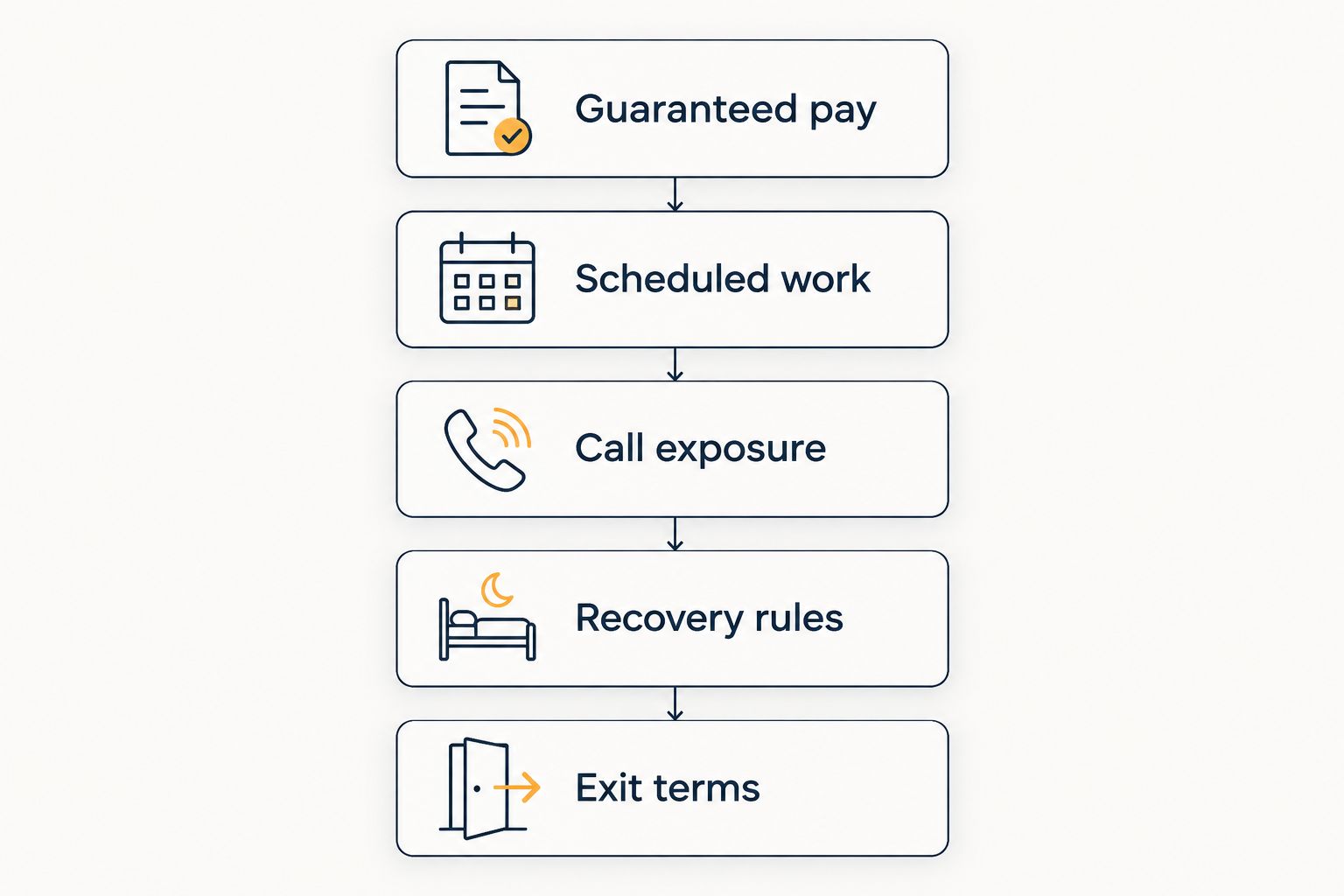
How these employer models are ranked
The ranking uses compensation clarity, call definition, workload transparency, coverage support, schedule control, and long-term terms. Each employer model has a distinct use case. The order is a decision path, not a claim that one model pays more than another.
An actual Midwest employer moves to the top of your shortlist when its written offer meets your priorities. Institutional reputation does not establish the terms of your specific appointment.
Which Midwest radiology employer should you choose?
Start with a hospital-employed role if you want a defined employment package. Choose daytime outpatient work if excluding call is non-negotiable. Choose an independent group if ownership is the objective, an academic department if teaching or research belongs in your job, and shift-based teleradiology if you want specified remote reading blocks.
RadBoard is a radiology job search platform for physicians comparing opportunities across 20 sources. Save relevant positions, then apply the same pay-and-call worksheet to each offer. A broad search finds alternatives; written terms determine which alternative fits.
FAQ
What's the best Midwest radiology employer for pay and low call?
Choose the employer whose written offer meets your compensation requirements and explicitly limits unwanted coverage. Hospital, outpatient, independent-group, academic, and remote labels do not establish a particular salary or call burden.
Which radiology employer model should I search for if I want no call?
Start with daytime outpatient roles and require explicit exclusions for nights, weekends, holidays, and backup coverage. Confirm whether hospital reads, procedures, or after-hours patient responsibilities remain part of the job.
Is a hospital-employed radiology job better than private practice?
Choose hospital employment for a defined employee role and independent private practice for a documented ownership objective. Compare the actual compensation and call terms rather than assuming either model pays more or requires less coverage.
Does no call mean no overnight radiology work?
No-call wording does not establish that a position excludes scheduled overnight shifts. Ask the employer to distinguish scheduled work, unscheduled call, and backup obligations in the agreement.
How much do the best Midwest radiology employers pay?
Evaluate each employer's current written compensation offer rather than assigning a salary to an employer category. Separate guaranteed compensation from contingent incentives and compare equivalent employment fractions and coverage duties.
What should I ask about a radiology partnership track?
Request written admission criteria, decision authority, financial obligations, distribution rules, and employee-versus-partner call allocation. Partnership-track wording alone does not guarantee ownership or future earnings.
Can RadBoard help me compare Midwest radiology jobs?
RadBoard aggregates 5,000+ radiology positions from 20 sources and provides search and swipe-to-save features. Use the platform to build a shortlist, then verify compensation, covered sites, and call obligations directly with each employer.
One last thing
Ask who owns the final unfinished study at the end of your shift. That question exposes whether the advertised schedule is a true responsibility boundary or simply the time new work stops arriving. Resolve it before accepting a 2026 offer.