
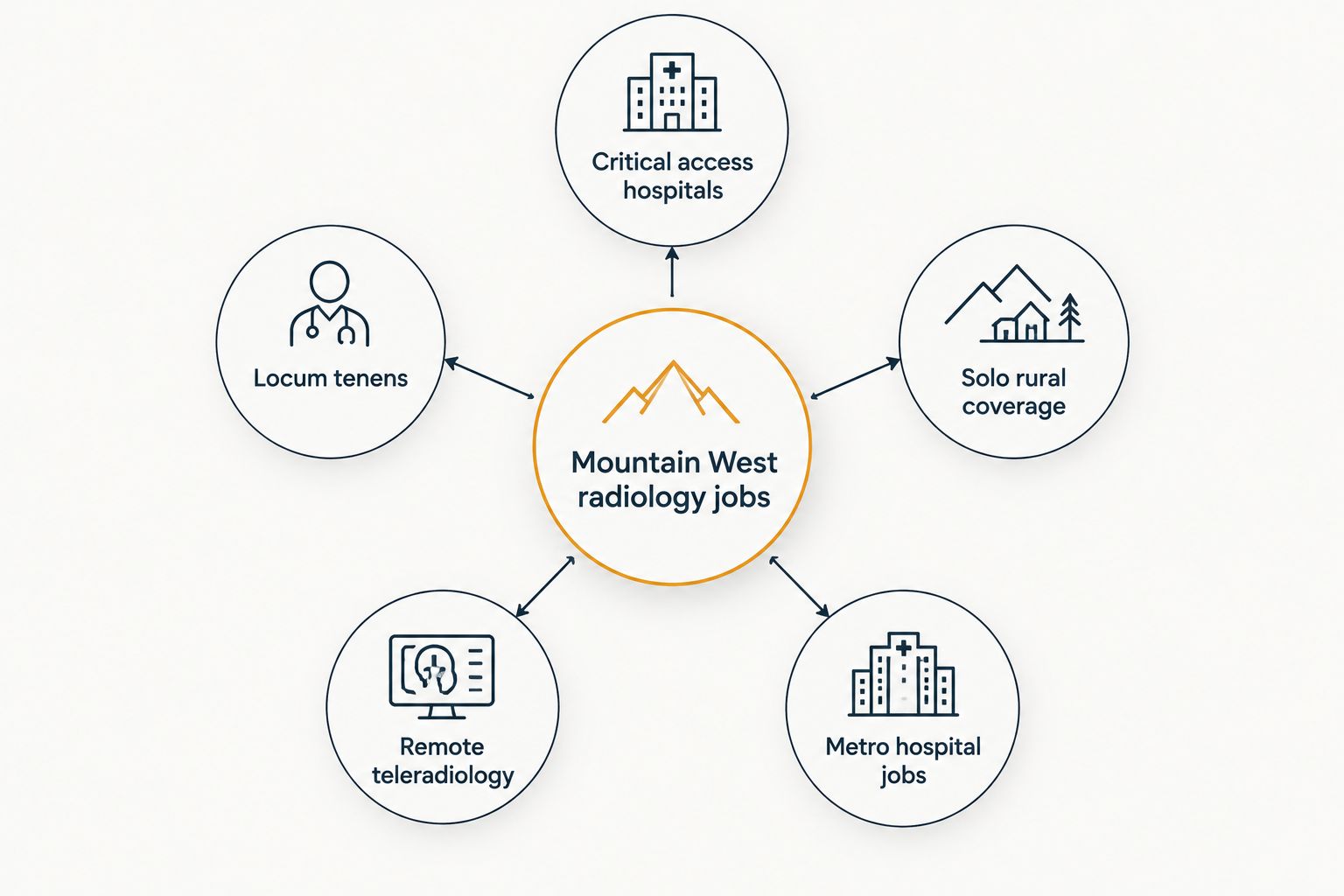
Best overall for pay: critical-access and rural hospital radiology jobs in Wyoming, Montana, and rural Idaho, where chronic radiologist shortages push salary and sign-on incentives above metro-area norms. Best for flexibility: Mountain West locum tenens assignments. Best for staying in the region without a hospital commitment: remote teleradiology jobs based anywhere across the eight-state Mountain West.
- Rural and critical-access hospital jobs pay the most across Wyoming, Montana, and rural Idaho in 2026.
- Locum tenens assignments in Mountain West shortage states carry the highest day-rate premiums.
- Remote teleradiology lets radiologists live in Boise, Bozeman, or Flagstaff while reading nationally.
- Metro hospital jobs in Denver, Salt Lake City, and Phoenix trade top pay for subspecialty coverage and stability.
- RadBoard tracks 5,000+ radiology jobs from 20 sources, including Mountain West openings.
Why this matters
The Mountain West's radiologist shortage isn't evenly distributed. Wyoming and Montana post fewer raw openings than Colorado or Arizona, but the radiology job search platform shows those smaller markets carrying disproportionately strong pay incentives, because so few radiologists live within driving distance of the hospitals that need coverage.
Compensation in this region isn't just about which state you pick. It's about which job type inside that state you take. A rural critical-access job in Cody, Wyoming and a Denver metro hospital job both show up as "Colorado radiology jobs" in a broad search, but they pay, staff, and schedule nothing alike. Sorting by job type, not just by city, is what actually predicts pay and call burden here in 2026.
What makes the best Mountain West radiology job
- Shortage-driven pay potential — how much a facility has to offer to fill the seat, not just a published base salary
- Call burden — solo coverage versus shared call versus no call at all
- Openings volume — how many active listings exist in that job type right now
- Licensing friction — single-state versus multi-state credentialing requirements
- Subspecialty fit — whether the role uses your fellowship training or reverts to general reads
- Relocation and lifestyle trade-off — small-town Wyoming versus Denver or Salt Lake City
Mountain West radiology jobs at a glance
| Job type | Best for | Standout feature | Key limitation |
|---|---|---|---|
| Critical-access & rural hospital jobs | Maximizing pay | Shortage-driven salary premiums and sign-on incentives | Solo or near-solo call coverage |
| Locum tenens assignments | Flexibility and testing the region | Day-rate premiums in shortage states | No long-term benefits or partnership track |
| Solo-coverage rural facility jobs | Full autonomy | Running the department without oversight | No peer backup for complex cases |
| Remote teleradiology jobs | Mountain West lifestyle without hospital ties | Read from anywhere in the region | Multi-state licensing overhead |
| Metro hospital-employed jobs | Stability and subspecialty coverage | Established benefits and CME support | Compensation trails rural premiums |
The five categories above cover distinct decisions, not competing versions of the same job.
1. Critical-access and rural hospital jobs: best Mountain West radiology job for pay
Critical-access hospital radiology jobs in Wyoming, Montana, and rural Idaho sit at the top of the pay ladder in this region. Chronic shortages force these facilities to compete on salary, sign-on bonuses, and loan repayment instead of location or lifestyle. Many of these postings also broaden what you actually read, since one radiologist frequently covers general, MSK, and body imaging at a single small hospital.
Critical-access and rural hospital jobs pros:
- Salary and sign-on incentives run above Mountain West metro averages
- Loan forgiveness is more common at nonprofit and critical-access facilities
- Broader scope of practice builds a generalist skill set fast
Critical-access and rural hospital jobs cons:
- Solo or near-solo call is standard, not the exception
- Subspecialty backup is thin or nonexistent
- Relocating to a town of a few thousand people is a real lifestyle trade-off
Best for: radiologists who prioritize compensation over city amenities. Apply now if pay is your primary driver in 2026.
2. Locum tenens assignments: best Mountain West radiology job for flexibility
Locum tenens pay by state tends to run higher in Mountain West shortage states than in less rural markets, because facilities pay a premium to fill short-term gaps fast. These assignments let you sample multiple hospitals and towns before deciding whether to relocate permanently, and most agencies handle travel and part of the credentialing process.
Locum tenens pros:
- Day-rate structure carries a premium in Wyoming, Montana, and rural Idaho
- Short contracts let you test a facility before committing long-term
- Licensing and travel support is typically included in the agreement
Locum tenens cons:
- No long-term benefits or partnership track
- Credentialing timelines vary widely by state
- Income between assignments is inconsistent
Best for: radiologists who want to test the Mountain West before relocating for good. Consider this route if you're not ready to sign a permanent contract in 2026.
3. Solo-coverage rural facility jobs: best Mountain West radiology job for autonomy
Solo-coverage rural facility jobs hand you the imaging department outright. There's no group to defer to on protocols, scheduling, or equipment decisions, which makes this the fastest route to real leadership experience in radiology. Idaho and Montana carry more of these single-radiologist setups than most other US regions, simply because there aren't enough radiologists to staff two per facility.
Solo-coverage pros:
- Full control over protocols, scheduling, and department priorities
- Builds leadership experience faster than a group practice would
Solo-coverage cons:
- No peer backup for complex or subspecialty cases
- Call responsibility falls on one physician, every time
- Burnout risk climbs without shared coverage
Best for: experienced generalists who want full control and can tolerate professional isolation. Consider this only if you've already worked without a peer safety net before.
4. Remote teleradiology jobs: best Mountain West radiology job for lifestyle without hospital ties
Remote teleradiology jobs let you live in Boise, Bozeman, or Flagstaff while reading studies for facilities anywhere in the country. Scheduling flexibility here generally beats onsite roles, since shifts are often self-selected rather than assigned by a department chief.
Teleradiology pros:
- Live anywhere in the Mountain West without tying your address to one employer
- Schedule flexibility is typically higher than onsite hospital roles
- No relocation required to access shortage-market pay
Teleradiology cons:
- Multi-state licensing adds real administrative overhead
- Home workstation setup and connectivity requirements fall on you
- Volume-based pay can fluctuate month to month
Best for: radiologists who want Mountain West living without being tied to a single hospital's call schedule. Consider this if licensing paperwork doesn't scare you off.
5. Metro hospital-employed jobs: best Mountain West radiology job for stability
Metro hospital-employed jobs in Denver, Salt Lake City, Phoenix, and Boise offer narrower, more predictable reading assignments because full subspecialty coverage is already staffed. Benefits packages and CME support are typically more established here than at smaller rural sites.
Metro hospital jobs pros:
- Full subspecialty coverage means fewer general reads outside your training
- Established benefits and CME support are the norm
- Competition for talent keeps recruiting and onboarding processes more standardized
Metro hospital jobs cons:
- Compensation trails the shortage premium paid at rural and critical-access sites
- Openings draw more applicants, since urban Mountain West cities pull talent from a wider radius
Best for: radiologists prioritizing stability and city amenities over maximum pay. Skip this if pay is your only driver in 2026; apply now if lifestyle stability matters more.
“Rural and critical-access postings in Wyoming and Montana routinely out-pay Denver and Salt Lake City metro openings, because the shortage is worse where fewer radiologists want to live.”
That gap is the single biggest driver behind this ranking, and it's worth checking current listings before assuming any one state is uniformly better than another.
Search Mountain West openings now
AI-powered search across 5,000+ radiology jobs from 20 sources, updated for 2026.
How we ranked
This ranking weighs shortage-driven pay potential first, since that's what separates a Wyoming critical-access job from a Denver metro job with the same title on paper. Call burden, current openings volume, licensing friction, and subspecialty fit follow in that order. None of these five categories is uniformly "best" — the right answer depends on whether 2026 is a pay year, a lifestyle year, or a testing year for you.
Which Mountain West radiology job should you choose?
If you're undecided, start with critical-access and rural hospital postings. They carry the strongest pay premiums in the region's tightest markets in 2026, and many include loan repayment or relocation support that offsets the location trade-off. If autonomy matters more than the paycheck, solo-coverage rural roles hand you the department outright. If you're not ready to relocate a family yet, locum tenens or remote teleradiology jobs let you test Mountain West markets first.
FAQ
What's the best radiology job in the Mountain West for pay in 2026?
Critical-access and rural hospital radiology jobs in Wyoming, Montana, and rural Idaho pay the most in 2026 because of persistent radiologist shortages in those markets. Locum tenens assignments in the same states come close through day-rate premiums, without the long-term commitment.
Is teleradiology better than an onsite hospital job in the Mountain West?
Teleradiology lets you live anywhere in the Mountain West while reading for facilities nationwide, which beats an onsite job on lifestyle flexibility. Onsite critical-access and metro hospital jobs still win on raw pay potential and benefits, depending on the facility.
How much do locum tenens radiologists make in Mountain West states?
Locum tenens day rates in Mountain West shortage states like Wyoming and Montana tend to run above the day-rate baseline seen in less rural markets, though the exact rate depends on subspecialty and facility. Compare individual contracts rather than a single published average.
Which Mountain West states have the most radiology job openings?
Colorado and Arizona post more raw openings than Wyoming or Montana because their populations and hospital systems are larger. Smaller states carry fewer total listings but often pay a stronger premium per opening due to the shortage.
Do rural Mountain West radiology jobs offer loan forgiveness?
Loan repayment and forgiveness programs are more common at nonprofit and critical-access hospitals in rural Mountain West markets than at private metro practices. Confirm the program terms directly with the facility before counting on it as part of total compensation.
Is Denver or Salt Lake City a strong market for radiology jobs in 2026?
Denver and Salt Lake City both offer steady radiology job volume in 2026 with full subspecialty coverage and established benefits, but pay trails what rural and critical-access facilities offer in the same region. Choose metro markets for stability, not maximum salary.
What licensing do I need for locum tenens work across Mountain West states?
Locum tenens work across multiple Mountain West states requires an active license in each state you read for, since radiology licensing isn't reciprocal between Wyoming, Montana, Colorado, Utah, Idaho, Nevada, Arizona, and New Mexico. Most locum agencies help manage the credentialing timeline, but budget several weeks per new state.
One last thing
Idaho and Montana carry some of the lowest radiologist-to-population ratios in the country, which is why solo and near-solo coverage roles show up more often there than in almost any other US region. If a listing doesn't specify backup coverage, assume there isn't any and ask directly before you sign anything in 2026.