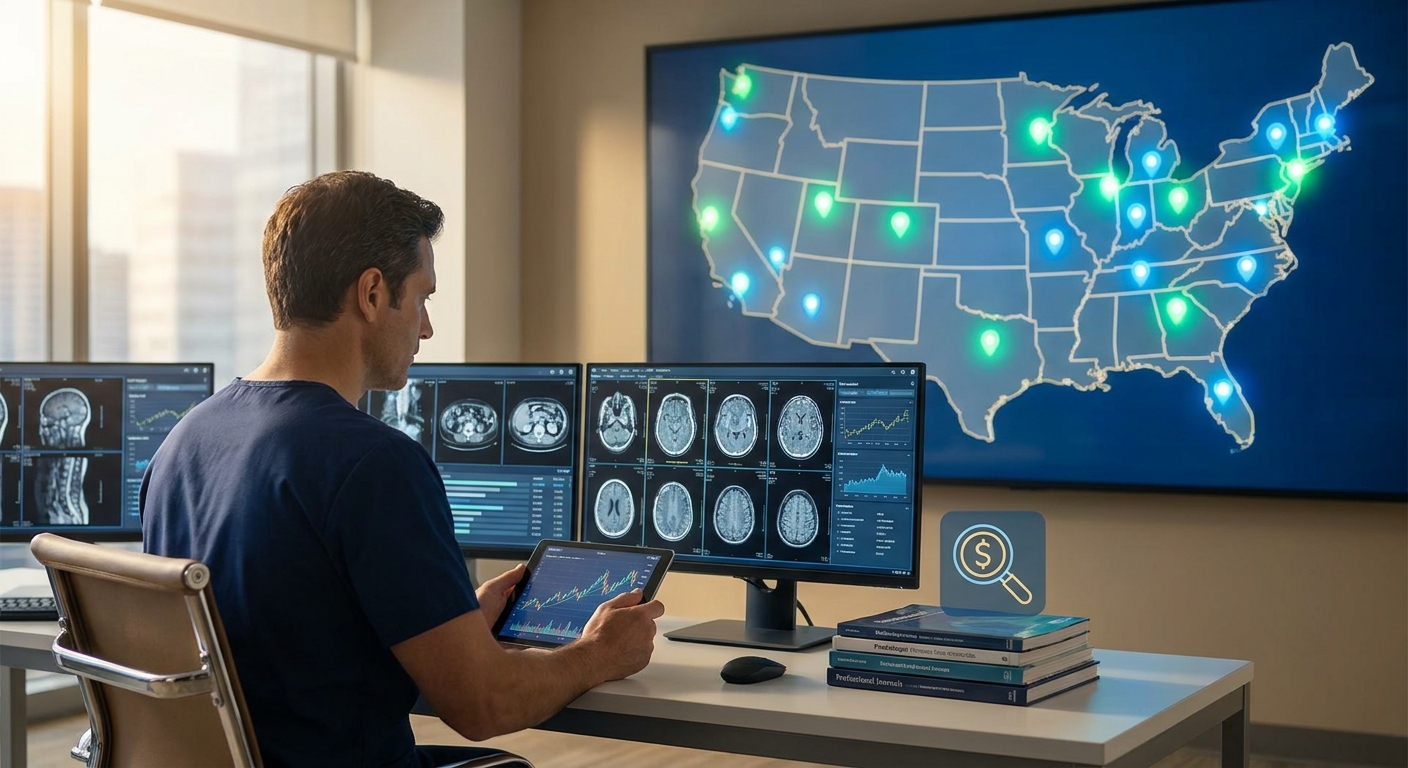
Salary alone does not tell you where a radiology job is actually worth taking in 2026 — state income tax, subspecialty demand, and rural shortage incentives move the real number by tens of thousands of dollars a year.
- Texas and Florida top the list of best states for radiologist jobs in 2026 because they combine zero state income tax with high posting volume.
- Wyoming and Alaska pay a rural premium through locum tenens and federal openings but offer few permanent slots.
- California carries the country's highest top income tax bracket at 13.3%, which erodes its high base salaries. Verdict: Hold.
- Tennessee and Washington round out the no-income-tax tier with growing metro health systems. Verdict: Buy.
Why this matters
A radiologist comparing a $420,000 offer in Sacramento against a similar offer in Nashville is not comparing equal paychecks. California's top marginal state income tax rate sits at 13.3%, the highest in the country, while Tennessee collects zero. That gap alone can be worth more than a signing bonus.
Geography also drives what kind of radiology job is even available. Rural states post fewer permanent openings but pay a premium for coverage gaps, while dense metro states have deeper subspecialist pools and more competition for the same seat. Before comparing salary lines, it helps to know how to negotiate a higher radiologist salary offer so a strong state ranking doesn't get undercut by a weak contract ask.
RadBoard aggregates 5,000+ radiology positions from 20 sources, and cross-referencing where those postings concentrate is the fastest way to spot which states are actually hiring in 2026 versus which ones just have reputation.
How these states are ranked
The ranking below weighs four factors that consistently move take-home pay and job availability for radiologists in 2026: state income tax burden, volume and mix of active postings, subspecialty and setting diversity (academic, private practice, outpatient, teleradiology), and rural or federal demand that pushes compensation above metro benchmarks. States that combine no income tax with high posting volume rank highest. States with strong nominal salaries but heavy tax drag or thin job pipelines rank lower, even when headline pay looks attractive.
The ranked list
Texas — the volume leader
Texas has zero state income tax and some of the fastest-growing metro health systems in the country, with Houston, Dallas, and Austin all expanding outpatient imaging capacity through 2026. The state supports every practice setting radiologists look for: academic centers, private practice partnership tracks, and high-volume outpatient groups.
The combination of no tax drag and consistent posting volume across radboard.io makes Texas the easiest state to land a competitive offer without waiting on a single hospital system. Verdict: Buy.
Florida — the retiree-driven volume play
Florida pairs zero state income tax with a population skew that keeps diagnostic imaging demand high year-round, especially in cardiac and musculoskeletal reads tied to an aging patient base. Coastal metro markets like Tampa and Orlando post consistently across both hospital-employed and private groups in 2026.
The tradeoff is a more saturated coastal job market than a decade ago, so radiologists targeting Florida should expect more competition for the top-paying outpatient slots. Verdict: Buy.
Tennessee — the no-tax dark horse
Tennessee has no state income tax and a Nashville healthcare corridor that has expanded well beyond hospital systems into imaging-heavy specialty groups. Certificate-of-need restrictions in Tennessee are lighter than in neighboring states, which keeps outpatient imaging center openings flowing.
That lighter regulatory load means more independent and private-equity-backed imaging groups posting jobs in 2026 than in tightly regulated states nearby. Verdict: Buy.
Washington — the tech-adjacent premium
Washington has no state income tax, and its healthcare systems around Seattle and Tacoma have kept pace with population growth by expanding both academic and community imaging departments. Salaries here run higher on paper than in Texas or Tennessee, partly to offset a cost of living that has climbed steadily through 2026.
Radiologists who want the tax advantage without the Seattle housing market can look at remote radiology jobs to capture Washington-adjacent pay without relocating into the metro core. Verdict: Hold.
Wyoming — the rural premium, thin pipeline
Wyoming's low population means few permanent radiologist positions open in any given year, but the ones that do open pay a rural premium and often route through locum tenens radiology jobs to cover coverage gaps between permanent hires. Facilities here regularly compete against telehealth-based coverage for the same shifts.
Wyoming works well as a supplemental income state or a bridge assignment, not as a primary job search target for someone who needs steady, immediate openings. Verdict: Consider.
Alaska — the federal and remote hybrid
Alaska combines rural shortage pay with a heavy concentration of federal and Indian Health Service imaging roles, which often come with loan repayment and benefits packages that don't show up in a base salary comparison. Access to Alaska's interior facilities is limited enough that many roles lean on remote reads backed by an on-site technologist.
Radiologists drawn to federal benefits should also check radiology jobs at VA hospitals nationally, since VA systems in Alaska and the Pacific Northwest post similar federal-benefit structures. Verdict: Consider.
California — high pay, high drag
California posts some of the highest nominal radiologist salaries in the country, driven by dense academic medical centers and a competitive private practice market in Southern California. But the state's 13.3% top marginal income tax bracket, the highest in the U.S. in 2026, cuts materially into that headline number, and certificate-of-need rules in several counties slow new outpatient imaging center openings.
California still makes sense for radiologists prioritizing academic prestige or subspecialty fellowship placement over raw take-home pay. Verdict: Hold.
New York — dense supply, dense competition
New York carries a high state income tax and one of the deepest pools of fellowship-trained subspecialists in the country, which means metro openings in Manhattan and Brooklyn draw heavy competition even at strong salary levels. Upstate and rural New York facilities post more openings relative to applicant volume, but pay less than the metro core.
Radiologists early in their career without a strong subspecialty niche will find New York's metro market harder to break into than Texas or Tennessee in 2026. Verdict: Skip for early career; Hold for established subspecialists.
See which states are hiring now
Search 5,000+ radiology jobs from 20 sources with AI-powered filters by state and subspecialty.
Comparison table
| State | Income Tax | Job Volume in 2026 | Best Fit | Verdict |
|---|---|---|---|---|
| Texas | None | High | Any setting, high volume | Buy |
| Florida | None | High | Outpatient, private practice | Buy |
| Tennessee | None | Growing | Outpatient, private equity groups | Buy |
| Washington | None | Moderate-high | Academic, remote hybrid | Hold |
| Wyoming | None | Low | Locum, rural coverage | Consider |
| Alaska | None | Low | Federal, VA, IHS roles | Consider |
| California | 13.3% top bracket | High | Academic, fellowship-trained | Hold |
| New York | High | High | Established subspecialists | Skip / Hold |
Where to find these jobs
- Filter by state and setting before filtering by salary number. A headline salary in California or New York needs a tax-adjusted comparison against Texas or Tennessee before it means anything.
- Check posting volume trends, not just current openings. A state with 300 open radiologist postings today and steady turnover is a better bet than a state with 50 rarely-refreshed listings.
- Cross-check federal and rural postings separately. VA, IHS, and locum tenens roles in low-tax rural states often carry benefits that don't show up in a base salary line.
FAQ
What are the best states for radiologist jobs in 2026?
Texas, Florida, and Tennessee rank highest in 2026 because each has zero state income tax paired with high and growing posting volume across outpatient, academic, and private practice settings.
Does state income tax really affect radiologist take-home pay?
Yes. California's top marginal income tax bracket is 13.3%, the highest in the country, which means a nominally higher California salary can net less take-home pay than a comparable offer in a no-tax state like Texas.
Is California still a good state for radiology jobs despite high taxes?
California works well for radiologists prioritizing academic centers or subspecialty fellowship placement, but the state's tax burden and certificate-of-need restrictions make it a Hold rather than a Buy for pure take-home pay.
Which states pay the highest rural radiology premiums?
Wyoming and Alaska pay the strongest rural premiums in 2026, largely through locum tenens contracts and federal roles that cover coverage gaps in low-population areas.
Are remote radiology jobs a way to get a no-tax-state salary without relocating?
Remote and teleradiology roles let radiologists work for facilities in states like Washington or Texas while living elsewhere, though state tax residency rules still apply based on where the radiologist actually lives.
How many radiology job postings does RadBoard track?
RadBoard aggregates 5,000+ radiology positions from 20 sources, which makes state-by-state volume comparisons possible without checking each hospital system's career page individually.
Is New York a good state for early-career radiologists?
New York's metro market is dense with fellowship-trained subspecialists, making it a tougher entry point for early-career radiologists compared to higher-volume, lower-competition states like Texas or Tennessee.
Do federal radiology jobs pay differently by state?
VA and Indian Health Service radiology roles carry standardized federal benefit structures regardless of state, which can make a federal job in a high-tax state more competitive than its base salary alone suggests.
One last thing
The states that look best on a salary chart in 2026 are not always the states with the most open radiologist jobs right now. Wyoming and Alaska pay well per shift but rarely post more than a handful of permanent roles a year, while Texas and Tennessee post continuously because their markets are actually growing. Rank states by hiring velocity, not by the biggest number on the offer letter.