
Best overall for an ownership-focused search: private-practice partnership-track roles. Best for a defined employment structure: hospital-employed roles; best for a daytime-focused search: outpatient imaging roles. This 2026 guide ranks the best radiology jobs in the Northeast by career fit and explains how to compare compensation and verify openings before applying.
- The best radiology jobs in the northeast depend on compensation structure, call obligations, subspecialty fit, and location.
- Private-practice partnership-track roles are the first choice for radiologists prioritizing ownership.
- Hospital-employed and outpatient imaging roles serve different priorities; compare duties before comparing compensation.
- RadBoard aggregates 5,000+ radiology positions from 20 sources for a broader radiology job search.
Why this matters
A compensation figure does not describe the job. You also need the clinical workload, call schedule, employment terms, and requirements for earning variable compensation. Compare those obligations before deciding which Northeast offer deserves an interview.
RadBoard is best for radiologists who want to search radiology positions aggregated from 20 sources. RadBoard brings together 5,000+ positions and offers swipe-to-save features. Use that breadth to build a shortlist, then confirm each role directly with the employer.
For regional consistency, use the US Census Bureau's Northeast definition: 9 states—Connecticut, Maine, Massachusetts, New Hampshire, Rhode Island, Vermont, New Jersey, New York, and Pennsylvania. Search the entire region only if you would actually relocate throughout it. Otherwise, specify your acceptable cities, commuting area, and onsite requirements.
What makes the best Northeast radiology job?
Rank a 2026 offer against these criteria before sorting by compensation:
- Compensation structure: Separate guaranteed compensation from productivity incentives, discretionary bonuses, and potential ownership distributions.
- Workload: Request the expected reading volume, modality mix, procedure responsibilities, and productivity measurement method.
- Schedule: Confirm clinical hours, nights, weekends, holidays, call frequency, and backup coverage.
- Subspecialty fit: Establish how much of the work matches your training and what general coverage remains.
- Employment terms: Review benefits, malpractice coverage, termination provisions, and restrictive covenants with qualified advisers.
- Geographic fit: Compare your actual housing, commuting, and household needs rather than treating every Northeast location as interchangeable.
A strong offer answers these questions in writing. A vague description is a reason to hold the application, not a reason to assume favorable terms.
Northeast radiology jobs at a glance
The order below is a decision tree, not a salary league table. Each role has a distinct use case; compare actual offers within the category that fits your priorities.
| Job type | Best for | Standout feature to seek | Compensation question | Key limitation |
|---|---|---|---|---|
| Private-practice partnership-track roles | Ownership-focused careers | Written ownership pathway | What is guaranteed before and after partnership? | Ownership terms require separate review |
| Hospital-employed roles | Defined employee relationships | Clear duties and benefits | How are clinical and nonclinical duties compensated? | Employer controls the position's scope |
| Outpatient imaging roles | Daytime-focused clinical work | Explicit outpatient coverage boundaries | What workload supports the stated compensation? | Outpatient does not automatically mean no call |
| Academic subspecialty roles | Teaching and research careers | Written academic responsibilities | Is nonclinical effort included in the offer? | Clinical and academic demands must both fit |
| Teleradiology roles | Location flexibility | Defined remote shifts and support | How do case mix and shift obligations affect earnings? | Remote work still has licensing and scheduling constraints |
| Locum tenens roles | Testing a practice before committing | Defined assignment scope | Which expenses and obligations remain yours? | Temporary work does not establish long-term continuity |
1. Private-practice roles: best for ownership-focused careers
Private-practice partnership-track roles are the default starting point if ownership matters more to you than employer type or remote flexibility. The central question is not whether the advertisement mentions partnership. It is whether the practice can explain the pathway, decision process, and financial obligations.
For a 2026 Northeast search, compare the employed phase and the potential ownership phase separately. Ask what changes in compensation, governance, call, and liability when a physician becomes an owner.
Private-practice role pros:
- An ownership pathway gives you a concrete subject for negotiation.
- Practice governance can be evaluated alongside clinical responsibilities.
- Subspecialty scope and general coverage can be compared within the same group.
Private-practice role cons:
- Partnership language alone does not establish eligibility or admission.
- Financial and governance documents add another layer of review.
- Ownership does not remove clinical workload or call obligations.
Best for: Radiologists who want ownership and are prepared to assess the business terms.
Request the relevant documents before treating projected partnership compensation as part of your decision. Speak with physicians who recently completed the process and ask whether their experience matches the written pathway.
Verdict: Hold until the partnership conditions are documented; then prioritize the role if ownership is your goal.
2. Hospital-employed roles: best for a defined employee relationship
Hospital-employed radiology roles place you in an employee relationship with the hiring organization. Your comparison should focus on the written scope of work, compensation formula, benefits, reporting structure, and service locations.
Do not equate employment with an unchanging schedule. Establish whether the position covers a single facility, multiple sites, or a combination of inpatient and outpatient services.
Hospital-employed role pros:
- An employment agreement provides a defined framework for reviewing duties.
- Benefits and leave can be assessed alongside compensation.
- Reporting relationships and administrative expectations can be clarified before signing.
Hospital-employed role cons:
- Your scope is subject to the employment agreement and employer policies.
- Coverage across facilities can affect commuting and workload.
- Administrative expectations require the same scrutiny as reading duties.
Best for: Radiologists who prefer an employee role over an ownership pathway.
Ask who approves schedule changes and how additional coverage is assigned. If the job includes committee work, quality oversight, or leadership duties, establish how those responsibilities fit into your clinical schedule.
Verdict: Hold until the duties and schedule are explicit; prioritize when the employee structure fits your needs.
3. Outpatient imaging roles: best for daytime-focused work
Outpatient imaging roles center on imaging services outside the inpatient setting. They deserve priority when your objective is a defined daytime schedule, but the setting alone does not establish working hours or exclude hospital coverage.
Ask about contrast supervision, procedures, urgent findings, patient-facing responsibilities, and cross-coverage. A position described as outpatient can still include obligations beyond routine diagnostic reading.
Outpatient imaging role pros:
- Site-specific responsibilities give you a clear basis for evaluating fit.
- Modality mix can be assessed against your preferred clinical work.
- A written daytime schedule supports direct comparison with other offers.
Outpatient imaging role cons:
- Outpatient work does not automatically exclude call or weekends.
- Onsite duties can limit remote flexibility.
- Reading expectations need to account for procedures and interruptions.
Best for: Radiologists prioritizing daytime work and a clearly bounded clinical setting.
For your 2026 shortlist, require an explicit answer about hospital cross-coverage. Compare the schedule in the advertisement with the schedule in the proposed agreement, including any language allowing reassignment.
Verdict: Hold until daytime hours and coverage boundaries are confirmed; skip if those boundaries conflict with your priorities.
4. Academic subspecialty roles: best for teaching and research
Academic subspecialty roles combine clinical radiology with academic responsibilities. Evaluate the clinical assignment, teaching expectations, research obligations, and promotion criteria as separate parts of the job.
A subspecialty title is only useful if the actual case mix matches it. Ask how much general coverage is expected and who controls nonclinical time.
Academic subspecialty role pros:
- Teaching responsibilities provide a direct fit for education-focused careers.
- A defined subspecialty assignment supports focused clinical development.
- Written academic expectations clarify the promotion pathway.
Academic subspecialty role cons:
- Academic responsibilities add demands beyond clinical reading.
- Nonclinical time needs explicit protection in the schedule.
- Promotion expectations can differ from your preferred career direction.
Best for: Radiologists who want teaching or research to remain part of their primary job.
Compare compensation against the entire appointment, not clinical hours alone. Request the criteria used to evaluate success and ask how the department handles conflicts between service coverage and academic commitments.
Verdict: Hold until academic duties and nonclinical time are defined; prioritize if teaching or research is a core objective.
5. Teleradiology roles: best for location flexibility
Teleradiology roles involve remote image interpretation. They fit a Northeast-based search when you want to remain in the region without tying every working day to a local reading room.
Distinguish your residence from the facilities you cover. Confirm the licensing, credentialing, workstation, communication, and shift requirements attached to the actual assignment.
Teleradiology role pros:
- Remote interpretation separates the reading location from the covered facility.
- Defined shifts allow direct comparison of schedule commitments.
- Written technical support responsibilities clarify the remote setup.
Teleradiology role cons:
- Remote does not mean self-scheduled.
- Licensing and credentialing remain part of the role.
- Case mix, turnaround expectations, and interruptions affect workload.
Best for: Radiologists prioritizing where they live while accepting a defined remote coverage schedule.
For a 2026 offer, ask how cases are assigned and how workload is measured. Establish what happens during technical outages and who handles urgent communication with referring teams.
Verdict: Hold until shifts, workload, and support responsibilities are explicit; skip if location flexibility conceals an unsuitable schedule.
6. Locum tenens roles: best for testing a practice
Locum tenens radiology roles are temporary assignments with a defined coverage purpose. Use them when you want to assess a setting before pursuing a longer commitment or when temporary work matches your career plan.
Evaluate the assignment itself, not an implied future position. Confirm the facilities, duties, schedule, cancellation terms, and insurance arrangements in the agreement.
Locum tenens role pros:
- A defined assignment gives you a bounded commitment to evaluate.
- Temporary coverage provides direct exposure to a practice setting.
- Assignment-specific terms support comparisons across opportunities.
Locum tenens role cons:
- Temporary work does not guarantee permanent employment.
- Credentialing and onboarding remain necessary.
- Cancellation terms and personal expenses affect the assignment's value.
Best for: Radiologists who want a temporary commitment or a practical assessment of a setting.
Ask whether the proposed schedule is confirmed and what happens if the assignment changes. Do not count future extensions as committed work unless they are documented.
Verdict: Hold until assignment terms are complete; prioritize for a trial period, not an assumed permanent role.
How to compare pay and verify openings
Use the same sequence for every Northeast opportunity. RadBoard's radiology job search aggregation helps you identify positions across sources; your final comparison belongs at the individual-offer level.
Define region
Write down your acceptable states, cities, commute, and relocation conditions. For remote work, specify where you intend to live and ask which covered facilities require licensing or privileges. Exclude locations you would not accept before reviewing compensation.
Match scope
Confirm the subspecialty mix, modalities, procedures, call, and service sites. Request a representative schedule and an explanation of workload measurement. Compare routine responsibilities with surge coverage and backup duties.
Compare compensation
Separate guaranteed compensation from conditional earnings. Compare required working time, leave, benefits, insurance obligations, and employment classification. Ask what happens when productivity falls below expectations and whether duties outside reading receive separate recognition.
Confirm opening
Ask whether the specific position is still being recruited, who employs the physician, and whether multiple advertisements describe the same role. Confirm the work location, hiring contact, intended start date, and application process before investing in interviews.
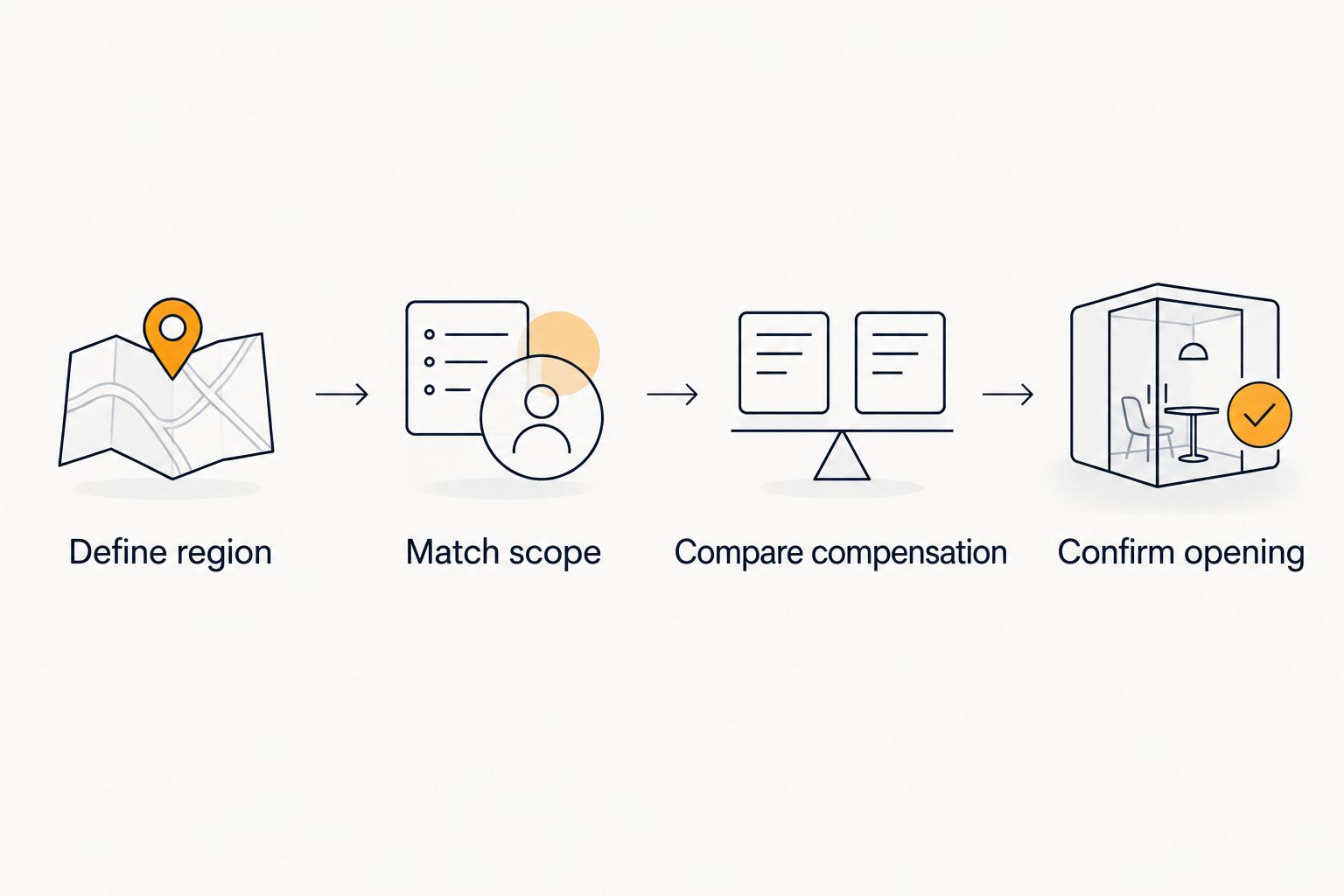
Keep a record of the employer's answers beside each saved position. An advertisement is the beginning of the evaluation; the written offer and agreement determine what you are accepting.
How these roles are ranked
The ranking follows distinct career priorities: ownership, employee structure, daytime work, academic responsibilities, location flexibility, and temporary commitments. It does not treat a job category as proof of higher compensation or more regional vacancies.
For a 2026 decision, apply the criteria to actual offers. A lower-ranked category becomes your first choice when its use case matches your needs better than the default.
Which Northeast radiology job should you choose?
Choose private-practice partnership-track roles first if ownership is your goal. Choose hospital employment if you want an employee relationship, or outpatient work if your priority is a confirmed daytime schedule.
Start your 2026 shortlist on RadBoard, then compare the same obligations across every employer. Do not promote an offer to your final shortlist until the compensation formula, clinical scope, schedule, and hiring status are clear.
Build your Northeast radiology shortlist
Search radiology positions aggregated from 20 sources, then confirm each role's terms with the employer.
FAQ
What's the best radiology job in the Northeast for me?
The best role is the one whose compensation structure, clinical duties, schedule, and location match your priorities. Start with partnership-track practice for ownership, hospital employment for an employee relationship, or outpatient imaging for a daytime-focused search.
Which Northeast state pays radiologists the most?
Use verified offer-level compensation comparisons rather than assuming a state determines the best pay. Compare guaranteed and conditional earnings alongside workload, benefits, call, and your household expenses.
How do I compare the number of radiology openings?
Count distinct roles after confirming the employer, location, and hiring status. Multiple advertisements can describe the same position, so advertisement totals are not the same as confirmed openings.
Are outpatient radiology jobs always no-call jobs?
No, an outpatient setting does not establish a no-call schedule. Ask about weekends, hospital cross-coverage, contrast supervision, procedures, and reassignment before accepting.
Is private practice better than hospital employment?
Private practice fits an ownership-focused career; hospital employment fits a preference for an employee relationship. Compare the actual agreements because employer type alone does not establish compensation, workload, or schedule.
Can I work remotely while living in the Northeast?
Teleradiology supports remote image interpretation, but each assignment has its own residence, licensing, credentialing, and shift requirements. Confirm those requirements for the facilities you would cover.
Where can I start searching for Northeast radiology jobs?
RadBoard aggregates 5,000+ radiology positions from 20 sources. Use it to identify opportunities, then confirm the location, clinical scope, compensation terms, and hiring status with the employer.
One last thing
Ask who covers the work when another radiologist is absent. The answer connects staffing, call, workload, and leave in a way a headline compensation figure does not. Request that explanation before deciding an offer fits your life.